Poem of the Week, by Rosanna Young Oh

Are you interested in a week of twice-daily no-pressure writing together on Zoom? Click here for details on our June 10-16 session of Write Together. I’d love to see you there!

Breakfast at a Kowloon hotel: waiters in black pants, white shirts, red vests. Platters of fruit and dumplings and smoked fish, bowls of congee, you tiao. It was all so beautiful. Then I saw a cockroach crawling around one of the fruit platters. I touched a waiter’s arm and silently nodded at the roach. His eyes widened and he bore the platter away through a door that swung open onto a different world: fiery woks, steam, cooks and busboys racing around shouting.

Did the waiter flick the cockroach off and bring the fruit platter back out? Maybe. Everyone’s trying to survive. There are other worlds within ours, just behind a swinging door, and if you look for them you see them everywhere.

Picking Blueberries, by Rosanna Young Oh

It was a risk my father had taken in midwinter:
ordering 240 pint boxes of blueberries
in less than desirable condition at a discount
so they could be repicked, repacked, and resold.

We stand together before crates of blueberries—
the color of river pebbles in water, some flecked with mold.
I am twenty-nine years old, and yet my father instructs
me as though I were a child again, hiding
between the aisles of lettuces and squash in the store.

“Daughter, look,” he says. He squeezes a blueberry
between his thumb and finger until the skin tears.
I see now: rotten ones bruise to the touch.

We pick in silence. By the second hour,
our fingers stiffen, their nail beds
purple from juice.

Suddenly, my father’s voice emerges as though from a distance:
“You were not meant to live this kind of life.”

But nor was he—a man with a mind made wide by books,
who as a child rose with the sun to read by its light.

We’re left with fewer boxes than we had thought.
How, how to price them? $3.99 per pint.

Click here for more information about Rosanna Young Oh.

alisonmcghee.com
My podcast: Words by Winter

Poem of the Week, by Alison McGhee

Are you interested in a week of twice-daily no-pressure writing together on Zoom? Click here for details on our June 10-16 session of Write Together. I’d love to see you there!

More than seventeen years have passed for the woman who wrote this poem. She re-upped her bargain with the planets when Venus and Jupiter and Mercury again conjoined in the southwestern sky, and if she’s lucky she’ll keep re-upping it as long as she’s alive. This poem goes out to everyone –not just mothers, but everyone–who would trade their own life if it meant someone they loved could keep living.


Bargain, by Alison McGhee

The newspaper reports that at twilight tonight
Venus and Jupiter will conjoin
in the southwestern sky,
a fist and a half above the horizon.
They won’t come together again for seventeen years.
What the article does not say is that Mercury, the
dark planet, will also be on hand.
He’ll hover low, nearly invisible in a darkened sky.
I stare out the kitchen window toward the sunset.

Seventeen years from now, where
will I be?
Mercury, Roman god of commerce and luck,
let me propose a trade:
Auburn hair, muscles that don’t ache, and a seven-minute mile.
Here’s what I’ll give you in return:
My recipe for Brazilian seafood stew, a talent for
French-braiding, an excellent sense of smell and
the memory of having once kissed Sam W.

Then I see my girl across the room.
She stands on a stool at the sink,
washing her toy dishes and
swaying to a whispered song,
her dark curls a nimbus in the lamplight.
The planets are coming together now.
Minute by minute the time draws nigh for me to watch.
Minute by minute my child wipes dry her red
plastic knife, her miniature blue bowls.

Mercury, here’s another offer, a real one this time:
Let her be.
You can have it all in return,
the salty stew, the braids, the excellent sense of smell
and the softness of Sam’s mouth on mine.
And my life. That too.
All of it I give for this child, that seventeen years hence
she will stand in a distant kitchen, washing dishes
I cannot see, humming a tune I cannot hear.


alisonmcghee.com
My podcast: Words by Winter

Poem of the Week, by Ishikawa Takuboku

Interested in a week of twice-daily no-pressure writing together on Zoom? Click here for details on our June 10-16 session of Write Together. I’d love to see you there!

A couple of weeks ago my daughter demonstrated a theragun to me. A theragun is a personal massager that’s kind of like a jackhammer, in a good way, and my daughter ran it up and down my shoulders and back a little fearfully.

I just don’t want to hurt those tiny bones of yours, she said at one point.

Which made me laugh, because I think of myself as tough and strong. Which I am. But then I read this poem and remembered the theragun, and for a second imagined a distant future, one I hope never happens.

Carrying mother on my back, by Ishikawa Takuboku

Carrying mother on my back
Just for a joke.
Three steps: then weeping—
She’s so light.

Click here for more details on Ishikawa Takuboku.

alisonmcghee.com
My podcast: Words by Winter

Poem of the Week, by Kathryn Nuernberger

Fourteen spots still open in our June Write Together session. Click here for details and to register. I’d love to see you in the Zoom room!

A heart-shaped box of drugstore chocolates was a big deal, back in the day. It was an annual Valentine’s treat from my parents, my dad really, since my mother hates to shop and he did almost all of it. Covered in cellophane, a big red bow, a whole little box for each of us.

As a grownup I turned into a chocolate snob, but when I pass by the Valentine’s chocolate display at CVS I remember how special it was, what a treat, to hold that heart-shaped box and know it was mine. Most of the time it’s not the thing itself that matters but the person, the homeland, the time of life behind the thing. Those, we hold in our heart of hearts forever.

The Sound of Music, by Kathryn Nuernberger

When I tell you I love
the song “Edelweiss”
you have to understand
that even though I too
am a sophisticate
who scorns musicals,
I was once a little girl
who stood in my grand-
father’s living room
singing, Cuckoo!
Cuckoo! while he sipped
his scotch and laughed
at my preciosity.
And when I sing the lyrics
in your ear—Small and
bright, clean and white,
you look happy to meet me
you have to understand
my grandfather only ever
had one friend, a jeweler
who also drank scotch,
and left his $10,000 Rolex
to my grandfather, who
wore it even though
it turned his wrist green,
wore it to the funeral,
where the daughter sang
in her ethereal voice. Blossom
of snow may you bloom
and grow, bloom and grow
forever. She couldn’t take
her eyes off the casket.
You have to understand that
my grandfather kept spinning
that heavy gold around
his wrist, and when he raised
his voice to join in, he cried
to sing it. Edelweiss, edelweiss,
bless my homeland forever.


Please click here for more information about Kathryn Nuernberger. 

alisonmcghee.com
My podcast: Words by Winter

Poem of the Week, by J. Estanislao Lopez

Click here for details and to register for our new Write Together session in early June. I’d love to see you in the Zoom room!

One evening last week I did a series of interviews with various media in Japan for my book Someday, which is about a mother’s dreams for her child. It was late night for me, morning in Japan, and each interviewer asked specifically about two pages in the book, one in which the child is alone, entering a deep wood, and another in which the child, having just received painful news, is folded up with sorrow.

Why did you include those pages? each interviewer asked.

Through the years, my best friend and I have talked about wishing we could bear our children’s pain for them. How much easier it would be, easier on us, and how wrong. To be fully alive means facing the unknown, experiencing everything, come what may. I remember not wanting to write those two pages and also knowing I had to.

Living in the Moment, by J. Estanislao Lopez

I like to live
         in the moment. No,
not that one —

Click here for more information about J. Estanislao Lopez

alisonmcghee.com
My podcast: Words by Winter
Poem of the Week, by Marge Piercy

Click here for details and to register for our new Write Together session in early June. I’d love to see you in the Zoom room!

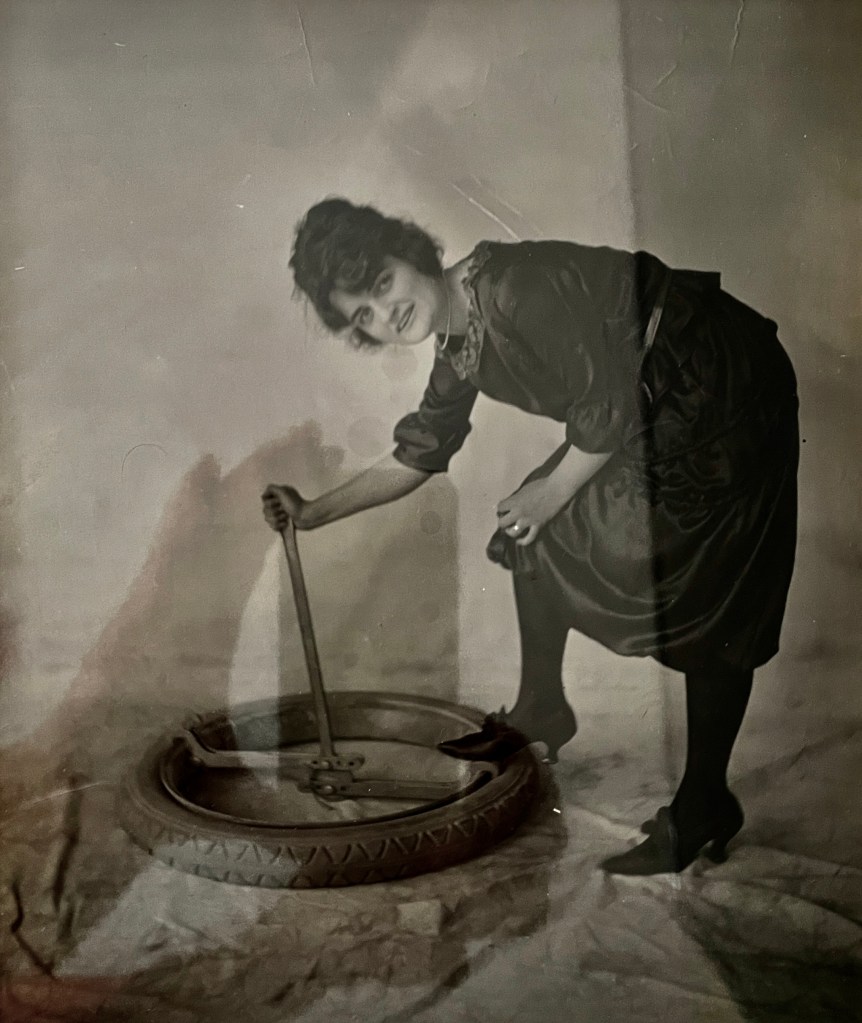
One of my grandmothers worked as a legal secretary in a Manhattan law firm, proud of her skill with shorthand and typing. Once, her boss, who was otherwise a good guy, yelled at her in front of the entire secretarial pool. Later that day he called her into his office to apologize. You shouted at me in public, she said, and you’ll apologize to me in public. Which he did.

My grandmother marched in the streets of New York as a suffragette. She had her first and only child at age forty and raised her with a love at once fierce and unconditional. This poem made me think of her, as I often do, and her hard, brave life. It hurts me to remember how much she always wanted to go to France. One of my first short stories, drafted while sitting on a bench on Sacré-Coeur, was about a young woman wandering the streets of Paris in honor of the grandmother who never had the means to travel.

My time in better dresses, by Marge Piercy

I remember job hunting in my shoddy
and nervous working class youth,
how I had to wear nylons and white
gloves that were dirty in half an hour
for jobs that barely paid for shoes.

Don’t put down Jew, my mother
warned, just say Protestant, it
doesn’t commit you to anything.
Ads could still say “white” and
in my childhood, we weren’t.

I worked in better dresses in Sam’s
cut-rate department store, $3.98
and up. I wasn’t trusted to sell.
I put boxes together, wrapped,
cleaned out dressing rooms.

My girlfriend and I bought a navy
taffeta dress with cutout top, wore it
one or the other to parties, till it failed
my sophistication test. The older
“girls” in sales, divorced, sleek,

impressed me, but the man in charge
I hated, the way his eyes stroked,
stripped, discarded. How he docked
our pay for lateness. How he sucked
on his power like a piece of candy.

Click here for more information about Marge Piercy.


alisonmcghee.com
My podcast: Words by Winter

Poem of the Week, by Jane Hirshfield

Click here for details and to register for our new Write Together session in early June. I’d love to see you in the Zoom room!

The first day you bring him home, hold the little street pup in your arms while he trembles and trembles. Reassure him you’ll be good to him. Tell him you’ll try to make every day a happy day. Make some food for him and watch him gobble it. Worry about his silence; why doesn’t he ever make a sound?

Two weeks in, leap when you hear a sharp and insistent bark. Turn from the stove to behold an unblinking, time to go for a walk gaze. Realize he hasn’t trembled or prostrated himself on the floor at the sound of his name in at least a week.

Two years in, sing him a good morning song when he wakes up. Race up and down the stairs playing I’m gonna get you until your heart pounds. Structure your time around runs and walks and visits to the dog park. Make room in the bed. Make room on your lap. A dog fills a dog-sized hole you didn’t know was there.

A Small-Sized Mystery, by Jane Hirshfield

Leave a door open long enough,
a cat will enter.
Leave food, it will stay.
Soon, on cold nights,
you’ll be saying “Excuse me”
if you want to get out of your chair.
But one thing you’ll never hear from a cat
is “Excuse me.”
Nor Einstein’s famous theorem.
Nor “The quality of mercy is not strained.”
In the dictionary of Cat, mercy is missing.
In this world where much is missing,
a cat fills only a cat-sized hole.
Yet your whole body turns toward it
again and again because it is there.


Click here for more information about Jane Hirshfield.

alisonmcghee.com
My podcast: Words by Winter

Poem of the Week, by Cecilia Woloch

My father, who died last month, was a giant of a man from boyhood on. He was famous for keeping the house-heating wood stove in our kitchen cranked to stupefying levels of heat. Much of our childhood was spent in service to that wood stove: cutting, chopping, hauling and stacking wood to keep it fed.

Many of my abiding memories of my father are centered around wood, which, even in his eighties, he continued to chop and haul. As a child, his giant presence could be overwhelming, but I picture him now, and think of how easy it can be to overlook, in a giant man, the tenderness and gentleness that also lived inside him.

The Pick, by Cecilia Woloch

I watched him swinging the pick in the sun,
breaking the concrete steps into chunks of rock,
and the rocks into dust,
and the dust into earth again.
I must have sat for a very long time on the split rail fence,
just watching him.
My father’s body glistened with sweat,
his arms flew like dark wings over his head.
He was turning the backyard into terraces,
breaking the hill into two flat plains.
I took for granted the power of him,
though it frightened me, too.
I watched as he swung the pick into the air
and brought it down hard
and changed the shape of the world,
and changed the shape of the world again.

Click here for details and to register for our new Write Together session in early June. 

Click here for more information about Cecilia Woloch.​

Poem (excerpt) of the Week, by Tim Seibles

Lots of old photos have been passing around my family these days, some I don’t remember ever being taken, except there I am: a laughing baby, a smiling teen, a young woman making funny faces at her babies, most recently a middle-aged woman in a pink sweatshirt crouched next to her dad, both smiling up at the photo taker.

Oh my face. You’ve been with me through every moment of my life, never questioning any feeling or how to express it. Immediately and by instinct you pull yourself into smiles, tears, laughter, anger, excitement. The older I get the more I appreciate you and all we have been through together, and the fact that no matter how you change, you are the face that everyone who loves me loves.

(Excerpt from) Ode to My Hands, by Tim Seibles

Five-legged pocket spiders, knuckled
starfish, grabbers of forks, why
do I forget that you love me:
your willingness to button my shirts,
tie my shoes—even scratch my head!
which throbs like a traffic jam, each thought
leaning on its horn. I see you

waiting anyplace always
at the ends of my arms—for the doctor,
for the movie to begin, for
freedom—so silent, such
patience! testing the world
with your bold myopia: faithful,
ready to reach out at my
softest suggestion, to fly up
like two birds when I speak, two
brown thrashers brandishing verbs
like twigs in your beaks, lifting
my speech the way pepper springs
the tongue from slumber.

Click here for details and to register for our new Write Together session in early June. 

Click here for more information about Tim Seibles.​

alisonmcghee.comMy podcast: Words by Winter

Poem of the Week, by Nikki Giovanni

How do I love thee, this poem? Let me count the ways. 1. Because I’m a sucker for teacher praise poems. 2. Because as a child the only way I could cope with the horror of writing elementary school book reports (people! to reduce a book to a plot summary is to kill it dead!) was to make up imaginary books and then write fake book reports about them. 3. Because I too adore Langston Hughes and Gwendolyn Brooks. 4. Because Nikki Giovanni is a lifelong badass and I love her. 5. Because censoring what a child reads and which books are allowed on shelves is a crime. 6. Because every book a child reads is a rung on a ladder leading up and up and up to a future they dream of making.

In Praise of a Teacher, by Nikki Giovanni

The reason Miss Delaney was my favorite teacher, not just my
favorite English teacher, is that she would let me read any book I
wanted and would allow me to report on it. I had the pleasure of
reading The Scapegoat as well as We the Living as well as Silver
Spoon
 (which was about a whole bunch of rich folk who were
unhappy), and Defender of the Damned, which was about
Clarence Darrow, which led me into Native Son because the real
case was defended by Darrow though in Native Son he got the
chair despite the fact that Darrow never lost a client to the chair
including Leopold and Loeb who killed Bobby Frank. Native Son
led me to Eight Men and all the rest of Richard Wright but I
preferred Langston Hughes at that time and Gwendolyn Brooks
and I did reports on both of them. I always loved English because
whatever human beings are, we are storytellers. It is our stories
that give a light to the future. When I went to college I became a
history major because history is such a wonderful story of who we
think we are; English is much more a story of who we really are.
It was, after all, Miss Delaney who introduced the class to My
candle burns at both ends; /It will not last the night; /But, ah, my
foes, and, oh, my friends— /It gives a lovely light.
 And I thought
YES. Poetry is the main line. English is the train.


Click here for Nikki Giovanni’s brief, funny, wonderful ‘biography.’

alisonmcghee.com
My podcast: Words by Winter.