Poem of the Week

Never done before, Mary OliverI wrote this poem seventeen years ago, after watching one of my daughters standing on a stool at the kitchen sink. A few things have changed in those years: that daughter and her brother and sister have grown up, I’m happy with blonde hair and I’d settle for an eight-minute mile. But everything else still holds. My bargain with the planets remains the same.

Bargain
     – Alison McGhee

The newspaper reports that at twilight tonight
Venus and Jupiter will conjoin
in the southwestern sky,
a fist and a half above the horizon.
They won’t come together again for seventeen years.
What the article does not say is that Mercury, the
dark planet, will also be on hand.
He’ll hover low, nearly invisible in a darkened sky.
I stare out the kitchen window toward the sunset.

Seventeen years from now, where
will I be?
Mercury, Roman god of commerce and luck,
let me propose a trade:
Auburn hair, muscles that don’t ache, and a seven-minute mile.
Here’s what I’ll give you in return:
My recipe for Brazilian seafood stew, a talent for
French-braiding, an excellent sense of smell and
the memory of having once kissed Sam W.

Then I see my girl across the room.
She stands on a stool at the sink,
washing her toy dishes and
swaying to a whispered song,
her dark curls a nimbus in the lamplight.
The planets are coming together now.
Minute by minute the time draws nigh for me to watch.
Minute by minute my child wipes dry her red
plastic knife, her miniature blue bowls.

Mercury, here’s another offer, a real one this time:
Let her be.
You can have it all in return,
the salty stew, the braids, the excellent sense of smell
and the softness of Sam’s mouth on mine.
And my life. That too.
All of it I give for this child, that seventeen years hence
she will stand in a distant kitchen, washing dishes
I cannot see, humming a tune I cannot hear.


Poem of the Week, by David Kirby


Never done before, mosaic detail

There’s a video somewhere in my house, laboriously taken on a huge VHS camcorder and then laboriously transferred years later to a cd, of a Rope Power competition at my children’s elementary school. Rope Power is a compilation of incredible feats of jump ropery –synchronized jump roping, trick jump roping, speed jump roping– practiced for weeks and months on end.  At the completion of Rope Power there’s a performance that all can attend. Loud music. Team t-shirts. Scads of children wildly jumping to the gasps and applause of the audience. Toward the end of my home video the gym clears for a special performance by an ace jump roper, who enters with one leg wrapped around his neck, jump-roping on the other. At one point he may do a sort of flip-thing while still jumping. It’s not clear, because at that point in the video the camera suddenly jostles and you can hear me yell (having just realized it), “Holy shit! That’s my son!” There are many reasons why I love this poem, and the line But I also wanted to learn that trick where you grab your left ankle in your right hand and then jump through with your other leg is one of them.


Taking It Home to Jerome
     – David Kirby

In Baton Rouge, there was a DJ on the soul station who was
always urging his listeners to “take it on home to Jerome.”

No one knew who Jerome was. And nobody cared. So it
didn’t matter. I was, what, ten, twelve? I didn’t have anything

to take home to anyone. Parents and teachers told us that all
we needed to do in this world were three things: be happy,

do good, and find work that fulfills you. But I also wanted
to learn that trick where you grab your left ankle in your

right hand and then jump through with your other leg.
Everything else was to come, everything about love:

the sadness of it, knowing it can’t last, that all lives must end,
all hearts are broken. Sometimes when I’m writing a poem,

I feel as though I’m operating that crusher that turns
a full-size car into a metal cube the size of a suitcase.

At other times, I’m just a secretary: the world has so much
to say, and I’m writing it down. This great tenderness.


For more information about David Kirby, please click here.

Poem of the Week, by Ted Kooser


IMG_0269

My grandfather had a wild child of a sister who, if I’m remembering right, ran off in her teens to marry a carnie. She loved to fall in love, but it didn’t always end well. I only met her once, at lunch, when my family was on a road trip and we stopped at her and her current husband’s home. When he was spoken about among family members, it was always in dark, hushed tones. He was mean, apparently, angry and abusive, with a violent temper, and my great-aunt was afraid of him. At that lunch what I, the child, saw was an old man who sat silently at the head of the table. I watched as he tried to spread mustard on a piece of bread. The knife dropped from his hand and mustard splattered on his plate. I remember the covert look he darted around the table when this happened. No one said anything or looked at him, but I remember briefly meeting his eyes and sensing his humiliation. The image of that old man and the look in his eyes has been with me my whole life, and it came flooding back when I read this poem.

Tattoo
– Ted Kooser

What once was meant to be a statement—
a dripping dagger held in the fist
of a shuddering heart—is now just a bruise
on a bony old shoulder, the spot
where vanity once punched him hard
and the ache lingered on. He looks like
someone you had to reckon with,
strong as a stallion, fast and ornery,
but on this chilly morning, as he walks
between the tables at a yard sale
with the sleeves of his tight black T-shirt
rolled up to show us who he was,
he is only another old man, picking up
broken tools and putting them back,
his heart gone soft and blue with stories.


For more information on Ted Kooser, please click here.


Poem of the Week, by Kim Addonizio

IMG_3122I never paid much attention to tattoos until my children and their friends, and then my own friends, started getting them. For me, it’s been a natural progression from disinterest + a tinge of sadness (that beautiful skin, forever altered) to mild interest + resignation (that beautiful skin, forever altered) to deep interest (what’s the story behind that tattoo? + admiration (it’s an art form, with the body as medium) = these days, tattoos are among the first things I notice when out wandering the streets and beach. This poem, by one of my favorite poets, makes me think about them in a different way, in an everything-we-can’t-see-but-know-is-there kind of way. All the unknown stories walking around out there.
 

First Poem for You
     – Kim Addonizio

I like to touch your tattoos in complete
darkness, when I can’t see them. I’m sure of
where they are, know by heart the neat
lines of lightning pulsing just above
your nipple, can find, as if by instinct, the blue
swirls of water on your shoulder where a serpent
twists, facing a dragon. When I pull you

to me, taking you until we’re spent
and quiet on the sheets, I love to kiss
the pictures in your skin. They’ll last until
you’re seared to ashes; whatever persists
or turns to pain between us, they will still
be there. Such permanence is terrifying.
So I touch them in the dark; but touch them, trying.


For more information on Kim Addonizio, please click here.

Poem of the Week, by Marge Piercy


Look at us, walking around in the world with only skin to cover up the muscles attached to tendon attached to bone that we’re all made of, invisible blood flowing through all of us all the time. Don’t our bodies seem so insubstantial for all the experiences we go through, all the conversations we have, all the music and tears and talk and laughter that pours out of us? So much of what makes up the heart of us is invisible. People from my past, for good and for not, flitted through my mind when I read this poem.

William Road

The visible and the in-
     – Marge Piercy

Some people move through your life
like the perfume of peonies, heavy
and sensual and lingering.
Some people move through your life
like the sweet musky scent of cosmos
so delicate if you sniff twice, it’s gone.
Some people occupy your life
like moving men who cart off
couches, pianos and break dishes.
Some people touch you so lightly you
are not sure it happened. Others leave
you flat with footprints on your chest.
Some are like those fall warblers
you can’t tell from each other even
though you search Petersen’s.
Some come down hard on you like
a striking falcon and the scars remain
and you are forever wary of the sky.
We all are waiting rooms at bus
stations where hundreds have passed
through unnoticed and others
have almost burned us down
and others have left us clean and new
and others have just moved in.


For more information on Marge Piercy, please click here.

Poem of the Week, by Todd Boss


My friend Erica and I are both the if-your-fingers-are-busy-then-your-concentration-is-more-focused types. We like to sit next to each other in meetings because we can then present a united front of seamstressery, which is a word I just made up. Erica, an artist specializing in handmade paper creations (her work is stunning), calmly plies her needle while I either knit or quilt. In this way, we can pay close attention to what’s being said. Slow, rhythmic projects that take time and care, like quilting or gardening or cooking or long hikes, both keep me sane and bring ideas floating into my head. When I read this poem by Todd Boss it brought me right back to elementary school, those fat pencils and thick paper with the wide lines. Wooden desks. The whispery sound of pencil on paper. The tangibility of the physical world.

Shack hammock (1)

The World Is in Pencil

– Todd Boss

—not pen. It’s got
that same silken
dust about it, doesn’t it,
that same sense of
having been roughed
onto paper even
as it was planned.
It had to be a labor
of love. It must’ve
taken its author some
time, some shove.
I’ll bet it felt good
in the hand—the o
of the ocean, and
the and and the and
of the land.


For more information on Todd Boss, please click here.

Poem of the Week, by Mary Karr

Scrolling through a few hundred poems this morning, no poetry goal in mind, I found this one by Mary Karr. It flung me back into memories of my long-ago cat Clemens, who appeared in my life one night when we were eating salmon. He hurled himself up from the ground and clung to the screen window of our first-floor apartment, yowling. We took him in and he never lIMG_1181eft. Clem was born to the streets and it was not possible to keep him inside all the time. He was a street cat, a warrior, scourge of the feline neighborhood. One day I returned home to find him lying on the front lawn, near death, one eye gouged half-out, deep wounds in his tail and sides that took him weeks both in the hospital and at home to recover from. He loved running water and sometimes I let the kitchen faucet trickle just to watch him crouch in the sink, batting at it. His nickname was shui mao, which translates as water cat. He loved tall boxes just barely big enough to contain him, from which he would stare out, sure that no one could see him. When he was nine he developed diabetes. It was twice-daily insulin shots from then on, none of which slowed him down much. He died at 17, having finally become an old, slow cat. Clem was magnificent. I still miss him.

For a Dying Tomcat Who’s Relinquished His Former Hissing and Predatory Nature
     – Mary Karr

I remember the long orange carp you once scooped
from the neighbor’s pond, bounding beyond
her swung broom, across summer lawns

to lay the fish on my stoop. Thanks
for that. I’m not one to whom offerings
often get made. You let me feel

how Christ might when I kneel,
weeping in the dark
over the usual maladies: love and its lack.

Only in tears do I speak
directly to him and with such
conviction. And only once you grew frail

did you finally slacken into me,
dozing against my ribs like a child.
You gave up the predatory flinch

that snapped the necks of so many
birds and slow-moving rodents.
Now your once powerful jaw

is malformed by black malignancies.
It hurts to eat. So you surrender in the way
I pray for: Lord, before my own death,

let me learn from this animal’s deep release
into my arms. Let me cease to fear
the embrace that seeks to still me.


For more information on Mary Karr, please click here.

Poem of the Week, by Jim Daniels

IMG_4028Those boots over there were sitting amongst the rundown running shoes and loafers and wingtips on a display rack of men’s shoes at Experienced Goods in Brattleboro, Vermont a few years ago. They were $8. It was clear that they were at least an inch too long for me, but because they were narrow I tried them on anyway and they fit as if someone had poured liquid leather around my feet and ankles and it magically turned into boots. I took them to an old-school cobbler to be resoled.
“Can you tell me what brand these are?” I said. “Because I need to buy only this brand for the rest of my life.”

He smiled.

“You can’t buy this brand,” the cobbler said. “There is no brand. These boots are probably thirty years old. They were handmade in Italy.”

Leather boots, steel toe boots especially, are one of the few things left in the world that can’t be rushed. They can’t be stonewashed or bleached or chemically altered in order to save time, because what boots need to fit right is exactly that: time. This poem reminds me of that fact.

Work Boots: Still Life
     – Jim Daniels

Next to the screen door
work boots dry in the sun.
Salt lines map the leather
and laces droop
like the arms of a new-hire
waiting to punch out.
The shoe hangs open like the sigh
of someone too tired to speak
a mouth that can almost breathe.
A tear in the leather reveals
a shiny steel toe
a glimpse of the promise of safety
the promise of steel and the years to come.

For more information on Jim Daniels, please click here.

Poem of the Week, by Leah Falk


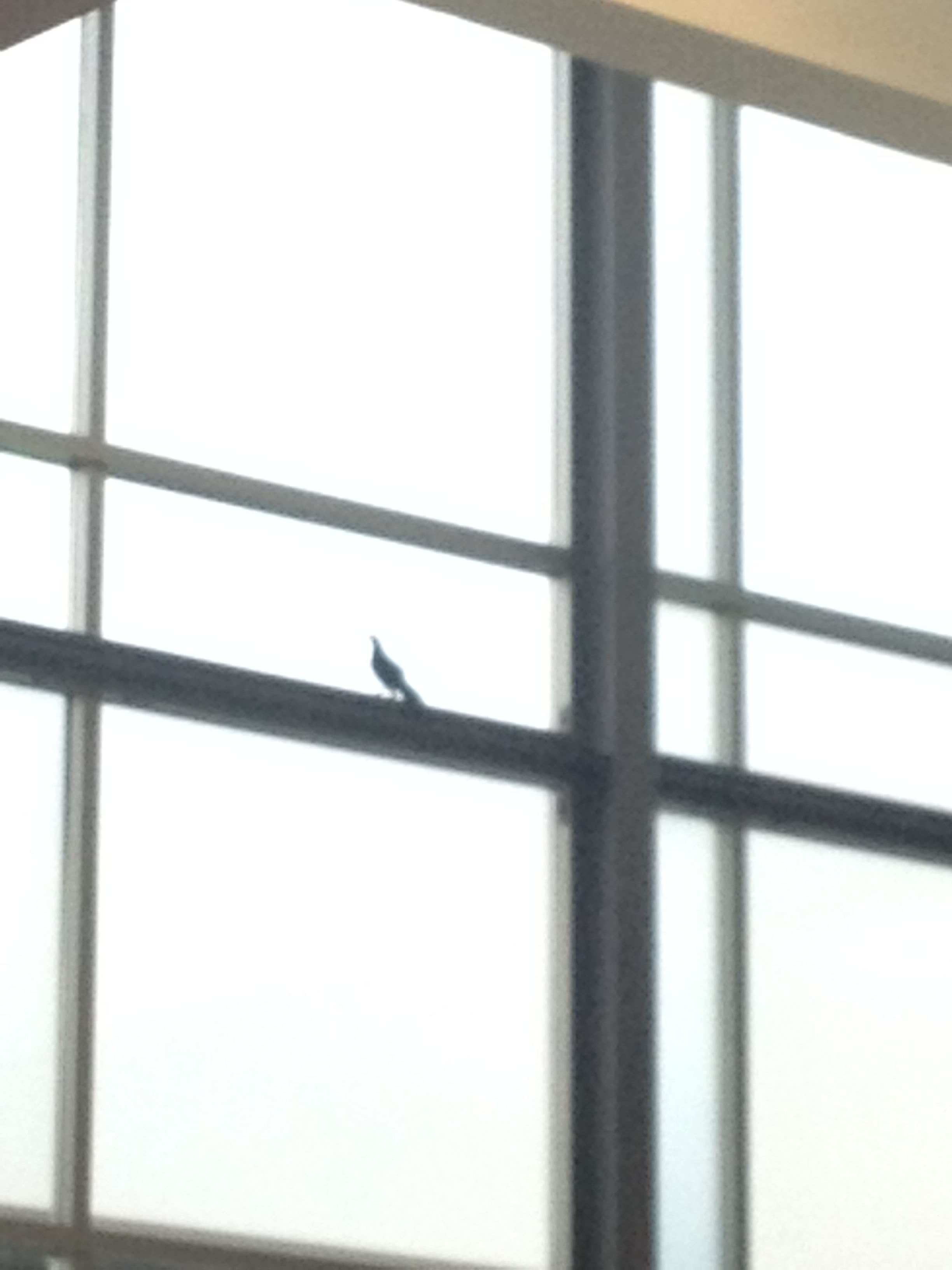
See that bird below? I’ve been watching him sing his heart out for hours now, here at the Austin, TX airport, where we have both taken up residence, me for the better part of 24 hours and him for who knows how long. A combination of overbooked flights, rebooked flights, unbooked flights and the chaos of the SXSW music festival have given me the opportunity to get to know this airport well, although probably not as well as this bird. I wander from one end of the terminal to another, listening to live music, eating pretzel bits offered up by the Auntie Anne’s server, talking to the Earl Campbell Sports Bar waiter who recognized me this morning from dinner last night, and listening to the bird. He might not be singing so much as wailing, and who can blame him? He made me think of this beautiful poem by Leah Falk. A torn page in the book of animals.

IMG_3996.JPG


Noah, to His Dove

– Leah Falk


With your wings of paper, fly, my bird, and find

a man who stands in water. In this land,

even far from shore, the brows of waves might break

against a sandy table, glass moon lit

to guide them toward last call, their salty end.


To the man who holds that trembling room

together with his feet—who holds his heart

against erosion—give your gentle body,


its crisp folds, its fragile case, its ink

as sweet as liquor. If he reads you over

and again, build us a house upon his rocky breast,


gather clay and willow. Until then, when I come

to your torn page in the book of animals,

my own heart stills and digs a trench that fills with rain.


For more information on Leah Falk, please click here.

My website.​​

My blog.
My Facebook page.

Twitter: @alisonmcghee

Poem of the Week, by Alden Nowlan

IMG_0382When I was a kid, the school bus I rode back and forth to school was a horror show of cruelty perpetrated by bullies who were aided and abetted by the bus driver. Every four years I pretend to be British (a six-week election campaign! silence until September!) but it’s not working. Being bullied, watching others be bullied, staying silent about the crime of bullying, watching the as-yet-unbullied align themselves nervously behind the bullies with the goal of not being bullied themselves are all part of the same putrid bully swamp. A poem about someone rejecting the surround-sound meanness, even covertly, even though he’s scared, can act as partial antidote to the poison. Poem of the week, by Alden Nowlan.

Flossie at School
     – Alden Nowlan

Five laths in a cotton dress
was christened Flossie
and learned how to cry,
her eyes like wet daisies
behind thick glasses.

She was six grades ahead of me
and wore bangs; the big boys
called her “The Martian,”
they snowballed her home,
splashed her with their bicycles,
left horse dung in her coat pockets.

She jerked when anyone spoke to her,
and when I was ten
I caught up with her one day
on the way home from school,
and said, Flossie I really like you
but don’t let the other kids know I told you,
they’d pick on me, but I do like you,
I really do, but don’t tell anybody.
And afterwards I was ashamed
for crying when she cried.


For more about Alden Nowlan, click here.