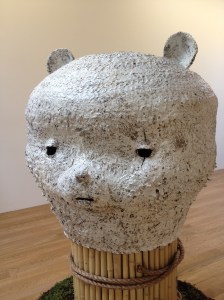
 I wanted to write about why I love this poem so much, but it grabbed me by the throat and told me that it could speak for itself, thanks.
This Is a Migrant Poem, by Miguel M. Morales
This is a migrant poem
a farmworking poem, a poem that covers itself
in long sleeves to avoid the burning sun.
That drinks enough water to avoid
dehydration but not enough to get water sickness.
This poem carries a machete, a hoe, a spade,
a knife, shears, and a file for filo.
This poem walks irrigated rows collecting mud
on its boots that add five pounds to each foot.
This poem guards the cornfield where his sister,
his mother, and his cousins, squat to pee.
This poem ducks down hitting the dirt to avoid the
echoing crop duster spraying anti-poem toxins that
burn our eyes and throats.
This poem is egg and chorizo burritos in aluminum foil,
steamed shut by the heat waiting for you at lunch
in a foam cooler in the trunk at the end of rows of soybean. This poem.
This poem smells of blood—and meat.
This poem flows from carcasses into open drains
of slaughter houses, on kill floors, in chilled freezers
with knives cutting, cutting, cutting, cutting—always cutting.
They duct tape knives into this poem’s hands
to cut even when its cut hands can cut no longer.
This poem is a gift of a strong back, of sturdy legs,
of silence, of patience.
And a never-ending work ethic
a never ending work ethic
a never ending work of ethics.
This poem shows you the bigger picture.
This poem is pragmatic, strategic, and erratic.
This poem reaches as it climbs ladders, as it stoops over,
as it pulls from branches, vines, as it unearths other poems
and tosses them into buckets and sacks slung across its stanzas.
This poem is paid by the word, by the piece,
by the hour, by the day, by the acre.
This poem has no benefits, no days off,
no health insurance, no childcare.
This poem is child labor. This poem is sexual assault.
This poem is deportation. This poem is missing wages,
broken vehicles, sunstroke.
This poem avoids irrigation ditches where
La Llorona hopes to drown it.
This poem knows she commands water and sends waves
of humidity and tempting mirages of cool rippling lakes.
This poem wears a rosary and a scapular and prays to St. Francis of Assisi
to protect them from snakes and rats that live in the fields
and to St. Michael the archangel to protect them from the farmer’s son
who watches his sisters
who follows his sisters
who pulls at his sisters.
This poem wakes up early, works all damn day, sweats all damn day.
This poem always needs a shower to wash off the dirt, to wash out the dirt,
to wash away the dirt.
This poem goes to bed early to do it all again
tomorrow.
This Poem is a Migrant Poem.
A. Farm. Working. Poem.
For more information on Miguel M. Morales, please click here.
 Sometimes all I want is a poem that’s rhythm and rhyme, words placed and spaced so they turn into a song inside my head. Langston Hughes does that. So does Dylan Thomas. And so does Mr. Eliot, below. I memorized this poem so that it will always be with me. Poem, you are a voice shaken from the yew-tree, and here I am, replying.
 This poem haunts me. Not because it’s sad –or maybe it is; I don’t really know what this poem is about– but because when I read it, it brings back times of internal struggle. Like
  People who have been reading the poem of the week on this blog for years now must think, seeing this week’s selection, Wow, does this woman love Naomi Shihab Nye. And they would be right. Sometimes, walking down the street, I recite lines from her poems, maybe because they’re beautiful, maybe because they make me feel less alone, maybe because they remind me, always, that kindness is all that matters. At a restaurant a couple of weeks ago, a friend said to me, “I read a poem today that I think you would love. It’s by a woman named Naomi something”–and I said, “Naomi Shihab Nye!” Once, a couple of years ago, I saw a tiny notice in the paper that she was giving a talk that very night at a school near me –she lives in Texas and this was in Minneapolis– so I zipped right over. The talk was in a high school classroom and I sat in a chair in the front row. And afterward I asked if she minded a photo. So that’s me, with Naomi my hero, and this concludes my Naomi Shihab Nye story in favor of her beautiful poem, of which I love this line most of all: Each carries a tender spot: Something our lives forgot to give us.
  That photo over there to the right is the very long tail of a very large rat that ran over my bare feet as I stood at the stove cooking dinner. The story behind the tail is one of intrigue and horror – me sauteeing vegetables at the stove while chatting with The Painter who was seated behind me, me suddenly feeling a squirrel or a small cat run over my bare feet, me shrieking and whirling around to tell The Painter that a squirrel or a cat had run over my bare feet, The Painter trying desperately to contain his horror because he had witnessed exactly what ran over my bare feet and rats are not cats.
  Yesterday I sprinkled some sliced almonds into a small pan and turned the flame on low. I stood beside the stove watching over the pan and occasionally flipping the almonds so that they would brown evenly and not burn. When they were dark golden I shook a little sugar over them and stirred until they were caramelized. Then I turned the almonds out onto a plate to cool and took the pan over to the sink. The sink is a strange, cheap, plasticky thing, scarred from hot pans, so I held the pan up to the faucet and ran water in it to cool it down first. The water hit the pan and steam billowed up into my face. Suddenly I was breathing in vaporized sugar – I could feel it in my lungs and taste it as it went down. It was the most amazing sensation. I stood there by the sink and thought, All these years I’ve been alive and this has never once happened to me before. Then I thought of this poem, which I have secretly treasured ever since I first read it because I love how words, if you toss them around in your mind and on your tongue, turn surprising and magical in that same alchemical way.
