Poem of the Week, by Thomas Reiter
 A few years ago my brother sent me a photo of my nephew, with the caption Getting his mind blown at Nickelodeon Universe. Nickelodeon Universe is a crowded and noisy place, but in the photo, my tiny nephew stands alone in a huge open space, his head craned up, staring at something I can’t see. The photo conveys profound stillness and concentration. Sometimes it pops up on my screensaver and I wonder again what my nephew was staring at, what was going through his mind.
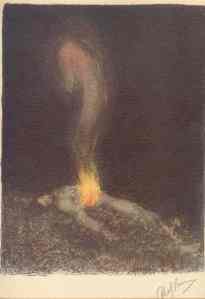
That photo makes me think of my grandmother, who once, in the middle of a thunderstorm, saw a ball of fire –molten electricity–appear in her living room. It raced around the floor, she told me, it climbed the walls and the stairs. Half a century later, she still shuddered at the memory. That photo of my nephew reminds me of the time I was walking down a country road and saw in the distance a quivering blackness that quaked and chirped. It turned out to be a tree so covered with black birds that it looked like an otherworldly living creature. Sometimes the world turns inside out for a minute and we stop, like the poet below, and stare. We don’t know then that we will remember that moment forever.
To the Boy Who Burned a Snowman, by Thomas Reiter
I thought of you again this morning
after a spring snowfall; of how, one
after another, wooden matches
—your mother’s stove lighters?—
flared as you came up the road
long after dark so many years ago,
a boy I’d never seen before.
I watched from an upstairs window:
you set the head against your forefinger,
the other end against your thumb,
and with a dip of the shoulder
like a submarine pitcher, a fireman,
pinwheeled a burst off the macadam.
No design but play, yet somehow
one with distance landed beside
the snowman I fashioned that morning—
an impulse from the crystalline yard,
my children grown and gone.
The hound’s-tooth coat, its frayed hem
trailing on the snow, its worth
fallen far below Goodwill, caught fire
that climbed to the woolen muffler
mice had nested in. And last the Tinkertoy
arms outstretched to you. You didn’t
see me, nor did I tap a threatening
gesture on the pane. A full moon,
and so of all the proud men
created from that out-of-season snow
he was his own light. You took
a step back as if to run, but then
slowly approached. You stood facing him
as though something—a secret?—
passed between snowman and boy.
You never reappeared, who started him
on his way home. He’d had his time.
I watched him pass into the spring grass,
where his absence would abound.
For more information on Thomas Reiter, please read this interview.
 My youngest didn’t walk until she was 22 months old. Instinct told me she was fine so I didn’t worry about this, but I observed her with interest. One day, when I was in the kitchen and she was sitting in a patch of sun on the living room floor, her back to me, I watched in wonder as she rose –no hands, no support, no nothing– to a full stand and began to walk. I had never seen a child go from crawling to perfect walking in an instant like that. She never went back to crawling.
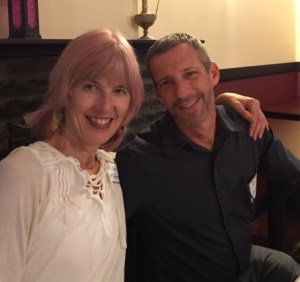 Neither my friend nor I had been to a high school reunion in many years –in my case, decades–and we were both nervous. The years we had spent growing up together in upstate New York seemed far away, and we hadn’t kept in touch with many classmates. So we met early, at the bar in that tiny stoplight-less town, and fortified ourselves with gin while paging through our yearbook to remind ourselves of faces and names. At one point I said to him, It’s been decades. We don’t look the same, will anyone else?
  Long ago, when I taught Mandarin at a big city high school in Minneapolis, some of my students would stay after school and talk with me. One was a Hmong young man, quiet and shy, with halting English. He would sit in the chair by my desk and cast his glance at the floor. For a long time I would inwardly urge him to look at me —look at me look at me come on look me in the eye– and then it came to me that his avoiding my direct gaze was part of his culture, and a sign of respect. All my annoyance melted away and from then on I was more soft-spoken, gentle, and slow in his presence.
  For years I’ve written
  A few days ago at the store I stood in line, my groceries on the conveyor belt: butter, greens, an avocado, carrots and peppers and potatoes. The person behind me placed their items on the belt: two packages of ice cream sandwiches. About once a year I get a craving for an ice cream sandwich, and looking at the picture on the boxes made me want one. I turned to see who was buying them. She was middle-aged, with faded hair and a worn, tired face, wearing a jacket with a broken zipper. Hunched over. She’s been through some things, was the thought in my mind, and I waited for her to look up so I could smile at her and chat a little while we waited for the cashier. But she never did look up. And I thought of this poem, by the wondrous Dorianne Laux. So many people out there, all of us maybe, who have been through some things. Oh, the water.
 My son was two years old and we were in the backyard. It was early spring, and I was digging around in the dirt when he suddenly bent double and started laughing and pointing. Dinosaurs, he said, dinosaurs! I followed his pointing finger to the patch of ferns next to us. They were just beginning to unfurl their fronds, and the stem of each was bent and curved, and in that instant I saw what he saw: the long curved necks of T-Rexes. My laughing little boy, looking at the world in a way I’d never seen it before. I have never looked at ferns the same way since. The memory of that day almost chokes me up, and so does this small poem.
  Rough, rough week. Children torn from their parents at borders, the suicides of loved people who projected happiness, the cruelty of our elected employees and the ongoing and unfathomable cowardice of their minions who stand by, watching our democracy crumble. Last night I scrolled through poem after poem, looking for one with clear eyes and a level gaze, like this one below. A poem that sees the situation for what it is and imagines it as it can be. Time for us to be the goddesses who remake this world.
  Yesterday, after heavy rains, I went for a long walk. I kept hearing opera music and I looked around to see a man grinning at me and nodding from his car, where the windows were open and the volume turned way up. I laughed and waved back at him, and the below poem leaped up into my mind. My grandmother, whose life was extraordinarily hard, used to recite it to us with an unfamiliar lilt in her voice.