Hey there, little guy.  It’s been almost a week now. I washed your blankets and hung them on the line. The mats and small rugs we scattered around on the wood floors to help you with traction are stored away. The Painter put your bed in the storage room and washed your food and water bowls. Neither of us can talk about you in public, so we don’t.
I held the phone to your ear at the end so that the girls you adored could tell you what a good boy you were, that they had always and would always love you, and that you could go now. The Painter and I had our arms around you when you died, and we wrapped you up and carried you out to the van together when it was over, crying so hard we could barely see.
Remember that day at the humane society so long ago? It was late, near closing time. We had been searching for weeks. We walked down the single aisle –it was a decrepit humane society, not one of the bigger and better-funded ones– and you were in the last cage. They had just admitted you that day. You looked up at us and slid your paw under the latched gate. You were not even a year old, a puppy in a Harley collar, and the family who surrendered you had written on the intake form that you were a “poor fit” for them.
 Their loss, right? You were a perfect fit for us, even though, full disclosure, you did drive us all a little crazy back in the day, when your hearing was perfect and your eyesight was perfect and you were wild with energy and too smart for your (our) own good. You barked at the mailman every single day, you had to be put in tennis ball detox time and time again, you shook that little green rug back and forth so violently I used to worry that you’d jostle your brain. And let us not forget your undying hatred of tiny white fluffy dogs.
At some point in the day you would sneak up on my perfectly made bed –this is back when you could still jump–and pull the quilt down and take a nap in the exact middle. Maybe you thought I wouldn’t notice. Remember how you jumped up onto the counter, a trick you learned from the cat, and gobbled down half that birthday pound cake before I came tearing into the kitchen like a banshee? Remember how those two guys in the car followed us that one day laughing and laughing because Miss, did you know that you and your dog have the exact same walk? Remember that other day when you and I practically ran around Isles and Bde Mka Ska because I was convinced that someone was tailing us, and then sure enough, that nice African guy came panting up to us at the end and said, Lady! Why you got to walk your dog so fast! I try to keep up for my exercise but my God lady I cannot! Remember how you would jump and scream –literally scream, not bark or yelp–when someone you loved walked through the door? You did that the very first time you met the Painter. It was a love affair between the two of you.
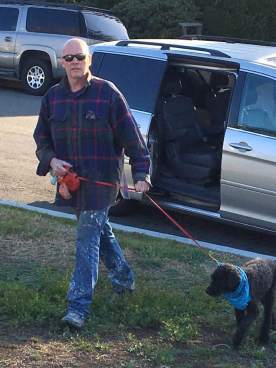
In the first few years when my babies were at their dad’s and I couldn’t sleep in the absence of their presence, I would wake you up and clip on the leash and out into the darkness we would go, tromping around the lakes, miles in the moonlight and street lights. It was the middle of the night but you never complained. You never whined. You never held back, wanting to stay home. You forged on, steady at my side as far as I took you, and I was not afraid because you were with me.
In fact, you always wanted to be with me. If I was sitting with my legs crossed, you draped your head over my ankle. If I was lying on the couch, you were curled up next to my feet. The last couple of years you would stand at the bottom of the stairs looking up at me, trying to gauge if I was going to stay up there a while instead of zipping back down, before making the slow clamber, one step at a time, up to be with me. Even at the end, when you must have been in bad pain, you still tried to get up so you could be close to us. So you could push your nose into our palms, lean your head against our legs, curl yourself into a black comma beneath the table as we ate.
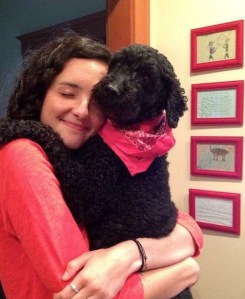 The day after you died, the girl to the right, the one who never, ever remembers her dreams, told me she’d had a dream so vivid it woke her up and she’d gone out to sit at her kitchen table to think about it. I was in a big city and I had to rescue a little dog and I was panicked and searching the city everywhere for him and finally found him. And he was in a little park playing with a bunch of other dogs, and he was so happy, and I realized I didn’t have to help him, so I left him with the other dogs. Do you think maybe it was Petey, sending us a message?
The last thing you ate was your pain pill, hidden in a glob of peanut butter that you licked off my fingers. There’s a half-full box of treats sitting on top of the fridge, and a half-full bag of food next to it. There’s a stack of neatly folded bandanas, all colors, on the shelf. Your blue collar and the sheriff address badge that we bought so long ago are on the couch. I don’t know what to do with them. I don’t know what to do with all this sorrow.
Pete. Petey-boy. Sweet Pete. You were the dog of my children’s childhoods, and now they are grown and you are gone. You were the dog of my life, Petey. Rest easy sweet boy.
I Ask Percy How I Should Live My Life, by Mary Oliver
Love, love, love, says Percy.
And hurry as fast as you can
along the shining beach, or the rubble, or the dust.
Then, go to sleep.
Give up your body heat, your beating heart.
Then, trust.
 Old men who hold their wives’ handbags for them as they put on their coats. Young fathers who hold their toddlers’ hands as they cross the street. The girl who jumps up to open the door for the woman using the walker. The cafe manager who keeps a water bowl outside, filled with cool water, for passing dogs. The man with the truck who goes up and down the rural road, plowing out his elderly neighbors. Everyone waving goodbye, tears in their eyes, as the ones they love disappear into the airport, like in the movie Love Actually*. The movie Love Actually. A note left in a poetry box, thanking the “poem attendant” for “all the good poems.” A carful of grinning men chattering in Spanish, pulling over to the side of a snowy road and pushing the young woman’s car out of the ditch. The world is full of sweetness. When I need to remind myself of that, which is often, in these days of bewildering cruelty and greed by our elected employees, this is one of the poems I recite to myself.
  Last week my water filter leaked into the storage bin where my youngest’s childhood mementoes are kept. I brought it upstairs and spread her things out to dry. Onesies, footie pajamas, overalls with ripped-out knees. Her high school graduation cap. Notebooks filled with book reports and drawings and journal entries. Cards she’d written to me, mostly construction paper drawings along with I love you mom. The arc of eighteen years spread out on the kitchen table and counters. The tiny quilt I made for her before she was born and which she wore to literal shreds was damp, and I picked up the strands and held them to my heart.
 You know those maps where you fill in all the states you’ve been to? The only one missing from mine is Alaska (I don’t count the time that I landed at the Anchorage airport on my way to China). I’ve been to all the lower 48 states, most of them multiple times, because road trips are big in my life. The earth is a living being beneath the tires, rising and falling, sweeping west and shrinking east. Most of the time I’m solo, like last week, when I drove 2089 miles in three days. When I get tired, or when it gets dark, I tuck my old tiny car behind a semi for comfort. Truckers sometimes get a bad rap, and once in a while it’s justified, but for the most part they drive their trucks way more safely than most people drive their cars.
 I’ll rewrite this whole life and this time there’ll be so much love, / you won’t be able to see beyond it.
  What wearies you? What renews you? Who brings you joy? Who exhausts you? When you think of safety and comfort and happiness, what place or person comes to mind? The answers to these questions are already known to you. They live in your body, in a place beyond conscious thought and its dangerous companions, rationalization and overriding.
  Long ago I wanted to write a book with an underlying theme of superheroes, but I was stuck. So I asked my son, then a teenager, this question: “What, in your opinion, is the most essential trait of a superhero?” His answer was immediate and clear: “A super villain.”
  Five years ago this week my older daughter and I were sitting on the porch of a cafe in Istanbul, smoking a hookah and eating mezes and pita bread. Later, we walked the streets of our neighborhood, which was on the Bosphorus. At one point the muezzins began their call to prayer, the sound of their voices wafting over the stone walls and cobblestones of that vast and sprawling city. The sun was falling below the horizon and my daughter was walking ahead of me, her tumble of dark curls falling over her navy jacket, and my heart seized up in a familiar way, the way it has seized up my entire life, when the world is too beautiful and you want to stop and freeze it but the minutes are passing and passing and passing regardless.
