Poem of the Week, by Robert Francis

My poems podcast, Words by Wintercan be found here.

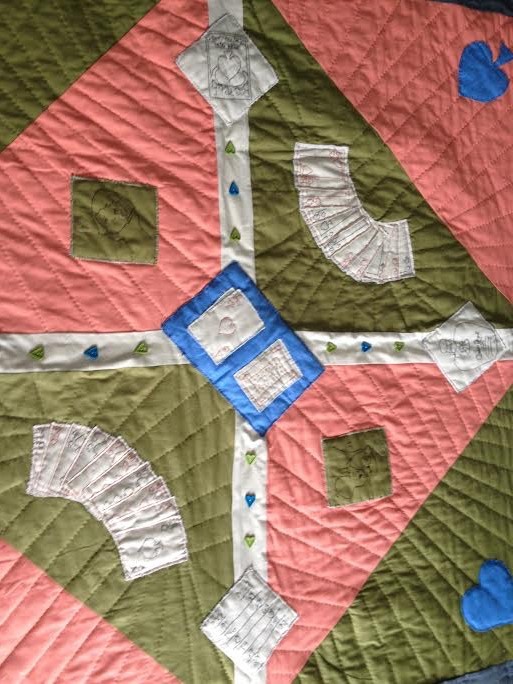
I’m a self-taught maker of extremely imprecise, freeform story quilts that I hand-quilt and then embroider. This morning as I flicked around the internet looking for cool hand-quilt block patterns, the word “quilt” suddenly looked entirely wrong. Too short, too abrupt, missing one or more letters, and what about that t at the end…just so weird.

When I was a kid I purposely turned words into not-words by saying them over and over and over and over until poof, they transmogrified into shapes and sounds, othernesses without meaning. Now here was the word quilt, a happy familiar word my entire life, doing the same thing to me, saying You think you know me? You don’t.

Which makes me wonder about everything else I think I know, but don’t.

Nothing Is Far, by Robert Francis

Though I have never caught the word
of God from any calling bird,
I hear all that the ancients heard.

Though I have seen no deity
enter or leave a twilit tree,
I see all that the seers see.

A common stone can still reveal
something not stone, not seen, yet real.
What may a common stone conceal?

Nothing is far that once was near.
Nothing is hid that once was clear.
Nothing was God that is not here.

Here is the bird, the tree, the stone.
Here in the sun I sit alone
between the known and the unknown.


For more information about the grievously under-sung poet Robert Francis, please click here.

alisonmcghee.com

Poem of the Week, by Nikki Giovanni

My poems podcast, Words by Wintercan be found here.

One afternoon when I was twenty-six I left South High School and jumped into my little red car. Turned on the music –was it a tape?–as loud as it would go. Maybe Annie Lennox, maybe Joan Armatrading. Stopped at the red light on Cedar and 22nd, waited until it turned green, and put my foot on the gas.

In that moment, several things happened at once. The tiny car rocked from a blast of wind. A blur of rushing red filled the windshield. My foot jammed on the brake. In the second afterward, I slammed the dashboard with my hand and the music stopped while I watched a giant, silent fire truck speed on down Cedar.

In all the years since there have been more moments of almost-death, but it’s that day, and the memory of how wildly I wanted to live, that came flooding through me when I read this poem.

Possum Crossing, by Nikki Giovanni

Backing out the driveway
the car lights cast an eerie glow
in the morning fog centering
on movement in the rain slick street

Hitting brakes I anticipate a squirrel or a cat or sometimes
a little raccoon
I once braked for a blind little mole who try though he did
could not escape the cat toying with his life
Mother-to-be possum occasionally lopes home … being
naturally … slow her condition makes her even more ginger

We need a sign POSSUM CROSSING to warn coffee-gurgling
neighbors:
we share the streets with more than trucks and vans and
railroad crossings

All birds being the living kin of dinosaurs
think themselves invincible and pay no heed
to the rolling wheels while they dine
on an unlucky rabbit

I hit brakes for the flutter of the lights hoping it’s not a deer
or a skunk or a groundhog
coffee splashes over the cup which I quickly put away from me
and into the empty passenger seat
I look …
relieved and exasperated …
to discover I have just missed a big wet leaf
struggling … to lift itself into the wind
and live

For more information about Nikki Giovanni, please click here.

alisonmcghee.com

Poem of the Week, by Joy Harjo

My poems podcast, Words by Wintercan be found here.

Think up a person, I tell the zoom room, like a toddler with wild red curls. Hands go up. People emerge. Now give me an object, like a ceramic pit bull. Objects appear. We write them all down, column A and column B. Now put one from each column together and write down what happens.

Ten minutes later, everyone reads aloud what they wrote. We lean forward to listen, clap, nod, laugh. Witnesses to unknown people and unknown worlds that instantly conjured themselves into being.

My fingers have spent their lives clattering across the keyboard, conjuring up worlds. What’s real? What’s not? Is there a difference? This poem feels so familiar.

The Poem I Just Wrote, by Joy Harjo

The poem I just wrote is not real.
And neither is the black horse
who is grazing on my belly.
And neither are the ghosts
of old lovers who smile at me
from the jukebox.

For more information about Joy Harjo, our current poet laureate, please click here.

alisonmcghee.com

Poem of the Week, by Ellen Bass

My poems podcast, Words by Wintercan be found here.

The world is too big if you make it so. This sentence has been running through my head lately. Every time I feel besieged by the world’s problems, which is most of the time, it comes back to me.

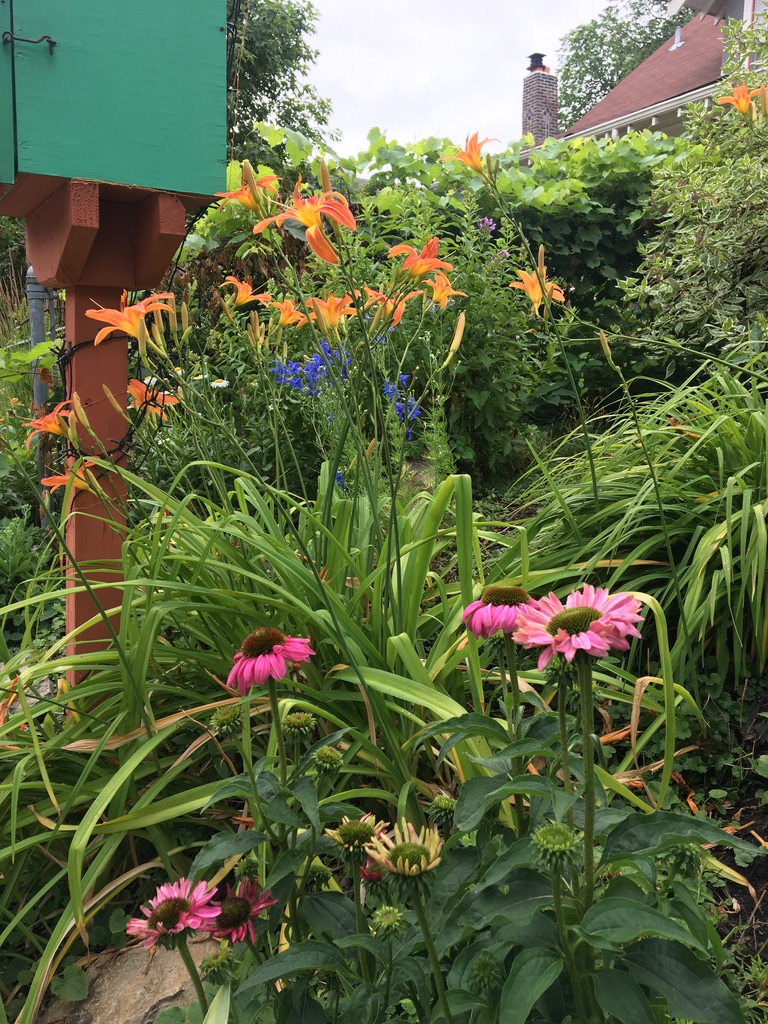
This morning the dog and I got up at dawn and went into our tiny backyard. We watered the vegetables and the flowers and the baby apple trees and the mint. The water made rainbows over the mint and the tight clean smell of it reset my mind a little. So I went in search of more lighten-ment. Crushed a little lavender, some Russian sage, basil, rosemary, more mint, until the air was full of their scents and so was I. The world is too big if you make it so.

Any Common Desolation, by Ellen Bass

can be enough to make you look up
at the yellowed leaves of the apple tree, the few
that survived the rains and frost, shot
with late afternoon sun. They glow a deep
orange-gold against a blue so sheer, a single bird
would rip it like silk. You may have to break
your heart, but it isn’t nothing
to know even one moment alive. The sound
of an oar in an oarlock or a ruminant
animal tearing grass. The smell of grated ginger.
The ruby neon of the liquor store sign.
Warm socks. You remember your mother,
her precision a ceremony, as she gathered
the white cotton, slipped it over your toes,
drew up the heel, turned the cuff. A breath
can uncoil as you walk across your own muddy yard,
the big dipper pouring night down over you, and everything
you dread, all you can’t bear, dissolves
and, like a needle slipped into your vein—
that sudden rush of the world.

For more information on Ellen Bass, please click here.

alisonmcghee.com

Poem of the Week, by Laura Gilpin

My poems podcast, Words by Wintercan be found here.

Whenever I pass a baby on the sidewalk our eyes meet and hold. Babies turn their heads to keep holding that gaze, sometimes all the way to the end of the block. They want to examine me, so they do. This is what I most appreciate about babies; that acceptance of themselves and what they want.

My dog is also like this. When he wants his belly rubbed, his throat stroked, he flops next to me and pushes his nose into me until I pet him. He’s taught himself how to speak what he must think is Human: low mutterings, high warbles that all mean touch me touch me touch me. He too knows what he wants and is unafraid to ask for it.

I don’t exactly know why babies and dogs and this poem make me want to cry, but they do.


The Two-Headed Calf, by Laura Gilpin

Tomorrow when the farm boys find this
freak of nature, they will wrap his body
in newspaper and carry him to the museum.

But tonight he is alive and in the north
field with his mother. It is a perfect
summer evening: the moon rising over
the orchard, the wind in the grass. And
as he stares into the sky, there are
twice as many stars as usual.

For more information on Laura Gilpin, please click here.

alisonmcghee.com

Poem of the Week, by Langston Hughes

My poems podcast, Words by Wintercan be found here.

Here in my neighborhood, in the wake of another shooting of a Black man, choppers circle nightly, protests happen nightly, and stores and restaurants keep their window plywood boards on standby.

Tension runs high. I scan the streets for cars and trucks with out of state plates driving erratically, zipping the wrong way down my one-way street, the way they did a year ago, when under cover of darkness men searched through our gardens for incendiaries planted earlier.

There’s plenty of racism to go around in Minnesota and there are also nationwide white supremacy groups happy to help the movement. I loved Langston Hughes’s poems as a child and I love them still. Last night I walked past a SWAT car filled with police officers at the end of my block and thought of this poem.


I, too, sing America
     – Langston Hughes

I am the darker brother.
They send me to eat in the kitchen
when company comes,
but I laugh,
and eat well,
and grow strong.

Tomorrow,
I’ll be at the table
when company comes.
Nobody’ll dare
say to me,
“Eat in the kitchen,”
then.

Besides, they’ll see how beautiful
I am
and be ashamed–

I, too, am America.


For more information about Langston Hughes, please click here.

alisonmcghee.com

Poem of the Week, by Eileen Myles

My poems podcast, Words by Wintercan be found here.

The way my dog places his paws on my shoulders and looks into my eyes. That day last week when the rain blew in and the temperature dropped 29 degrees in twenty minutes. How coffee beans smell when they’re ground fresh at dawn. The way the man behind the cheese counter yesterday said Excuse me, I just have to tell you I love your hair and then hugged himself with happiness. These purple Dr. Seussian flowers. This bowl of crisp popcorn. How extravagantly the mint spreads beneath the baby apple tree. How the earth begins to rise beneath the car from the Dakotas westward, like the crest and slope of the planet’s chest. The way the calm baby in the stroller this morning silently turned to keep my gaze all the way down the block. I wish I could give all of this to all of you.

At a Waterfall, Reykjavik, by Eileen Myles

I still feel like
the world
is a piece
of bread

I’m holding
out half
to you.

For more information about Eileen Myles, please click here.

alisonmcghee.com
Words by Winter: my new podcast

Poem of the Week, by Philip Larkin

My poems podcast, Words by Wintercan be found here.

Hey Driz. Drizzle. Z’Drazzle. Drazzle. Draz. It’s been just over a week since we held hands in your living room and talked and laughed and cried. We both knew it would be our last conversation.

Daisy the dog kept watch from the porch. I don’t know who has her now, but I know it’s someone wonderful, because you would have made sure of that.

Last night I lay awake thinking about Grandpa, that past, ancient dog of yours, the one you cared for with such devotion that you spent hours every night —hours–wandering your backyard with him as he stumbled around the perimeter, looking for something that never appeared.

You had so much more patience than I ever will, Z’drizzle.

To your students, you were that teacher, the teacher they’ll remember their entire lives, the teacher who saw them, who knew them, who understood them in a way no one else did. I may as well have been one of your students.

Remember our greasy breakfasts and love of diners? Remember how you introduced me to Al’s? Remember our mutual adoration of the State Fair?

How about the day you brought a few of your favorite students all the way to Minneapolis to meet me? You taught them to love my first novel. Remember her, you said, pretending I couldn’t hear you. She’s going to be famous. Then you took them all out for pizza in the big city.

Remember that time we sailed around the streets of Elbow Lake in that giant old convertible of yours, when I was the author for the author event you yourself had organized and we were already fifteen minutes late? You were always late. This didn’t seem to bother you or anyone else either. Maybe because everyone loved you so much.

Did it surprise me that the Go Fund Me organized by your students surpassed its $100 goal by over $12,000? It did not. Did it surprise me that you never mentioned a word of it to me? It did not.

Remember when you went surfing for the first time, on that trip to southern California? I never heard you talk like that. Never saw that look in your eyes. You loved surfing in a way that changed you. I remember trying to figure out how you, on a rural teacher’s salary, could somehow afford to go surfing in California more often.

The only novel of mine you didn’t know practically by heart is the last one, the one I dedicated to you, Z’draz, long before we knew you were sick. You never read that one because Dammit, you always make me cry, Alison McGhee, and I have to save my tears until I’m through this and can handle another Alison McGhee book.

Z’driz, you always called me by my full name. In every single conversation we ever had, including the last one, you would at some point pause, shake your head, and say Alison McGhee, with this look in your eyes. As if I was some kind of wonder. Which I’m not, but guess what? You were.

Zdrazil loved my writing, I wept to a friend the other night. He loved me. It was like I couldn’t do anything wrong in his eyes.

Oh my beautiful friend. I will miss you forever.

You told me that last day you were scared to die and I told you I didn’t trust people who weren’t. We laughed about that, a little. Four days later you crossed through that door.

I’m going to write about you, John Zdrazil, I said, when you couldn’t keep your eyes open anymore and I knew it was time to go. And you know I mean it because I’m using your full and proper name.

Ordinarily that would’ve made you laugh, but you just looked me in the eye and nodded slowly. Then your eyes filled.

Write me a poem, you said.

John Zdrazil, that is the one and only request you ever made of me. Write me a poem. I drove the three hours home and wrote you a series of haiku then and there, so I could text them to you before it was too late. We were out of time and we both knew it. We’re all out of time, which is why we should be careful of each other, and kind, the way you always were, John.

The Mower, by Philip Larkin

The mower stalled, twice; kneeling, I found   
a hedgehog jammed up against the blades,   
killed. It had been in the long grass.

I had seen it before, and even fed it, once.   
Now I had mauled its unobtrusive world   
unmendably. Burial was no help:

Next morning I got up and it did not.
The first day after a death, the new absence   
is always the same; we should be careful

of each other, we should be kind   
while there is still time.

For more information about Philip Larkin, please click here.

alisonmcghee.com
Words by Winter: my new podcast

Poem of the Week, by Cathy Ross

My poems podcast, Words by Wintercan be found here.

Years ago my daughter and I spent a magical week in Istanbul. We visited mosques, ate Turkish candy, drank mint tea, took a boat down the Bosphorus to the mouth of the Black Sea, smoked a hookah on the front porch of a restaurant where we sat for hours watching the passersby. We were mistaken, variously, for Brazilian, French, and Canadian women.

One evening, while my daughter slept, I sat by the window and listened to the calls of the muezzins rising over the city in the call to prayer. The sound filled my heart and I told myself what I always do when something beautiful happens during a trip: You’ll be back, Allie. You’ll hear this again. But I won’t. Every beautiful moment is a miracle, and then it’s gone.

If the Moon Came Out Only Once a Month, by Cathy Ross

If the moon came out only once a month
people would appreciate it more. They’d mark it
in their datebooks, take a walk by moonlight, notice
how their bedroom window framed its silver smile.
And if the moon came out just once a year,
it would be a holiday, with tinsel streamers
tied to lampposts, stores closing early
so no one has to work on lunar eve,
travelers rushing to get home by moon-night,
celebrations with champagne and cheese.
Folks would stay awake ’til dawn
to watch it turn transparent and slowly fade away.
And if the moon came out randomly,
the world would be on wide alert, never knowing
when it might appear, spotters scanning empty skies,
weathermen on TV giving odds—“a 10% chance
of moon tonight”—and when it suddenly began to rise,
everyone would cry “the moon is out,” crowds
would fill the streets, jostling and pointing,
night events would be canceled,
moon-closure signs posted on the doors.
And if the moon rose but once a century,
ascending luminous and lush on a long-awaited night,
all humans on the planet would gather
in huddled, whispering groups
to stare in awe, dazzled by its brilliance,
enchanted by its spell. Years later,
they would tell their children, “Yes, I saw it once.
Maybe you will live to see it too.”
But the moon is always with us,
an old familiar face, like the mantel clock,
so no one pays it much attention.
Tonight
why not go outside and gaze up in wonder,
as if you’d never seen it before,
as if it were a miracle,
as if you had been waiting
all your life.

For more information on Cathy Ross, please check out her website.


alisonmcghee.com

Poem of the Week, by Rosemerry Wahtola Trommer

My poems podcast, Words by Wintercan be found here.

Dog person versus cat person versus beer versus wine versus Gen Z versus baby boomers versus millennials versus Gen X versus The Greatest Generation versus red states versus blue states versus New England versus Midwest versus West versus North versus South versus pro versus anti.

Categorization makes me tense. Can’t I love both dogs and cats? (I do.) Can’t I be a novelist and a poet and a picture book writer? (I am.) Why do any of us have to be this and not that? Someone profits by having us believe it’s a good thing to divide, slot, label and categorize, and it’s not us. I love blurred lines and this poem for the same reason.

Where We Are Headed, by Rosemerry Wahtola Trommer

At first we just say flower. How
thrilling it is to name. Then it’s
aster. Begonia. Chrysanthemum.

We spend our childhood learning
to separate one thing from another.
Daffodil. Edelweiss. Fern. We learn

which have five petals, which have six.
We say, “This is a gladiolus, this hyacinth.”
And we fracture the world into separate

identities. Iris. Jasmine. Lavender.
Divorcing the world into singular bits.
And then, when we know how to tell

one thing from another, perhaps
at last we feel the tug to see not
what makes things different, but

what makes things the same. Perhaps
we feel the pleasure that comes
when we start to blur the lines—

and once again everything
is flower, and by everything,
I mean everything.


For more information on Rosemerry Wahtola Trommer, please check out her website.

alisonmcghee.com