Poem of the Week, by Joseph Fasano

There’s still room in both our two remaining fall four-hour Zoom workshops: The Intuitive Leap on November 14, and Poetry, from Flicker to Flame, on November 17. Click here and scroll for all the details.

For me the moments of giving birth and adoption weren’t love, exactly, they were something way bigger than that. The instant knowledge, in my bones, that I’d do anything to keep this child alive. Give up my own life without hesitation. Protect this child against any threat, any danger. Do anything, anything to keep them safe, or make them feel safe. Even if I had to lie.

Words Whispered to a Child Under Siege 

No, we are not going to die.
The sounds you hear knocking the windows and chipping the paint
from the ceiling, that is a game
the world is playing.
Our task is to crouch in the dark as long as we can
and count the beats of our own hearts.
Good. Like that. Lay your hand
on my heart and I’ll lay mine on yours.
Which one of us wins
is the one who loves the game the most
while it lasts.
Yes, it is going to last.
You can use your ear instead of your hand.
Here, on my heart.
Why is it beating faster? For you. That’s all.
I always wanted you to be born
and so did the world.
No, those aren’t a stranger’s bootsteps in the house.
Yes, I’m here. We’re safe.
Remember chess? Remember
hide-and-seek?
The song your mother sang? Let’s sing that one.
She’s still with us, yes. But you have to sing
without making a sound. She’d like that.
No, those aren’t bootsteps.
Sing. Sing louder.
Those aren’t bootsteps.
Let me show you how I cried when you were born.
Those aren’t bootsteps.
Those aren’t sirens.
Those aren’t flames.
Close your eyes. Like chess. Like hide-and-seek.
When the game is done you get another life. 

Click here for more information on Joseph Fasano.


alisonmcghee.com
My podcast: Words by Winter

Poem of the Week, by Louise Glück*

Still room in both our two remaining fall four-hour Zoom workshops: The Intuitive Leap on November 14, and Poetry, from Flicker to Flame, on November 17. Click here and scroll for all the details.

Half a row of a bookshelf here in the House Made of Books is dedicated to books from my childhood. A Tree Grows in Brooklyn. Heidi. Bambi. My Side of the Mountain. The Trumpet of the Swan. A strange little book called Editha’s Burglar. I don’t re-read these books; they’re embedded in my bones. Once in a while I run my fingers along their tattered, fraying covers.

A while ago I realized that these books are about children alone in the world, either literally or because they can’t find their place. Children like that sometimes grow up to be writers, sending words into the darkness, trying to un-lonely the lonely.


from October, by Louise Glück

I was young here. Riding
the subway with my small book
as though to defend myself against

this same world:

you are not alone,
the poem said,
in the dark tunnel.

*I wrote this blog a few days ago and found out late last night that Louise Glück died yesterday. I’ve loved her work forever and am so sad she’s gone. Click here for more information about her life and poetry.

alisonmcghee.com
My podcast: Words by Winter

Poem of the Week, by Roger Robinson

Click here for info on Baby Be, my brand-new book for parents and the little kids they’re crazy about. (I loved writing this book.) 

Everyone walks around with a stone in their shoe, my friend GE told me a long time ago, and ever since I’ve thought about that saying, and the rueful way he smiled when he said it. It softens me, when I’m out in the world, to look at everyone I meet as the keepers of secret stories I know nothing about.

There’s a treehouse high in an oak tree where I go in my mind, an imaginary place where nothing bad can reach me, a place I’m always safe. Because I carry a stone or few in my shoes too. Don’t you?

A Portable Paradise, by Roger Robinson

And if I speak of Paradise,
then I’m speaking of my grandmother
who told me to carry it always
on my person, concealed, so
no one else would know but me.
That way they can’t steal it, she’d say.
And if life puts you under pressure,
trace its ridges in your pocket,
smell its piney scent on your handkerchief,
turn its anthem under your breath.
And if your stresses are sustained and daily,
get yourself to an empty room – be it hotel,
hostel or hovel – find a lamp
and empty your paradise onto a desk:
your white sands, green hills and fresh fish.
Shine the lamp on it like the fresh hope
of morning, and keep staring at it till you sleep.

Click here for more information about British poet Roger Robinson.

alisonmcghee.com

My podcast: Words by Winter

Poem of the Week, by Justyna Bargielska

Two new online half-day workshops just added to November’s schedule: The Intuitive Leap on November 14 and Poetry, from Flicker to Flame on November 17. For details, please click and scroll down. I’d love to see you in the zoom room!

In second grade one of my classmates died of a common childhood disease that most of us weathered without incident. One day he was at his desk in the row next to the door, and the next he wasn’t. In my mind I see him as he was in his Picture Day photo: dark hair parted on the side, sweater over shirt.

At seven, I thought about him every day. He and my grandfather shared the same old-fashioned first name, and it seemed strange that my grandfather could still be alive when my classmate wasn’t. I still think about that boy. When I became a mother I thought about his mother, and the silence surrounding his empty desk. When I read this poem below, I thought about him again. How we can know only the number of days we’ve already lived, not the number of days remaining.

The Great Plan B, by Justyna Bargielska (translated from the Polish by Maria Jastrzębska)

On my ninth birthday the scoutmaster
gave me a card with the number of days
I’d already lived. It was an extraordinary number
shimmering and dancing, one of those numbers
you can’t save
in notches on a wolf’s bone
or in letters or digits, you can only
speak it onto a recordable postcard or carve it in basalt.
Do you know what our odds are? Zero.
But I’ve learnt to play for time
as it’s the body no less which is left on the battlefield.

For more information about Polish poet Justyna Bargielska, please click here.
alisonmcghee.com

My podcast: Words by Winter

Poem of the Week, by David Hernandez

Two spots still open in our nuts and bolts “how to move from draft to finished book” Plotting for Pantsers workshop on Tuesday, October 3, 6-9:30 pm CT. To register, and to check out our other two remaining November workshops, please click and scroll down. I’d love to see you in the zoom room!

I grew up waaaay out in the country in upstate New York, no town, no streetlights, nada. At night the sky glittered with thousands of stars. The Milky Way. The Big Dipper. Orion. Once in a while the Northern Lights.

If I stared at the sky long enough, stars were suddenly not stars but portals into another world. Pinpricks punched into black paper, that if somehow I could peer into would bring answers to questions I didn’t know how to ask.

Sincerely, the Sky, by David Hernandez

Yes, I see you down there
looking up into my vastness.

What are you hoping
to find on my vacant face,

there within the margins
of telephone wires?

You should know I am only
bright blue now because of physics:

molecules break and scatter
my light from the sun

more than any other color.
You know my variations—

azure at noon, navy by midnight.
How often I find you

then on your patio, pajamaed
and distressed, head thrown

back so your eyes can pick apart
not the darker version of myself

but the carousel of stars.
To you I am merely background.

You barely hear my voice.
Remember I am most vibrant

when air breaks my light.
Do something with your brokenness.

Click here for more information about poet and writer David Hernandez.

alisonmcghee.com

My podcast: Words by Winter

Poem of the Week, by V. Penelope Pelizzon

Three spots still open in Plotting for Pantsers, Tuesday, October 3, 6-9:30 pm CT. To register, please click and scroll down. I’d love to see you in the zoom room!

Yesterday I had breakfast with my college Chinese teacher. He and his wife were in town from Vermont and we sat and talked softly about life, about teaching, about all the years between then and now. I told him that when I think of the word “teacher,” it is he who comes to mind. I still remember the first day of Chinese 101, freshperson year in college, a long table with twenty other teenagers. A tall man strode into the room and looked each of us in the eye.

Nimen hao!” he barked.

In my memory, we all sat straight up, frozen with attention, half terrified, half transfixed. Next day, only eight students returned. I was one of them. Now the memories of tracing characters over and over, the hours and hours spent in the basement of Sunderland Language Lab, earphones clamped on my head, are like a dream. A dream of youth, and time, and a new world opened almost unknowingly because of a man who singlehandedly changed the course of my life with the power of his astonishing teaching.

To Certain Students
–  V. Penelope Pelizzon

On all the days I shut my door to light,
all the nights I turned my mind from sleep

while snow fell, filling the space between the trees
till dawn ran its iron needle through the east,

in order to read the scribblings of your compeers,
illiterate to what Martian sense they made

and mourning my marginalia’s failure to move them,
you were what drew me from stupor at the new day’s bell.

You with your pink hair and broken heart.
You with your knived smile. You who tried to quit

pre-law for poetry (“my parents will kill me”).
You the philosopher king. You who saw Orpheus

alone at the bar and got him to follow you home. You
green things, whose songs could move the oldest tree to tears.

Click here for more information on V. Penelope Pelizzon.

alisonmcghee.com.

My podcast: Words by Winter

Poem of the Week, by Michael Bazzett

Three spots still open in Plotting for Pantsers, Tuesday, October 3, 6-9:30 pm CT. For more details and to register, please click and scroll down. I’d love to see you in the zoom room!

The night we brought him home he sat on my lap, trembling, watching as we played gin rummy and drank Negronis. When I went to the kitchen he slipped a card off the draw pile and covered it with his paw. Then he took a sip of my cocktail. Now he’ s taught himself to speak Human and I’ve taught myself to speak Dog. We communicate via hoots, trills and barks on his side, tone of voice on mine, and without words we know exactly what the other is saying: Come out on the porch and sit with me, he says, and I’m going out for a little bit, but I’ll be back, I say.

Sometimes I put on music, pick him up in my arms and dance him around the living room. He loves it. So do I.

Moon, by Michael Bazzett

The night you climbed in bed and curled up close
because your hair’d been shorn and the cool
air of the winter house had found bare skin,
you fell asleep and grumbled into dreaming
like an old farmer after too much wine
until scrabbling toenails on the roof lifted
your head alertly in the dark. “Raccoon,”
I said. Your tail thumped twice under the sheets.
If you did not realize you were a dog
until that moment, I’m unsurprised. You looked
at me then said, “Imagine if I’d lain up there
in ambush.” Your glinting humor is so gentle
as to disappear at times, like how you fall
abashed when singing love songs to the moon.​ 

Click here for more information about Michael Bazzett.

alisonmcghee.com
My podcast: Words by Winter
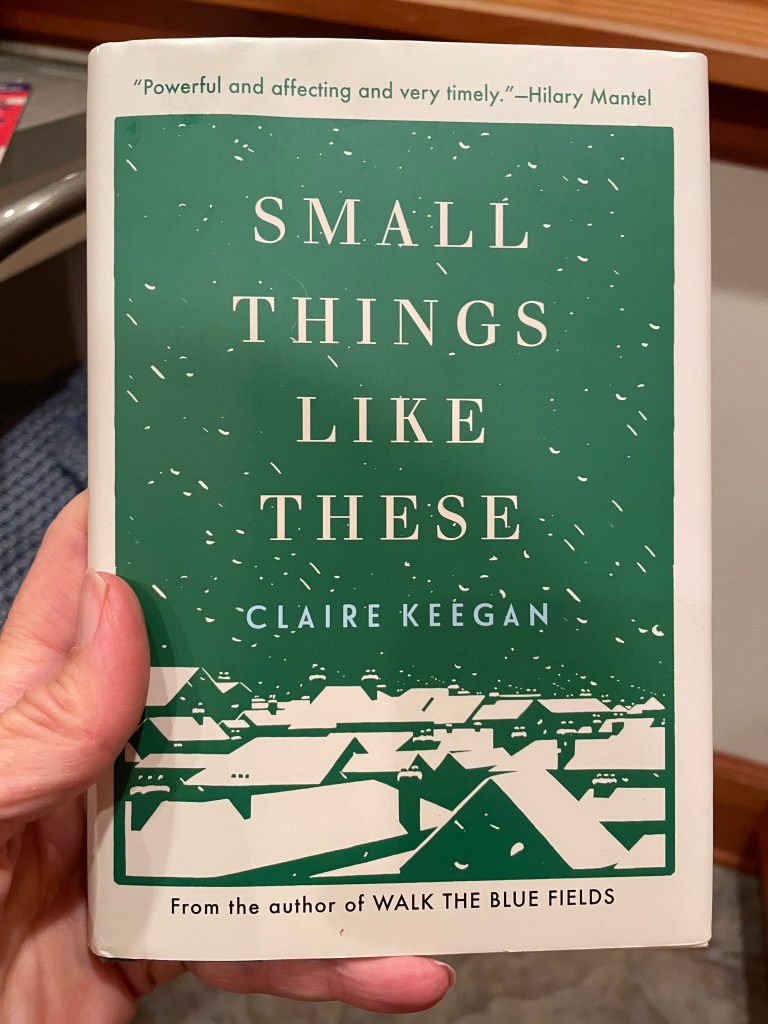
Poem of the Week, by Tony Hoagland

Four spots open in Memoir in Moments: Writing Your Life, next Friday, September 8, 1-4:30 CT. To register, please click and scroll down. I’d love to see you in the zoom room.

Eight years ago, on a whim, I sat down at my dining table and hand-wrote myself a letter. Dear Alison, it began, here are some things you did in 2015. Each entry, such as loved your children and wrote and rewrote that book and stayed in good shape despite plantar fasciitis, holds within it an arc of emotion and effort and accomplishment. I read it again just now. Everything I tried to do that year came rushing back over me, along with a sense of being just one of a long line of humans who are all just trying.

Which brings me to this beautiful farewell poem by Tony Hoagland, especially the ending lines, which I had to read twice to understand were not an admonition but a gentle acknowledgment to himself that he had been a good man who should have been kinder to himself.

Distant Regard, by Tony Hoagland

If I knew I would be dead by this time next year
I believe I would spend the months from now till then
writing thank-you notes to strangers and acquaintances,
telling them, “You really were a great travel agent,”
or “I never got the taste of your kisses out of my mouth.”
or “Watching you walk across the room was part of my destination.”
It would be the equivalent, I think,
of leaving a chocolate wrapped in shiny foil
on the pillow of a guest in a hotel–
“Hotel of earth, where we resided for some years together,”
I start to say, before I realize it is a terrible cliche, and stop,
and then go on, forgiving myself in a mere split second
because now that I’m dying, I just go
forward like water, flowing around obstacles
and second thoughts, not getting snagged, just continuing
with my long list of thank-yous,
which seems to naturally expand to include sunlight and wind,
and the aspen trees which gleam and shimmer in the yard
as if grateful for being soaked last night
by the irrigation system invented by an individual
to whom I am quietly grateful.
Outside it is autumn, the philosophical season,
when cold air sharpens the intellect; 
the hills are red and copper in their shaggy majesty.
The clouds blow overhead like governments and years.
It took me a long time to understand the phrase “distant regard,”
but I am grateful for it now,
and I am grateful for my heart,
that turned out to be good, after all;
and grateful for my mind,
to which, in retrospect, I can see
I have never been sufficiently kind.

Click here for more information about beloved poet Tony Hoagland.
alisonmcghee.com
My podcast: Words by Winter

Poem of the Week, by Rainer Maria Rilke

I’d love to see you in one or both of next week’s afternoon workshops, The Intuitive Leap or Memoir in MomentsClick here and scroll for all the details. 

Photo by Stephen Kiernan

That woman sitting on the bar stool with a martini and a magazine, or alone on her couch spinning imaginary people into books, or flying solo around the world: she is me. But won’t you be lonely? is a question I’ve heard a lot in my life, and I don’t know how to answer it, because isn’t everyone, somewhere inside themselves, lonely?

It’s rare to be deeply understood. Rare to meet a kindred spirit who understands when you need to jump in your car and drive alone for thousands of miles, or go to a movie alone, or hike alone. Falling in love doesn’t change this conundrum. It took me a long time to understand that my heart’s silent, fierce response to a disappointed partner —What you want from me I cannot give you–did not mean I was at fault. Thirty years ago I might not have understood this beautiful poem below, but I do now. 

Pathways, by Rainer Maria Rilke

Understand, I’ll slip quietly
away from the noisy crowd
when I see the pale stars rising, blooming, over the oaks.

I’ll pursue solitary pathways
through the pale twilit meadows,
with only this one dream: 

You come too.

Click here for more information about Rainer Maria Rilke.

*Today’s post first appeared in 2019.

alisonmcghee.com
My podcast: Words by Winter
Poem of the Week, by Joseph Fasano

I’d love to see you in our Freedom of Form workshop next Thursday, August 24. Four hours, $100 or pay as you’re able. Click and scroll for all the details

I volunteer as a trained crisis counselor via text. Everyone who reaches out to us is in pain, much of it hard to witness. The other day I talked with a teen who’s being bullied in a particularly vicious way. In our time together I shared resources and we brainstormed ways they could find relief and build connections. The teen’s quiet, hurting resolve went straight to my heart. Over and over I told them how courageous and self-aware they were.

What I wanted to do was hold that child close and reassure them they are perfect exactly as they are. In the days following our conversation I keep sending invisible messages to them through the invisible air, tiny lamps to light their way, hoping they can somehow feel the love beaming toward them.

Urgent Message to a Friend in Pain, by Joseph Fasano

I have to tell you
a little thing about living
(I know, I know, but hear me)
a little thing I’ve carried
in the dark:
Remember when you saw the stars of childhood,
when you knelt alone and thought
that they were there for you,
lamps that something held
to prove your beauty?
They are they are they are they
are they are.

Click here for more information about Joseph Fasano.

alisonmcghee.com
My podcast: Words by Winter