The dedication behind the dedication
I dedicated my brand-ne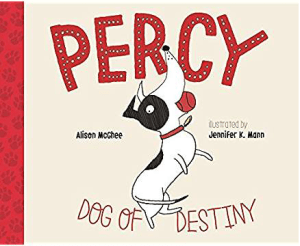 w picture book, Percy, Dog of Destiny, to my dear friend Judy Osborn. Why? Take a look at that handsome dog below. His name is Wrigley, and he’s one of the astonishing American Vet Dogs, trained to provide moral support to our troops and veterans. (See the goggles and weights on Wrigley’s back? That’s part of his training as a helicopter dog. Check out this video if you don’t believe me.) A dog of destiny if ever there was one.

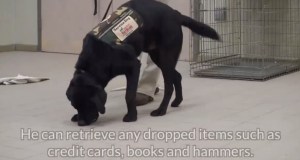
I’ve had the honor of watching Wrigley grow from a tender puppy (last photo below) into the soulful, beautiful dog he is now. Not in person, but through my friend Judy’s photographs. Judy, who is a civil servant by day and a dog whisperer the rest of the time, worked with Wrigley almost every weekend for a year. During the week, Wrigley was loved and trained by Sam, an inmate at the Maryland Correctional Training Center in Hagerstown, MD., and each weekend, Judy picked him up and took him with her everywhere, so that he would be as used to the enormous outside world as he was to the confines of the prison.

Q. Judy, what drew you personally to the Vet Dog program?
A. I’ve always loved dogs and I’ve always been interested in how dogs can help all kinds of people — kids learning to read; people recovering in hospitals; veterans dealing with PTSD or physical disabilities; prisoners who need unconditional love; senior citizens who need connection. I became more conscious of veterans because I live near Walter Reed National Military Medical Center and I see veterans in Bethesda who are amputees.
After the recent deaths of three dear friends, I decided life was too short to wait until retirement to do what I loved. I had done some volunteering with Warrior Canine Connection (puppy petting!) but wanted to do something on a regular basis that involved dogs and vets and inmates. America’s Vet Dogs was perfect because the dogs are trained during the week by inmates and the prison was relatively close (in DC terms, anyway – an hour and a half drive). And since my commitment was only on weekends, I didn’t think I would get attached to the dog (ha ha!).
Q. You worked in tandem with an inmate to train Wrigley. What was that like?
A. “My” inmate — Sam — is an inmate at the Maryland Correctional Training Center in Hagerstown, MD. Sam was the main trainer of Wrigley, who was his first dog, and he worked with Wrigley 24/7. My commitment was at least three weekends a month, two nights each weekend, to practice the commands in the “real” world and to socialize Wrigley, i.e., expose him to all sorts of situations, places, people, noises and smells. Doorbells! Garbage trucks! Leaf blowers! Construction sites! People who walk funny! Skateboarders! Drunk people! Clowns! Squirrels and cats! Bowling alleys! Hospitals! Libraries! Buses! Boats! Subways! I even did things with Wrigley that I failed to do with my own son when he was little (a pontoon boat at a local lake).
The list they gave us is quite extensive. We had a training book that gave us “field trips” that were appropriate for the age of the dog. Each weekend we were supposed to repeat two field trips we’d done before, and add two new ones. Sam and I made a great team. We gave each other lots of detailed information from week to week, and Sam would work on things that I found Wrigley hadn’t yet mastered in the outside world.
Q. What was the most rewarding aspect of working with Wrigley?
A. The most rewarding thing is knowing that I helped bring the joy (and boundless energy) of Wrigley to the many veterans he will meet. He will be deployed for a while (though it’s unclear if it’s with the Army, the Air Force, or the Mass National Guard) and he will bring great comfort to our soldiers who are under so much stress. He is then on track to be a “facility dog” who will be assigned to a military base or VA hospital and get to hang out with all the veterans who are there for therapy.
Q. What was the hardest aspect of this work?
A. Saying goodbye. Worrying about him — knowing that he doesn’t like being in a kennel; wondering how it will be for him overseas; hoping he is with people who love him and treat him well. I miss his goofiness and his beautiful face.
And it was also tough never getting to meet Sam to talk about our boy together, since the rules prohibit any interaction. Towards the end, we both could really appreciate and understand how far we — and Wrigley — had come. We were able to share that through notes, but it wasn’t the same. I did get permission to write Sam a goodbye letter.
Q. Do you have insight or advice for the general public with regard to vets and their dogs, or service dogs in general?
A. DO NOT PET THE DOG. Service dogs are working and having a stranger pet the dog (or even talk to the dog) could endanger the handler’s life. It’s best not to even ask to pet the dog since sometimes that can cause stress for the handler.
I did meet some wonderful people who would come up and speak to me. Lots of people wanted to know about the Vet Dog program, lots of people offered a ton of support to us and to him. Children could always pet him provided they asked first and stayed calm; I tried to make these teaching moments. One of the last weekends I met an eight year old boy at the farmer’s market. Wrigley and this little boy just fell in love with each other. So very sweet.
Q. What have your dog experiences in life thus far taught you, either about yourself or about human relationships?
A. People need connection, unconditional love, and acceptance; dogs provide all of the above. Dogs also make you live in the moment — there’s no way I can hurry through my morning to get to work without first rubbing my dog Khaki’s belly. (She goes downstairs first and lies on her back so her belly is the first thing I see when I come downstairs.) And, as hungry as she is when I come home, she demands — and I give — a belly rub and cuddle then too.
For more information about America’s Vet Dogs, or to support the wonderful work they do, please click here.
 That dapper little gentleman to the left is our dog, Petey. Petey is almost fourteen, and every day he wears a bandanna from his large collection. He loves pig ears. He will wade with great caution into the lake if he can a) see the bottom clearly and b) only up to his chest, at which point he will c) bow his head so that he can take a few sips before d) retreating. When his hair gets too Rasta we take him to Royal Pet and get him a puppy cut, which a) makes him look as if he’s lost ten pounds and b) prompts our neighbor Kathie to look askance and say, “I see you got him that rat cut again.”
 I wanted to write about why I love this poem so much, but it grabbed me by the throat and told me that it could speak for itself, thanks.
 A long, long time ago I read Innumeracy, a slender, astonishing book by the mathematician John Allen Paulos, in which he explains how the inability of most of us to deal rationally with enormous numbers results in confused personal decisions and public policy as well as susceptibility to pseudoscience of all kinds. In one chapter Paulos lays out the fact that, on average, every breath we take contains a minimum of three molecules of air breathed by every single person who ever lived and breathed on this planet. I think about this fact every single day. It has influenced every aspect of my life, not least of which is that in times of deep grief, it brings me comfort. Breathe in, Alison. Remember that you’re breathing in some of the same air that every single person you love, the ones who are living and the ones who are dead, have breathed. This lovely, elegiac poem by Tim Nolan, one of a series about his mother and her passing, brings me that same sense of loss and comfort.
 August 25th, 1849
 That photo over there to the right is the very long tail of a very large rat that ran over my bare feet as I stood at the stove cooking dinner. The story behind the tail is one of intrigue and horror – me sauteeing vegetables at the stove while chatting with The Painter who was seated behind me, me suddenly feeling a squirrel or a small cat run over my bare feet, me shrieking and whirling around to tell The Painter that a squirrel or a cat had run over my bare feet, The Painter trying desperately to contain his horror because he had witnessed exactly what ran over my bare feet and rats are not cats.
  Friends, I’m old enough to remember the Willie Horton ad. I’m old enough to remember when the Central Park Jogger –who was around my age, a jogger like me, white like me, educated like me– was raped and left for dead. I remember being terrified at the idea of “wilding” youths –who, somehow, were always black– out to get girls like me. And I remember three months ago, when I was stunned at the outcome of this election and none of my friends who aren’t white were.
 hat before spellcheck, he would say the word out loud and then look through the dictionary trying to find it by first letter. A word like psychology, for example, he would sound out and then search through all the S words. Not finding it, he would then look through all the C’s even though he was sure that it couldn’t begin with C. It was a slow and agonizing process, and all his papers came back with low grades and comments like “Your insights are terrific but you must learn to proofread.”
  Yesterday I sprinkled some sliced almonds into a small pan and turned the flame on low. I stood beside the stove watching over the pan and occasionally flipping the almonds so that they would brown evenly and not burn. When they were dark golden I shook a little sugar over them and stirred until they were caramelized. Then I turned the almonds out onto a plate to cool and took the pan over to the sink. The sink is a strange, cheap, plasticky thing, scarred from hot pans, so I held the pan up to the faucet and ran water in it to cool it down first. The water hit the pan and steam billowed up into my face. Suddenly I was breathing in vaporized sugar – I could feel it in my lungs and taste it as it went down. It was the most amazing sensation. I stood there by the sink and thought, All these years I’ve been alive and this has never once happened to me before. Then I thought of this poem, which I have secretly treasured ever since I first read it because I love how words, if you toss them around in your mind and on your tongue, turn surprising and magical in that same alchemical way.
