Long ago one of my small children asked if I wanted to play a board game. It was evening and I was tired, so tired, beyond tired.
I’m sorry, honey. But I think I’m just too tired.
Would you like to read a book together instead?
How many more times would my child want the simple pleasure of my company? Even then, in the moment, I knew saying no would be something I’d regret forever. Now I look back through the tunnel of years at my child’s quiet nod, their small back disappearing down the hallway.
Wished Away, by Kathleen Wedl
I wish for the days I wished my teen granddaughters wouldn’t sprawl across my silken bed in street clothes their pollen infested ripped shorts and indoor/outdoor socks defiling my anti-allergy refuge reveling in their secrets and embarrassments trying their bravado on each other like leather bustiers. Where was the sage warning me to be careful what I wished for, those long afternoons all breathable air saturated with happy chittering and chortling. They’re gone. My satin comforter smooth, fresh as the first chill of September.
Today I’ll gather apples as the air becomes crisp, something to put up for winter. Think how the jewels will glisten under glass.
Click here for more information about poet Kathleen Wedl’s new collection, Ordinary Time.
Dear chatbot, please write a 1000-word essay about Alison McGhee’s novel What I Leave Behind, including the themes of the novel and the themes of her work in general. Note voice, style, tone, and anything that makes this novel unique. This was the assignment I gave to a chatbot a few months ago (and yes, I did say “Dear chatbot” and “please.” Because I’m polite.). The essay was finished in seconds. It was good, for the most part, articulate and careful and full of tender references to the narrator Will’s love and care for his little brother.
But no little brother exists in my novel. A crucial fact which no one who hadn’t read it would ever know.
We speed along, faster and faster and faster and faster, saving and saving and saving time. So much time saved. And so much lost along the way.
For a Student Who Used AI to Write a Paper, by Joseph Fasano
Now I let it fall back in the grasses. I hear you. I know this life is hard now. I know your days are precious on this earth. But what are you trying to be free of? The living? The miraculous task of it? Love is for the ones who love the work.
Write Together, our week of no-pressure, twice-daily guided writing prompts via Zoom, begins next Saturday, June 10. Spots are still available, so if you’d like to join in, just let me know. Click here for details. I’d love to see you in the zoom room!
Right after college I moved to Boston and began my life as a self-employed penniless writer. Sometimes I took a creative writing workshop through Harvard Extension. In one of them, I wrote a short story about a young woman who was married to a nice man, a good man, a man who bored her. She dreamed of passion, of adventure, of wild sweeps of emotion. One of the male writers in the room, speaking of the story, said “But what’s wrong with nice?” and I inwardly rolled my eyes and scoffed at what I perceived as his own boringness.
That story is probably at the bottom of a file cabinet somewhere in my house, but I don’t want to find it. I don’t want to think about the girl I used to be, how she silently equated “nice” with “boring,” and how wrong she was.
The Wrong Man, by Judith Waller Carroll
A few years after I married you, when our love had settled down to that steady simmer that’s sometimes mistaken for boredom, something triggered a memory—a whiff of Brut cologne, iced instant coffee— and suddenly I craved the misery that marked my brief time with him: the lurching stomach, the sweet prickle at the back of my neck. I even started to dial the number I still knew by heart, but there you were walking through the doorway, arms full of something ordinary— groceries or shirts from the cleaners— wearing that half-smile that could always start a fire inside me, a flame much deeper than the remembered pain.
Unless, by Carol Shields. Long ago I read The Stone Diaries (which won the Pulitzer Prize), my only Shields novel until now. Which is too bad, because Unless is a wonderful novel. In an uncanny way, Shields strikes me as a bridge between tell-nothing-about-the-narrator Rachel Cusk and allow-us-fully-in Elizabeth Strout, not to mention that all three novelists are writing books about women who are writers (something which did not occur to me until I’d finished all three books, which you can take as proof of my obtusity). Set north of Toronto, Unless charts both the writing life and the mothering life of Reta Winters, whose beloved oldest child, in an abrupt turnaround, spends her days on a Toronto corner with a begging bowl, seeking goodness. The daughter’s mysterious malady and her mother’s heartbreak are charted in one of the most quietly fierce feminist novels I’ve read. Beautiful.
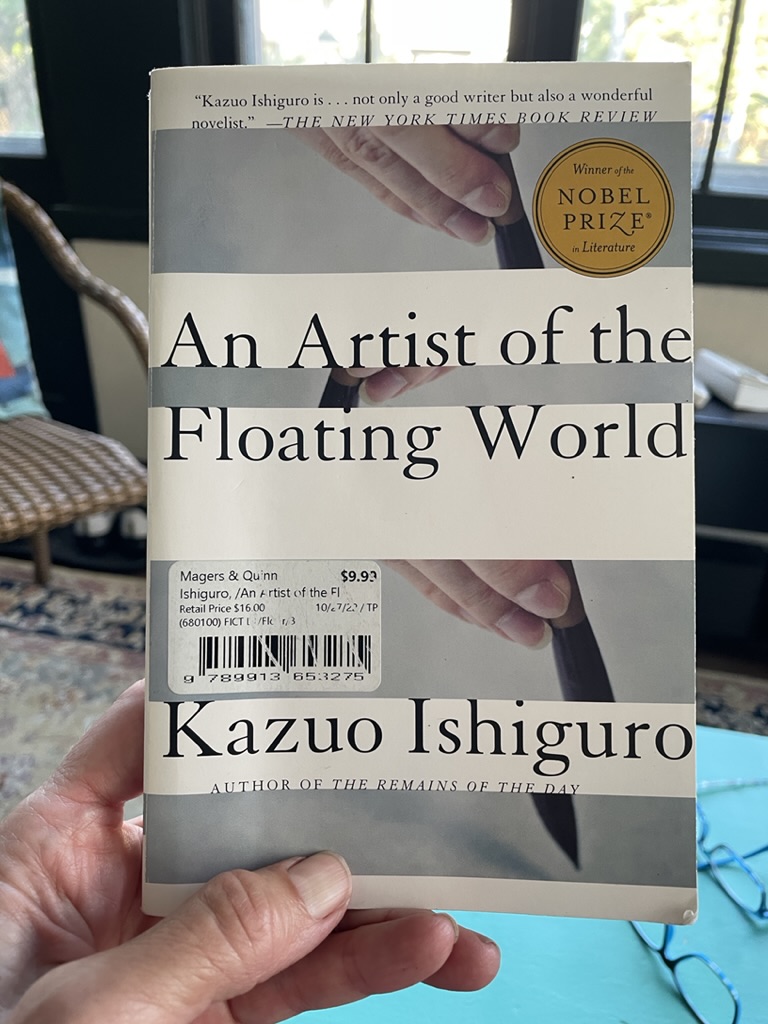
An Artist of the Floating World, by Kazuo Ishiguro. I space my Ishiguro novels out, mostly because I don’t want to run out of them in my lifetime, and I picked up this one at Magers & Quinn fully intending to save it for later, but then read the first page and boom, finished it. I have come to understand there’s a central mystery at the heart of all Ishiguro novels, one that will be revealed to me slowly, in small bits and fragments of narrative and dialogue, and that by the end will have torn my heart open. Such is the way with An Artist of the Floating World, Ishiguro’s second published book. Set in Japan in the first few years after WWII, an older artist, paying close attention to those around him, begins to rethink his role, both personal and public, in his country’s march to war. A quiet, introspective, profoundly human book.
The Corrected Version, by Rosanna Young Oh. In this collection of poems, Oh reflects on a childhood as the daughter of Korean immigrants who opened a small grocery store on Long Island. From the future she lives in now, Oh looks back on the details of her family’s life, and what her parents taught her in word and example as they devoted themselves not to the work of the mind they’d been educated for, but to the labor of keeping the store and their children going. The poet’s eye Oh brings to scene and imagery turns memory vivid, infused with both love and clarity. From my favorite poem, in which she and her father are picking through blueberries: Suddenly, my father’s voice emerges as though from a / distance: “You were not meant to live this kind of life.” / But nor was he—a man with a mind made wide by books,/who as a child rose with the sun to read by its light. To me, born and raised in a nation where most inhabitants, like me, are descended from immigrants, this lovely book feels both familiar and deeply specific.
Useful Phrases for Immigrants, by May-Lee Chai. Short story collections can be hard for me, only because each story often feels novel-like in its depth and scope, and then poof, it’s over and there are many more to read. Not so with Chai’s stories, which are similar (sometimes puzzlingly so; family configurations and objects can be startling alike, especially in two of the stories) – I read the collection in a single day. Chai is piercingly honest and evocative in her exploration of the Chinese immigrant experience, both recent (xìa hai, jumping into the ocean) and generational, in long-established families. In this way, Useful Phrases for Immigrants reminds me of Kelly Yang’s wonderful novels for children; I was equally absorbed in Chai’s people and their frustrations, accomplishments, longings, and relationships both familial and cross-cultural. I wish that Chai’s fictional Uncle Lincoln, who radiates kindness and clarity, existed in real life, so that we we could be friends.
Horse, by Geraldine Brooks. This is my first novel by Pulitzer Prize winner Brooks, and…wow. I learned so, so much about the world of horses, horse racing back when it was a national obsession, and aspects of the Civil War I hadn’t known about. Horse skips back and forth from mid-1800s Kentucky and points south to 2019 D.C. to 1950s Manhattan, and is mostly told through the voices of Jarret, an enslaved horseman; Thomas, an equestrian artist; Martha, a mid-century pioneer contemporary art collector; Jess, a scientist who specializes in articulating the skeletons of long-gone animals, and Theo, finishing his Ph.D. in art history. I list these voices because they all seem so different from one another, and yet part of Brooks’ genius is weaving an increasingly intimate net that enfolds them all –and us—in the historical and ongoing racial wrongs of this country and the world. Jarret is (to me) by far the most affecting person in this exceptional, extraordinarily researched novel.
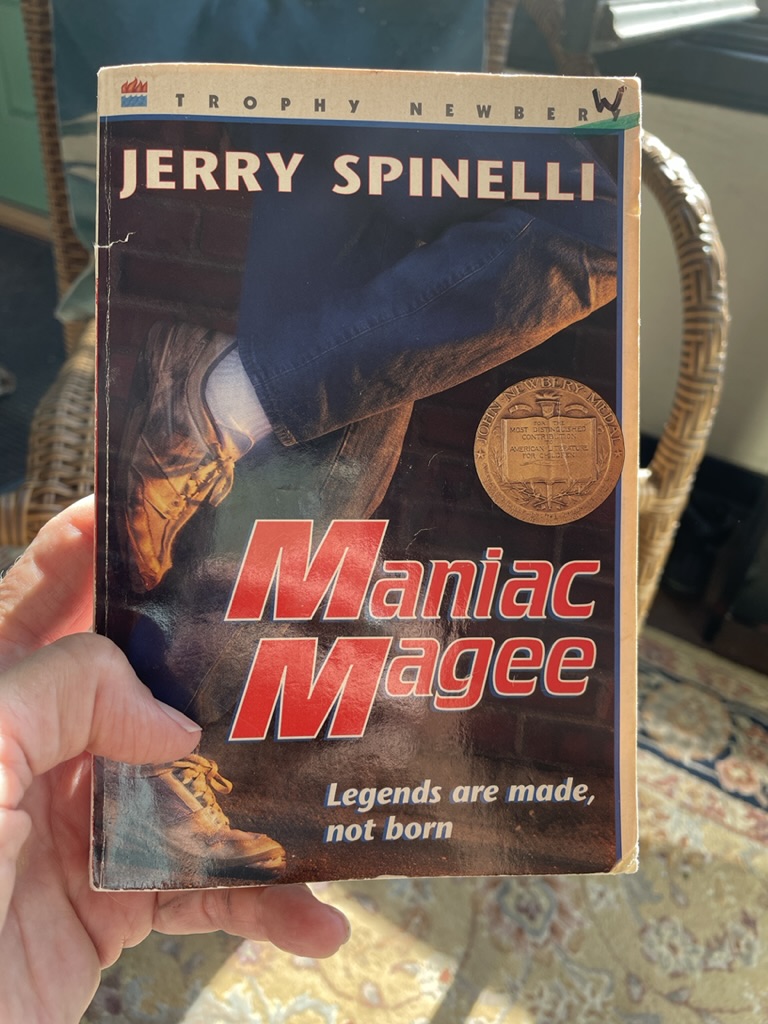
Maniac Magee, by Jerry Spinelli. Another in my never-read-this-children’s-classic when it came out books. What an interesting, unusual, challenging book. Jeffrey Magee, aka Maniac Magee, takes off running (literally) in the first few pages and never stops. Set in a Pennsylvania town divided (again literally) into Black and white halves, Maniac takes it upon himself, in his search for a home and family to call his own, to unite the townspeople. The book is unrealistic and yet, in what feels like an absolute determination toward happiness and resolve, transcends that unrealism to become a story of optimism, belief that change can happen, and love. Somehow I wasn’t fundamentally put off by the fact that it’s a white kid written by a white author who opens up hearts on both sides of the divide. I ended up loving everyone in this book, which, I noticed only after finishing it (see obtusity comment above), is another Newbery winner.
Ivy and Bean, by Annie Barrows and Sophie Blackall. I found this wee book, the first in the beloved series, in a little free library and gobbled it down as I drank a mug of coffee (I drink coffee slowly). Such a charming, funny, spirited novel. I kept thinking all the way through of how much fun my friend and I had writing the Bink & Gollie books together, and the effervescence of Ivy and Bean, both in the evocation of the two kids and in the pairing of text and illustration, made me think that Barrows and Blackall must also have so much fun writing and illustrating these books. A charmer.
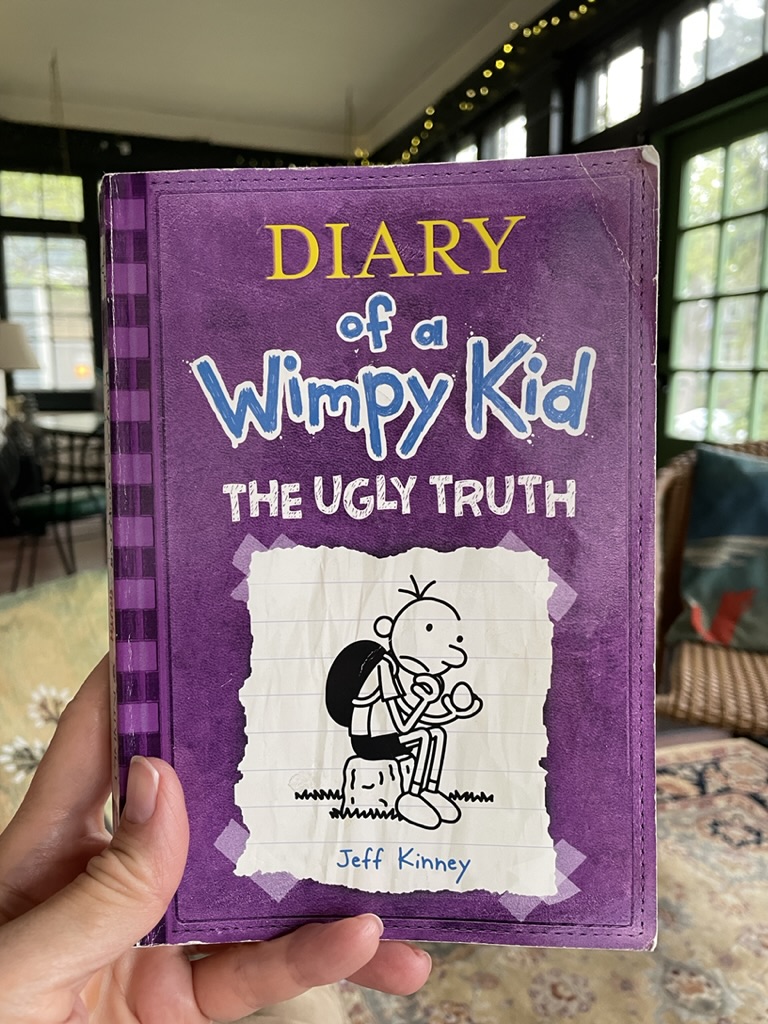
Diary of a Wimpy Kid: The Ugly Truth, by Jeff Kinney. I remember reading and enjoying the first Wimpy Kid when it came out long ago. Either I’ve changed or the books have, because I didn’t just enjoy The Ugly Truth, which was published a few years later, I sat on my porch chortling out loud all the way through. Kinney is so, so good at being inside the head of a middle school kid, and so is the way he relays family, school, and social situations. The diary format is perfect because it allows the reader to feel and empathize with child narrator Greg’s point of view while also stepping back and viewing him from an outsider’s point of view. Nothing is off-limits for discussion, and yet there’s something so reassuring in the way everything is discussed. I finished The Ugly Truth and texted a friend: “Kinney’s a damn genius.” Truth.
Eight spots remaining in our June 10-16 Write Together week of twice-daily no-pressure writing together on Zoom! Click here for details. I’d love to write with you next month.
Last weekend I watched a friend dance alone as a band played directly in front of them. The world isn’t easy to navigate for this friend, but as the hours passed and they danced on and on, you could see them shed their layers of confusion and bewilderment until they were nothing but their own body fused with music, fully at ease.
I think I needed that, was all they said at the end of the night, drenched in sweat, relaxed and happy.
Who am I without the names and categories the world slots me into? Who would I be if everything fell away, if my shadow was cast far behind me because I had no need of a shadow? The first time I read this poem I nearly cried. I keep reading it to myself, out loud, wondering who I am.
The Desire to Be Oneself, by Homero Aridjis (after Kafka) – translated from the Spanish by George McWhirter
If you could be a horseman riding bareback through the winds and rains on a transparent horse constantly buffeted by the velocity of your mount if you could ride hard until your clothes were cast off far behind you because there is no need of clothes until reins were done with because there is no need of reins until your shadow was cast far behind you because there’s no need of a shadow and then you might see countryside not as countryside but a fistful of air if only you could cast the horse far behind you and ride on, on yourself
Are you interested in a week of twice-daily no-pressure writing together on Zoom? Click here for details on our June 10-16 session of Write Together. I’d love to see you there!
Breakfast at a Kowloon hotel: waiters in black pants, white shirts, red vests. Platters of fruit and dumplings and smoked fish, bowls of congee, you tiao. It was all so beautiful. Then I saw a cockroach crawling around one of the fruit platters. I touched a waiter’s arm and silently nodded at the roach. His eyes widened and he bore the platter away through a door that swung open onto a different world: fiery woks, steam, cooks and busboys racing around shouting.
Did the waiter flick the cockroach off and bring the fruit platter back out? Maybe. Everyone’s trying to survive. There are other worlds within ours, just behind a swinging door, and if you look for them you see them everywhere.
Picking Blueberries, by Rosanna Young Oh
It was a risk my father had taken in midwinter: ordering 240 pint boxes of blueberries in less than desirable condition at a discount so they could be repicked, repacked, and resold.
We stand together before crates of blueberries— the color of river pebbles in water, some flecked with mold. I am twenty-nine years old, and yet my father instructs me as though I were a child again, hiding between the aisles of lettuces and squash in the store.
“Daughter, look,” he says. He squeezes a blueberry between his thumb and finger until the skin tears. I see now: rotten ones bruise to the touch.
We pick in silence. By the second hour, our fingers stiffen, their nail beds purple from juice.
Suddenly, my father’s voice emerges as though from a distance: “You were not meant to live this kind of life.”
But nor was he—a man with a mind made wide by books, who as a child rose with the sun to read by its light.
We’re left with fewer boxes than we had thought. How, how to price them? $3.99 per pint.
Click here for more information about Rosanna Young Oh.
Are you interested in a week of twice-daily no-pressure writing together on Zoom? Click here for details on our June 10-16 session of Write Together. I’d love to see you there!
More than seventeen years have passed for the woman who wrote this poem. She re-upped her bargain with the planets when Venus and Jupiter and Mercury again conjoined in the southwestern sky, and if she’s lucky she’ll keep re-upping it as long as she’s alive. This poem goes out to everyone –not just mothers, but everyone–who would trade their own life if it meant someone they loved could keep living.
Bargain, by Alison McGhee
The newspaper reports that at twilight tonight Venus and Jupiter will conjoin in the southwestern sky, a fist and a half above the horizon. They won’t come together again for seventeen years. What the article does not say is that Mercury, the dark planet, will also be on hand. He’ll hover low, nearly invisible in a darkened sky. I stare out the kitchen window toward the sunset.
Seventeen years from now, where will I be? Mercury, Roman god of commerce and luck, let me propose a trade: Auburn hair, muscles that don’t ache, and a seven-minute mile. Here’s what I’ll give you in return: My recipe for Brazilian seafood stew, a talent for French-braiding, an excellent sense of smell and the memory of having once kissed Sam W.
Then I see my girl across the room. She stands on a stool at the sink, washing her toy dishes and swaying to a whispered song, her dark curls a nimbus in the lamplight. The planets are coming together now. Minute by minute the time draws nigh for me to watch. Minute by minute my child wipes dry her red plastic knife, her miniature blue bowls.
Mercury, here’s another offer, a real one this time: Let her be. You can have it all in return, the salty stew, the braids, the excellent sense of smell and the softness of Sam’s mouth on mine. And my life. That too. All of it I give for this child, that seventeen years hence she will stand in a distant kitchen, washing dishes I cannot see, humming a tune I cannot hear.
Interested in a week of twice-daily no-pressure writing together on Zoom? Click here for details on our June 10-16 session of Write Together. I’d love to see you there!
A couple of weeks ago my daughter demonstrated a theragun to me. A theragun is a personal massager that’s kind of like a jackhammer, in a good way, and my daughter ran it up and down my shoulders and back a little fearfully.
I just don’t want to hurt those tiny bones of yours, she said at one point.
Which made me laugh, because I think of myself as tough and strong. Which I am. But then I read this poem and remembered the theragun, and for a second imagined a distant future, one I hope never happens.
Carrying mother on my back, by Ishikawa Takuboku
Carrying mother on my back Just for a joke. Three steps: then weeping— She’s so light.
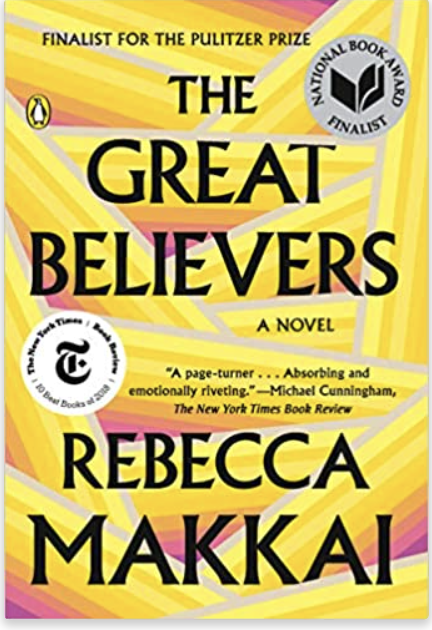
The Great Believers, by Rebecca Makkai. This is my first Makkai novel but it won’t be my last. Because I don’t read book descriptions, reviews, or book jackets before I read a book, I wasn’t prepared for the emotional heft of this novel, which revolves around a core group of beloved friends and flips back and forth between the 1980s and 2015. Makkai’s command of detail and deep knowledge of the beginning of the AIDS crisis brought me right back to those early days, when my gay friends were so young and confronting that hideous, bewildering disease that took so many of them. The emotional and physical havoc of AIDS, and the love, support and anger within the community, reverberates throughout this elegy of a novel. Intense. Painful. Powerful.
Dear Mr. Henshaw, by Beverly Cleary. After The Great Believers I turned to Beverly Cleary as both a palate cleanser and to continue my goal of reading children’s classics I never read when I was a child. Cleary’s trademark hilarity, deadpan realism, and inventiveness with structure and situation are on full display here, but I did not expect to tear up as many times as I did. This small book, structured first as letters from a child to his favorite author, Mr. Henshaw, and then as Dear Mr. Henshaw entries in a private journal, grows in depth and power as we experience the boy’s life along with him from childhood to adolescence. So much wisdom in this novel, which packs an emotional punch I did not anticipate. Then I looked at the book cover again and saw it had won the Newbery, so…duh. Wonderful book.
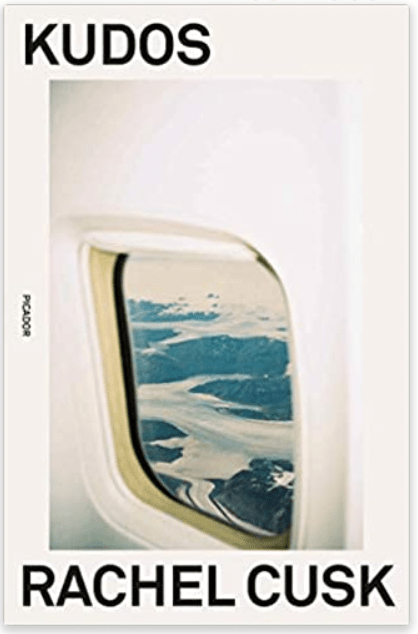
Kudos, by Rachel Cusk. In this, the final novel in the Transit trilogy, Cusk again stunned me with the precision, strangeness, and almost overwhelming honesty with which the people in her books speak to each other. Every bit of social niceties is stripped away, so that each conversation goes straight to the gut, or jugular, or heart of the heart of the situation. Our same novelist is again traveling to another part of Europe for a book conference. Cusk neither analyzes nor returns to conversations between the people in her novels, but fragments of them haunt me, such as the unknowing contempt, in Kudos, of a celebrated male writer for the wife he describes as perfectly happy being the stay at home mother of their children. After which he casually mentions she just finished a book for children which happened to sell in a three-book deal. DUDE. Cusk’s people have conversations that lay bare the complexities of marriage and divorce in a way that’s profoundly uncomfortable for me to read. I’ve never read someone who writes like Rachel Cusk.
Lucy by the Sea, by Elizabeth Strout. Because of my no-prior-info policy with regard to reading, this latest Lucy Barton novel by Strout took me by surprise. This is the first pandemic novel I’ve read, and it hurt in ways I wouldn’t have predicted. Everything we/the world went through. All the ways we/the world changed. Add to the omnipresent fear, pain and loneliness the murder of George Floyd, which happened a 20-minute from my own house in Minneapolis, which Strout pinpoints as ground zero for the resulting wild anger and uprisings that rose around the country, and this novel went straight to my gut. Although I initially wanted to throttle Lucy for her dithering, by the end of this slender novel I was struck –yet again—by the odd, organic wisdom this fascinating fictional woman brings to her understanding of life and human relationships and, by extension, to our current lives.
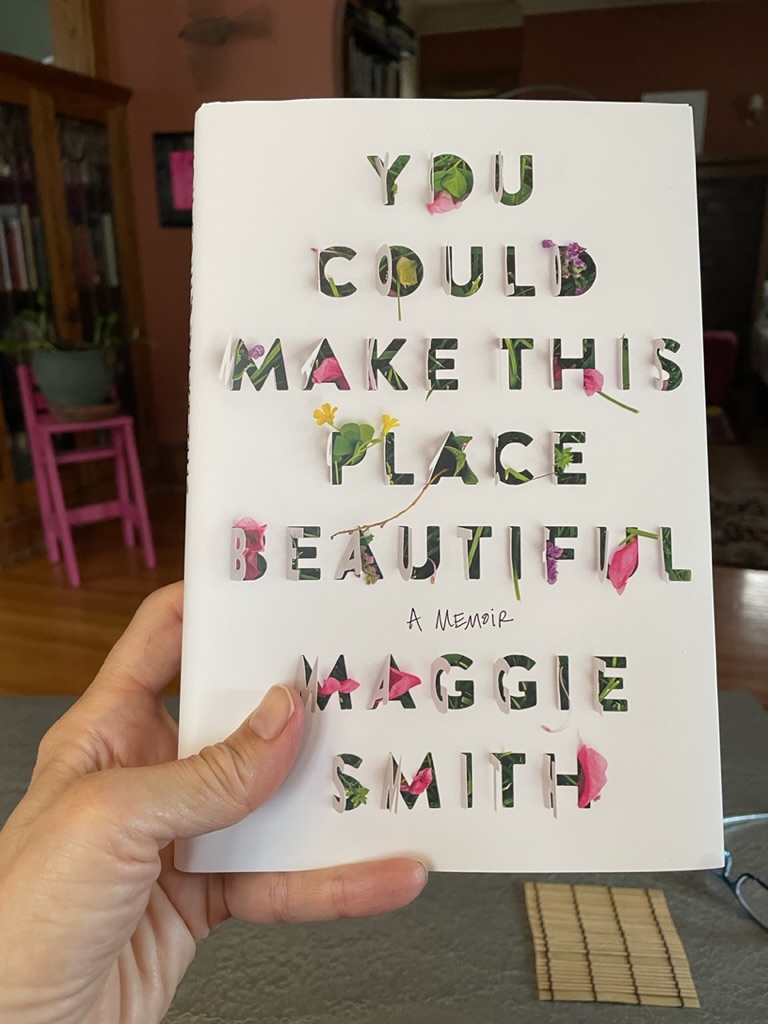
You Could Make This Place Beautiful, by Maggie Smith. In this memoir, by the poet who penned Good Bones, a poem that stunned me (and the rest of the world) when it came out, Smith wonders aloud on the page in each of the brief, illuminative passages that compose the book about the selves she was in her marriage, as it crumbled, and as she makes her way through the first years afterward. Widely thought of as a “divorce” memoir, I see this book as so much more than that: a woman finding her place as an artist in a world that regards the work of writing as not work, as something to be done when it doesn’t inconvenience others, as something so difficult to claim that I remember how awkward and embarrassed I felt when, in my own life, I forced myself to say “I’m working” instead of “I’m writing.” Why can’t we (and I’m talking specifically about women here) be partners and mothers and artists? Answer: we can. You Could Make This Place Beautiful is the fierce, searching story of a woman staking her claim in the world.
Fourteen spots still open in our June Write Together session. Click here for details and to register. I’d love to see you in the Zoom room!
A heart-shaped box of drugstore chocolates was a big deal, back in the day. It was an annual Valentine’s treat from my parents, my dad really, since my mother hates to shop and he did almost all of it. Covered in cellophane, a big red bow, a whole little box for each of us.
As a grownup I turned into a chocolate snob, but when I pass by the Valentine’s chocolate display at CVS I remember how special it was, what a treat, to hold that heart-shaped box and know it was mine. Most of the time it’s not the thing itself that matters but the person, the homeland, the time of life behind the thing. Those, we hold in our heart of hearts forever.
The Sound of Music, by Kathryn Nuernberger
When I tell you I love the song “Edelweiss” you have to understand that even though I too am a sophisticate who scorns musicals, I was once a little girl who stood in my grand- father’s living room singing, Cuckoo! Cuckoo! while he sipped his scotch and laughed at my preciosity. And when I sing the lyrics in your ear—Small and bright, clean and white, you look happy to meet me —you have to understand my grandfather only ever had one friend, a jeweler who also drank scotch, and left his $10,000 Rolex to my grandfather, who wore it even though it turned his wrist green, wore it to the funeral, where the daughter sang in her ethereal voice. Blossom of snow may you bloom and grow, bloom and grow forever. She couldn’t take her eyes off the casket. You have to understand that my grandfather kept spinning that heavy gold around his wrist, and when he raised his voice to join in, he cried to sing it. Edelweiss, edelweiss, bless my homeland forever.











 Alison McGhee