My new book Dear Brother is in the world as of Tuesday! Click here for more info and/or to register for its launch party.
Maybe you, like me, talk to the people you love who aren’t on the planet anymore. Maybe you look up and oh, there she is, coming toward you at the end of the block, waving…but wait, no, it’s just someone who looks like her. Maybe you see a cardinal, or an eagle, or a small red fox, and that’s the sign you and your loved one agreed upon, so you know they’re still with you.
And maybe you’re also like me in that sometimes a sign isn’t enough. Sometimes you just want them right back there in the room with you, nodding off in the big chair, or telling you a story, because you need their presence, their courage, their steady-as-a-rock-ness.
The Courage That My Mother Had, by Edna St. Vincent Millay
The courage that my mother had Went with her, and is with her still: Rock from New England quarried; Now granite in a granite hill.
The golden brooch my mother wore She left behind for me to wear; I have no thing I treasure more: Yet, it is something I could spare.
Oh, if instead she’d left to me The thing she took into the grave!— That courage like a rock, which she Has no more need of, and I have.
Click here for more information about Edna St. Vincent Millay.
Click here to peruse our summer and fall one-day online writing workshops. I’d love to see you in the zoom room.
There is a town in North Ontario Dream comfort memory to spare And in my mind I still need a place to go All my changes were there
College is the place I go in my heart when I need a place to go: Maple leaves ironed between wax paper. Mountains turned to flame in the fall. My mailbox for four years: 2947. My i.d. #: 84337. Blue sky winter afternoons. A narrow bed with a blue wool blanket. A library carrel. The language lab, headphones over my ears. Dancing at the Alibi. Chinese characters written over and over and over. The boy who wore the army jacket and set up a shrine to John Prine in his dorm room. The girl who laced her hiking boots with red laces.
For me it was college, but it doesn’t have to be. A person, a place, an experience, a single moment: and suddenly the roof of your life lifts off and blows away.
Directions to Your College Dorm, by Faith Shearin
All hallways still lead to that room with its ceiling so high it might have been
a sky, and your metal bed by the window, and your crate of books. First,
you must walk across the deep winter campus to find your friend
throwing snowballs that float for years. Then, open our letters:
shelves of words. You will find our coats, our awkwardness, the tickets
from the trains that witnessed our confusion. Love was the place
where we became as naked as morning; it was dangerous and
dappled and we visited its shores with suitcases and maps from childhood.
I remember our shadows growing on your wall while a candle
swallowed itself. You kept a single glass of water on a desk and it trembled
Twin Citians, please come to my Dear Brother book party at the Red Balloon on Tuesday, August 8 at 6:30 pm. I’d love to see you there!
The other day a wave of missing my friend John Zdrazil, who died two years ago, flooded through me and I just wanted to hear his voice and that big laugh. Feel the sun of his presence shining on me. So I picked up my phone and scrolled through a few of our many years of texts. My God, he was hilarious. And soulful. And smart. And he just loved me so much, exactly as I am, which is so rare in life.
I miss you, Z’driz, I texted him, and listened to the swoosh as it sent itself to wherever he is now.
Late that night I picked up my phone again to read more of our messages to each other, but everything was gone, erased, deleted, except those four words: I miss you, Z’driz. All our conversations, all our laughter, all the books we loved and everything we said about them, invisible now. Floating somewhere in the scrim between worlds.
How Often One Death, by Danusha Laméris
How often one death carries another. Like when my painting teacher, Eduardo, died, and the cat
he’d had for years succumbed the same month to the same rare ailment. Or how when they buried
my friend’s grandfather in Japan, the pond-full of koi he’d tended all his life, sickened, turned belly-up.
Who or what is in our keeping? A house, unoccupied, quickly turns itself, sinks earthward.
Long-married couples are known to give up the ghost within hours of each other.
Think of the hum that holds the walls together, the roof high, keeps the rot at bay a little longer.
As surely as we, too, are pinned here by others, whose presence urges our cells to replicate, our lives
more single than we imagine. Even the woman I can’t see, who lives in a studio on the other side
of the wall. She washes a dish and the water runs through the pipes between us, like blood through the arteries
of a single heart.
Click here for more information about the wondrous Danusha Laméris.
Click here for a list of our summer and fall half-day workshops. I’d love to see you in the zoom room.
When I first moved to Minneapolis, I taught Mandarin at a big city high school where many of my students were recent immigrants from South Asia. I was especially close to a boy from Laos, a boy full of laughter and jokes, intensely smart and talented, who longed for his home country. He used to tell me stories about its beauty, the colors and fruits and simplicity of his life there despite a near-total lack of money. Once he told me that when he was sick, his mother would feed him a precious egg to help him get better.
A single egg.
All these years since, I’ve thought of my student and that story. As I sit here in my kitchen, where I cook myself two eggs nearly every day, I’m thinking of him again.
Ghost Hunger, by Cecilia Woloch
Sometimes when I wipe the bowl with my bread when I scramble one egg, two eggs, with milk when I stir the kasha until it’s thick when I sit at the table and bow my head I think of how my father ate how he bowed his head—though he didn’t pray at least not in the usual way of grace but always that posture over his plate of supplication, gratitude— the hungry shoulders of the boy who’d stuffed his mouth with pulled grass once who never got over that there was enough Sometimes I wipe the bowl with my bread Sometimes I feed his ghost this prayer
Click here for more information about Cecilia Woloch.
Today’s my birthday, and this poem goes out as a gift to all you beautiful poetry people out there, in hopes it fills you with the same happiness I feel every time I read it. Out loud, because this poem demands out loud-ness.
The Language of Joy, by Jacqueline Allen Trimble
Black woman joy is like this: Mama said one day long before I was born she was walking down the street, foxes around her neck, their little heads smiling up at her and out at the world and she was wearing this suit she had saved up a month’s paycheck for after it called to her so seductively from the window of this boutique. And that suit was wearing her, keeping all its promise in all the right places. Indigo. Matching gloves. Suede shoes dippity-do-dahed in blue. With tassels! Honey gold. And, Lord, a hat with plume de peacock, a conductor’s baton that bounced to hip rhythm. She looked so fine she thought Louis Armstrong might pop up out of those movies she saw as a child, wipe his forehead and sing ba da be bop oh do de doe de doe doe. And he did. Mama did not sing but she was skiddly-doing that day, and the foxes grinned, and she grinned and she was the star of her own Hollywood musical here with Satchmo who had called Ella over and now they were all singing and dancing like a free people up Dexter Avenue, and don’t think they didn’t know they were walking in the footsteps of slaves and over auction sites and past where old Wallace had held onto segregation like a life raft, but this was not that day. This day was for foxes and hip rhythm and musical perfection and folks on the street joining in the celebration of breath and holiness. And they did too. In color-coordinated ensembles, they kicked and turned and grinned and shouted like church or football game, whatever their religious preference. The air vibrated with music, arms, legs, and years of unrequited sunshine. Somebody did a flip up Dexter Avenue. It must have been a Nicholas Brother in a featured performance, and Mama was Miss-Lena-Horne-Dorothy-Dandridge high-stepping up the real estate, ready for her close-up. That’s when Mama felt this little tickle. She thought it might be pent-up joy, until a mouse squirmed out from underneath that fine collar, over that fabulous fur, jumped off her shoulder and ran down the street. Left my mama standing there on Dexter Avenue in her blue suit and dead foxes. And what did Mama do? Everybody looking at her, robbed by embarrassment. She said, “It be like that sometimes,” then she and Satchmo, Ella, and the whole crew jammed their way home.
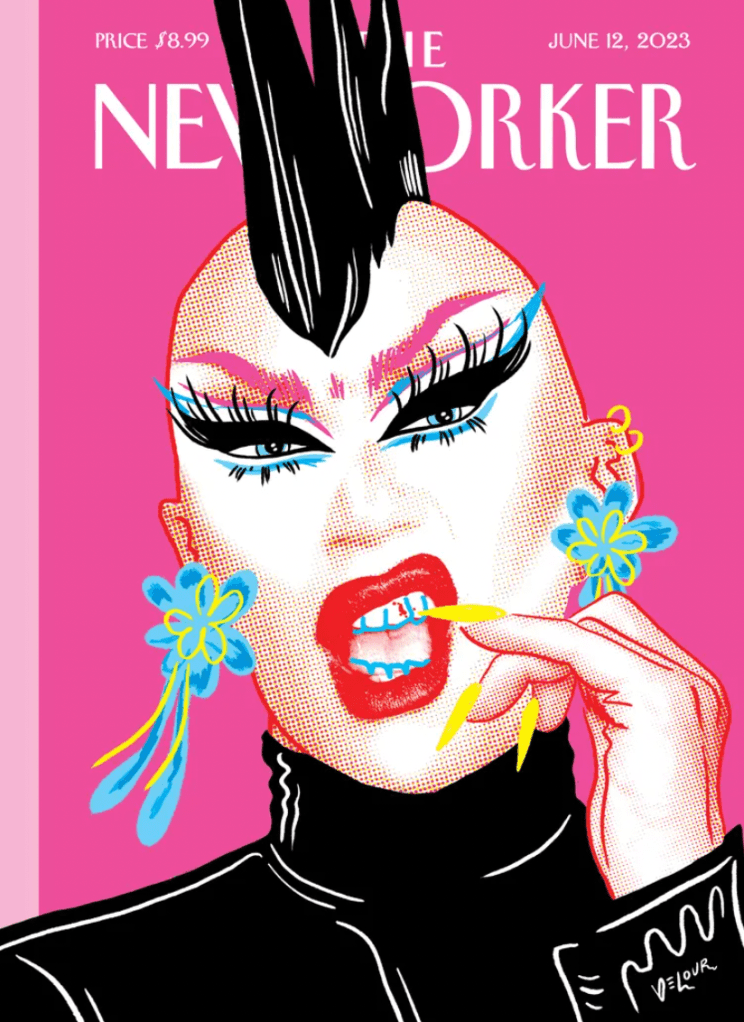
The New Yorker, 12 June 2023. If you are like me, and I’m sure you’re not because you’re much better and more organized, sometimes the New Yorkers pile up. And up. And more up. And oh look, a new one just came sailing through the mail slot. In order to make myself (and possibly you?) feel like less of a loser, I hereby declare each issue of the New Yorker a book in and of itself, because when I put it that way, reading each New Yorker book becomes a beautiful endeavour (I purposely stuck that “u” in endeavour because of my love and admiration of Canadians). The June 12 issue is my favorite issue of the month. In it, Jiayang Fan, a writer I greatly admire, writes about her mother in What Am I Without You? This is Fan’s first piece of memoir in the wake of her mother’s death, of ALS, and in my view it’s the best thing she’s written yet. Wild. Poetic. In it, Fan states that because of the circumstances of their you-and-me-and-nobody-else shared life, she and her mother are not separate people; they merged into a single being in both life and death. I don’t know many writers who would make that claim with such unapologetic clarity. That cool fierceness is one of the things I most admire about Fan.
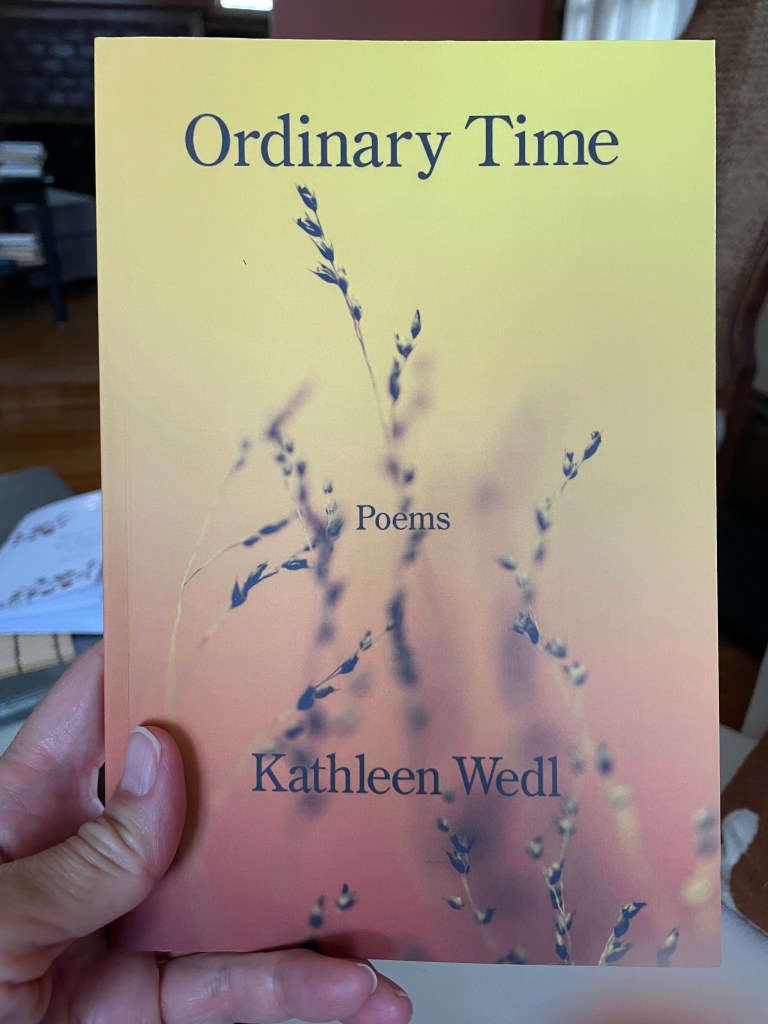
Ordinary Time, by Kathleen Wedl. In this, the poet’s debut collection, threads from a lifetime of marriage and family and fifty years as a psychiatric nurse are woven together into a portrait of love and wisdom. Wedl understands that the things, the literal things we draw around us in our lives, are evidence of our longings and our loves, and she is at her poetic best when describing, with trademark deadpan humor, the give and take of a long marriage of opposites: You give me Honeycrisp/I give you prickly pear. You give me Brave New World/I give you Great Expectations. In my favorite of all the poems in this lovely collection, she looks back on the years when her granddaughters sprawled out in her non-allergenic sealed space of a bedroom, with their pollen infested ripped shorts/and indoor/outdoor socks, thinking of all that she wished away, those long afternoons/all breathable air saturated with happy/chittering and chortling. So often we don’t know we loved something, or some time, or someone so much when we had them. Lovely work.
The New Yorker (again), 12 June 2023. Like so many others, I love, revere, and seek out the work of George Saunders. His latest story, Thursday in the same issue of the New Yorker as Jiayang Fan’s stunning What Am I Without You? is another Saunders story that starts out …weird? is that the word? and gradually deepens and deepens until, if you’re me, you get to the end, heart cracked and bewildered, and have to put the magazine down and take your dog on a long walk, trying to find your way out of Saunders World back into your own life while also trying to figure out just how the man does what he does. Damn.
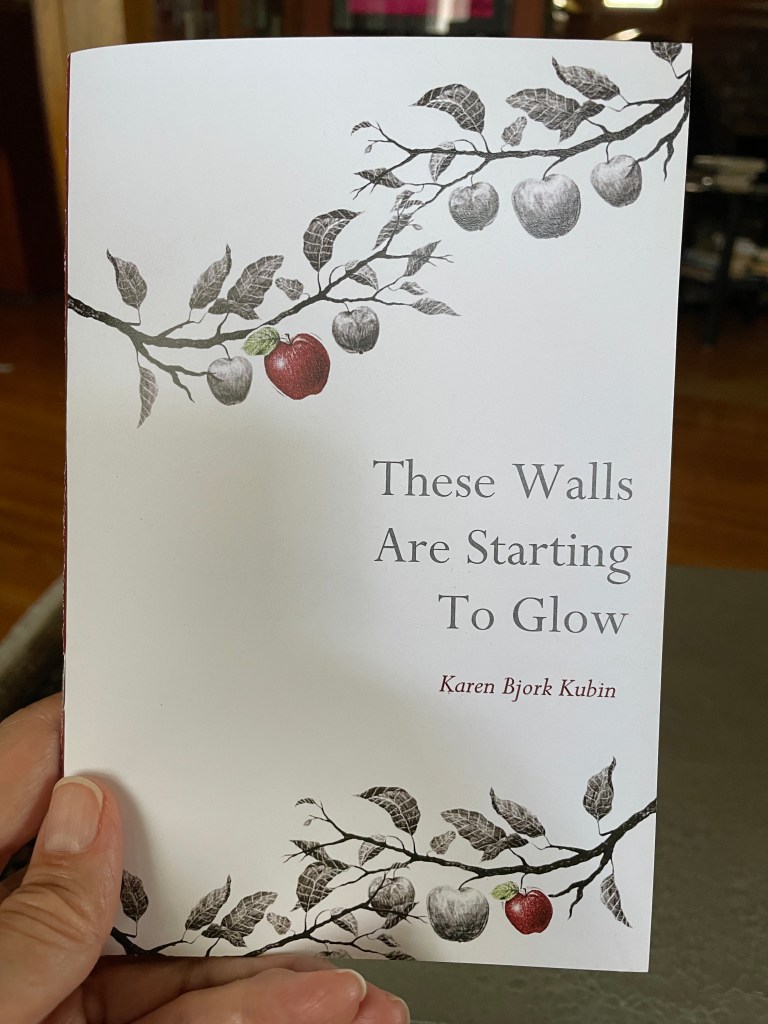
These Walls Are Starting to Glow, by Karen Bjork Kubin. My expectations of this chapbook, based on previous experience of the poet’s beautiful work, was that it would be a hushed, inward, collection of lyrical poems that draw their power from language, artistry, and the wisdom that comes from hard-won experience. So I propped myself up on the orange couch on my pretty, sunlit porch, opened up to the first poem and…holy shit. I sat there in shock. Wild, fierce, full of fury at the cruelty of those in power and an equally furious determination to make this world better, these poems Take A Stand. Each poem begins with an epigraph from a traditional nursery rhyme about a girl or woman and then flips that narrative on its head. I read the entire chapbook in one sitting. Are you looking for a gift for someone you love, maybe someone young, someone questioning the crazy unfairness of this world? Give them this book.
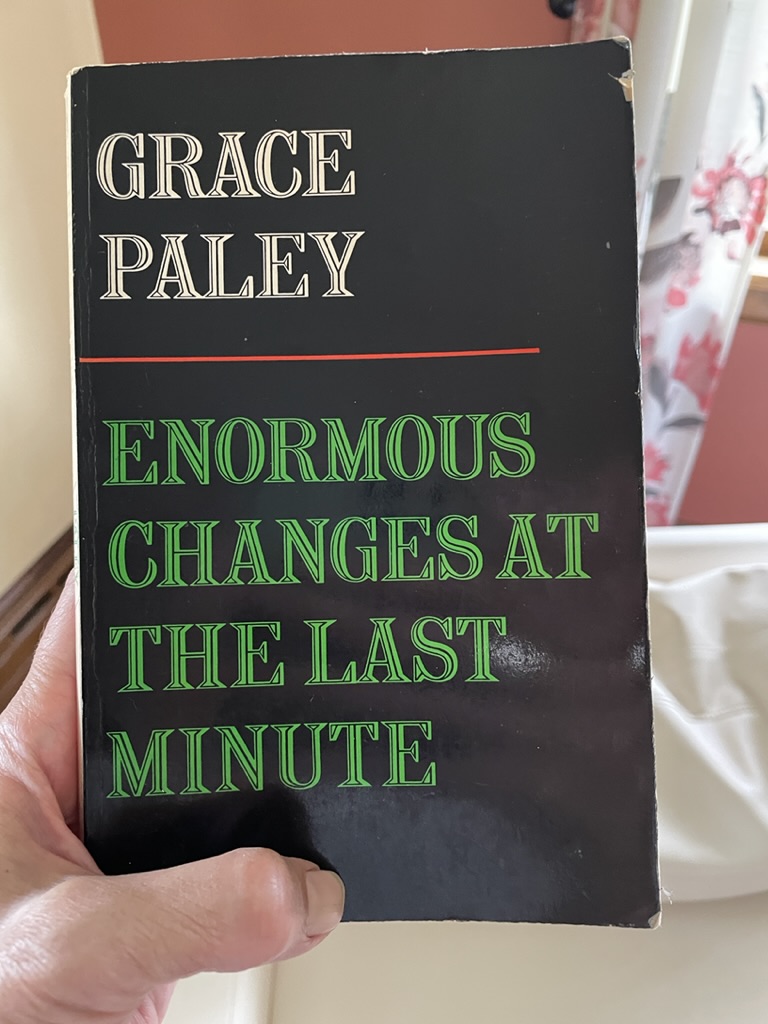
Enormous Changes at the Last Minute, by Grace Paley. Paco the dog-child and I were out for one of our early morning rambles when we stopped by one of our favorite Little Free Libraries to inspect its contents. I saw a copy of Enormous Changes and thought, huh, it’s been many a year since I read a Grace Paley story, and I’ve never read the entire collection; perhaps it’s time. Long, long ago I read stories by both Paley and Tillie Olson at the same time, and their influence on me has been silent and deep. (I read Olson’s work with fascination and unease as a young woman born with a ferocious determination to be a writer; they read as if she were trying to tell me something about being a woman in this world, a woman with a marriage and children and housework who wanted all that and who also wanted so much more, and about how hard I would have to work to stake my claim on tough, unyielding ground. She was right.) Meanwhile, Grace Paley is a wild writer, an experimentalist icon whose stories startle and fascinate me now way more, somehow, than they did when I was young. These are daring stories in every way, from subject matter to language, and it stuns me that they were published more than fifty years ago. Structurally and in terms of voice and point of view, these stories read as if they’re inside out, almost, in that you don’t always know if you’re inside the narrator’s head or if she’s speaking. Paley is fearless, with a voice that reads to me like the precursor of Elizabeth Strout’s Lucy Barton. And she’s also disturbing, with “disturbing” meant here as a kind of troubling and exhilarating compliment.
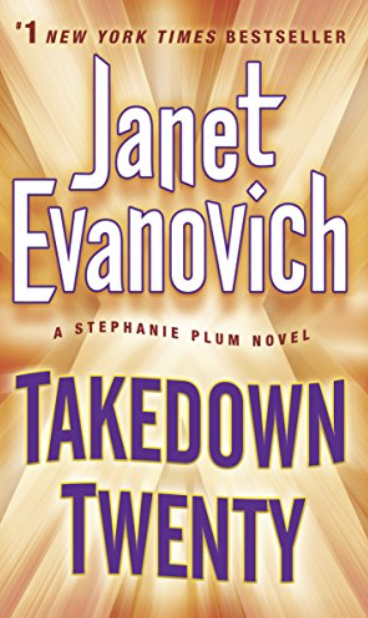
Takedown Twenty, by Janet Evanovich. You know I’m a Stephanie Plum fan who turns to her shelf of closely guarded Stephanie novels when I need a break from the world. One of these novels goes down just like my twice-yearly bag of Lay’s classics. You end up full and satisfied and you know you won’t need another one for some time. Thank you, Stephanie Plum, Lula, Ranger, Morelli, Grandma, Giovichinni’s, Cluck in a Bucket, dear departed Uncle Sandor and your giant powder-blue Buick, and everyone who lives in the Burg. Sometimes you’re just the ticket.
Locker Room Talk: Women in Private Spaces, edited by Michelle Filkins and Margaret Aldrich. Locker room talk. A familiar phrase turned hideous to so many of us by what it now evokes in the wake of the 2016 election. In this absorbing and wonderful anthology, just out from Spout Press, editors Filkins and Aldrich reclaimed the phrase by asking women writers to contribute essays and poems and memoirs about what “locker room talk” means to them. I was moved to tears by some of the contributions, include Jude Nutter’s poem about a brief, piercing airport encounter, Maureen Aitken’s memoir about the freedom of dancing in the singular bar where she felt safe, Mo Murphy’s lovely piece about all she’s learned and held in her heart in decades of work in a salon, and several others. This is a beautiful book. (Full disclosure: I have an essay in this anthology.)
Last week my daughter asked why there was duct tape wrapped around my foot. “To dissolve a callous,” I said, which is something I read duct tape can do (among its zillion other uses). She shook her head in a sad but familiar way, and I laughed and thought of the foot doctor who once lectured me on how I should stop wearing high heels.
Dude. You clearly do not know meat all, I thought.
These feet of mine have tromped up and down a thousand mountains and through a thousand woods and they show it. Occasionally I pick things up with my extra-long toes rather than bend down and use my fingers, and no, I’m not kidding. I always felt so sorry for Cinderella.
The Lost Shoe, by Karen Bjork Kubin
Doodle, doodle, doo, The Princess lost her shoe: Her highness hopped, The fiddler stopped, Not knowing what to do.
It had never before occurred to me to kick it off. And you know princesses don’t just lose things, right?
I have not found the courage yet to chuck the other. For now, the chill and bite of floor against skin is almost more
than I can bear. Let me feast on it. Give me earth. Give me time, and I will bare the other, will bare the rest,
and I do not need your music anymore. I have my own, and steps to learn, a dance to keep, and turn, and turn.
Long ago someone I loved bought a set of small salt and pepper shakers for a friend. He showed them to me and I admired the ingenious way the shakers curved into each other. They slipped in my friend’s hand and he carefully fit them together again so they were tucked safely in his palm.
This moment has come back to me over and over and over, through all the years between then and now. Why, I don’t know. But every time I picture those shakers, my friend’s hand, the intent look on his face as he kept them safe, the image goes straight to my heart.
Encounter, by Czeslaw Milosz
We were riding through frozen fields in a wagon at dawn. A red wing rose in the darkness.
And suddenly a hare ran across the road. One of us pointed to it with his hand.
That was long ago. Today neither of them is alive, Not the hare, nor the man who made the gesture.
O my love, where are they, where are they going The flash of a hand, streak of movement, rustle of pebbles. I ask not out of sorrow, but in wonder.
Click here for more information on Czeslaw Milosz.
Long ago one of my small children asked if I wanted to play a board game. It was evening and I was tired, so tired, beyond tired.
I’m sorry, honey. But I think I’m just too tired.
Would you like to read a book together instead?
How many more times would my child want the simple pleasure of my company? Even then, in the moment, I knew saying no would be something I’d regret forever. Now I look back through the tunnel of years at my child’s quiet nod, their small back disappearing down the hallway.
Wished Away, by Kathleen Wedl
I wish for the days I wished my teen granddaughters wouldn’t sprawl across my silken bed in street clothes their pollen infested ripped shorts and indoor/outdoor socks defiling my anti-allergy refuge reveling in their secrets and embarrassments trying their bravado on each other like leather bustiers. Where was the sage warning me to be careful what I wished for, those long afternoons all breathable air saturated with happy chittering and chortling. They’re gone. My satin comforter smooth, fresh as the first chill of September.
Today I’ll gather apples as the air becomes crisp, something to put up for winter. Think how the jewels will glisten under glass.
Click here for more information about poet Kathleen Wedl’s new collection, Ordinary Time.
Dear chatbot, please write a 1000-word essay about Alison McGhee’s novel What I Leave Behind, including the themes of the novel and the themes of her work in general. Note voice, style, tone, and anything that makes this novel unique. This was the assignment I gave to a chatbot a few months ago (and yes, I did say “Dear chatbot” and “please.” Because I’m polite.). The essay was finished in seconds. It was good, for the most part, articulate and careful and full of tender references to the narrator Will’s love and care for his little brother.
But no little brother exists in my novel. A crucial fact which no one who hadn’t read it would ever know.
We speed along, faster and faster and faster and faster, saving and saving and saving time. So much time saved. And so much lost along the way.
For a Student Who Used AI to Write a Paper, by Joseph Fasano
Now I let it fall back in the grasses. I hear you. I know this life is hard now. I know your days are precious on this earth. But what are you trying to be free of? The living? The miraculous task of it? Love is for the ones who love the work.






 Alison McGhee