New one-day creative writing workshops!
Dear writers,
If any of these three new June workshops look interesting to you, please join us. I’d love to see you there. All workshops are taught in the Uptown neighborhood of Minneapolis.
Friday, June 8: Manuscript Feedback: Picture Books
Location: Uptown’s Community Gathering Space, 36th & Bryant Ave. S., Minneapolis
Time: 12-4 pm
Cost: $100, payable via personal check or this Paypal link.
Do you have a picture book manuscript that you need feedback on? Welcome to my one-day picture book manuscript feedback class! We’ll begin by going over the basics of picture book writing, then move on to individual feedback. Each participant is welcome to bring a picture book manuscript to distribute to the class. We’ll read each out loud, make notes, and then talk about the story. Where is its inherent power? Are there ways to make it stronger?
The class is designed for picture book writers of all abilities, experience levels and subject matter – so I forbid you to worry or feel inadequate. Note also that even if you don’t have a current manuscript in hand, you are welcome to attend, because the class will provide lots of useful information for your future drafts. Enrollment is limited to 12.
Friday, June 15: The Transformation of Trauma
Location: Uptown’s Community Gathering Space, 36th & Bryant Ave. S., Minneapolis
Time: 2-4 pm.
Cost: FREE, but registration is required. Send me an email at alison_mcghee@hotmail.com to add your name to the list.
Are you haunted by the memory of trauma? Maybe someone sexually assaulted you, or abused you over a long period of time. Maybe you’re having a hard time going on after the loss of someone you loved. Maybe as a child, or adult, you struggled through domestic violence or emotional manipulation. If your life is compromised by these memories, and you’re looking for a way to work through them and find a happier and more peaceful life, welcome to this workshop. The making of art, in all its many and varied forms, can be a profound way to make sense of past experiences that were unfair, unwanted, and cruel. We’ll do some brief writings, read and discuss a few short readings, and hopefully find ways to unlock your own power. This class is designed for people of any writing ability or experience – all are welcome. Enrollment is limited to 10.
Thursday, June 21: Creative Writing Kickstart
Location: Uptown’s Community Gathering Space, 36th & Bryant Ave. S., Minneapolis
Time: 5:30-8:30 pm
Cost: $75, payable via personal check or this Paypal link.
Have you always wanted to write but aren’t sure how to begin? Or, are you a writer in need of an energy boost and a fresh start? This three-hour intensive Kickstart workshop will recharge your writing energy and help you develop a regular writing practice. We’ll do several brief writings and talk about various aspects of craft and process –maybe language, maybe flow, maybe dialogue, maybe tense and point of view, maybe some other things– in terms of what makes great writing great.
The class is designed for writers of all abilities, experience levels and genres – so I forbid you to worry if you’ve never written before! Whether you’re a longtime writer in need of a boost or someone who’s always had an interest in writing but never known how to sit down and get started, the class is designed for you.
Bonus: Weekly writing prompts will be emailed to you for one month following the end of class. Enrollment is limited to 15.
 I. My new novel, What I Leave Behind, out on May 15, stars 16-year-old Will. Will is one of those charming people that everyone loves – maybe because he’s naturally cool, but probably because he’s fundamentally kind. He knows how to make lonely people feel less lonely, for example his socially-awkward boss Tom at Dollar General. He knows how hard life can be –he lost his dad to suicide a few years ago and his childhood friend was recently assaulted—but instead of turning inward to his own pain and sorrow Will tries to make the lives of those around him better.
 Born a Crime, by Trevor Noah. I listened to Trevor Noah read his memoir aloud to me as my tiny little car and I cruised along the highways of Arizona, New Mexico and Oklahoma. What a wonderful book. Noah was born to a black South African woman and a white British father in South Africa – his birth was literally a crime back in the waning days of apartheid, hence the title of the memoir. Like Sherman Alexie’s You Don’t Have to Say You Love Me, this book is as much an homage to his fierce, brilliant, take-no-shit mother as it is his own story. Listening to Noah talk about race, class, the city vs. the townships, and his coming of age on the mean streets of both made me think about my own country and upbringing. This book is by turns hilarious, enraging, enlightening, and always utterly absorbing. Highly recommend – and if you’re an audio fan, get the audio version. Noah is an uncanny mimic.
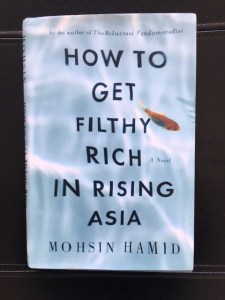 How to Get Filthy Rich in Rising Asia, a novel by Mohsin Hamid. Such a poignant, bittersweet, moving novel this is. It’s been kicking around on my bookshelves for a couple of years now, because even though I knew it was a novel, every time I looked at it I would tilt my head and think How to Get Filthy Rich in Rising Asia? Just doesn’t sound like a novel. And because I don’t care about getting filthy rich in rising Asia (or anywhere else for that matter), it stayed on the shelf. But once I finally cracked the cover and began reading, wow. Structured like the get rich quick self-help books that are apparently wildly popular in Asia, with each chapter heading a different aspect of how to get rich, the book charts the life of one unnamed man. We follow him from early childhood in rural Pakistan (I’m assuming, because the country, like the main character, is never named) to old age in a sprawling, tentacled, ever-growing city, every step of the way alighting, like a hummingbird, on the various aspects of his life and longings that never change. A delicate, painfully-wrought, beautiful book. I loved this novel and will now seek out Hamid’s other books. Highly recommend.
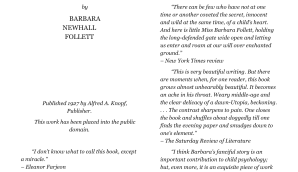 The House Without Windows: And Eepersip’s Life There, a novel by Barbara Newhall Follett. Reading this brief novel was an experience unlike any I’ve had before when reading. The author, who was born in 1914 and vanished at the age of thirty, was eight years old when she wrote the novel and twelve when it was published. After reading
  You know those maps where you fill in all the states you’ve been to? The only one missing from mine is Alaska (I don’t count the time that I landed at the Anchorage airport on my way to China). I’ve been to all the lower 48 states, most of them multiple times, because road trips are big in my life. The earth is a living being beneath the tires, rising and falling, sweeping west and shrinking east. Most of the time I’m solo, like last week, when I drove 2089 miles in three days. When I get tired, or when it gets dark, I tuck my old tiny car behind a semi for comfort. Truckers sometimes get a bad rap, and once in a while it’s justified, but for the most part they drive their trucks way more safely than most people drive their cars.
 I’ll rewrite this whole life and this time there’ll be so much love, / you won’t be able to see beyond it.
  What wearies you? What renews you? Who brings you joy? Who exhausts you? When you think of safety and comfort and happiness, what place or person comes to mind? The answers to these questions are already known to you. They live in your body, in a place beyond conscious thought and its dangerous companions, rationalization and overriding.
 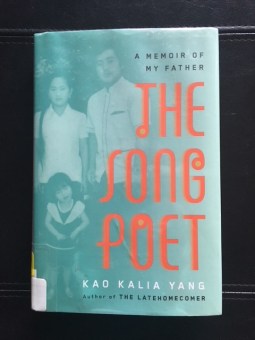 Everything that Kao Kalia Yang writes I read slowly and usually twice, not because there is anything confusing about her sentence structures but because her words and stories fill my heart with emotion. Sorrow, love, longing, rage and redemption – page by page, they all swim through. This is the second memoir by Yang. Her first, The Latehomecomer, was published some years ago and is (to my knowledge) the first Hmong American memoir, about her family’s long and arduous journey from the mountains of Laos to the refugee camps of Thailand to the grueling new world of Minnesota. In The Song Poet, which is primarily about her father Bee Yang, she adopts the voice of her father along with her own in order to tell his personal story and the family’s continuing saga.
  I’m late to the Saga party, but WOW. What a fabulous beginning to a graphic epic of one small family in a universe at war. Volume One and I spent the whole day together curled up on the couch, because I couldn’t put this book down. Fierce Alana, tender Marko, and baby Hazel –who is one of the narrators of the book, from an unnamed perspective many years hence– are impossible to resist. Artwork by Fiona Staples perfectly complements Brian K. Vaughan’s narrative, which leaps into action with the first sentence and Does Not Let Up. I’m swept away. Volume Two of many is up next. Highly recommend.
 Future Home of the Living God, by Louise Erdrich.
 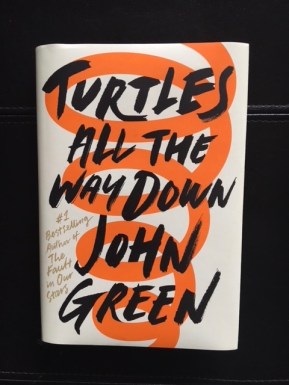 he Fault in Our Stars, I remember thinking, damn, this guy is captivating. I passed that book on to both my daughters and we all held it to our hearts and still quote lines from it to each other. Turtles All the Way Down is another book I’ll hold in my heart. John Green has an uncanny way with snappy dialogue, the profundity of best-friendship, setting (this one is set in his native Indianapolis, and after reading it I feel as if I could draw a map of the neighborhood), and his books are both deeply sorrowful and funny as hell. The man doesn’t shy away from the harshness of life, in this case the loss of a parent and the main character’s ongoing struggle with debilitating OCD and other mental health issues. Nor does he shy away from how beautiful life can be. What I most love about Green’s writing is how his characters slice through the external layers and speak to each other directly from the heart. It’s as if instead of turning away from the fact that they –and we–are all mortal, they fully know themselves to be exactly that, and they cut away the bullshit and get straight to the heart of the matter. Wonderful novel.
 Landscape with Invisible Hand, by M.T. Anderson.
 Yes, I’m adding a bunch of latest New Yorkers to this list, because let’s face it, people: A single New Yorker is the equivalent of a book. Which means that if you make it through an entire New Yorker every week, you’re reading a book a week. I used to panic when the New Yorkers would start piling up – I felt guilty and ashamed and like a loser. Then I said the hell with it and gave myself permission to read whatever I happened to read that week, or any week, or even years later. I have loved this magazine my entire adult life, and not once have I let my subscription lapse. The writers are so damn good, and they take their time, and I take my time, and that’s a beautiful thing in a world paced the way this one is paced. Some of my favorite writers ever began and/or still write for The New Yorker, people like Atul Gawande and John McPhee and Jelani Cobb and Jia Tolentino and Jerome Groopman. My secret pleasure: Reading the tiny reviews of restaurants I’ll never go to, just because I love the way a room and tables and plates of food on those tables come to life in my mind.
  Long ago I wanted to write a book with an underlying theme of superheroes, but I was stuck. So I asked my son, then a teenager, this question: “What, in your opinion, is the most essential trait of a superhero?” His answer was immediate and clear: “A super villain.”
  Alison McGhee