Poem of the Week, by Pat Mora
Mrs. Martin was the only one who believed in me.
When Mr. Jackson died I flew across the country to his funeral and told his family what he had meant to me.
I still have the note that Miss Delaney gave me on the last day of third grade.
I named my son after Mr. James, the way you might name a son for his father. Because that’s how important Mr. James was to me.
Teachers wield power –sometimes for bad, like the first-grade teacher who hung a sign around my sister’s neck that read “I talk too much in class,” but mostly for good. And that power lasts a lifetime. How many times I have given this prompt in a workshop —Think of a powerful figure from your childhood and write about that person– and listened to story after story about a teacher. A magical teacher who created a cloud of safety around a child ignored, unseen, and unsung, as in the quiet, lovely poem below.
Ode to Teachers, by Pat Mora
I remember
the first day,
how I looked down,
hoping you wouldn’t see
me,
and when I glanced up,
I saw your smile
shining like a soft light
from deep inside you.
“I’m listening,” you encourage us.
“Come on!
Join our conversation,
let us hear your neon certainties,
thorny doubts, tangled angers,”
but for weeks I hid inside.
I read and reread your notes
praising
my writing,
and you whispered,
“We need you
and your stories
and questions
that like a fresh path
will take us to new vistas.”
Slowly, your faith grew
into my courage
and for you—
instead of handing you
a note or apple or flowers—
I raised my hand.
I carry your smile
and faith inside like I carry
my dog’s face,
my sister’s laugh,
creamy melodies,
the softness of sunrise,
steady blessings of stars,
autumn smell of gingerbread,
the security of a sweater on a chilly day.
For more information on Pat Mora, please click here.
 Old men who hold their wives’ handbags for them as they put on their coats. Young fathers who hold their toddlers’ hands as they cross the street. The girl who jumps up to open the door for the woman using the walker. The cafe manager who keeps a water bowl outside, filled with cool water, for passing dogs. The man with the truck who goes up and down the rural road, plowing out his elderly neighbors. Everyone waving goodbye, tears in their eyes, as the ones they love disappear into the airport, like in the movie Love Actually*. The movie Love Actually. A note left in a poetry box, thanking the “poem attendant” for “all the good poems.” A carful of grinning men chattering in Spanish, pulling over to the side of a snowy road and pushing the young woman’s car out of the ditch. The world is full of sweetness. When I need to remind myself of that, which is often, in these days of bewildering cruelty and greed by our elected employees, this is one of the poems I recite to myself.
  Last week my water filter leaked into the storage bin where my youngest’s childhood mementoes are kept. I brought it upstairs and spread her things out to dry. Onesies, footie pajamas, overalls with ripped-out knees. Her high school graduation cap. Notebooks filled with book reports and drawings and journal entries. Cards she’d written to me, mostly construction paper drawings along with I love you mom. The arc of eighteen years spread out on the kitchen table and counters. The tiny quilt I made for her before she was born and which she wore to literal shreds was damp, and I picked up the strands and held them to my heart.
 I. My new novel, What I Leave Behind, out on May 15, stars 16-year-old Will. Will is one of those charming people that everyone loves – maybe because he’s naturally cool, but probably because he’s fundamentally kind. He knows how to make lonely people feel less lonely, for example his socially-awkward boss Tom at Dollar General. He knows how hard life can be –he lost his dad to suicide a few years ago and his childhood friend was recently assaulted—but instead of turning inward to his own pain and sorrow Will tries to make the lives of those around him better.
 Born a Crime, by Trevor Noah. I listened to Trevor Noah read his memoir aloud to me as my tiny little car and I cruised along the highways of Arizona, New Mexico and Oklahoma. What a wonderful book. Noah was born to a black South African woman and a white British father in South Africa – his birth was literally a crime back in the waning days of apartheid, hence the title of the memoir. Like Sherman Alexie’s You Don’t Have to Say You Love Me, this book is as much an homage to his fierce, brilliant, take-no-shit mother as it is his own story. Listening to Noah talk about race, class, the city vs. the townships, and his coming of age on the mean streets of both made me think about my own country and upbringing. This book is by turns hilarious, enraging, enlightening, and always utterly absorbing. Highly recommend – and if you’re an audio fan, get the audio version. Noah is an uncanny mimic.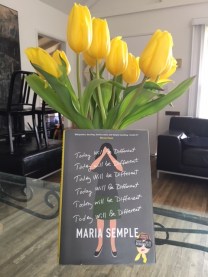
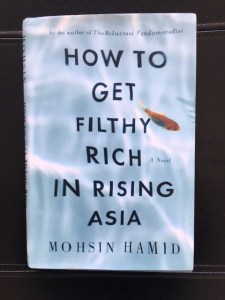 How to Get Filthy Rich in Rising Asia, a novel by Mohsin Hamid. Such a poignant, bittersweet, moving novel this is. It’s been kicking around on my bookshelves for a couple of years now, because even though I knew it was a novel, every time I looked at it I would tilt my head and think How to Get Filthy Rich in Rising Asia? Just doesn’t sound like a novel. And because I don’t care about getting filthy rich in rising Asia (or anywhere else for that matter), it stayed on the shelf. But once I finally cracked the cover and began reading, wow. Structured like the get rich quick self-help books that are apparently wildly popular in Asia, with each chapter heading a different aspect of how to get rich, the book charts the life of one unnamed man. We follow him from early childhood in rural Pakistan (I’m assuming, because the country, like the main character, is never named) to old age in a sprawling, tentacled, ever-growing city, every step of the way alighting, like a hummingbird, on the various aspects of his life and longings that never change. A delicate, painfully-wrought, beautiful book. I loved this novel and will now seek out Hamid’s other books. Highly recommend.
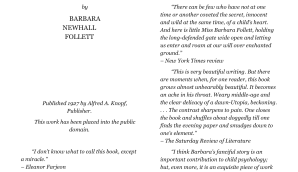 The House Without Windows: And Eepersip’s Life There, a novel by Barbara Newhall Follett. Reading this brief novel was an experience unlike any I’ve had before when reading. The author, who was born in 1914 and vanished at the age of thirty, was eight years old when she wrote the novel and twelve when it was published. After reading
  You know those maps where you fill in all the states you’ve been to? The only one missing from mine is Alaska (I don’t count the time that I landed at the Anchorage airport on my way to China). I’ve been to all the lower 48 states, most of them multiple times, because road trips are big in my life. The earth is a living being beneath the tires, rising and falling, sweeping west and shrinking east. Most of the time I’m solo, like last week, when I drove 2089 miles in three days. When I get tired, or when it gets dark, I tuck my old tiny car behind a semi for comfort. Truckers sometimes get a bad rap, and once in a while it’s justified, but for the most part they drive their trucks way more safely than most people drive their cars.
 I’ll rewrite this whole life and this time there’ll be so much love, / you won’t be able to see beyond it.
  Alison McGhee