Poem of the Week, by Naomi Shihab Nye
 People who have been reading the poem of the week on this blog for years now must think, seeing this week’s selection, Wow, does this woman love Naomi Shihab Nye. And they would be right. Sometimes, walking down the street, I recite lines from her poems, maybe because they’re beautiful, maybe because they make me feel less alone, maybe because they remind me, always, that kindness is all that matters. At a restaurant a couple of weeks ago, a friend said to me, “I read a poem today that I think you would love. It’s by a woman named Naomi something”–and I said, “Naomi Shihab Nye!” Once, a couple of years ago, I saw a tiny notice in the paper that she was giving a talk that very night at a school near me –she lives in Texas and this was in Minneapolis– so I zipped right over. The talk was in a high school classroom and I sat in a chair in the front row. And afterward I asked if she minded a photo. So that’s me, with Naomi my hero, and this concludes my Naomi Shihab Nye story in favor of her beautiful poem, of which I love this line most of all: Each carries a tender spot: Something our lives forgot to give us.
Jerusalem, by Naomi Shihab Nye
“Let’s be the same wound if we must bleed.
Let’s fight side by side, even if the enemy
is ourselves: I am yours, you are mine.”
—Tommy Olofsson, Sweden
I’m not interested in
who suffered the most.
I’m interested in
people getting over it.
Once when my father was a boy
a stone hit him on the head.
Hair would never grow there.
Our fingers found the tender spot
and its riddle: the boy who has fallen
stands up. A bucket of pears
in his mother’s doorway welcomes him home.
The pears are not crying.
Later his friend who threw the stone
says he was aiming at a bird.
And my father starts growing wings.
Each carries a tender spot:
something our lives forgot to give us.
A man builds a house and says,
“I am native now.”
A woman speaks to a tree in place
of her son. And olives come.
A child’s poem says,
“I don’t like wars,
they end up with monuments.”
He’s painting a bird with wings
wide enough to cover two roofs at once.
Why are we so monumentally slow?
Soldiers stalk a pharmacy:
big guns, little pills.
If you tilt your head just slightly
it’s ridiculous.
There’s a place in my brain
where hate won’t grow.
I touch its riddle: wind, and seeds.
Something pokes us as we sleep.
It’s late but everything comes next.
For more information on Naomi Shihab Nye, please click here.
 I wanted to write about why I love this poem so much, but it grabbed me by the throat and told me that it could speak for itself, thanks.
 A long, long time ago I read Innumeracy, a slender, astonishing book by the mathematician John Allen Paulos, in which he explains how the inability of most of us to deal rationally with enormous numbers results in confused personal decisions and public policy as well as susceptibility to pseudoscience of all kinds. In one chapter Paulos lays out the fact that, on average, every breath we take contains a minimum of three molecules of air breathed by every single person who ever lived and breathed on this planet. I think about this fact every single day. It has influenced every aspect of my life, not least of which is that in times of deep grief, it brings me comfort. Breathe in, Alison. Remember that you’re breathing in some of the same air that every single person you love, the ones who are living and the ones who are dead, have breathed. This lovely, elegiac poem by Tim Nolan, one of a series about his mother and her passing, brings me that same sense of loss and comfort.
 That photo over there to the right is the very long tail of a very large rat that ran over my bare feet as I stood at the stove cooking dinner. The story behind the tail is one of intrigue and horror – me sauteeing vegetables at the stove while chatting with The Painter who was seated behind me, me suddenly feeling a squirrel or a small cat run over my bare feet, me shrieking and whirling around to tell The Painter that a squirrel or a cat had run over my bare feet, The Painter trying desperately to contain his horror because he had witnessed exactly what ran over my bare feet and rats are not cats.
  I’m the mother of an immigrant and the aunt to immigrants. Family members and many of my dearest friends are gay. I am both a patron and former client of Planned Parenthood. I do not identify as Christian. These four facts alone make me –a white, middle-class born-and-bred citizen of this country– and my immediate and extended family current targets for persecution by my own government. Beyond that, many of my students, colleagues and friends are a) not white, b) Muslim, c) immigrants, d) people living with mental and physical disabilities. Being a patriotic American, which I most certainly am, means that my responsibility is to speak out against fascism. Being a progressive, which I also most certainly am, means keeping my focus on the bigger picture, which is the world as I know it to be, the one that Naomi Nye so beautifully brings to life in this poem.
 Hello, you’ve reached the Crisis Connection. This is Anna. Could you tell me your first name? I remember the sound of that woman’s voice. This was many many years ago. Someone close to me was in terrible shape, and nothing I did helped, and in panic and desperation I had called the hotline seeking guidance as to how to help. My name is Alison but that doesn’t matter it’s not me who needs help it’s my friend and I don’t know what to do and I began to describe the situation as she listened. And listened. Her calm and her focus, over more than a thousand miles of an invisible cell phone connection, was tangible. How are you feeling right now, Alison? Where are you, Alison? What’s your plan for the next few hours? Is there a way you can take care of yourself in this hard time? To this day I can hear her voice, so calm and warm in my ear. Saying my name. Listening. I remember looking up at the sky at one point. It was late at night, far from the city, and the stars were thick in the heavens. After a long time my voice was slow and tired, but I now had a little more energy to keep going. I will remember that conversation the rest of my life. The poem below made me think of Anna, and that long ago dark night. I wish there were some way to tell her how grateful I will always be to her.
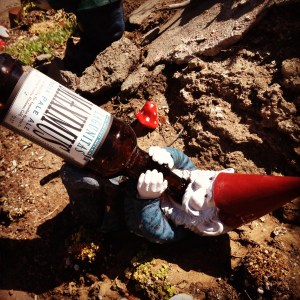 Quite a year we just had. A year that drove that poor little garden gnome in the photo on the right to drink, not to mention me with my cabinet full of gin. So many poems feel like possibilities to greet the new year, but this one by Langston Hughes feels the most possible. It’s strange, because if asked I would never list Langston Hughes on my Favorite Poet list, but lines from his poems come drifting through my mind almost every day. Like this one: Hold fast to dreams, for if dreams go, life is a barren field frozen with snow. And this one: They’ll see how beautiful I am and be ashamed– I, too, am America. And this one: I’ve known rivers: Ancient, dusky rivers. My soul has grown deep like the rivers. And most of all, I see that my own hands can make the world that’s in my mind. Goodbye, 2016. Here’s to the baby new year.
