Poem of the Week, by Adelia Prado
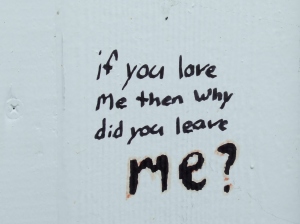 My daughter at eight: What would happen if you die? I tell her she would be very sad but everyone would take such good care of her, and she says No, they wouldn’t. Because I would be dead too, of sadness. My son at four shuffles out of the bedroom in his first pair of flip-flops, having put them on himself with the strap between his second and third toes. It’s fine, mama, don’t worry, they don’t hurt, I can walk. My grandmother, flustered and red-faced in the small kitchen where she’s trying to make dinner for me: Oh Alison, I’m just no use at all anymore. Me outwardly protesting but inwardly stricken by the knowledge that in that single instant, everything is now changed.
“Because living is just too much!” I always say when someone in an audience asks why I became a writer. “It’s all too hard! I’d lose my mind if I didn’t turn it into books!”
I laugh and they laugh, but do they know I’m not joking? Writing makes it possible for me to live in a world without my grandmother in it, a world where my heart beats outside my body in the form of my children, where every new day brings a thousand possibilities and a thousand losses. Writing is my way of cheating time.
The Mystical Rose, by Adelia Prado
The first time
I became conscious of form,
I said to my mother:
“Dona Armanda has a basket in her kitchen
where she keeps tomatoes and onions”
and began fretting that even lovely things
eventually spoil,
until one day I wrote:
“It was here in this room that my father died,
here that he wound the clock
and rested his elbows
on what he thought was the windowsill
but was the threshold of death.”
I understood that words grouped like that
made it possible to live without
the things they describe,
that my father was returning, indestructible.
It was as if someone had painted a picture
of Dona Armanda’s basket and said:
“Now you can eat the fruit.”
So, there is order in the world!
—where does it come from?
And why does order, which is joy itself,
and bathes in a different light
than the light of day,
make the soul sad?
We must protect the world from time’s corrosion,
cheat time itself.
And so I kept writing: “My father died in this room…
Night, you can come on down,
your blackness can’t erase this memory.”
That was my first poem.
For more information on Adelia Prado, please follow this link.
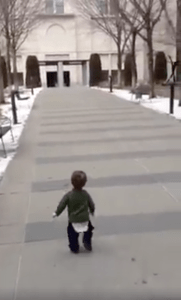 My five year old nephew is currently huddled behind closed doors inside his family’s new freestanding pantry, where he fits neatly into the bottom cupboard. I know this because my brother texts me ongoing updates as to this fixation with the pantry, along with the fact that my nephew just declared he’s no longer a ninja genius but a secret agent. (Didn’t surprise me at all. I never bought the ninja genius line.) My nephew cracks me up and breaks my heart the way all little kids, over and over, break my heart.
  In the lobby of the Minnesota Public Radio headquarters are three white egg-shaped chairs. Whenever I’m there I crawl into one of them, sit cross-legged, and close my eyes. Sitting in one is like wearing a warm sweatshirt with the hood pulled entirely over your head. My love for those chairs is inordinate. When I picture a safe place to comfort myself when sad or troubled, those egg-shaped chairs come to mind.
  A few years ago a lifelong minor heart glitch spiraled out of control. I didn’t tell anyone until a couple hours before the surgery to fix it, so as not to worry them, and I took a Lyft to the hospital. But just before the procedure, as the surgical team was pushing the gurney into the OR, I put my hand on the arm of the nearest blue-masked nurse. Please take good care of me, I said. I don’t want to die.
 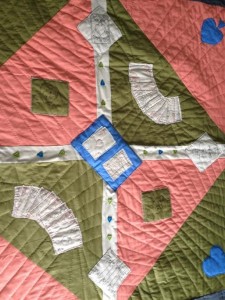 The day after I moved to Minneapolis, I bought a sewing machine. This was in the days of newspaper ads, and I found a used one for $60 and insisted my then-boyfriend and I track it down that very day. That ancient, impossibly heavy machine is what I’ve used to make all the quilts I’ve ever made, sewing together blocks I hand-stitch piecemeal. Story quilts, every one of them, made not according to a pattern but out of my head and heart.
  Someone close to me sent me a booklet a while ago, photos and written memories of her life. It’s a fascinating glimpse into a childhood spent solo with older parents in upper Manhattan, a gentle childhood filled not with money, of which there was very little, but with family card games, shared meals, trips to museums and playgrounds, school days and summer camp upstate. Black and white photos show a small, smiling girl in the embrace of a mother and father who clearly adored her. Here they are leaning against a railing by Rockaway Beach. Here they are on the stoop of an apartment building. Here’s the little girl on the first day of school.
 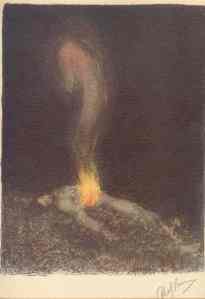 This body of mine. These bodies of ours. As a girl I often witnessed both my friends and older women close to me disparage their bodies. One of my grandmothers had been a model in her youth, and she despised photos of her aged self so much that I couldn’t let them near her – she would snatch them and tear them up. My other grandmother openly hated her heavy legs, had hated them her whole life long. In response to this self-hatred, which was so painful to see, I early on vowed never to say one bad word about my body to anyone, especially my daughters. This is a vow I kept. But still. This body of mine. This body that will do everything in its power to keep me alive until my last breath. Oh my body, I have not always loved you the way you deserve to be loved. Fearfully and wonderfully made body, I have not always been good to you. When I heard this poem, I wept.
 My three children and I were in upstate New York. This was a long time ago, and we were making our annual summer trek around New England to visit family and friends. We had just finished touring the Utica Club Brewery, one of my favorite childhood destinations, a tour that ends with a complimentary beer or root beer in a Victorian saloon. We were all tired. I was chatting with my parents while my children wandered around, trying out various red velvet chairs.
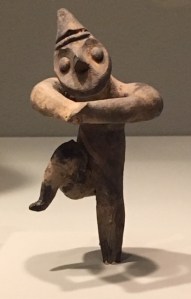 We went to a museum the other day with no specific purpose in mind and found ourselves in the Chinese art galleries. Jade. Porcelain. Bronze. Ornate vessels for cooking, for ceremonies, for burial. An arched gateway which used to lead to a family’s compound. A room with a low table, ink, brushes, where someone used to practice calligraphy. We peered in through the interwoven black wooden squares of traditional Chinese architecture. At one point a tiny capering man entranced me and I wanted to reach through the glass, and the thousands of years between us, and take him home.
  When my dog Petey was still alive I used to bring him to the Blessing of the Animals at the Basilica. One year, a woman with a small clear plastic box sat at the end of the pew next to Petey and me. She was anxious, agitated, and when the priests began walking up and down the aisle swinging incense and shaking holy water on the animals, she held the box up in the air.
 Alison McGhee