Poem of the Week, by Carl Dennis
 My friend Todd is an art museum guard by day and an artist by day and night. He composes and records original songs, dives deep into pop music he orders from Japan, watches and re-watches Miyazaki films, reads and re-reads favorite novels and finds something new in them each time. Whatever draws him, he will follow: He’s learning Japanese, has become a sushi expert, and gradually, over the years, has compiled a collection of hilarious and somehow profound observations on life as a museum guard.
Todd is an artist, and so am I, and the ways we go about it are so different. I’ve never pulled an all-nighter in my life. I rarely re-read books or re-watch movies. When an idea grabs me, the intensity of the grabbing almost scares me. Instead of diving in full throttle the way Todd would do, I’m more likely to hold the idea in the back of my mind and channel its power into small daily tasks on my scrap paper to-do list.
There’s no one way to be an artist in the world, no one way to make your art. Books result from my process just as music results from Todd’s. But I look at him and the way he lives his life and it’s like I’m looking at a planet similar to the one I live on, close by but unavailable to me. There are so many ways to read the beautiful poem below, most of them related to history and the ways it repeats. But when I read it, it was the difference between the poet Carl Dennis and his brother that struck me, because it’s the difference between Todd and me, and it almost made me cry.
War and Peace, by Carl Dennis
In 1949, when I was ten,
a year after the airlift for beleaguered Berlin
had foiled Stalin’s attempt to starve it
and the Marshall Plan was offering battered Europe
a hand to get on its feet, my brother Robert,
six years older, inched his way, in the room we shared,
through the thousand pages of War and Peace
while I lay sleeping. It took him four months,
an hour a night, a project that seemed to me
even more peculiar than his listening after school
to symphonies and quartets. Yes, our mother
had often mentioned the book as her father’s favorite,
the one he’d first read, in his village near Uman,
in Tolstoy’s Russian, though he’d learned his Russian
after Yiddish and Ukrainian. But that didn’t explain
my brother’s pressing on after the first few pages.
Four months just to learn about the families
he tried to describe to me, the Bolkonskis
and Rostovs and Bezukhovs, or about the French
on the march near Moscow, and Tsar Alexander.
it was all so far from the suburb of St. Louis
where we were living peaceably with our parents
most of the time, in a quiet neighborhood.
Of course, by the time my brother read Tolstoy
he’d listened to music composed in Madrid and Naples,
in Leipzig, Vienna, and St. Petersburg.
On a Saturday close to his thirteenth birthday,
before he was driven off to his Bar Mitzvah,
he lost himself in the Rite of Spring.
If I say I followed my brother’s lead when sixteen
by reading, all summer long, his dog-eared copy
of War and Peace—the Maude translation—
I don’t equate my motive for sticking with it—
wanting to be like him, not left behind—
with his simple wish to open his life
to the wonders available. When I need to list
the wonders I’ve seen, I begin by returning
to the year I was ten, 1949,
the year that NATO began its efforts
to defend the free world from the world of darkness,
when my brother crossed the border each night
as if darkness were not an obstacle,
as if the iron curtain were a curtain of gauze,
no harder to lift than to turn a page.
For more information on Carl Dennis, please click here.
 Q: Does writing about hard things ever make you agitated and upset, so that you have to walk away from the writing and regain your equilibrium?
 Long ago I left behind the simple prayers of my childhood, the ones spoken in unison with others in church, or around the table at a special meal when everyone named something they were thankful for. I’ve never known what God is, and I don’t know what God is to others. If forced to come up with a definition, my definition of God would be something like the feeling of my children on either side of me in bed as I read them to sleep when they were little. God would be the high school students I used to teach, ringed on the floor in our classroom on the giant pillows I’d made, still and silent and sometimes falling asleep on Friday afternoons as I read them stories. God would be the idea and the feeling of peace, of a place where nothing bad can happen, where only love and comfort dwell. God would be the poems that swell my heart open in a way that almost hurts, like this one below.
 When my children were little one of our favorite books was The Philharmonic Gets Dressed. Such a simple story. In apartments all over New York City, orchestra musicians are dressing for the evening performance. Everyone wears black. They muscle their instruments, large and small, into cabs and the subway, and they head to work. My children and I read this book over and over, usually at bedtime, where it soothed their way into sleep. It’s long gone from my shelves, but I still think about it.
  The men I love most get it, with “it” being the malevolence of treating women as if we’re not equal. At one point the other night, when I could suddenly barely talk because of the rage that filled me, a male friend said about sexism, It’s like air, invisible and everywhere. And you breathe it in your whole life, but when the switch flips and you suddenly realize how deep it goes and how awful it is, it’s fucking overwhelming.
 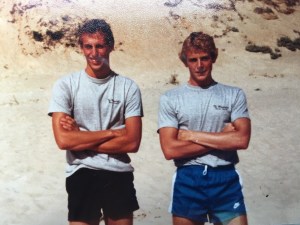 It was the summer of a long pink skirt, ice cream cones, cartwheels on the beach, waitress shifts followed by late nights at the bar followed by breakfast at the diner, a little rented room and a refrigerator shared with twelve other girls. This was Cape Cod, a long time ago, and my buddies Doc and RJ and Stu would descend on weekends. After we walked back from the bar I’d hold the back door open for them and they’d sneak upstairs to my room (guests weren’t allowed) to sleep on the floor around my bed. One weekend they brought a new boy with them, someone I’d never met, and I instantly liked him. That night we all decided to sleep on the beach instead of sneaking into my room. We spread quilts and looked up at the stars, waves lapping at the shore.
  Every summer in my teens I canoed with friends through the Rideau region of lakes and canals in Ontario. We camped every night, swam, cooked, laughed, told ghost stories and played games. One annual camping spot was on a lake with an enormous rope swing tied to an overhanging tree. You grabbed the rope, stepped back as far as you could, swung out over the water and then plummeted. The rope swing took nerve. The drop was steep and the water cold, and once you committed, you had to leap – if you swung back you’d crash against the tree and the rocky bluff. Leaping from it was wild and exhilarating. Once, as I swung out, I looked down to see a long water snake swirling in the water directly below me. My fear of snakes is lifelong and deep-seated, and I was horrified, but there was no going back. I plummeted with my eyes closed and struck out for shore the second I surfaced.
 A few years ago my brother sent me a photo of my nephew, with the caption Getting his mind blown at Nickelodeon Universe. Nickelodeon Universe is a crowded and noisy place, but in the photo, my tiny nephew stands alone in a huge open space, his head craned up, staring at something I can’t see. The photo conveys profound stillness and concentration. Sometimes it pops up on my screensaver and I wonder again what my nephew was staring at, what was going through his mind.
  Once, a long time ago, someone close to me handed me a memo and asked me to read it. It was a work memo that summarized some unfair working conditions. I didn’t know who had written it, but my first comment was “Wow. Whoever wrote this can’t spell worth a damn and doesn’t know how to use punctuation, either.” The person who had handed me the memo didn’t hear me say this, for which I was instantly grateful, because it turned out that they had written it. This was a person I loved with all my heart. The shame I felt in that moment is something that will be with me forever.
  My youngest didn’t walk until she was 22 months old. Instinct told me she was fine so I didn’t worry about this, but I observed her with interest. One day, when I was in the kitchen and she was sitting in a patch of sun on the living room floor, her back to me, I watched in wonder as she rose –no hands, no support, no nothing– to a full stand and began to walk. I had never seen a child go from crawling to perfect walking in an instant like that. She never went back to crawling.
