Poem of the Week, by Bradley Trumpfheller

​Minnesotans! I’m offering three free workshops this spring on the transformation of trauma. Click here for more information and to register. All are welcome, no writing experience necessary. (Non-Minnesotans, note that I will be adding these to my workshop offerings in the future, and they will always be free.)

When you fold laundry you see the insides of clothes and sheets and towels –their raggedy seams and straining buttonholes and raveling threads–before you turn them right side out so they’re presentable for public viewing.

I’m like that laundry. No matter what’s unraveling inside, I know how to look smooth and together. Maybe most of us are like this.

This poem makes me think about the invisible seams in everyone. From heartbreaks mended (you’re never the same), memories beautiful or awful (you remember them all), dreams you dreamed that came true (or didn’t), a place or a person you return to in your mind when you need to be soothed.

Loom, by Bradley Trumpfheller

My mother says when she is anxious she finds a seam, 
finds stitches on her clothes, on furniture she’s near, always 
a verge has that feel, birch joints, wrinkles. It’s a relief
to think with the hands. Not with what years do, 
not with rings or someone else’s sadness. With the repair 
in a sheet her sister tore, breeze-fretted in the yard. 
Finds exactly where the hickory trees start themselves
against the yard. And shows me on the photograph 
which is only one of several, where though again 
they did not touch each other, standing on some shore, 
her mothers’ shadows touch each other. 
She shows it to me now to soothe me. As if soon 
it will be that blue in the air. Soon is what 
she thinks with. What she runs 
the edge of her thumb, her index finger over. 

Click here for more information about Bradley Trumpfheller. Today’s poem was published in 2024 by the Academy of American Poets. 

alisonmcghee.com
My podcast: Words by Winter

Poem of the Week, by Anna Belle Kaufman

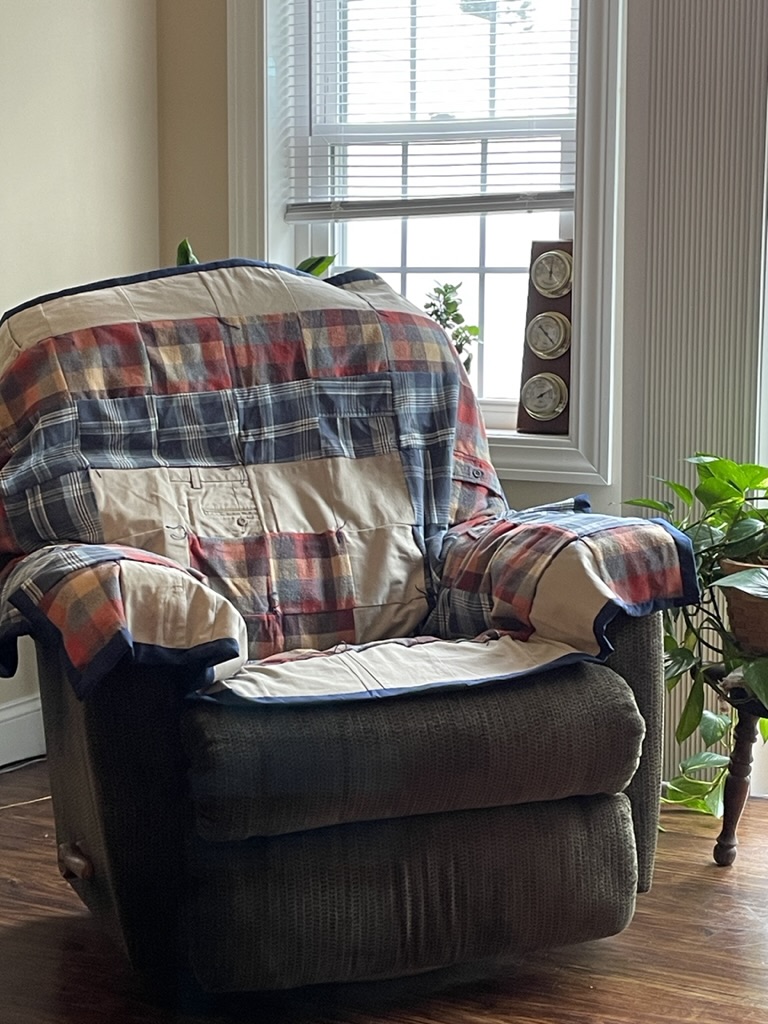
My father, who died two years ago today, was a giant man. Some of his clothes hang in my closet: his old army jacket, his Dairylea windbreaker, one of his Yankees baseball caps.

After he died I turned two of his other shirts and a pair of his worn pants into a simple patchwork quilt for my mother. It was hard to cut up his clothes. Wait, this is his favorite shirt, he’s going to need it, even though he wasn’t.

I still need him though. His enormous presence –that giant laugh, that hurricane hug, his absolute solidity–was grounding in a way I didn’t understand until he was gone.

Cold Solace, by Anna Belle Kaufman

When my mother died,
one of her honey cakes remained in the freezer.
I couldn’t bear to see it vanish,
so it waited, pardoned,
in its ice cave behind the metal trays
for two more years.

On my forty-first birthday
I chipped it out,
a rectangular resurrection,
hefted the dead weight in my palm.

Before it thawed,
I sawed, with serrated knife,
the thinnest of slices —
Jewish Eucharist.

The amber squares
with their translucent panes of walnuts
tasted — even toasted — of freezer,
of frost,
a raisined delicacy delivered up
from a deli in the underworld.

I yearned to recall life, not death —
the still body in her pink nightgown on the bed,
how I lay in the shallow cradle of the scattered sheets
after they took it away,
inhaling her scent one last time.

I close my eyes, savor a wafer of
sacred cake on my tongue and
try to taste my mother, to discern
the message she baked in these loaves
when she was too ill to eat them:

I love you.
It will end.
Leave something of sweetness
and substance
in the mouth of the world.

Click here for more information about poet, artist, and writer Anna Belle Kaufman. Today’s poem first appeared in The Sun magazine in 2010. 

 alisonmcghee.com
My podcast: Words by Winter

Poem of the Week, by Robert W. King

My house is more than a century old and filled with handcrafted woodwork and leaded glass bookcases and windows so beautiful that some days I stop just to admire them. I wonder about the craftspeople who made them, and how many hours and weeks and months and years of painstaking work it took them, and for only a single purpose: to make something beautiful and durable that would last for hundreds of years, far beyond their own lifetimes. Something for others to depend on. Something to be nurtured and cared for.

The people who made my house are the opposite of people who move fast and break things –things like the idea of democracy–that others, for centuries, have loved and cherished and protected and given their lives for.

Work, by Robert W. King

The workmen over and above the fence
fit bricks, lift mortar, slap it accurately
in place. Guilty by sitting idle, I
imagine they envy my luxury
of doing nothing until I remember
the days I had my hands full of shovel,
the dragline plowing the ditch of a sewer
through a future subdivision and how
I pitied those who walked by our work
with no apparent occupation,
denied the pleasure of making something,
piece by piece—even if it would soon
be buried—they would depend upon.

Click here for more information about poet Robert W. King. This poem was first published in 2008, in the online journal Rattle #29
alisonmcghee.com
My podcast: Words by Winter

Poem of the Week, by Danusha Laméris

​Where are they now, those fictional people I spun up out of thin air and set free? I miss them: Clara and Mallie and William T., The Bartender and Tamar and Crystal. I miss Will, lonely boy wandering the streets of LA, leaving kindness in his wake.

My people live in an invisible world parallel to ours. Sometimes I’m able to coax them through the scrim. Sometimes they fill me in on their lives. Sometimes I wish I could change things for them, but they are their own selves now, and they get to be who they are. I wish I could have them all over to dinner, make their favorite foods, tell them how much I love them.

Fictional Characters, by Danusha Laméris

Do they ever want to escape?
Climb out of the white pages
and enter our world?

Holden Caulfield slipping in the movie theater
to catch the two o’clock
Anna Karenina sitting in a diner,
reading the paper as the waitress
serves up a cheeseburger.

Even Hector, on break from the Iliad,
takes a stroll through the park,
admires the tulips.

Maybe they grew tired
of the author’s mind,
all its twists and turns.

Or were finally weary
of stumbling around Pamplona,
a bottle in each fist,
eating lotuses on the banks of the Nile.

For others, it was just too hot
in the small California town
where they’d been written into
a lifetime of plowing fields.

Whatever the reason,
here they are, roaming the city streets
rain falling on their phantasmal shoulders.

Wouldn’t you, if you could?
Step out of your own story,
to lean against a doorway
of the Five & Dime, sipping your coffee,

your life, somewhere far behind you,
all its heat and toil nothing but a tale
resting in the hands of a stranger,
the sidewalk ahead wet and glistening.

Click here for more information about the wondrous poet Danusha Laméris. Today’s poem is from from The Moons of August, published in 2014 by Autumn House Press.
alisonmcghee.com
My podcast: Words by Winter

Poem of the Week, by June Beisch

When your world is being swamped with cruelty and greed, when you’re exhausted by the hatred and pain others seem determined to unleash, what do you do? How do you resist? One way is to write fiction. Not as an escape, but a conjuring.

Doesn’t matter if you’re not a writer, write the world you want to live in. Write the world you do live in but make it better, full of people who see others as they truly are – fellow humans with dreams, hopes, sorrows, loves. Don’t give away your power. Understand that conjuring begins with knowing that things that seem impossible right now aren’t. Think of those bulbs that flower under snow, and imagine the world you want to live in, and then stubbornly live in it as if it already exists. Will a better world into being until it blooms.

Henry James, by June Beisch

“Poor Mr. James,” Virginia Woolf once said:
“He never quite met the right people.”
Poor James. He never quite met the
children of light and so he had to invent them.
Then, when people said: No one is like that.
Your books are not reality, he replied:

So much the worse for reality.

He described himself as “slow to conclude,
orotund, a slow-moving creature, circling his rooms
slowly masticating his food.”

Once, when a nephew asked his advice
on how to live, he searched his mind.
Number One, be kind, he said.
Number Two, be kind and
Number Three, be kind.

Click here for more information on June Beisch. Today’s poem was first published in 2004 by Cape Cod Literary Press in Beisch’s collection Fatherless Woman
alisonmcghee.com
Words by Winter: my podcast

Poem of the Week, by James Baldwin

It’s hard to live in the world. This line has spoken itself in my head throughout my life, especially right now. Don’t let them get to you, Allie. That little mantra got me through some hard times when I was a child, and while it’s a flawed philosophy it’s still a helpful one when it comes to bullies, because bullies love reactions.

Who do you turn to in hard times? That question was asked a few weeks ago in my church, where the only creed is love, compassion, kindness, inclusion, and social justice. Those who have gone before me, was my instant answer. Those who have done the hard things. Those who have already stepped through those distant doors and did so with courage and heart. Like James Baldwin. What seems hopeless isn’t, because the earth is always shifting, the light is always changing, and nothing is fixed.

For Nothing Is Fixed, by James Baldwin

For nothing is fixed,
forever, forever, forever,
it is not fixed;
the earth is always shifting,
the light is always changing,
the sea does not cease to grind down rock.
Generations do not cease to be born,
and we are responsible to them
because we are the only witnesses they have.
The sea rises, the light fails,
lovers cling to each other,
and children cling to us.
The moment we cease to hold each other,
the moment we break faith with one another,
the sea engulfs us and the light goes out. 

Click here for more information about poet, essayist, short story writer, critic, novelist and iconic American James Baldwin.  

alisonmcghee.com
My podcast: Words by Winter
Poem of the Week, by Naomi Shihab Nye

​More than half my country’s wealth is hoarded by a few hundred billionaires. A few of them have bought their way into power and have said they’d like to take away the bare-bones security our government guarantees to ordinary hardworking people. They call it ‘disruption,’ but it’s chaos and destruction and pain. It doesn’t have to be this way. We don’t have to let it be this way.

When they were tiny and had a bad dream I held my children and sang to them and soothed them so they would feel loved and secure and safe. Isn’t that what we were born to do? Don’t we reach out instinctively to help those who are hurting? We’re not going to be able to live in this world if we can’t take care of each other.

Shoulders, by Naomi Shihab Nye

A man crosses the street in rain,
stepping gently, looking two times north and south,
because his son is asleep on his shoulder.

No car must splash him.
No car drive too near to his shadow.

This man carries the world’s most sensitive cargo
but he’s not marked.
Nowhere does his jacket say FRAGILE,
HANDLE WITH CARE.

His ear fills up with breathing.
He hears the hum of a boy’s dream
deep inside him.

We’re not going to be able
to live in this world
if we’re not willing to do what he’s doing
with one another.

The road will only be wide.
The rain will never stop falling.

 Click here for more information about the iconic Naomi Shihab Nye. Today’s poem is from her collection Red Suitcase, published in 1994 by BOA Editions. 

alisonmcghee.com
My poetry + conversations podcast: Words by Winter

Poem of the Week, by Kasey Jueds

When the world feels too much, too scary, too overwhelming, too helpless, my dog brings me back to his world, the world of wild things who do not tax their lives with forethought of grief. The world of warm fur, small thudding heart, searching eyes I feel gazing at me until I lift my eyes to his and he thuds his tail rapidly, over and over again, shifting on his front paws and willing me to motion for him to jump up onto my lap to push his cold nose against me and butt me with his head harder than you think he’d be capable of until I pet him. Over and over and over he wants to be petted, and over and over and over I pet him until he’s ready to get on with his day, his stores of affection and attention, and mine, having been renewed.

Claim, by Kasey Jueds

Once during that year
when all I wanted
was to be anything other
than what I was, the
dog took my wrist
in her jaws. Not to hurt
or startle, but the way
a wolf might, closing her mouth
over the leg of another
from her pack. Claiming me
like anything else: the round luck
of her supper dish or the bliss
of rabbits, their infinite
grassy cities. Her lips
and teeth circled
and pressed, tireless
pressure of the world
that pushes against you
to see if you’re there,
and I could feel myself
inside myself again, muscle
to bone to the slippery
core where I knew
next to nothing
about love. She wrapped
my arm as a woman might wrap
her hand through the loop
of a leash—as if she
were the one holding me
at the edge of a busy street,
instructing me to stay.

Click here for more information about Kasey Jueds (pronounced Judds). Today’s poem is from her book Keeper​, published in 2013 by the University of Pittsburgh Press.
alisonmcghee.com
My poetry podcast: Words by Winter

Andes Mint #16: Sleepwalker

Sleepwalker

A child enters your room sometime after midnight.
You know it’s your son by the silhouette of his cheek,
his spiky, sleep-tossed hair.
You say his name. He doesn’t answer.
You call his name again and
again, he does not answer.
It is your boy, isn’t it?
Or have you transformed a masked stranger into a
second-grader in blue plaid flannel pajamas?

A whisper of a laugh escapes him and
it does not sound like the laughter of the boy you know.
Someone else has come upon you,
insinuated himself into your family,
eased in on a black night.
Fear slips cold gloves around your lungs and
you can’t breathe.
Motionless on the threshold, the
stranger stares at you in darkness.

Next morning at breakfast the
eight-year-old is back. His spoon lifts
in and out of a cereal bowl, flashing silver.
He sees you gazing at him in the morning sun.
He smiles his gap-toothed smile.
After a minute you smile back at him.
You don’t want to think about
what you witnessed there, in the dark:
the man inside the boy, waiting to get out.

Poem of the Week, by Wendell Berry

There is No Going Back
– Wendell Berry

No, no, there is no going back.
Less and less you are
that possibility you were.
More and more you have become
those lives and deaths
that have belonged to you.
You have become a sort of grave
containing much that was
and is no more in time, beloved
then, now, and always.
And so you have become a sort of tree
standing over a grave.
Now more than ever you can be
generous toward each day
that comes, young, to disappear
forever, and yet remain
unaging in the mind.
Every day you have less reason
not to give yourself away.

For more information on Wendell Berry, please click here: http://www.wendellberrybooks.com/

Facebook: http://www.facebook.com/home.php?#!/pages/Alison-McGhee/119862491361265?ref=ts