Poem of the Week, by Joyce Sutphen

IMG_4786Last month I was in the foothills of the Adirondacks, poking around my parents’ giant vegetable garden (the thing could supply a small farmer’s market) talking tomatoes and beans with my father. Every summer and fall growing up we had an assembly line in the kitchen, washing and chopping and blanching and bagging zucchini and corn and beans and all kinds of squash for the freezer. Like most of the men I grew up around, my father always wears a hat (cap for everyday, hat-hat for solemn occasions), goes to the diner every morning, knows how to drive a tractor and change its oil, and has spent his life working hard and helping his neighbors and voting in elections. Joyce Sutphen’s elegant, fierce poems bring me back to my childhood. Some of them, like this one below, bring me to tears.

Our Fathers
     – Joyce Sutphen

Our fathers, who lived all their lives on earth—
are going now. They have given us all
we need, and when we asked, they gave us more.

Their names are beautiful to us, holy
as the names of stars, as familiar
as the roads we traveled, falling asleep

on the way from one farm to another.
Their kingdoms were small; they were never
interested in more than one homestead,

and as for evil: although they could not
keep it from us, they tried to keep us from
temptation, though we were like all children

and wanted our own power and glory,
world without end, forever and amen.


For more information on Joyce Sutphen, please click here.

Website
Blog
Facebook page
@alisonmcghee

Poem of the Week, by Jim Harrison

cropped-cropped-cropped-panther-mountain-30-september-20131.jpg

Larger than life wilderness hunter fisher beautiful women drop at my feet gunslinger writing got old for me a long time ago. When I come across it I think, Oh come on. Tell me what’s really going on in there, behind the bluster and the swagger and the macho. Tell me how you feel about your child, or what you think about when you think about leaving this world. Which is why I so love this poem, by the larger than life Mr. Harrison, who died this past March.

Debtors
     – Jim Harrison

They used to say we’re living on borrowed
time but even when young I wondered
who loaned it to us? In 1948 one grandpa
died stretched tight in a misty oxygen tent,
his four sons gathered, his papery hand
grasping mine. Only a week before, we were fishing.
Now the four sons have all run out of borrowed time
while I’m alive wondering whom I owe
for this indisputable gift of existence.
Of course time is running out.
It always has been a creek heading east, the freight
of water with its surprising heaviness
following the slant of the land, its destiny.
What is lovelier than a creek or riverine thicket?
Say it is an unknown benefactor who gave us
birds and Mozart, the mystery of trees and water
and all living things borrowing time.
Would I still love the creek if I lasted forever?


For more information on Jim Harrison, please click here.

Poem of the Week, by Warsan Shire

Yesterday a friend posted a plea to the dear people of earth, to stop, stop stop stop, please let’s just have one week that’s horror-free. Yes please. This tiny brain of mine wasn’t built to withstand the kind of information that comes at it day in and day out, every minute of every hour. Hell, my brain wouldn’t be able to handle constant good news, let alone the kind of news that these past few weeks have been all about. Sometimes you just keep waking up, all night long, thinking what can I do, what can I do, how can I make it better, how can I make it better, while images from the day’s onslaught scroll through your mind like videos. Breathe in, breathe out, focus on the breath, do what you can, do what you can, do what you can. Sometimes all you can do, before you haul yourself up and get back to trying, is seek out a poem that expresses exactly the way you feel in this moment. Like this poem below.


IMG_4760

what they did yesterday afternoon
     – Warsan Shire

they set my aunts house on fire
i cried the way women on tv do
folding at the middle
like a five pound note.
i called the boy who used to love me
tried to ‘okay’ my voice
i said hello
he said warsan, what’s wrong, what’s happened?
i’ve been praying,
and these are what my prayers look like;
dear god
i come from two countries
one is thirsty
the other is on fire
both need water.
later that night
i held an atlas in my lap
ran my fingers across the whole world
and whispered
where does it hurt?
it answered
everywhere
everywhere
everywhere.


For more information on Somali-born Warsan Shire (whose poetry Beyonce set to music and movement in “Lemonade”), please click here.

Poem of the Week, by Langston Hughes

IMG_4736I’ve sat in silent, exhausted rage around dinner tables listening to men and women argue about rape and which factors that lead up to it are under a woman’s control. Sometimes I leave the room and go into the kitchen to bang my head against a hot stove, because that feels better than listening to good men, many of whom I like and respect, explain with care and patience how women shouldn’t get so drunk, especially late at night, how they shouldn’t walk alone, shouldn’t wear certain outfits, that it just is not safe, how they wish so much the world wasn’t like that for women, but it is. What a revelation, I think, thanks for solving that whole rape thing.
We have a rape problem because men rape women. That’s where the conversation begins. How do you change a culture in which, at such a deep level that it’s nearly invisible, there is a belief that women are prey + men can’t control their sex drive = rape? You start by pointing it out. By talking. And with recognizing that men have to change that culture.

That right there is as close as I can come to even beginning to imagine what it’s like to be black in my country. And the way to start changing a culture in which racism is so systemic that it’s barely noticeable to white people is for white people to point it out to each other, to have those hard conversations. It is not the responsibility of black people. This is on white people.

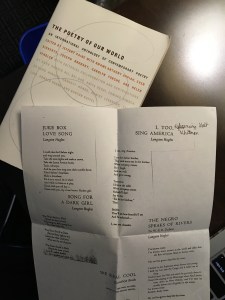
Yesterday I walked past a little free library. The first book I saw in it was The Poetry of Our World, which I took with me. In it, as a bookmark, was a quarter-folded sheet of paper with poems by Langston Hughes and Gwendolyn Brooks. If I were a superstitious person who looked to the universe for signs, I would have taken that as a sign that one of those poems should be the poem of the week. I’m not that kind of person, but Mr. Hughes, I see how beautiful you are, and I am ashamed.

I, too, sing America
     – Langston Hughes

I am the darker brother.
They send me to eat in the kitchen
when company comes,
but I laugh,
and eat well,
and grow strong.

Tomorrow,
I’ll be at the table
when company comes.
Nobody’ll dare
say to me,
“Eat in the kitchen,”
then.

Besides, they’ll see how beautiful
I am
and be ashamed–

I, too, am America.


For more information on Langston Hughes, please click here.

Poem of the Week, by Jim Daniels


IMG_4539

A long time ago I decided not to grade my students on their creative writing, even though creative writing is what I teach. Grading someone on their talent usually means they’ll write what they think they they’re good at, smart at. Push out those boundaries, I tell them, try something new, something you’ve never tried before. Who knows what you might come up with? What they come up with is sometimes astonishing, and when they surprise themselves with it the whole room fills with light and energy and power. Smartness and talent are cool to witness and to experience, but beyond that, who cares? So many other things matter so much more. Like kindness.

Dim
     – Jim Daniels

Today my son realized someone’s smarter
than him. Not me or his mom —
he still thinks we know everything —
one of the other kids, Nathan. Making fun
of him at the computer terminal
for screwing up at the math game.
Other kids laughing at him. Second grade.
I’m never gonna be as smart as him,
he says.
I’m never gonna be as smart
as half my students if we’re talking
IQs. He doesn’t want me to explain.
He wants me to acknowledge
that he’s dumb. He’s lying in bed
and taking his glasses off and on,
trying to get them perfectly clean
for the morning. I’m looking around
his dark room for a joke or some
decent words to lay on him. His eyes
are glassy with almost-tears. Second grade.
The world wants to call on him.
I take his hand in mine.


For more information on Jim Daniels, please click here.

Website
Blog
Facebook page
@alisonmcghee

Poem of the Week, by Robert Hayden

My father and I were in the car last month, driving back from the diner where we go early each morning I’m home visiting my parents. (Say the word “home” to yourself – what’s the image that comes instantly into your mind?) I asked him if he thought tIMG_3873here was anything beyond this world, and that my grandmother –his mother– had told me near the end of her life that she believed in a heaven where my grandfather, and her parents, and her sister and her friends would all be waiting for her when she got there. My father laughed and said he didn’t know about that, but that he did believe there was some kind of force in the universe, beyond his power to grasp. When I was a child my father was a force in my universe. He was a giant man with giant physical strength, the kind of man who would pour Clorox on a bleeding wound to disinfect it and avoid a doctor visit. This poem, by Robert Hayden, always comes to mind on Father’s Day. I first read it as a child and didn’t understand it. But I do now.

Those Winter Sundays 
     – Robert Hayden
Sundays too my father got up early
and put his clothes on in the blueblack cold,
then with cracked hands that ached
from labor in the weekday weather made
banked fires blaze. No one ever thanked him.
I’d wake and hear the cold splintering, breaking.
When the rooms were warm, he’d call,
and slowly I would rise and dress,
fearing the chronic angers of that house,
Speaking indifferently to him,
who had driven out the cold
and polished my good shoes as well.
What did I know, what did I know
of love’s austere and lonely offices?
For more information on Robert Hayden, please click here.


Poem of the Week, by Billy Collins

Istanbul, Turkish coffeeWhen it comes time to leave this world? That one perfect cup of coffee in the morning. The snap of the cards being shuffled for another game of rummy late at night at a bar. The red shirt I always wore on Saturday nights at the Alibi. The look on my toddler’s face that day he bent over laughing at the ferns unfurling in the back yard because to him they looked like dragons. The scarred brown heft of the chunk of wood I bought at a garage sale and use as a cutting board. These are the things that come to mind, when I think about what I’ll most miss.

Why are so many poets afraid to write about ordinariness? Stitch that abstraction back down to earth, I sometimes tell my students. Give us a shoelace or a candy wrapper or a torn birthday card to hang our hearts on.

Poem of the Week, by one of my favorite poets, a man who has never been afraid to write about the enchantment of ordinary things.

Aimless Love
     – Billy Collins

This morning as I walked along the lakeshore,
I fell in love with a wren
and later in the day with a mouse
the cat had dropped under the dining room table.
In the shadows of an autumn evening,
I fell for a seamstress
still at her machine in the tailor’s window,
and later for a bowl of broth,
steam rising like smoke from a naval battle.
This is the best kind of love, I thought,
without recompense, without gifts,
or unkind words, without suspicion,
or silence on the telephone.
The love of the chestnut,
the jazz cap and one hand on the wheel.
No lust, no slam of the door –
the love of the miniature orange tree,
the clean white shirt, the hot evening shower,
the highway that cuts across Florida.
No waiting, no huffiness, or rancor –
just a twinge every now and then
for the wren who had built her nest
on a low branch overhanging the water
and for the dead mouse,
still dressed in its light brown suit.
But my heart is always propped up
in a field on its tripod,
ready for the next arrow.
After I carried the mouse by the tail
to a pile of leaves in the woods,
I found myself standing at the bathroom sink
gazing down affectionately at the soap,
so patient and soluble,
so at home in its pale green soap dish.
I could feel myself falling again
as I felt its turning in my wet hands
and caught the scent of lavender and stone.


For more information about Billy Collins, please click here.


Poem of the Week, by Kenneth Rexroth

12992796_10153436069706921_222675689_n-2“Live every day like it’s your last because someday you’re going to be right.”

“I am America. I am the part you won’t recognize. But get used to me. Black, confident, cocky, my name not yours. My religion, not yours; my goals, my own; get used to me.”

“The fight is won or lost far away from witnesses – behind the lines, in the gym, and out there on the road, long before I dance under those lights.”

“Man, I ain’t got no quarrel with them Viet Cong. No Vietcong ever called me nigger.”

Last night I woke up in the middle of the night to the news that Muhammad Ali had died. He was a hero to me, as he was to so many others. Not because he was a boxer (I’m not a fan of boxing; Ali suffered from Parkinson’s for over thirty years) but because he was only and ever himself; he stood up for what he believed in and he never backed down. Ali was tough as hell, and so is this poem.

The Bad Old Days
     – Kenneth Rexroth

The summer of nineteen eighteen
I read The Jungle and The
Research Magnificent. That fall
my father died and my aunt
took me to Chicago to live.
The first thing I did was to take
a streetcar to the stockyards.
In the winter afternoon,
gritty and fetid, I walked
through the filthy snow, through the
squalid streets, looking shyly
into the people’s faces,
those who were home in the daytime.
Debauched and exhausted faces,
starved and looted brains, faces
like the faces in the senile
and insane wards of charity
hospitals. Predatory
faces of little children.
Then as the soiled twilight darkened,
under the green gas lamps, and the
sputtering purple arc lamps,
the faces of the men coming
home from work, some still alive with
the last pulse of hope or courage,
some sly and bitter, some smart and
silly, most of them already
broken and empty, no life,
only blinding tiredness, worse
than any tired animal.
The sour smells of a thousand
suppers of fried potatoes and
fried cabbage bled into the street.
I was giddy and sick, and out
of my misery I felt rising
a terrible anger and out
of the anger, an absolute vow.
Today the evil is clean
and prosperous, but it is
everywhere, you don’t have to
take a streetcar to find it,
and it is the same evil.
And the misery, and the
anger, and the vow are the same.


For more information on Kenneth Rexroth, please click here.
Website
Blog
Facebook page

Poem of the Week, by Eve Grubin

IMG_0447Every morning, soon as I wake up, I make a list of things to do that day. As the day goes on, things get crossed off, until night comes, at which point I turn into a pumpkin and can do no more. Whatever wasn’t done on that day’s list goes onto tomorrow’s list. Once in a great while –like once a year or so– the end of the afternoon approaches and it looks as if everything on the list might actually get crossed off. This is a terrifying thought –what would happen if there were nothing left on the list?– so I quickly add a couple more things. To leave this world without having done it all, I guess that’s the only thing that feels right to me. So you can see why I love this poem.


Unfinished

– Eve Grubin

My husband has trouble finishing things.
When he washes the dishes
he leaves at least one pot in the sink and a few pieces of silverware.
He says that my writing about this
may constitute lashon hara, speaking negatively about others.
‘Not finishing things is zecher l’churban,’ he adds,
a way of remembering the destruction of the Temple
which stood in Jerusalem nearly two-thousand years ago.
Now he’s in the other room making the bed, which will look lovely
except for a few untucked corners, a pillow askew,
strange for a man who is slightly OCD, who can’t bear
a slanted piece of paper on my desk.

Yesterday, he almost
finished his article on Ælfric’s use of Latin in Old English prose,
and he began one of the tasks on his list of things to do.
Who needs finality when unfinishing creates a longing
for what has not yet happened?


For more information on Eve Grubin, please click here.

Poem of the Week, by Jalal al-Din Rumi

For the story behind this week’s choice of poem, click here.

Poem excerpt from One-Handed Basket Weaving, by Rumi

I’ve said before that every craftsman
searches for what’s not there
to practice his craft.
A builder looks for the rotten hole
where the roof caved in.
A water-carrier
picks the empty pot.
A carpenter
stops at the house with no door.
Workers rush toward some hint
of emptiness, which they then
start to fill. Their hope, though,
is for emptiness, so don’t think
you must avoid it. It contains
what you need!
Dear soul, if you were not friends
with the vast nothing inside,
why would you always be casting your net
into it, and waiting so patiently?