 A few weeks ago an anonymous teen sent me the note to the right, and I wished I could put my arms around them. Three times in my own life, I’ve called a crisis hotline. Each time, I was calling because someone I loved was contemplating suicide, and I wanted to get help for them. Advice by proxy, with me as the conduit. Each time, the volunteer kept ignoring my pleas for help for my friend and calmly and gently steered me back to myself: Where are you right now? How do you feel right now? What’s your plan for when we hang up?
What was really happening was that the hotline volunteer understood –when I didn’t–that I had called because of my own desperation and terror. These conversations lasted close to an hour each time, and when I hung up, some small part of peace and belief had been restored in me and I was able to keep going. Sometimes you feel, for whatever reason, that you can’t burden your friends and family with your pain and worry. I can’t begin to express my gratitude to these anonymous voices, trained to listen, and to see below the surface.
Those voices are why I added crisis hotlines to the back of my novel What I Leave Behind, which is a book at core about kindness in the face of profound sorrow. What good can an anonymous voice on the other end of an anonymous phone line do? A lot, because that voice is not, in fact, anonymous. None of us are anonymous. We are all connected. Like the brilliant Andrea Gibson says in their mesmerizing poem below, What I know about living is the pain is never just ours. Every time I hurt I know the wound is an echo, so I keep listening for the moment the grief becomes a window.
The Nutritionist, by Andrea Gibson
The nutritionist said I should eat root vegetables,
said if I could get down thirteen turnips each day
I would be grounded, rooted.
Said my head would not keep flying away to where the darkness lives.
The psychic told me my heart carries too much weight,
said for twenty dollars she’d tell me what to do.
I handed her the twenty and she said, “Stop worrying, darling,
you will find a good man soon.”
The first psycho-therapist said I should spend three hours a day
sitting in a dark closet with my eyes closed and my ears plugged.
I tried it once but couldn’t stop thinking
about how gay it was to be sitting in the closet.
The yogi told me to stretch everything but the truth,
said focus on the out breath,
said everyone finds happiness
if they can care more about what they can give
than what they get.
The pharmacist said Klonopin, Lamictal, Lithium, Xanax.
The doctor said an antipsychotic might help me forget
what the trauma said.
The trauma said, “Don’t write this poem.
Nobody wants to hear you cry about the grief inside your bones.”
But my bones said, “Tyler Clementi dove into the Hudson River
convinced he was entirely alone.”
My bones said, “Write the poem.”
To the lamplight considering the river bed,
to the chandelier of your faith hanging by a thread,
to everyday you cannot get out of bed,
to the bullseye of your wrist,
to anyone who has ever wanted to die:
I have been told sometimes the most healing thing we can do
is remind ourselves over and over and over
other people feel this too.
The tomorrow that has come and gone
and it has not gotten better.
When you are half finished writing that letter
to your mother that says “I swear to God I tried,
but when I thought I’d hit bottom, it started hitting back.”
There is no bruise like the bruise
loneliness kicks into your spine
so let me tell you I know there are days
it looks like the whole world is dancing in the streets
while you break down like the doors of their looted buildings.
You are not alone
in wondering who will be convicted of the crime
of insisting you keep loading your grief
into the chamber of your shame.
You are not weak
just because your heart feels so heavy.
I have never met a heavy heart that wasn’t a phone booth
with a red cape inside.
Some people will never understand
the kind of superpower it takes for some people
to just walk outside some days.
I know my smile can look like the gutter of a falling house
but my hands are always holding tight to the rip cord of believing
a life can be rich like the soil,
can make food of decay,
turn wound into highway.
Pick me up in a truck with that bumper sticker that says,
“It is no measure of good health
to be well adjusted to a sick society.”
I have never trusted anyone
with the pulled back bow of my spine
the way I trusted ones who come undone at the throat
screaming for their pulses to find the fight to pound.
Four nights before Tyler Clementi
jumped from the George Washington bridge
I was sitting in a hotel room in my own town
calculating exactly what I had to swallow
to keep a bottle of sleeping pills down.
What I know about living
is the pain is never just ours.
Every time I hurt I know the wound is an echo,
so I keep listening for the moment the grief becomes a window,
when I can see what I couldn’t see before
through the glass of my most battered dream
I watched a dandelion lose its mind in the wind
and when it did, it scattered a thousand seeds.
So the next time I tell you how easily I come out of my skin
don’t try to put me back in.
Just say, “Here we are” together at the window
aching for it to all get better
but knowing there is a chance
our hearts may have only just skinned their knees,
knowing there is a chance the worst day might still be coming
let me say right now for the record,
I’m still gonna be here
asking this world to dance,
even if it keeps stepping on my holy feet.
You, you stay here with me, okay?
You stay here with me.
Raising your bite against the bitter dark,
your bright longing,
your brilliant fists of loss.
Friend, if the only thing we have to gain in staying is each other,
my god that is plenty
my god that is enough
my god that is so so much for the light to give
each of us at each other’s backs
whispering over and over and over,
“Live. Live. Live.”
To listen to Andrea Gibson perform this poem, click here.
For more information on poet and performer Andrea Gibson, click here.
Website
Blog
Facebook page
@alisonmcghee
 Someone close to me sent me a booklet a while ago, photos and written memories of her life. It’s a fascinating glimpse into a childhood spent solo with older parents in upper Manhattan, a gentle childhood filled not with money, of which there was very little, but with family card games, shared meals, trips to museums and playgrounds, school days and summer camp upstate. Black and white photos show a small, smiling girl in the embrace of a mother and father who clearly adored her. Here they are leaning against a railing by Rockaway Beach. Here they are on the stoop of an apartment building. Here’s the little girl on the first day of school.
  This body of mine. These bodies of ours. As a girl I often witnessed both my friends and older women close to me disparage their bodies. One of my grandmothers had been a model in her youth, and she despised photos of her aged self so much that I couldn’t let them near her – she would snatch them and tear them up. My other grandmother openly hated her heavy legs, had hated them her whole life long. In response to this self-hatred, which was so painful to see, I early on vowed never to say one bad word about my body to anyone, especially my daughters. This is a vow I kept. But still. This body of mine. This body that will do everything in its power to keep me alive until my last breath. Oh my body, I have not always loved you the way you deserve to be loved. Fearfully and wonderfully made body, I have not always been good to you. When I heard this poem, I wept.
 My three children and I were in upstate New York. This was a long time ago, and we were making our annual summer trek around New England to visit family and friends. We had just finished touring the Utica Club Brewery, one of my favorite childhood destinations, a tour that ends with a complimentary beer or root beer in a Victorian saloon. We were all tired. I was chatting with my parents while my children wandered around, trying out various red velvet chairs.
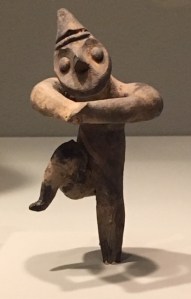 We went to a museum the other day with no specific purpose in mind and found ourselves in the Chinese art galleries. Jade. Porcelain. Bronze. Ornate vessels for cooking, for ceremonies, for burial. An arched gateway which used to lead to a family’s compound. A room with a low table, ink, brushes, where someone used to practice calligraphy. We peered in through the interwoven black wooden squares of traditional Chinese architecture. At one point a tiny capering man entranced me and I wanted to reach through the glass, and the thousands of years between us, and take him home.
  When my dog Petey was still alive I used to bring him to the Blessing of the Animals at the Basilica. One year, a woman with a small clear plastic box sat at the end of the pew next to Petey and me. She was anxious, agitated, and when the priests began walking up and down the aisle swinging incense and shaking holy water on the animals, she held the box up in the air.
 A couple of months ago I hurt a friend when I pushed a semi-joke too far. The friend didn’t say anything or change expression, but I went to bed uneasy. Despite the Painter’s assurances that he had noticed nothing and all was well, my gut said otherwise. I woke up and sent an apology, the gracious acceptance of which proved that my gut was right. In the weeks since, shame and sadness keep bubbling up in their familiar way. How many times a day do you feel like a failure? I once asked the Painter. All day every day, he answered, to which I nodded.

 Here’s the fourth-floor walkup you called home. Here’s the tiny room overlooking Joy Street where Laurel used to roll her waitressing change into paper tubes for the rent. Here’s your room, with the big saggy bed left by a previous tenant. Here’s the bathroom where you didn’t pee at night because darkness was the domain of the cockroaches. Here’s the plant in the sunny window that you wound around itself because it was out of control.
