Poem of the Week, by W.S. Merwin
 My daughter and I were in Istanbul for a week, our first time in a country where the call to prayer sounded five times a day. I remember sitting by the window at sunset as the song of the muezzins rose in the air. It was beautiful and unearthly and I wanted to hold onto it so it would never end. It’s an almost panicky feeling, that wanting to hold on. Long ago, as a means of coping with it, I began to tell myself that You can always come back, Alison.
In my heart, pigeons are still fluttering around my daughter on the cobblestones, and we are still wandering the shore of the Bosphorus, and we are both looking up, up, up at the dome of the Hagia Sophia. And then back, back, back I go in time, to the magical moment when she first opened her eyes. Every minute of being alive is its own first and last. You can’t go back.
Youth, by W.S. Merwin
Through all of youth I was looking for you
without knowing what I was looking for
or what to call you I think I did not
even know I was looking how would I
have known you when I saw you as I did
time after time when you appeared to me
as you did naked offering yourself
entirely at that moment and you let
me breathe you touch you taste you knowing
no more than I did and only when I
began to think of losing you did I
recognize you when you were already
part memory part distance remaining
mine in the ways that I learn to miss you
from what we cannot hold the stars are made
 The suicide of Alan Krueger last week, a man I didn’t know but whose work I admire, a man clearly beloved by so many, hit me hard. It brought me back to my early twenties, when the suicide of someone I loved both ended his life and permanently altered mine. Crying comes hard to me and does not bring relief, but it came anyway this week. At one point I found myself alone, apologizing out loud for things I wish I’d done differently.
  One of the top-rated MFA programs in the country once recruited me to fly out and interview for a fiction position. A day into the interview, deep in discussion of teaching technique with the faculty and students, I subtly began to portray myself as less interested in criticism and more interested in nurturing a creative spark. This wasn’t what they wanted in a teacher and I knew it. I was in effect throwing the interview, but I wasn’t sure why.
 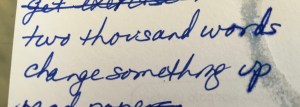 A few days ago at sunset the sky was unearthly. The Painter came home, grabbed his camera and tripod and headed to the beach to take a bunch of photos. My internal, unspoken take on this, having never seen him take a sunset photo before: You had a frustrating day in the studio. Nothing was working with your paintings. You feel blocked, so you’re trying something new, to change up the energy and get things moving again.
  We were classmates. He was a country kid, like me, and like me, he was condemned to ride the bus for miles and miles. I dreaded that bus every day of my life –it was a place of fear and intimidation and endless cruelty.
 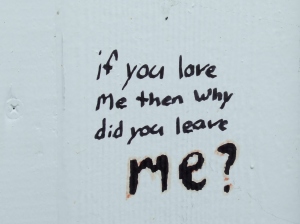 My daughter at eight: What would happen if you die? I tell her she would be very sad but everyone would take such good care of her, and she says No, they wouldn’t. Because I would be dead too, of sadness. My son at four shuffles out of the bedroom in his first pair of flip-flops, having put them on himself with the strap between his second and third toes. It’s fine, mama, don’t worry, they don’t hurt, I can walk. My grandmother, flustered and red-faced in the small kitchen where she’s trying to make dinner for me: Oh Alison, I’m just no use at all anymore. Me outwardly protesting but inwardly stricken by the knowledge that in that single instant, everything is now changed.
  My five year old nephew is currently huddled behind closed doors inside his family’s new freestanding pantry, where he fits neatly into the bottom cupboard. I know this because my brother texts me ongoing updates as to this fixation with the pantry, along with the fact that my nephew just declared he’s no longer a ninja genius but a secret agent. (Didn’t surprise me at all. I never bought the ninja genius line.) My nephew cracks me up and breaks my heart the way all little kids, over and over, break my heart.
  In the lobby of the Minnesota Public Radio headquarters are three white egg-shaped chairs. Whenever I’m there I crawl into one of them, sit cross-legged, and close my eyes. Sitting in one is like wearing a warm sweatshirt with the hood pulled entirely over your head. My love for those chairs is inordinate. When I picture a safe place to comfort myself when sad or troubled, those egg-shaped chairs come to mind.
  A few years ago a lifelong minor heart glitch spiraled out of control. I didn’t tell anyone until a couple hours before the surgery to fix it, so as not to worry them, and I took a Lyft to the hospital. But just before the procedure, as the surgical team was pushing the gurney into the OR, I put my hand on the arm of the nearest blue-masked nurse. Please take good care of me, I said. I don’t want to die.
 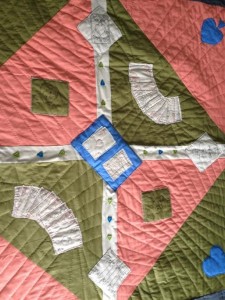 The day after I moved to Minneapolis, I bought a sewing machine. This was in the days of newspaper ads, and I found a used one for $60 and insisted my then-boyfriend and I track it down that very day. That ancient, impossibly heavy machine is what I’ve used to make all the quilts I’ve ever made, sewing together blocks I hand-stitch piecemeal. Story quilts, every one of them, made not according to a pattern but out of my head and heart.
  Alison McGhee