Poem of the Week, by William Stafford
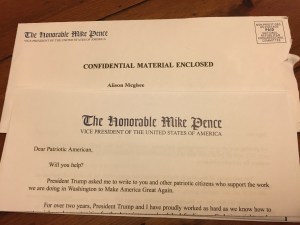 Last fall I began getting letters like this from the president, the vice-president, the NRA, anti-abortion organizations. Not my typical mail. Why me? Then it came to me: in August a friend died, a Marine combat veteran, and in his honor I made a donation to the Wounded Warrior project, which must have triggered a hundred conservative mailing lists.
Given my political leanings, it would be easy to post those letters on Twitter with a snarky comment and watch the equally snarky responses roll in, but that would only make things worse. Here’s the thing: most people are not zealots. You can be a pacifist and still support veterans. You can be an atheist and still respect your neighbor’s need to pray to a God you don’t believe in. You can have deep qualms about abortion and still support the right to have one.
You can despise your uncle’s racist comments and cut off contact with him, or you can remember how he taught you to ride a bike and showed up at all your basketball games. You can remember how it felt when you woke up to your own internalized racism. You can choose to open a conversation with him, one that might open a mental window, one that will take a lot of patience that you might assume neither of you have.
But you do have that patience. We all do, once we recognize how deep the darkness is, and how easy it is to get lost.
A Ritual to Read to Each Other, by William Stafford
If you don’t know the kind of person I am
and I don’t know the kind of person you are
a pattern that others made may prevail in the world
and following the wrong god home we may miss our star.
For there is many a small betrayal in the mind,
a shrug that lets the fragile sequence break
sending with shouts the horrible errors of childhood
storming out to play through the broken dike.
And as elephants parade holding each elephant’s tail,
but if one wanders the circus won’t find the park,
I call it cruel and maybe the root of all cruelty
to know what occurs but not recognize the fact.
And so I appeal to a voice, to something shadowy,
a remote important region in all who talk:
though we could fool each other, we should consider—
lest the parade of our mutual life get lost in the dark.
For it is important that awake people be awake,
or a breaking line may discourage them back to sleep;
the signals we give — yes or no, or maybe —
should be clear: the darkness around us is deep.
For more information about William Stafford, please click here.
My website. My blog. My Facebook page.
Twitter and Instagram: @alisonmcgheewriter
 Last summer, driving to Vermont, I detoured past my grandparents’ dairy farm. That’s how I think of it –their farm, on McGhee Hill Road–even though it’s been almost half a century since it changed hands, bought by city dwellers who turned the barn into a house and the house into guest quarters.
  Who am I? What is my place in this world? How do I stay steady and strong and never stop trying to help the world? Our burning planet. The onrush of artificial intelligence. This heedless erosion of democracy. These are my three biggest panics.
  The summer I turned nineteen I took the bus west to Wisconsin, to work at a mom and pop resort where the owners housed us in a firetrap and fed us leavings from the guests’ plates.
  People who say they have “no regrets” mystify me. Regrets, oh I’ve got a few. Like last night when I couldn’t get back to sleep for thinking about the times I yelled at my children when they were little. This didn’t happen much, but every time it did, my self-hatred was huge. It still is. As a mother I wanted always and only to be a comfort to my kids. But when you’re yelling, you’re not a comfort, are you?
 Years ago I bought some raw land on a slope in Vermont. Hired someone to grade a tiny cleared patch in the woods. Drilled a well. Bought a one-room cabin kit off eBay and hired a carpenter to put it together. Spent many days and nights staring up from the porch and the hammock at the enormously tall pines pictured to the right.
 In my 1000 Words class you could write anything you wanted –poem, essay, memoir, story, children’s book–as long as it was fewer than one thousand words. Does it sound easier to write short than long? It’s not. You have to take an image, a dream, a thought, a burning wish, and hone and pare it until there’s not an extra word.
 Last week I tucked myself behind a long black semi, far enough back so he could see me and my rattletrap moving truck in his big side mirrors. I do this sometimes on the highway when I’m tired or troubled or just want someone else to take over a little of the decision-making. Truckers (with a few exceptions) are the best drivers out there. They have to be.
  Alison McGhee