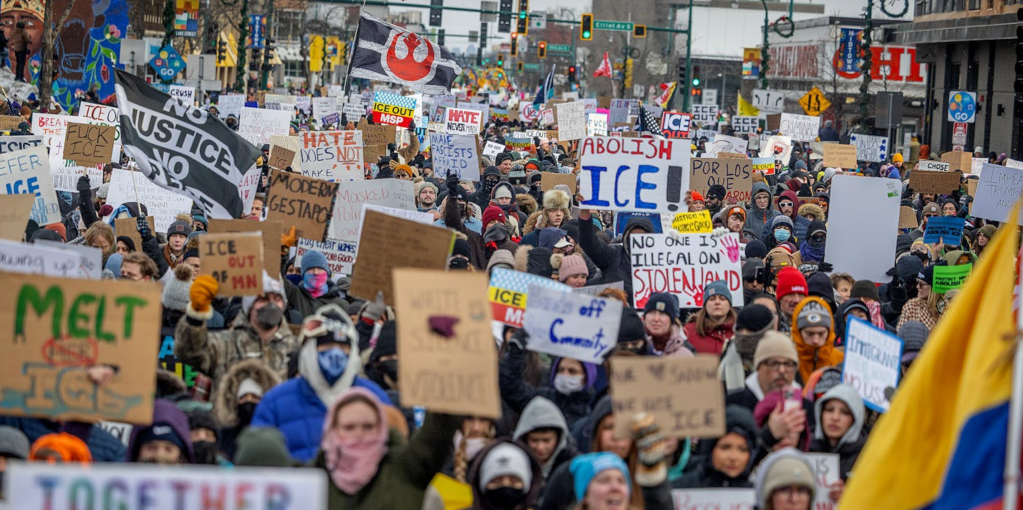
Poem of the Week, by Alice N. Persons

When walking in crowds I sometimes think that man could be a rapist or that man could be a serial killer or I wonder if that’s a loaded gun in that bulgy pocket. There’s no fear in these thoughts, just a kind of distant, idle curiosity.

I’m switching things up now, though. Maybe that woman runs a senior dog rescue; maybe that man sings show tunes in a nursing home every Thursday; maybe she’s a pediatric oncologist; maybe he roams the neighborhood every day with a plastic bag; picking up trash.

Maybe that woman with the dark hair and sparkly eyeglasses once saw a young man standing by the edge of a tall building, and she sensed he was gathering his strength to jump, and she approached gently and told him how she had once felt the same way, and she was there to listen if he wanted to talk, and he did, and she listened, and now a decade later they send each other a tiny daily text, just to say Hi, thinking about you. Sending love.

the man in front of you, by Alice N. Persons 

is just tall enough
has soft black hair
and golden skin
wide shoulders
and smells good

you stand behind him
in the movie line
or buying flowers on boylston street
or see him on the subway
not far down the car
his clean brown hands
on the overhead rail

the man in front of you
could have just killed someone
or might have a bitter face
may love no one
or always sleep alone

the man in front of you
hurries out of the station
or rushes around the corner
and vanishes into a cab
you never see his face
but in dreams he comes to you
and does not slip away

Click here for more information about Alice N. Persons. Today’s poem appears in Never Say Never, published in 2004 by Moon Pie Press.  
alisonmcghee.com​ 
My podcast: Words by Winter

Poem of the Week, by Ada Limón

A few months ago I was tromping around the Zurich airport train station, backpack heavy on my shoulders, following signs, twisting and turning down this hallway and that. Now to figure out the ticket kiosk. Now to find the right platform. Now to double check the time. Tired. Hungry. Thirsty. Worried worried worried and so sad about my country.

Ticket in hand, I turned a corner and locked eyes with a small brown dog who looked at me calmly, as if she’d been waiting for me. I dropped to my knees next to her and held out the back of my hand and she lay her head on it. The animal part of me wanted to live with this dog forever, and I looked up at her human, who smiled in understanding. The world was calm for a moment.

While Everything Else Was Falling Apart, by Ada Limón

In the Union Square subway station nearly fifteen
years ago now, the L train came clanking by
where someone had fat-Sharpied a black heart
on the yellow pillar you leaned on during a bleak day
(brittle and no notes from anyone you crushed upon).
Above ground, the spring sun was the saddest one
(doing work, but also none). What were you wearing?
Something hopeful to show the world you hoped?
A tall man was learning from a vendor how to pronounce
churro. High in the sticky clouds of time, he kept
repeating churro while eating a churro. How to say
this made you want to live? No hand to hold
still here it was: someone giving someone comfort
and someone memorizing hard how to ask for it again.

Click here for more information about Ada Limón. Today’s poem is from The Chorus These Poets Create: Twenty Years of Letras Latinas

alisonmcghee.com
My podcast: Words by Winter
Poem of the Week, by Charlotte Parsons

The elementary school bus I grew up riding, nearly an hour each way to and from school, was an ongoing nightmare. Fights, bullying, cruelty, all egged on by our horrible bus driver. That school bus has appeared and reappeared in many of my novels, always as a place of fear and torment. (There’s a reason I’m a fiction writer.)

We can replicate that kind of cruelty or we can push back against it. It’s beyond exhausting and beyond terrifying to see our current vicious administration rise up against our fellow humans. We are all in this together. We will all come to an end one day. Those who called from the planes and towers on 9/11 were calling with messages of love.

Nine-Eleven, by Charlotte Parsons

You passed me on the street
I rode the subway with you
You lived down the hall from me
I admired your dog in the park one morning
We waited in line for a concert
I ate with you in the cafes
You stood next to me at the bar
We huddled under an awning during a downpour
We dashed across the street to beat the light
I bumped into you coming round the corner
You stepped on my foot
I held the door for you
You helped me up when I slipped on the ice
I grabbed the last Sunday Times
You stole my cab
We waited forever at the bus stop
We sweated in steamy August
We hunched our shoulders against the sleet
We laughed at the movies
We groaned after the election
We sang in church
Tonight I lit a candle for you
All of you

Although today’s poem has been featured on hundreds of websites I’m unable to find out any information about poet Charlotte Parsons other than that this poem first appeared on The Writer’s Almanac on September 11, 2017. This leads me to suspect that Charlotte Parsons is a pseudonym for someone else. If anyone’s in the know, please clue me in. 

alisonmcghee.com
My podcast: Words by Winter

Poem of the Week, by Rob Ingraham

In elementary school we had to write a lot of book reports, and this felt unbearable to me. How can a book possibly be boiled down to a few lines of plot and description of style? It would have crushed my soul, so I had to come up with an alternative, which was to make up imaginary books and then write book reports about them.

Most of my imaginary books were about winter pioneers, trying their best to survive in a one-room unchinked cabin, huddled around meager fires, facing the endless snows of winter. (Yes, I’m a northerner, and yes, I spent a lot of time reading the Little House books.)

To this day I can’t read book jackets, and it’s almost impossible for me to write jacket copy for one of my own books. I feel the same way about resumés. How can a bland listing of degrees and jobs possibly convey the truth of a human being?

Resumé, by Rob Ingraham

In French, it simply means a summary,
which limits what it can and can’t convey
despite my padding and hyperbole.
No room to cite the winter night I lay
inside an ambulance (my friend was dead),
they strapped me down, the flares lit up the snow.
No place to say how luckily I wed,
or itemize what took me years to know.
The format’s not designed to mention awe;
transcendence can’t be summarized at all.
And nowhere on the page to say I saw
a plane explode, I saw a building fall.
But these are skills not easily assessed;
all references provided on request.

I’ve been unable to find out more personal information about Rob Ingraham, but you can click here for another of his poems. Today’s poem was first published in Rattle #22 in the winter of 2004. 

alisonmcghee.com
My podcast: Words by Winter
Poem of the Week, by Hafiz

Excerpt from a small blue diary I kept when I was in fifth grade: It’s weird but when you walk into a room of people you can feel the air. The air is a color and a texture that you can see and feel and it’s how people are feeling. But what’s really weird is you can change how they feel if you concentrate really hard.

I believed this at ten, and I still believe it. In our early twenties my sister and I used to go to parties and some of the parties were flat and dull. We would look at each other and murmur social overdrive, social overdrive, and then throw ourselves into the scene and try to put everyone at ease and make everyone feel connected and happy.

Social overdrive social overdrive is a mantra for me in these vicious times. How to lift up another human being, or a roomful of them, or a nation. How to change the energy in the room, how to channel not anger and bitterness but love and kindness and acceptance. Something that Hafiz, who lived and died 700 years ago, knew well.

With That Moon Language, by Hafiz (translated by Daniel Ladinsky)

Admit something:

Everyone you see, you say to them,
“Love me.”

Of course you do not do this out loud;
otherwise, someone would call the cops.

Still though, think about this,
this great pull in us
to connect.
Why not become the one
who lives with a full moon in each eye
that is always saying,
with that sweet moon language,
what every other eye in this world
is dying to hear?​

Click here for more information about this poem, attributed to the Persian poet Hafiz/Hafez. Please note also that reputable sources say that most of the beloved poems attributed to Hafiz were actually written by his purported translator Daniel Ladinsky.
alisonmcghee.com
My podcast: Words by Winter

Poem of the Week, by X.J. Kennedy

​I was driving the first time I heard Joan Osborne sing One of Us. Her voice came pouring out of my tinny car radio and instantly I knew this would be one of the songs of my life, like Fast Car by Tracy Chapman (and, yes, Alison by Elvis Costello). I think of One of Us to myself a lot these days, like last week when ICE hauled a man out of his car in front of the Walker Art Center, his terrified wife screaming and screaming, and when the working, nursing mother of an infant was held in jail for three weeks because she mistakenly didn’t show up for a court appointment eight years ago when she was a teen. It’s delusional to think they won’t be coming for you and me. We’re all one.


A Scandal in the Suburbs, by X.J. Kennedy

We had to have him put away,
For what if he’d grown vicious?
To play faith healer, give away
Stale bread and stinking fishes!
His soapbox preaching set the tongues
Of all the neighbors going.
Odd stuff: how lilies never spin
And birds don’t bother sowing.
Why, bums were coming to the door—
His pockets had no bottom—
And then-the foot-wash from that whore!
We signed. They came and got him.

Click here for more information about X.J. Kennedy. This poem first appeared in New and Selected Poems, 1955-2007, published in 2007 by The Johns Hopkins University Press. 
alisonmcghee.com
My podcast: Words by Winter
Poem of the Week, by Keetje Kuipers

The other day, after a funeral, longtime friends and I had a quiet, deep conversation about the possibility of something beyond the rules of any one religion, lives before and beyond this one, a higher consciousness and good that transcends the castigation and stone-throwing surrounding us.

My definition of God? Maybe something like the feeling of my children on either side of me as I read them to sleep when they were little. The high school students I used to teach, ringed on the floor of our classroom on the giant pillows  I’d made, silent and absorbed on Friday afternoons as I read to them. Crouching in my garden, bees and butterflies floating from flower to flower as I dig in the dirt. The idea and feeling of peace, of a place where only love and comfort dwell. Poems that open my heart in a way that almost hurts, like this one.

Prayer, by Keetje Kuipers

Perhaps as a child you had the chicken pox
and your mother, to soothe you in your fever
or to help you fall asleep, came into your room
and read to you from some favorite book,
Charlotte’s Web or Little House on the Prairie,
a long story that she quietly took you through
until your eyes became magnets for your shuttering
lids and she saw your breathing go slow. And then
she read on, this time silently and to herself,
not because she didn’t know the story,
it seemed to her that there had never been a time
when she didn’t know this story—the young girl
and her benevolence, the young girl in her sod house—
but because she did not yet want to leave your side
though she knew there was nothing more
she could do for you. And you, not asleep but simply weak,
listened to her turn the pages, still feeling
the lamp warm against one cheek, knowing the shape
of the rocking chair’s shadow as it slid across
your chest. So that now, these many years later,
when you are clenched in the damp fist of a hospital bed,
or signing the papers that say you won’t love him anymore,
when you are bent at your son’s gravesite or haunted
by a war that makes you wake with the gun
cocked in your hand, you would like to believe
that such generosity comes from God, too,
who now, when you have the strength to ask, might begin
the story again, just as your mother would,
from the place where you have both left off.

Click here for more information about Keetje Kuipers. Today’s poem was originally published in the winter of 2007, in Rattle, Issue #28.

alisonmcghee.com
My podcast: Words by Winter

Poem of the Week, by Faith Shearin

When my son was eleven he went away to camp for a full month, a decision I was not at all sure of. The camp was three hours away in another state and I missed him terribly and wrote and sent packages and tried not to worry and hoped he was having fun, which it turned out he was. At the end of camp, parents had a choice: they could pick their child up or their child could ride back to the city on the camp bus. I chose to drive up, not knowing that literally every other camper would take the bus back.

When I got there it was raining lightly. The woods were green and deep, the cabins were empty, and I suddenly felt inadequate, as if I’d deprived my son of a few more hours of fun on the bus with his friends. No one was there but a few counselors and a quiet boy in a blue rain jacket, watching me with calm eyes, waiting for me to recognize him, this same boy who had once lived inside me.

Spelling Bee, by Faith Shearin

In the spelling bee my daughter wore a good
brown dress and kept her hands folded.
There were twelve children speaking

into a microphone that was taller than
they were. Each time it was her turn
I could barely look. It wasn’t that I wanted

her to win but I hoped she would be
happy with herself. The words were too hard
for me; I would have missed chemical,

thermos, and dessert. Each time she spelled
one correctly my heart became a bird.
She once fluttered so restlessly beneath

my skin and, on the morning of her arrival,
her little red hands held nothing.
Her life since has been a surprise: she can

sew; she can draw; she can read. She hates
raisins but loves science. All the parents
must feel this, watching from the cheap

folding chairs. Somewhere inside them
love took shape and now
it stands at the microphone, spelling.

Click here for more information about poet Faith Shearin. Today’s poem is from her collection Moving the Piano, published in 2011 by Stephen F. Austin State University Press.

alisonmcghee.com
My podcast: Words by Winter
Poem of the Week, by Stanley Kunitz

I’ve kept two journals in my life, one at age nine and the other at nineteen. Most entries as a nine-year-old were about my cute baby brother or the boy I had a crush on. As a nineteen-year-old I wrote in code about things that felt overwhelming. Yesterday I read an interview with a woman who’s kept journals since she was a child. Sometimes she reaches for one and leafs through it, remembering who she used to be and the changes she’s been through. I wish I’d done that, I said to the Painter last night, then I would remember all the selves I’ve ever been. Who and what are our true affections? How do we reconcile our hearts to their feasts of losses?

The Layers, by Stanley Kunitz

I have walked through many lives,
some of them my own,
and I am not who I was,
though some principle of being
abides, from which I struggle
not to stray.
When I look behind,
as I am compelled to look
before I can gather strength
to proceed on my journey,
I see the milestones dwindling
toward the horizon
and the slow fires trailing
from the abandoned camp-sites,
over which scavenger angels
wheel on heavy wings.
Oh, I have made myself a tribe
out of my true affections,
and my tribe is scattered!
How shall the heart be reconciled
to its feast of losses?
In a rising wind
the manic dust of my friends,
those who fell along the way,
bitterly stings my face.
Yet I turn, I turn,
exulting somewhat,
with my will intact to go
wherever I need to go,
and every stone on the road
precious to me.
In my darkest night,
when the moon was covered
and I roamed through wreckage,
a nimbus-clouded voice
directed me:
“Live in the layers,
not on the litter.”
Though I lack the art
to decipher it,
no doubt the next chapter
in my book of transformations
is already written.
I am not done with my changes.

Click here for more information about Stanley Kunitz, who, in 2000, at age ninety-five, became the tenth poet laureate of the United States. Today’s poem is from from The Collected Poems of Stanley Kunitz​, published in 1978. 

alisonmcghee.com
My podcast: Words by Winter
Poem of the Week, by Wendy Cope

Sometimes I look at the people around me, on the bus, on the sidewalk, in the theater, in the grocery store, and think about the secret love stories they carry in their hearts. Stories they haven’t told anyone else, maybe, or a love so far in the past that no one in their lives today remembers that person but them. I hope that when they remember that love and how treasured they felt, even for a few days or a few months or a few years, that somewhere in the world their former love thinks of them, and smiles, and lights up for a minute.

Postcards, by Wendy Cope

At first I sent you a postcard
from every city I went to.
𝘎𝘳ü𝘴𝘴𝘦 𝘢𝘶𝘴 𝘉𝘢𝘵𝘩, 𝘢𝘶𝘴 𝘉𝘪𝘳𝘮𝘪𝘯𝘨𝘩𝘢𝘮,
𝘈𝘶𝘴 𝘙𝘰𝘵𝘵𝘦𝘳𝘥𝘢𝘮, 𝘢𝘶𝘴 𝘛𝘦𝘭 𝘈𝘷𝘪𝘷.
𝘔𝘪𝘵 𝘓𝘪𝘦𝘣𝘦. Cards from you arrived
in English, with many commas.
𝘏𝘰𝘱𝘦, 𝘺𝘰𝘶’𝘳𝘦 𝘧𝘪𝘯𝘦 𝘢𝘯𝘥 𝘴𝘵𝘪𝘭𝘭 𝘢𝘭𝘪𝘷𝘦,
says one from Hong Kong. By that time
we weren’t writing quite as often.

Now we’re nearly nine years away
from the lake and the blue mountains,
And the room with the balcony,
But the heat and light of those days
can reach this far from time to time.
Your latest was from Senegal,
mine from Helsinki. I don’t know
if we’ll meet again. Be happy.
If you hear this, send a postcard.

Click here for more information about Wendy Cope. Today’s poem is from If I Don’t Know, published in 2001 by Faber and Faber.

alisonmcghee.com
My podcast: Words by Winter