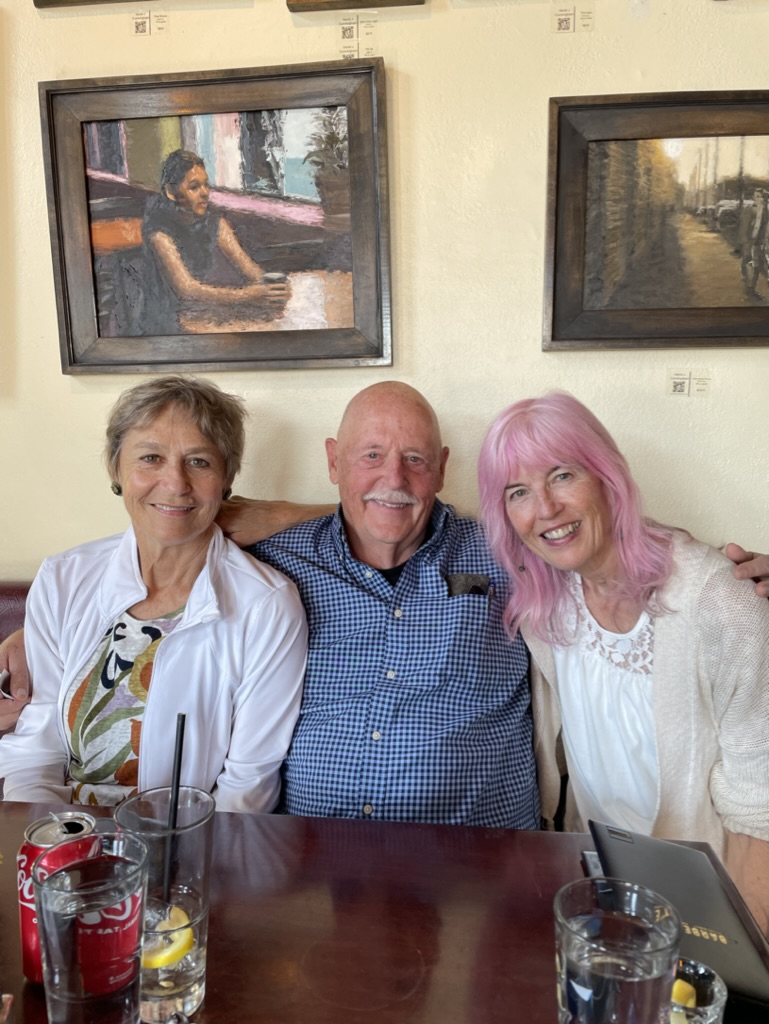
 All day today I kept returning to the photo of an old friend, lying in a bed pushed against a bank of windows in her house. Her husband sat in a chair and leaned over the side of the bed, her son held one of her i.v.-tubed hands and her daughter the other. She was smiling and so were they. The photo was taken yesterday morning, on the last full day of her life as her long and mighty battle drew to a close. No one who knew her was left untouched by her grace, her dark humor, her ferocious love of being alive. She left nothing unsaid. All those she loved knew they were loved. If energy remains constant, then she is still with us. From the archives, in honor of Lissa.
* * *
You get a reminder of it sometimes, when you walk by a house being built. Or when you’re tearing out a wall damaged by one of last winter’s ferocious ice dams. Or when your electrician friend comes to put in a new outlet in the room that has only one.
Touring a factory can do it too. A brewery, for example. The cavernous rooms, the grind and hum of machinery, the rattle of conveyor belts, the machines that fill the bottles, the giant vats of beer, the sour smell of fermentation.
Followed by the sight of perfectly packaged six-packs: brown bottles in their bright boxes, silently stacked on shelves. You see them in the store and, unless you consciously remind yourself, you forget where they came from. You don’t think about the mess, the grind, the chaos of their beginning.
When the wall of the house is torn open, it’s impossible to forget. Rough lathe and crumbled old plaster, newspapers from 1945 stuffed inside for insulation. Electrical cords writhing their way in twisted bundles up and down between floors.
If you hover in the room when the electrician is working on the outlet, watching and waiting, you will see sparks fly, the tiniest of fires.
This too will remind you of what is beneath the surface. All these reminders, all the time, should you choose to notice them: there is another life alongside this life.
Now you’re thinking of when writing is the easiest, which is when you’re not thinking. Your fingers are just tap-tapping away, and words appear on the screen and you look at them with interest, as if they were written by someone else.
Were they?
An image appears in your mind: a little bracelet made of red plastic beads next to a blue child’s ring. These were the treasures that you and some of your friends in fifth grade played King of the Mountain with one brief winter week. The snow piles at the elementary school were so high that year that you dug snow caves into them, made snow roads on top of them.
You buried the jewelry and searched for it. Why this game was so entrancing you don’t know, but all of you were entranced. Then came the day when the jewelry couldn’t be found, and the game ended.
The thing is, though, it’s still there. That red plastic bracelet, that little blue ring: they are still out there. Probably feet under the ground in the grass by the side of the red brick elementary school, but there.
All these years –almost your whole life, at this point– you have thought about them. The red bracelet. The blue ring.
Nothing goes entirely away. Some part of it stays.
Look at that small, square brown pillow with a pattern of leaves needlepointed on top. It was the first thing that caught your eye just now when you looked up. It’s carefully placed by the armrest of the couch in this room. Your grandmother made that pillow.
You look at it and she immediately fills your mind. You can hear her voice. You can see her hand, arthritic fingers and ropy veins. Now she’s laughing. Now she’s urging more raspberry popover and ice cream on you.
Doesn’t this mean that she’s still here? That some part of her is still with you, like the silent, unseen electricity running its way up and down every wall of this house?
Yesterday, a lovely day when the outdoors was made indolent by the sun, you passed two girls and a boy, late teens all, sitting on a stone bench by the lake. Laughing. Tugging down the shoulders of their tanks, flexing their biceps, each insisting their muscles were the biggest.
You wanted to stop and watch them, they were so beautiful. Smooth, smooth brown skin, white teeth, dark hair tied back. You walked away from them, listening to their easy talk. You tried to picture them fifty years hence, what they would be like then, if they would still know each other, still be together.
Then you imagined the bones and blood and ligaments and arteries just under the surface of that silken skin, how it is there right now. Hidden. Invisible. Doing its silent work.That shadow world, indivisible from the outer one in which we move. A world of spirits and memories, things you once held. The world where the stories begin.
Sometimes you get a glimpse of it. The torn-open wall, a presence on the stairs, a long-lost voice come whispering into a dream. Your grandmother, and that one line in that one letter: “What a beautiful life we had.”
Sometimes, falling asleep or waking up, there is the sensation of something just out of reach. A familiar stranger with you, hiding his face amidst a crowd of stars.
 Alison McGhee