The Song Poet, by Kao Kalia Yang.
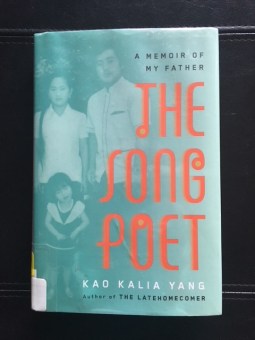 Everything that Kao Kalia Yang writes I read slowly and usually twice, not because there is anything confusing about her sentence structures but because her words and stories fill my heart with emotion. Sorrow, love, longing, rage and redemption – page by page, they all swim through. This is the second memoir by Yang. Her first, The Latehomecomer, was published some years ago and is (to my knowledge) the first Hmong American memoir, about her family’s long and arduous journey from the mountains of Laos to the refugee camps of Thailand to the grueling new world of Minnesota. In The Song Poet, which is primarily about her father Bee Yang, she adopts the voice of her father along with her own in order to tell his personal story and the family’s continuing saga. I treasure this book. It belongs on bookshelves everywhere, not only because of its beautiful portrayal of the painful triumph of a family beset by a new world, but also because it’s a reminder of just how hard it is to build a new life in a distant land. A profoundly moving book.
Saga, by Brian K. Vaughan and Fiona Staples.
 I’m late to the Saga party, but WOW. What a fabulous beginning to a graphic epic of one small family in a universe at war. Volume One and I spent the whole day together curled up on the couch, because I couldn’t put this book down. Fierce Alana, tender Marko, and baby Hazel –who is one of the narrators of the book, from an unnamed perspective many years hence– are impossible to resist. Artwork by Fiona Staples perfectly complements Brian K. Vaughan’s narrative, which leaps into action with the first sentence and Does Not Let Up. I’m swept away. Volume Two of many is up next. Highly recommend.
 Future Home of the Living God, by Louise Erdrich.
Louise Erdrich’s latest is her first novel set in a future dystopia. Although scratch that – the future dystopia she describes in Future Home of the Living God feels pretty damn familiar. The flow of this novel is both waterfall and still pool and I read it with mounting unease and fear, the same way I remember feeling when I read The Handmaid’s Tale many years ago. In fact, Future Home of the Living God might best be read as a later edition, a companion piece to Atwood’s novel: an uneasy pairing, both harbingers of doom, both battle cries for the resistance. Highly recommend.
Turtles All the Way Down, by John Green.
Years ago, when I read T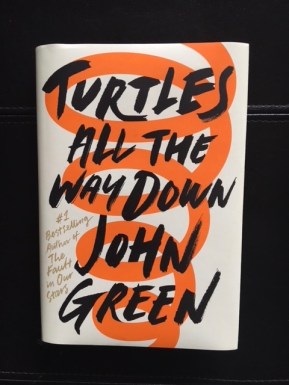 he Fault in Our Stars, I remember thinking, damn, this guy is captivating. I passed that book on to both my daughters and we all held it to our hearts and still quote lines from it to each other. Turtles All the Way Down is another book I’ll hold in my heart. John Green has an uncanny way with snappy dialogue, the profundity of best-friendship, setting (this one is set in his native Indianapolis, and after reading it I feel as if I could draw a map of the neighborhood), and his books are both deeply sorrowful and funny as hell. The man doesn’t shy away from the harshness of life, in this case the loss of a parent and the main character’s ongoing struggle with debilitating OCD and other mental health issues. Nor does he shy away from how beautiful life can be. What I most love about Green’s writing is how his characters slice through the external layers and speak to each other directly from the heart. It’s as if instead of turning away from the fact that they –and we–are all mortal, they fully know themselves to be exactly that, and they cut away the bullshit and get straight to the heart of the matter. Wonderful novel.
 Landscape with Invisible Hand, by M.T. Anderson.
Argh! Why does everything this man writes destroy me! But also leave me weirdly gratified despite my deep disturbation! I swear, M.T. Anderson cannot not write an incredible book. This one reads like a return to the world of Feed, which was written fifteen years ago and which has haunted me ever since. In the brief, hilarious, and devastating Landscape with Invisible Hand, the hapless inhabitants of planet Earth have traded their soul permanent colonization by the alien Vuuvs in exchange for advanced technology and cures for all diseases. But now there are no jobs, no money, and more illness than ever, because no one can pay for the Vuuv cures. Like Future Home of the Living God, this novel reads like a near-future/present-day dystopia. Help. I kind of hate to recommend because this one hits so close to home, but I have to recommend anyway. Hugely. It’s brilliant.
WPA Guide to 1930s New York City, by the WPA writers.

This was a very cool and unexpectedly moving read for me. The Federal Writers Project was sponsored by the fabulous post-Great Depression Works Progress Administration (God, I wish we had something like that these days). My mother lent this book to me, urging me to read the Lower East Side section because my Jewish grandfather and his family settled in the tenements there after escaping the pogroms in Russia at the turn of the previous century. (My family’s story is a familiar one: they worked in the sweatshops, suffered from grinding poverty and poor health and unending work, and my great-uncle eventually died of suicide rather than put his family through the pain and expense of watching him die of tuberculosis. But I digress.) To read the descriptions of an area I know well, through the eyes of a 1930’s observer, is to experience the era in a particular and specific way – instead of a movie creating an era and scene, it’s words on a page. Fascinating glimpse into our country’s history.
The New Yorker, by a whole bunch of very talented writers.
 Yes, I’m adding a bunch of latest New Yorkers to this list, because let’s face it, people: A single New Yorker is the equivalent of a book. Which means that if you make it through an entire New Yorker every week, you’re reading a book a week. I used to panic when the New Yorkers would start piling up – I felt guilty and ashamed and like a loser. Then I said the hell with it and gave myself permission to read whatever I happened to read that week, or any week, or even years later. I have loved this magazine my entire adult life, and not once have I let my subscription lapse. The writers are so damn good, and they take their time, and I take my time, and that’s a beautiful thing in a world paced the way this one is paced. Some of my favorite writers ever began and/or still write for The New Yorker, people like Atul Gawande and John McPhee and Jelani Cobb and Jia Tolentino and Jerome Groopman. My secret pleasure: Reading the tiny reviews of restaurants I’ll never go to, just because I love the way a room and tables and plates of food on those tables come to life in my mind.
 Born a Crime, by Trevor Noah. I listened to Trevor Noah read his memoir aloud to me as my tiny little car and I cruised along the highways of Arizona, New Mexico and Oklahoma. What a wonderful book. Noah was born to a black South African woman and a white British father in South Africa – his birth was literally a crime back in the waning days of apartheid, hence the title of the memoir. Like Sherman Alexie’s You Don’t Have to Say You Love Me, this book is as much an homage to his fierce, brilliant, take-no-shit mother as it is his own story. Listening to Noah talk about race, class, the city vs. the townships, and his coming of age on the mean streets of both made me think about my own country and upbringing. This book is by turns hilarious, enraging, enlightening, and always utterly absorbing. Highly recommend – and if you’re an audio fan, get the audio version. Noah is an uncanny mimic.
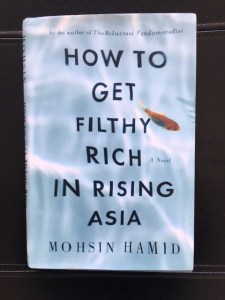 How to Get Filthy Rich in Rising Asia, a novel by Mohsin Hamid. Such a poignant, bittersweet, moving novel this is. It’s been kicking around on my bookshelves for a couple of years now, because even though I knew it was a novel, every time I looked at it I would tilt my head and think How to Get Filthy Rich in Rising Asia? Just doesn’t sound like a novel. And because I don’t care about getting filthy rich in rising Asia (or anywhere else for that matter), it stayed on the shelf. But once I finally cracked the cover and began reading, wow. Structured like the get rich quick self-help books that are apparently wildly popular in Asia, with each chapter heading a different aspect of how to get rich, the book charts the life of one unnamed man. We follow him from early childhood in rural Pakistan (I’m assuming, because the country, like the main character, is never named) to old age in a sprawling, tentacled, ever-growing city, every step of the way alighting, like a hummingbird, on the various aspects of his life and longings that never change. A delicate, painfully-wrought, beautiful book. I loved this novel and will now seek out Hamid’s other books. Highly recommend.
 The House Without Windows: And Eepersip’s Life There, a novel by Barbara Newhall Follett. Reading this brief novel was an experience unlike any I’ve had before when reading. The author, who was born in 1914 and vanished at the age of thirty, was eight years old when she wrote the novel and twelve when it was published. After reading
  You know those maps where you fill in all the states you’ve been to? The only one missing from mine is Alaska (I don’t count the time that I landed at the Anchorage airport on my way to China). I’ve been to all the lower 48 states, most of them multiple times, because road trips are big in my life. The earth is a living being beneath the tires, rising and falling, sweeping west and shrinking east. Most of the time I’m solo, like last week, when I drove 2089 miles in three days. When I get tired, or when it gets dark, I tuck my old tiny car behind a semi for comfort. Truckers sometimes get a bad rap, and once in a while it’s justified, but for the most part they drive their trucks way more safely than most people drive their cars.
 I’ll rewrite this whole life and this time there’ll be so much love, / you won’t be able to see beyond it.
  What wearies you? What renews you? Who brings you joy? Who exhausts you? When you think of safety and comfort and happiness, what place or person comes to mind? The answers to these questions are already known to you. They live in your body, in a place beyond conscious thought and its dangerous companions, rationalization and overriding.
  Long ago I wanted to write a book with an underlying theme of superheroes, but I was stuck. So I asked my son, then a teenager, this question: “What, in your opinion, is the most essential trait of a superhero?” His answer was immediate and clear: “A super villain.”
  Five years ago this week my older daughter and I were sitting on the porch of a cafe in Istanbul, smoking a hookah and eating mezes and pita bread. Later, we walked the streets of our neighborhood, which was on the Bosphorus. At one point the muezzins began their call to prayer, the sound of their voices wafting over the stone walls and cobblestones of that vast and sprawling city. The sun was falling below the horizon and my daughter was walking ahead of me, her tumble of dark curls falling over her navy jacket, and my heart seized up in a familiar way, the way it has seized up my entire life, when the world is too beautiful and you want to stop and freeze it but the minutes are passing and passing and passing regardless.
 It’s been almost a week now. I washed your blankets and hung them on the line. The mats and small rugs we scattered around on the wood floors to help you with traction are stored away. The Painter put your bed in the storage room and washed your food and water bowls. Neither of us can talk about you in public, so we don’t.
 Alison McGhee