Poem of the Week, by Naomi Shihab Nye
 For years I’ve written haikus for people I don’t know. They send me a photo of someone and a few words about that person, along with $30, and I conjure up something about the person looking back at me from the photo. This takes some time. I want to get to something essential, something of this human being’s heart and soul. No one has ever sent me a photo of someone they don’t love dearly, and I respect that love and want the haiku to reflect it. Once it’s finished, I hand-letter the haiku on a piece of card stock and mail it back. All the proceeds go to support a school I’m involved with in Haiti. The photo/haiku/school forms an invisible triangle: 1) Me at my wooden desk gazing at 2) a photo of someone I don’t know in support of 3) both the sender and students, none of whom I’ve met in real life. You can’t order a poem like you order a taco, except sometimes you can. Poems are everywhere. Like the wondrous Ms. Nye says, what we have to do is live in a way that lets us find them.
Valentine for Ernest Mann, by Naomi Shihab Nye
You can’t order a poem like you order a taco.
Walk up to the counter, say, “I’ll take two”
and expect it to be handed back to you
on a shiny plate.
Still, I like your spirit.
Anyone who says, “Here’s my address,
write me a poem,” deserves something in reply.
So I’ll tell a secret instead:
poems hide. In the bottoms of our shoes,
they are sleeping. They are the shadows
drifting across our ceilings the moment
before we wake up. What we have to do
is live in a way that lets us find them.
Once I knew a man who gave his wife
two skunks for a valentine.
He couldn’t understand why she was crying.
“I thought they had such beautiful eyes.”
And he was serious. He was a serious man
who lived in a serious way. Nothing was ugly
just because the world said so. He really
liked those skunks. So, he re-invented them
as valentines and they became beautiful.
At least, to him. And the poems that had been hiding
in the eyes of skunks for centuries
crawled out and curled up at his feet.
Maybe if we re-invent whatever our lives give us
we find poems. Check your garage, the off sock
in your drawer, the person you almost like, but not quite.
And let me know.
For more information on Naomi Shihab Nye, please click here.
 A few days ago at the store I stood in line, my groceries on the conveyor belt: butter, greens, an avocado, carrots and peppers and potatoes. The person behind me placed their items on the belt: two packages of ice cream sandwiches. About once a year I get a craving for an ice cream sandwich, and looking at the picture on the boxes made me want one. I turned to see who was buying them. She was middle-aged, with faded hair and a worn, tired face, wearing a jacket with a broken zipper. Hunched over. She’s been through some things, was the thought in my mind, and I waited for her to look up so I could smile at her and chat a little while we waited for the cashier. But she never did look up. And I thought of this poem, by the wondrous Dorianne Laux. So many people out there, all of us maybe, who have been through some things. Oh, the water.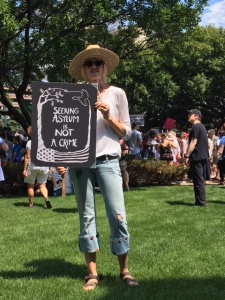
 Growing up in the age of Darwinian elementary schools –the gym teacher would choose the two best athletes to captain every team, and one by one they would pick off first the good athletes, then the midlings, then the uncoordinated, until finally there was only one child remaining, huddled against the wall– I hated gym class. Not because I was bad at sports (I’m not) but because I can’t stand cruelty. And that little ritual was fundamentally cruel.
  Rough, rough week. Children torn from their parents at borders, the suicides of loved people who projected happiness, the cruelty of our elected employees and the ongoing and unfathomable cowardice of their minions who stand by, watching our democracy crumble. Last night I scrolled through poem after poem, looking for one with clear eyes and a level gaze, like this one below. A poem that sees the situation for what it is and imagines it as it can be. Time for us to be the goddesses who remake this world.
  Yesterday, after heavy rains, I went for a long walk. I kept hearing opera music and I looked around to see a man grinning at me and nodding from his car, where the windows were open and the volume turned way up. I laughed and waved back at him, and the below poem leaped up into my mind. My grandmother, whose life was extraordinarily hard, used to recite it to us with an unfamiliar lilt in her voice.
 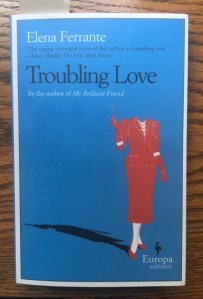 Troubling Love, by Elena Ferrante.
 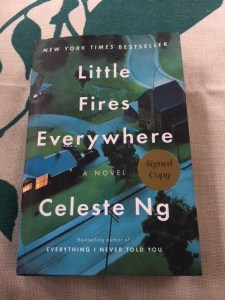 Little Fires Everywhere, by Celeste Ng. Damn. This is a hell of a novel. I was instantly absorbed into the lives of this Shaker Heights community and its denizens. Ng writes with such clarity about every one of her people, no matter who they are, weaving issues of class and race into the powerful themes of the book in such a way that I empathized with everyone. That’s not an easy task. You know what else is an inordinately difficult task? To write in the third person omniscient (in which you’re inside the heads of everyone) and pull it off, the way Ng does, seemingly without effort. And her portrayal of Mia, the photographer artist at the core of every scene, was astonishing in its powerful take on what drives an artist and her art. I loved this book.
 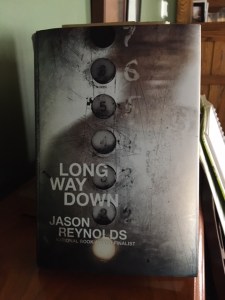 Long Way Down, by Jason Reynolds. Jason Reynolds can do no wrong in my eyes. He’s changing the world, one book and one speech at a time, and Long Way Down is no exception. The structure of the book is cool –it takes place in a single elevator ride from the 13th floor to the lobby of the building in which the main character lives–and it’s told in near-verse. Few words, huge power. This novel shook me up and made me want to reach into its world and wrap my arms around everyone, living and dead, who is given a voice here.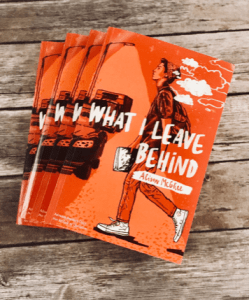
 Looking for Alaska, by John Green. This is my third John Greene novel, and when I finished it I decided to read everything else he’s written. The man deserves his bestselling and critically acclaimed status. The way he gets straight to the heart of the matter, the matter being life and its big questions in the face of tough situations, especially in his brilliant dialogue, is the way I wish we all were, all the time, in real life. His people are so real and so lovable, and they care so much about each other. Hilarious, painful, heart-opening.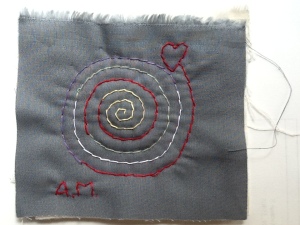
 Old men who hold their wives’ handbags for them as they put on their coats. Young fathers who hold their toddlers’ hands as they cross the street. The girl who jumps up to open the door for the woman using the walker. The cafe manager who keeps a water bowl outside, filled with cool water, for passing dogs. The man with the truck who goes up and down the rural road, plowing out his elderly neighbors. Everyone waving goodbye, tears in their eyes, as the ones they love disappear into the airport, like in the movie Love Actually*. The movie Love Actually. A note left in a poetry box, thanking the “poem attendant” for “all the good poems.” A carful of grinning men chattering in Spanish, pulling over to the side of a snowy road and pushing the young woman’s car out of the ditch. The world is full of sweetness. When I need to remind myself of that, which is often, in these days of bewildering cruelty and greed by our elected employees, this is one of the poems I recite to myself.
  Last week my water filter leaked into the storage bin where my youngest’s childhood mementoes are kept. I brought it upstairs and spread her things out to dry. Onesies, footie pajamas, overalls with ripped-out knees. Her high school graduation cap. Notebooks filled with book reports and drawings and journal entries. Cards she’d written to me, mostly construction paper drawings along with I love you mom. The arc of eighteen years spread out on the kitchen table and counters. The tiny quilt I made for her before she was born and which she wore to literal shreds was damp, and I picked up the strands and held them to my heart.
 Alison McGhee