Poem of the Week, by Marie Howe

IMG_4207
The summer after college graduation, my sister and I headed to a Colorado ski town for the summer. We lived and worked in a hotel with a bunch of other temporary people, among them a guy named Jerry and his buddies. They were gay men, bright and blunt and full of hilarious advice. In my memory Jerry is always in a bathrobe, smoking and ironing shirt after shirt at the permanently set up ironing board in his room. The hotel felt like a giant dorm, doors ajar, constant conversation. We laughed all the time.

Six months later, I had moved far away to Boston. A strange disease was just beginning to take hold, a killer disease that seemed to affect only gay men. Rumors were that it was transmitted by sex. I remember unfunny jokes by unfunny straight people. I remember vast uneasiness among my gay friends. I remember feeling terrified for them.

Flash forward many years to now, when there is good treatment but still no cure for the strange disease. Some of my friends have lived with the virus for close to forty years. Others have died. Sometimes Jerry flashes into my mind, and I wonder about him and the others who lived in our long-ago hotel. The first time I read this poem by Marie Howe, whose brother died of AIDS, I memorized it. I don’t know why I think of Jerry when I recite it to myself, but I do. Jerry, are you out there, still ironing your shirts, still making everyone around you laugh? 


My Dead Friends, by Marie Howe

​I have begun,
when I’m weary and can’t decide an answer to a bewildering question

to ask my dead friends for their opinion
and the answer is often immediate and clear.

Should I take the job? Move to the city? Should I try to conceive a child
in my middle age?

They stand in unison shaking their heads and smiling—whatever leads
to joy, they always answer,

to more life and less worry. I look into the vase where Billy’s ashes were —
it’s green in there, a green vase,

and I ask Billy if I should return the difficult phone call, and he says, yes.
Billy’s already gone through the frightening door,

whatever he says I’ll do.


​Click for more information on​ Marie Howe.


Website

Blog

Facebook page

@alisonmcghee


Poem of the Week, by Andrea Gibson

Screen Shot 2018-11-24 at 8.51.08 AMA few weeks ago an anonymous teen sent me the note to the right, and I wished I could put my arms around them. Three times in my own life, I’ve called a crisis hotline. Each time, I was calling because someone I loved was contemplating suicide, and I wanted to get help for them. Advice by proxy, with me as the conduit. Each time, the volunteer kept ignoring my pleas for help for my friend and calmly and gently steered me back to myself: Where are you right now? How do you feel right now? What’s your plan for when we hang up? 

What was really happening was that the hotline volunteer understood –when I didn’t–that I had called because of my own desperation and terror. These conversations lasted close to an hour each time, and when I hung up, some small part of peace and belief had been restored in me and I was able to keep going. Sometimes you feel, for whatever reason, that you can’t burden your friends and family with your pain and worry. I can’t begin to express my gratitude to these anonymous voices, trained to listen, and to see below the surface.

Those voices are why I added crisis hotlines to the back of my novel What I Leave Behind, which is a book at core about kindness in the face of profound sorrow. What good can an anonymous voice on the other end of an anonymous phone line do? A lot, because that voice is not, in fact, anonymous. None of us are anonymous. We are all connected. Like the brilliant Andrea Gibson says in their mesmerizing poem below, What I know about living is the pain is never just ours. Every time I hurt I know the wound is an echo, so I keep listening for the moment the grief becomes a window.

The Nutritionist, by Andrea Gibson

The nutritionist said I should eat root vegetables,
said if I could get down thirteen turnips each day
I would be grounded, rooted.
Said my head would not keep flying away to where the darkness lives.

The psychic told me my heart carries too much weight,
said for twenty dollars she’d tell me what to do.
I handed her the twenty and she said, “Stop worrying, darling,
you will find a good man soon.”

The first psycho-therapist said I should spend three hours a day
sitting in a dark closet with my eyes closed and my ears plugged.
I tried it once but couldn’t stop thinking
about how gay it was to be sitting in the closet.

The yogi told me to stretch everything but the truth, 
said focus on the out breath,
said everyone finds happiness
if they can care more about what they can give
than what they get.

The pharmacist said Klonopin, Lamictal, Lithium, Xanax.

The doctor said an antipsychotic might help me forget
what the trauma said.

The trauma said, “Don’t write this poem.
Nobody wants to hear you cry about the grief inside your bones.”

But my bones said, “Tyler Clementi dove into the Hudson River
convinced he was entirely alone.”

My bones said, “Write the poem.”
To the lamplight considering the river bed,
to the chandelier of your faith hanging by a thread,
to everyday you cannot get out of bed,
to the bullseye of your wrist,
to anyone who has ever wanted to die:

I have been told sometimes the most healing thing we can do
is remind ourselves over and over and over
other people feel this too.

The tomorrow that has come and gone
and it has not gotten better.

When you are half finished writing that letter
to your mother that says “I swear to God I tried,
but when I thought I’d hit bottom, it started hitting back.”

There is no bruise like the bruise
loneliness kicks into your spine
so let me tell you I know there are days
it looks like the whole world is dancing in the streets
while you break down like the doors of their looted buildings.
You are not alone
in wondering who will be convicted of the crime
of insisting you keep loading your grief
into the chamber of your shame.

You are not weak
just because your heart feels so heavy.
I have never met a heavy heart that wasn’t a phone booth
with a red cape inside.

Some people will never understand
the kind of superpower it takes for some people
to just walk outside some days.
I know my smile can look like the gutter of a falling house
but my hands are always holding tight to the rip cord of believing
a life can be rich like the soil,
can make food of decay,
turn wound into highway.

Pick me up in a truck with that bumper sticker that says, 
“It is no measure of good health
to be well adjusted to a sick society.”

I have never trusted anyone
with the pulled back bow of my spine
the way I trusted ones who come undone at the throat
screaming for their pulses to find the fight to pound.
Four nights before Tyler Clementi
jumped from the George Washington bridge
I was sitting in a hotel room in my own town
calculating exactly what I had to swallow
to keep a bottle of sleeping pills down.

What I know about living
is the pain is never just ours.
Every time I hurt I know the wound is an echo,
so I keep listening for the moment the grief becomes a window,
when I can see what I couldn’t see before
through the glass of my most battered dream
I watched a dandelion lose its mind in the wind
and when it did, it scattered a thousand seeds.

So the next time I tell you how easily I come out of my skin
don’t try to put me back in.
Just say, “Here we are” together at the window
aching for it to all get better
but knowing there is a chance
our hearts may have only just skinned their knees,
knowing there is a chance the worst day might still be coming

let me say right now for the record,
I’m still gonna be here
asking this world to dance,
even if it keeps stepping on my holy feet.

You, you stay here with me, okay?
You stay here with me.

Raising your bite against the bitter dark,
your bright longing,
your brilliant fists of loss.
Friend, if the only thing we have to gain in staying is each other,
my god that is plenty
my god that is enough
my god that is so so much for the light to give
each of us at each other’s backs
whispering over and over and over,
“Live. Live. Live.”

To listen to Andrea Gibson perform this poem, click here.

For more information on poet and performer Andrea Gibson, click here.

Website

Blog

Facebook page

@alisonmcghee

Poem of the Week, by Czeslaw Milosz

Boston public garden ducklingsHere’s the fourth-floor walkup you called home. Here’s the tiny room overlooking Joy Street where Laurel used to roll her waitressing change into paper tubes for the rent. Here’s your room, with the big saggy bed left by a previous tenant. Here’s the bathroom where you didn’t pee at night because darkness was the domain of the cockroaches. Here’s the plant in the sunny window that you wound around itself because it was out of control.

Here’s the curbside rocking chair that your friend lugged up for you. Here’s the curbside rug on the living room floor where you used to host your Chinese dinner parties. Here’s the couch you were lying on that spring Thursday when the phone call came. This is the place you fled a few weeks later. The place where you were a girl and then not. The place that comes back to you in dreams, just the way this poem does. 

Encounter
    – Czeslaw Milosz

We were riding through frozen fields in a wagon at dawn.
A red wing rose in the darkness.

And suddenly a hare ran across the road.
One of us pointed to it with his hand.

That was long ago. Today neither of them is alive,
Not the hare, nor the man who made the gesture.

O my love, where are they, where are they going
The flash of a hand, streak of movement, rustle of pebbles.
I ask not out of sorrow, but in wonder.

 
For more information on Czeslaw Milosz, please click here

Poem of the Week, by Anne Sexton

IMG_0695When he was little, my son sometimes asked me questions that seized my heart, questions like Mama, what if we’re all characters in a book, and someone is writing us right now? Where these questions came from, I don’t know. Then and now he was what I think of as an old soul. Once, when he was a teenager and we sat in a waiting room, I assumed he was bored and offered him a book to read. No, he said, I’m just going to sit here and think. 

These days, in the midst of theories that maybe we’re all characters in a video game being played by beings in a galaxy far, far away, I think about my son’s long-ago question. Then and now I have no answers. Curiosity, fear, longing and wonderment, all tumbling around inside me like an animal clutched fast to my heart. 


The Poet of Ignorance, by Anne Sexton

Perhaps the earth is floating,
I do not know.
Perhaps the stars are little paper cutups
made by some giant scissors,
I do not know.
Perhaps the moon is a frozen tear,
I do not know.
Perhaps God is only a deep voice
heard by the deaf,
I do not know.

Perhaps I am no one.
True, I have a body
and I cannot escape from it.
I would like to fly out of my head,
but that is out of the question.
It is written on the tablet of destiny
that I am stuck here in this human form.
That being the case
I would like to call attention to my problem.

There is an animal inside me,
clutching fast to my heart,
a huge crab.
The doctors of Boston
have thrown up their hands.
They have tried scalpels,
needles, poison gasses and the like.
The crab remains.
It is a great weight.
I try to forget it, go about my business,
cook the broccoli, open the shut books,
brush my teeth and tie my shoes.
I have tried prayer
but as I pray the crab grips harder
and the pain enlarges.

I had a dream once, 
perhaps it was a dream,
that the crab was my ignorance of God.
But who am I to believe in dreams? 


Click here for more information about the beautiful poet Anne Sexton.  

Website

Blog

Facebook page

@alisonmcghee

Poem of the Week, by Carl Dennis

IMG_0696My friend Todd is an art museum guard by day and an artist by day and night. He composes and records original songs, dives deep into pop music he orders from Japan, watches and re-watches Miyazaki films, reads and re-reads favorite novels and finds something new in them each time. Whatever draws him, he will follow: He’s learning Japanese, has become a sushi expert, and gradually, over the years, has compiled a collection of hilarious and somehow profound observations on life as a museum guard. 

Todd is an artist, and so am I, and the ways we go about it are so different. I’ve never pulled an all-nighter in my life. I rarely re-read books or re-watch movies. When an idea grabs me, the intensity of the grabbing almost scares me. Instead of diving in full throttle the way Todd would do, I’m more likely to hold the idea in the back of my mind and channel its power into small daily tasks on my scrap paper to-do list. 

There’s no one way to be an artist in the world, no one way to make your art. Books result from my process just as music results from Todd’s. But I look at him and the way he lives his life and it’s like I’m looking at a planet similar to the one I live on, close by but unavailable to me. There are so many ways to read the beautiful poem below, most of them related to history and the ways it repeats. But when I read it, it was the difference between the poet Carl Dennis and his brother that struck me, because it’s the difference between Todd and me, and it almost made me cry.


War and Peace, by Carl Dennis

In 1949, when I was ten,
a year after the airlift for beleaguered Berlin
had foiled Stalin’s attempt to starve it
and the Marshall Plan was offering battered Europe
a hand to get on its feet, my brother Robert,
six years older, inched his way, in the room we shared,
through the thousand pages of War and Peace
while I lay sleeping. It took him four months,
an hour a night, a project that seemed to me
even more peculiar than his listening after school
to symphonies and quartets. Yes, our mother
had often mentioned the book as her father’s favorite,
the one he’d first read, in his village near Uman,
in Tolstoy’s Russian, though he’d learned his Russian
after Yiddish and Ukrainian. But that didn’t explain
my brother’s pressing on after the first few pages.
Four months just to learn about the families
he tried to describe to me, the Bolkonskis
and Rostovs and Bezukhovs, or about the French
on the march near Moscow, and Tsar Alexander.
it was all so far from the suburb of St. Louis
where we were living peaceably with our parents
most of the time, in a quiet neighborhood.
Of course, by the time my brother read Tolstoy
he’d listened to music composed in Madrid and Naples,
in Leipzig, Vienna, and St. Petersburg.
On a Saturday close to his thirteenth birthday,
before he was driven off to his Bar Mitzvah,
he lost himself in the Rite of Spring.
If I say I followed my brother’s lead when sixteen
by reading, all summer long, his dog-eared copy
of War and Peace—the Maude translation—
I don’t equate my motive for sticking with it—
wanting to be like him, not left behind—
with his simple wish to open his life
to the wonders available. When I need to list
the wonders I’ve seen, I begin by returning
to the year I was ten, 1949,
the year that NATO began its efforts
to defend the free world from the world of darkness,
when my brother crossed the border each night
as if darkness were not an obstacle,
as if the iron curtain were a curtain of gauze,
no harder to lift than to turn a page.    


​For more information on Carl Dennis, please click here.​

Website

Blog

Facebook page

@alisonmcghee

Poem of the Week, by Tony Hoagland

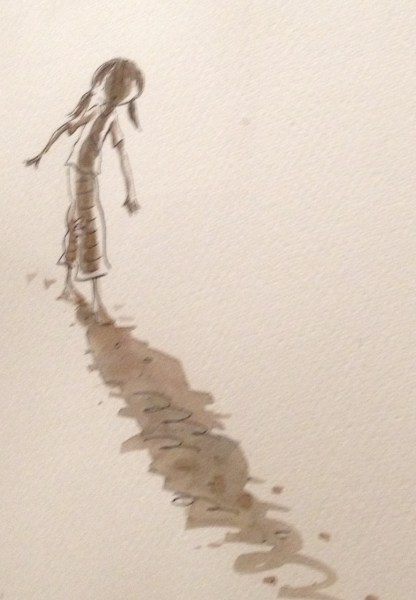
img_6112Q: Does writing about hard things ever make you agitated and upset, so that you have to walk away from the writing and regain your equilibrium?
A: Nope. Life is what’s hard. Writing is always solace.

This exchange took place in a university undergraduate creative writing class a couple of weeks ago. Writing is how I translate all the emotion and experience of living into something that’s bigger than me. It’s a means of transcendence, a way to push away all that hugeness and also absorb it. To make a connection with other human beings you don’t know and have never met.

So is reading, poetry especially. For decades Tony Hoagland’s work has been solace. It’s like he saw into my heart and wrote poems meant just for me, even though he was beloved by so many. I meant to write him a letter this fall, telling him how much he means to me, but he died last week, so my letter will never be written. Don’t take it personal, they said; but I did, I took it all quite personal– Oh Tony, I’m so sad you’re gone.


Personal, by Tony Hoagland

Don’t take it personal, they said;
but I did, I took it all quite personal—

the breeze and the river and the color of the fields;
the price of grapefruit and stamps,

the wet hair of women in the rain—
And I cursed what hurt me

and I praised what gave me joy,
the most simple-minded of possible responses.

The government reminded me of my father,
with its deafness and its laws,

and the weather reminded me of my mom,
with her tropical squalls.

Enjoy it while you can, they said of Happiness
Think first, they said of Talk

Get over it, they said
at the School of Broken Hearts

but I couldn’t and I didn’t and I don’t
believe in the clean break;

I believe in the compound fracture
served with a sauce of dirty regret,

I believe in saying it all
and taking it all back

and saying it again for good measure
while the air fills up with I’m-Sorries

like wheeling birds
and the trees look seasick in the wind.

Oh life! Can you blame me
for making a scene?

You were that yellow caboose, the moon
disappearing over a ridge of cloud.

I was the dog, chained in some fool’s backyard;
barking and barking:

trying to convince everything else
to take it personal too.


I’ve sent out many Tony Hoagland poems in the past, and I could send out Tony Hoagland poems every week for a year; that’s how much I loved him. For more poems by Tony, please click here.

Website

Blog

Facebook page

@alisonmcghee

Excuse me

IMG_1258A few years ago I sat in a crowded auditorium listening to a speaker lecture on a topic I don’t remember. What I do remember is that fifteen minutes into his lecture, he was interrupted by an audience member who jumped to his feet and, under the guise of asking a question, began to harangue the speaker. The speaker, who was elderly and softspoken, was clearly stunned at the interruption, which had clearly been planned. The audience member grew taller and louder as he launched into his own, counterpoint lecture. He gesticulated. He menaced.

Everyone in the room was instantly on edge, disturbed and deeply uneasy. You could feel the tension in the air. We looked at each other, wild-eyed: What do we do? What should we do? No one moved. But something had to be done. So I jumped up and waved my hand until the angry audience member saw me and paused for a second. 

“Excuse me, but your original question has nothing to do with your comments,” I said. “Please sit down.”

This was someone not used to being challenged. He didn’t know what to do with my interruption. He started questioning me, in annoyance and surprise, lost his train of thought, fumbled, sat down. 

It sounds like such a simple thing, but interrupting this man was extremely hard for me. My heart raced and my hands trembled and I couldn’t stop shaking. But my mission –to put a stick in the spokes of the runaway heckler– was accomplished.

This incident, and others like it, comes back to me a lot these days. We have so much more power, as a group and also as a single human being, than we think we do. People take their cues from leaders, and every day I remind myself that I can be a leader. That I am a leader. Every single one of us is, if we choose to be.

We are surrounded right now with daily assaults, some of them deadly, to human decency and our sense of our country as a functioning democracy. In the midst of this, it helps to remind yourself that you are a leader. Leaders act more often than react. Acting out of optimism, hope, faith and determination to make this world better will give you far more energy than reacting with despair and outrage to every day’s fresh hell. 

What I tell myself: Alison, there are too many fresh hells right now to handle, so don’t try to handle them all. But every single time there’s a chance to be kind, to stop a bully, to thwart a racist or sexist remark, to look someone in the eye and smile, to take positive action, do it. 

Concrete actions that are helping me right now:

In-depth conversations with people who believe differently from me but who remind me that we have far more in common than our voting records.

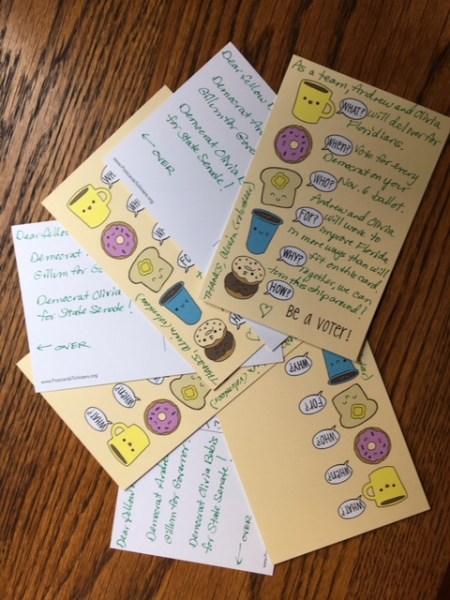
Hand-writing postcards to get out the vote.

Teaching creative writing classes on the Transformation of Trauma for free.

Distributing poems to all my neighbors.

Donating money, a little every day, to a good cause.

Reading: history, novels, poetry.

History is full of examples of leaders who fomented violence and hate wherever they went, with deadly consequences. We are seeing that right now in our own country. But violence and hate can be counteracted at every turn. Take action. Don’t lose the faith. 


Poem of the Week, by Keetje Kuipers

Screen Shot 2018-04-05 at 8.44.01 AMLong ago I left behind the simple prayers of my childhood, the ones spoken in unison with others in church, or around the table at a special meal when everyone named something they were thankful for. I’ve never known what God is, and I don’t know what God is to others. If forced to come up with a definition, my definition of God would be something like the feeling of my children on either side of me in bed as I read them to sleep when they were little. God would be the high school students I used to teach, ringed on the floor in our classroom on the giant pillows  I’d made, still and silent and sometimes falling asleep on Friday afternoons as I read them stories. God would be the idea and the feeling of peace, of a place where nothing bad can happen, where only love and comfort dwell. God would be the poems that swell my heart open in a way that almost hurts, like this one below.
 

Prayer, by Keetje Kuipers

Perhaps as a child you had the chicken pox
and your mother, to soothe you in your fever
or to help you fall asleep, came into your room
and read to you from some favorite book,
Charlotte’s Web or Little House on the Prairie,
a long story that she quietly took you through
until your eyes became magnets for your shuttering
lids and she saw your breathing go slow. And then
she read on, this time silently and to herself,
not because she didn’t know the story,
it seemed to her that there had never been a time
when she didn’t know this story—the young girl
and her benevolence, the young girl in her sod house—
but because she did not yet want to leave your side
though she knew there was nothing more
she could do for you. And you, not asleep but simply weak,
listened to her turn the pages, still feeling
the lamp warm against one cheek, knowing the shape
of the rocking chair’s shadow as it slid across
your chest. So that now, these many years later,
when you are clenched in the damp fist of a hospital bed,
or signing the papers that say you won’t love him anymore,
when you are bent at your son’s gravesite or haunted
by a war that makes you wake with the gun
cocked in your hand, you would like to believe
that such generosity comes from God, too,
who now, when you have the strength to ask, might begin
the story again, just as your mother would,
from the place where you have both left off.


For more information about Keetje Kuipers, please click here.


Poem of the Week, by Olav Hauge

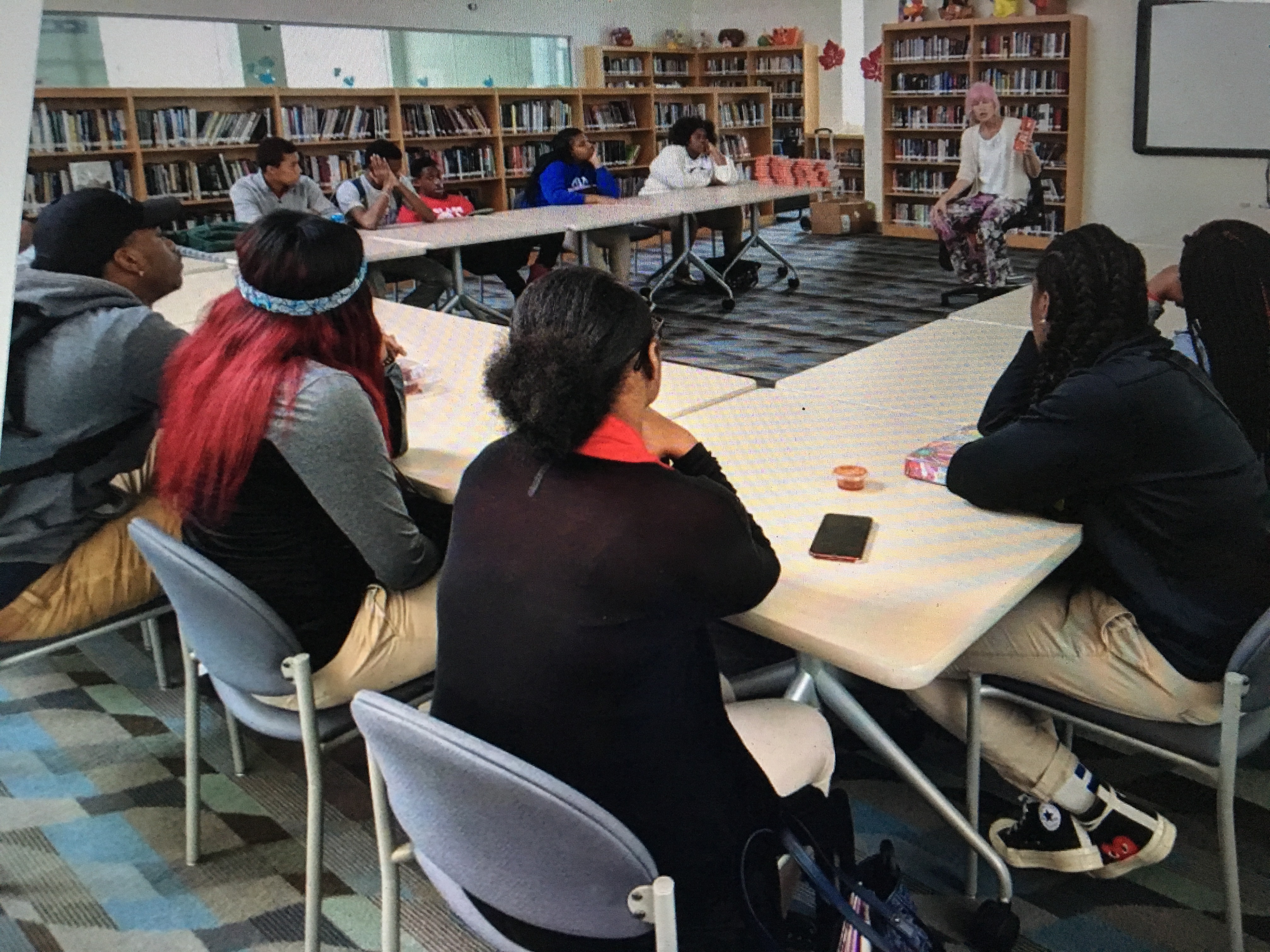
IMG_1168Me to a roomful of high school students last week: “Raise a hand if you’ve lost someone you love to murder.”
Every hand went up.

Every hand. At least that’s how it looked to me, standing there. How do you make your way through something impossibly hard? That was the premise of our conversation, and the students took turns reading out loud from my novel What I Leave Behind, which is about exactly that. Impossible hardship is something these students are no strangers to. Institutionalized racism and sexism and poverty are all designed to keep a few people sitting pretty at the expense of so many, and one result is a roomful of children who have all watched loved ones die violently. 

I asked them how they coped. Some meditated. Some did yoga. Some cooked. Some listened to music. And every one of them seemed to make art: writing, painting, drawing, singing. They clearly understood the power of art, how you can use it to translate and transcend an impossible experience, push it out of you and at the same time absorb it. Art can keep you connected to others. These students are old souls, wise beyond their years. I got back to my hotel that night to find that a friend in Germany had sent me a poem that I’d forgotten, a poem I love. A poem that the minute I saw it felt like the poem to send in honor of these beautiful, powerful youth. We have to do better by them.

This Is the Dream, by Olav Hauge (translated by Robert Hedin and Robert Bly)

This is the dream we carry through the world
that something fantastic will happen
that it has to happen
that time will open by itself
that doors shall open by themselves
that the heart will find itself open
that mountain springs will jump up
that the dream will open by itself
that we one early morning
will slip into a harbor
that we have never known. 

For more information on Olav Hauge, please click here.
Website

Blog

Facebook page

@alisonmcghee


Dear Sister, the backstory

Picture the scene: Me arriving home to find my youngest plopped on the couch happily watching tv alone, surrounded by her stuffed animals, blankie, and an assortment of the pretzels and crackers that at the time comprised most of her body wScreen Shot 2018-09-28 at 1.11.39 PM copyeight and were the reason my nickname for her was Dry Salty Crunchy Carbohydrate.
Me, wary: “Where’s your big brother?”

Her, happy: “Dunno.”

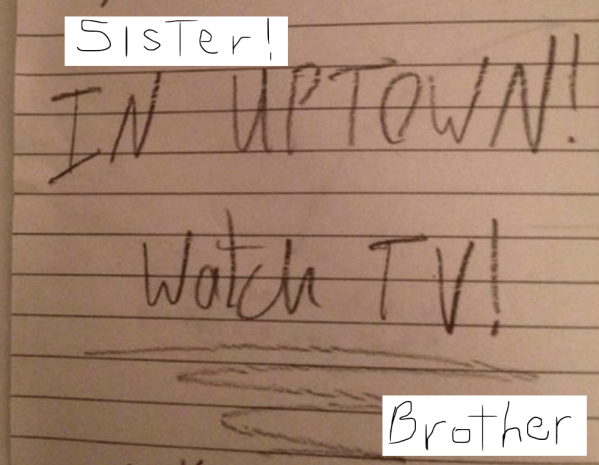
At which point I walked into the kitchen to find this note on the fridge. Which I stuck in a box of my son’s childhood mementoes and forgot about.

Screen Shot 2018-09-28 at 1.15.25 PM copy

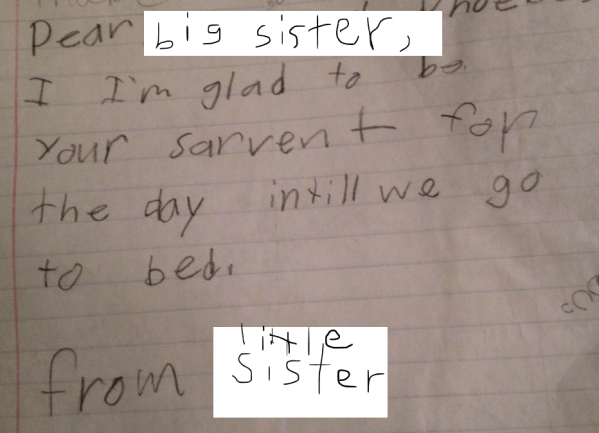
Picture this scene as well: me noticing one weekend day that my youngest seemed to be spending much of her time trundling about the house doing small chores and fetching things for her big sister and big sister’s friend. 

Me to big sister and big sister’s friend, who were clearly enjoying a life of leisure with their indentured servant, suspiciously: “What’s going on here?”

Them, airily: “Nothing. Just playing.”

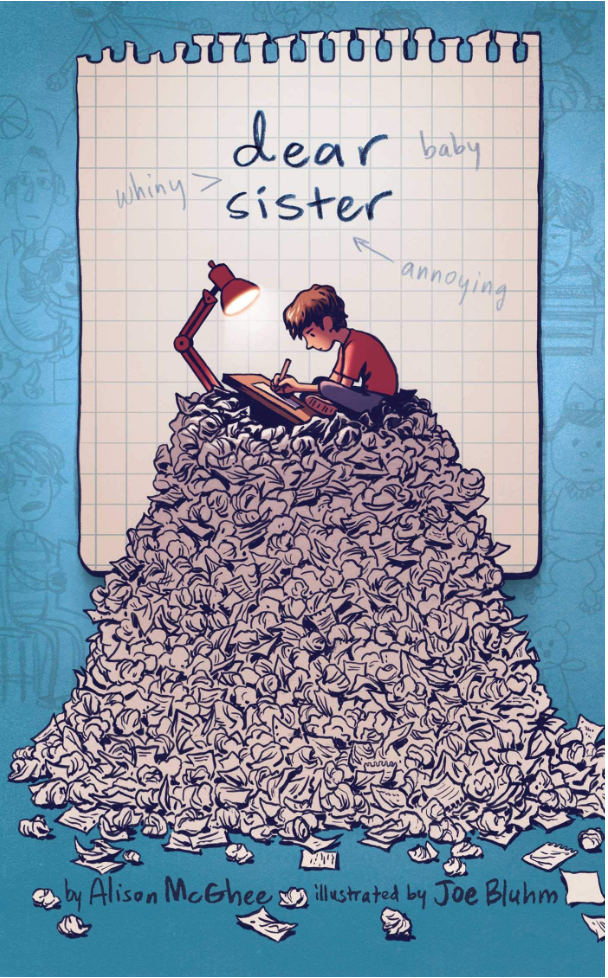
Later that day I found the above note. Which I stuck in a box of my older daughter’s mementoes and then forgot about. Until a couple of years ago, when they were all in college and I decided to go through those boxes and found both notes and a bunch more. Which gave me the idea to write a book about the sibling relationship that consisted entirely of notes and drawings. And here we are! Dear Sister, a graphic novel-ish book for all ages, illustrated by the fabulous Joe Bluhm, comes out tomorrow wherever you buy your books. 

Screen Shot 2018-09-03 at 5.59.26 PM

To order a copy

From your local indie bookstore
From Amazon
From Barnes & Noble