“Maybe a Fox”

Maybe a FoxMy lovely friend Kathi Appelt and I wrote a novel together, Maybe a Fox, here on Indiebound and here on Amazon, which was published last week. It began as a lark (I’ve always wanted to use that phrase, so thank you for letting me do so here), sparked by our friendship and a poem we both loved, but it took us one helluva long time to write it, as you will see if you read the below post we wrote about the process. The book has so far gotten a bunch of starred reviews, which makes us happy, given that at a few points we were close to throwing in the towel (on the book, not our friendship).

Maybe a Fox has also just been published in audio form. For better and for worse, I did the recording. Click here for a sample of the audio version. Recording a book on audio is weird and fascinating. The booth is silent and you have to sit perfectly still. You have to physically place your hands where you want them before you say a word, for example, because the sound mics are so sensitive that the tiny touch of your finger on your jeans will sound like wind. You can see the producer and the sound engineer beyond the soundproof window, chatting and drinking coffee and eating malted milk balls, but everything’s silent where you are. This was such a cool experience.

How in the world do you write a novel with another person? Kathi and I just jumped in and figured it out as we went along (and along and along and along and along).

The collaboration that would become Maybe a Fox began many years ago in a freezing and dingy dorm at Vermont College of Fine Arts, where we were new both to the faculty and to each other. Alison’s roller bag had gone missing at the airport, and she remembers Kathi tilting her head in sympathy and offering, in that beautiful Texas accent of hers, to lend her a pair of pajamas. Kathi doesn’t remember that, but she does remember breakfast the next day, when the two of us loaded up our trays and scuttled to sit together at a small table between two huge pillars in the drafty dining hall, a table we sat at every day, three times a day, for each of the residencies we shared.

It was friend-love at first sight, and it was that very first week, when we were eating one of the many meals we ate together Between the Pillars, that Kathi suggested we write a book together.

“What kind of book?” Alison said.

“A book about two sisters,” Kathi answered.

Both of us had many other projects that occupied us, and the idea was tabled, although one of us would occasionally bring it up over the years. Then, about five years ago, Alison sent out a poem about a small red fox in snow as her Poem of the Week. Something about that little fox ignited both of us, and we decided to take the plunge and begin our book.

The ground rules:

  1. The book would be about two sisters who were somehow separated, and it would also contain a small red fox.
  2. Each of us would take on a new challenge in the writing, something she’d never done before as a writer.
  3. We would each write in a separate viewpoint, with chapters alternating between those viewpoints.

After considering the sister possibilities –twins separated at birth? Sisters each living with one parent? One sister in prison and the other not? One sister alive and the other not?—we left it vague. Sisters, separated somehow. We figured the fox would appear on its own terms, when the time was right, so we didn’t worry about that. As for the personal writing challenge, Kathi decided to write in first person, since she hadn’t before, and Alison decided to write in the voice of the fox, since up until then she’d stayed strictly with humans.

We began the book by trading chapters weekly, sometimes more often if the muse struck. We worked wildly fast, most of the time, and the story gathered ground and impetus week by week. Kathi was fascinated by the fact that some rare rivers disappear underground. Alison was fascinated by the idea of an animal that could sense things from a world beyond this one. We tossed ideas back and forth, tried them out week by week, abandoned them if they were dead ends, followed them as far as we could if they felt powerful.

Eventually we realized that we were writing a book about maybes, about the way we as human beings try to answer unanswerable questions –what happens when we die? What happens with grief too big to stand? What happens when you can’t find the answers to what you most need to know?—and that sense, of both possibility and heartbroken wonder, became the core of the novel.

We wrote an entire, unwieldy mess of a draft in half a year. With the ongoing help of our wonderful agent and the massive efforts of our beloved editor Caitlyn Dlouhy, we rewrote that mess of a draft countless (literally, we have no idea at this point how many times we rewrote that book) times over the next four years. What began as an alternating-chapter, alternating-point of view method turned into a we’ll-work-on-the-whole-thing-together method. Where Alison once was the sole writer of the fox chapters, and Kathi the sole writer of the Jules chapters, we can no longer point to any voice or passage or chapter as belonging to either of us. We moved from emailed chapters to simultaneous Google doc revisions to taking turns separately revising the entire book (over and over).

At one point early on, Kathi flew up from Texas and we sat on Alison’s porch in Minneapolis and took turns reading chapters out loud to each other, pencils in hands, marking up places to revise. We laughed. We cried. We talked through every aspect of plot and character. We never once, strangely enough, argued. Kathi flew back to Texas and the rewrites continued for another three years. At some point along the way we began sending each other fox totems: a fox necklace, a framed fox photograph, a felt basket with a fox on it, fox notecards. Alison now sees foxes wherever she goes; like the characters in Maybe a Fox, she considers them good luck.

Maybe a Fox is so much a part of our hearts and souls at this point that we privately admit to each other we have no idea if it’s any good or not; it just is. We do know that we still, each of us, cry when we read the ending. Just like Jules and Sylvie in Maybe a Fox, we consider ourselves sisters. Sister Kathi, Sister Alison. Our book is made out of wonder and longing and struggle and love. We hope it finds a good place in the world.

Poem of the Week, by Jim Daniels

IMG_4028Those boots over there were sitting amongst the rundown running shoes and loafers and wingtips on a display rack of men’s shoes at Experienced Goods in Brattleboro, Vermont a few years ago. They were $8. It was clear that they were at least an inch too long for me, but because they were narrow I tried them on anyway and they fit as if someone had poured liquid leather around my feet and ankles and it magically turned into boots. I took them to an old-school cobbler to be resoled.
“Can you tell me what brand these are?” I said. “Because I need to buy only this brand for the rest of my life.”

He smiled.

“You can’t buy this brand,” the cobbler said. “There is no brand. These boots are probably thirty years old. They were handmade in Italy.”

Leather boots, steel toe boots especially, are one of the few things left in the world that can’t be rushed. They can’t be stonewashed or bleached or chemically altered in order to save time, because what boots need to fit right is exactly that: time. This poem reminds me of that fact.

Work Boots: Still Life
     – Jim Daniels

Next to the screen door
work boots dry in the sun.
Salt lines map the leather
and laces droop
like the arms of a new-hire
waiting to punch out.
The shoe hangs open like the sigh
of someone too tired to speak
a mouth that can almost breathe.
A tear in the leather reveals
a shiny steel toe
a glimpse of the promise of safety
the promise of steel and the years to come.

For more information on Jim Daniels, please click here.

Poem of the Week, by Leah Falk


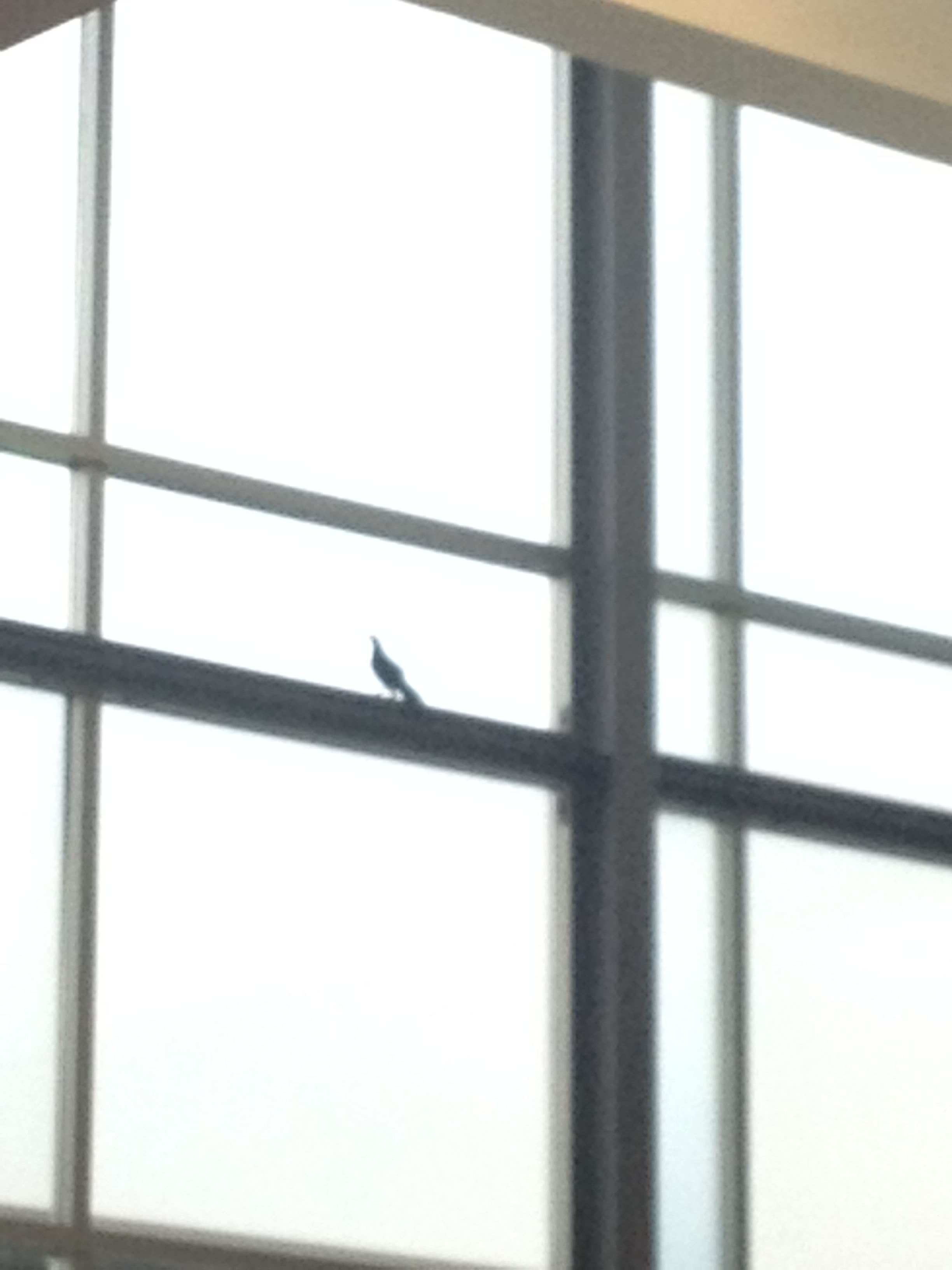
See that bird below? I’ve been watching him sing his heart out for hours now, here at the Austin, TX airport, where we have both taken up residence, me for the better part of 24 hours and him for who knows how long. A combination of overbooked flights, rebooked flights, unbooked flights and the chaos of the SXSW music festival have given me the opportunity to get to know this airport well, although probably not as well as this bird. I wander from one end of the terminal to another, listening to live music, eating pretzel bits offered up by the Auntie Anne’s server, talking to the Earl Campbell Sports Bar waiter who recognized me this morning from dinner last night, and listening to the bird. He might not be singing so much as wailing, and who can blame him? He made me think of this beautiful poem by Leah Falk. A torn page in the book of animals.

IMG_3996.JPG


Noah, to His Dove

– Leah Falk


With your wings of paper, fly, my bird, and find

a man who stands in water. In this land,

even far from shore, the brows of waves might break

against a sandy table, glass moon lit

to guide them toward last call, their salty end.


To the man who holds that trembling room

together with his feet—who holds his heart

against erosion—give your gentle body,


its crisp folds, its fragile case, its ink

as sweet as liquor. If he reads you over

and again, build us a house upon his rocky breast,


gather clay and willow. Until then, when I come

to your torn page in the book of animals,

my own heart stills and digs a trench that fills with rain.


For more information on Leah Falk, please click here.

My website.​​

My blog.
My Facebook page.

Twitter: @alisonmcghee

Poem of the Week, by Alden Nowlan

IMG_0382When I was a kid, the school bus I rode back and forth to school was a horror show of cruelty perpetrated by bullies who were aided and abetted by the bus driver. Every four years I pretend to be British (a six-week election campaign! silence until September!) but it’s not working. Being bullied, watching others be bullied, staying silent about the crime of bullying, watching the as-yet-unbullied align themselves nervously behind the bullies with the goal of not being bullied themselves are all part of the same putrid bully swamp. A poem about someone rejecting the surround-sound meanness, even covertly, even though he’s scared, can act as partial antidote to the poison. Poem of the week, by Alden Nowlan.
Flossie at School
     – Alden Nowlan

Five laths in a cotton dress
was christened Flossie
and learned how to cry,
her eyes like wet daisies
behind thick glasses.

She was six grades ahead of me
and wore bangs; the big boys
called her “The Martian,”
they snowballed her home,
splashed her with their bicycles,
left horse dung in her coat pockets.

She jerked when anyone spoke to her,
and when I was ten
I caught up with her one day
on the way home from school,
and said, Flossie I really like you
but don’t let the other kids know I told you,
they’d pick on me, but I do like you,
I really do, but don’t tell anybody.
And afterwards I was ashamed
for crying when she cried.


For more about Alden Nowlan, click here.

Bookstore visits, March 7-10

Maybe a Fox

Greetings, anyone and everyone who lives within driving distance of the below bookshops! My lovely, funny, talented friend and novel-writing collaborator Kathi Appelt and I are embarking on a whirlwind tour next week, visiting bookstores to read from Maybe a Fox and chitchat with y’all (I’m channeling Kathi’s Texas drawl, can you tell?) about books and reading and your favorite cocktail (kidding) (but not really – I’m always on the lookout for a tasty new cocktail).

Maybe a Fox has gotten a bunch of starred reviews and great press and those who’ve read advance copies seem to be fans. It’s a book about two sisters, one of them gone forever, and how their lives intertwine with a baby girl fox. Set in Vermont, in the woods by a rushing river, it’s also a story about grief, memory, love, hope and wonderment. We would LOVE to see you next week if you’re around. We’ll also be appearing in Los Angeles (both of us), Texas again (Kathi) and Dubai (Alison) next month, so check for updates if you’re interested.

Monday, March 7—Milwaukee, WI

Oak Creek Public Library—6:30 p.m.

Tuesday, March 8—Naperville, IL

Anderson’s Bookshop—6:00 p.m.

Wednesday, March 9—Houston, TX

Blue Willow Bookshop—5 p.m.

Thursday, March 10—College Station, TX

Jacque’s Toys and Books—5:30 p.m.

Saturday, March 20–Tustin, CA (Alison only)

Once Upon a Storybook, 11 a.m.

Hope to see you there!


Public radio interview

Poetry hut, flowersFor anyone interested, here is the link to the public radio interview I did this morning. The thoughtful and talented Kerri Miller and I talked about poetry, my poetry hut (pictured to the left there), teaching, writing, the making of Firefly Hollow, the inner lives of children (and grownups), what it means to be a lifelong adventurer, the freedom that comes when you stop caring what others think of you in favor of resting with your own intentions, how the death of someone you loved when you were young affects you then and forever, how a book can momentarily take the poverty and pain out of a child’s life, a novel I feared and hated as a teenager but never forgot, the enormous usefulness of waiting instead of acting, Galway Kinnell, teaching at my beloved Metropolitan State University, school bus bullies, and a whole bunch of other things.

Poem of the Week, by Nancy Willard

Pete in first snow, 2011Snow in the city is beautiful for about a day, sometimes two days if it’s a blizzard and no plows or cars can get through the streets. The minute the plows go through, that beauty degenerates into muddy ice, brown clumps flung up on curbs, nearly impassable single-file streets where cars take turns one by one. Snow in upstate New York, where I grew up, is beautiful for months (and months and months) on end, because there’s nothing to interfere with it. White and blue and green and pink, all the colors of snow in the shifting light, turn every field and wood into calm. I remember waking up in the middle of the night to the rumble of snowplows sweeping down Route 274, their orange revolving light circling the walls of my room. Someone out there is taking care of us, is what the memory of that sound still feels like to me.


The Snow Arrives After Long Silence
– by Nancy Willard

The snow arrives after long silence
from its high home where nothing leaves
tracks or stains or keeps time.
The sky it fell from, pale as oatmeal,
bears up like sheep before shearing.

The cat at my window watches
amazed. So many feathers and no bird!
All day the snow sets its table
with clean linen, putting its house
in order. The hungry deer walk

on the risen loaves of snow.
You can follow the broken hearts
their hooves punch in its crust.
Night after night the big plows rumble
and bale it like dirty laundry

and haul it to the Hudson.
Now I scan the sky for snow,
and the cool cheek it offers me,
and its body, thinned into petals,
and the still caves where it sleeps.


For more information on Nancy Willard, please click here.

My Facebook page.

Poem of the Week, by ee cummings

Abel Pann, breathing life into AdamWhen I was a kid I used to read ee cummings’ poems not so much for the words but for the way he put them down on the page, all shoved up against each other, parentheses around some, weird punctuation, missing spaces, and the complete lack of upper case letters, down to the way he spelled his own name. Why why why why does he do it that way, I used to wonder. The strangeness and unconventionality was so fascinating. He was a Famous Person so I knew that all these choices must be intentional, but why why why?

If at first I didn’t care about the poems themselves, now I love them. Mr. Cummings is one of my most beloved poets, in fact. A small white used paperback copy of his 50 Poems that I found at a garage sale sits on a shelf in the living room; this poem felt right for today.

in spite of everything
– e.e. cummings

in spite of everything
which breathes and moves, since Doom
(with white longest hands
neatening each crease)
will smooth entirely our minds

– before leaving my room
i turn, and (stooping
through the morning) kiss
this pillow, dear
where our heads lived and were.


For more about ee cummings, please click here.


Poem of the Week, by Ellery Akers

California, choo choo train cloudsMany years ago I read Innumeracy, a slender, astonishing book by John Allen Paulos, about how the understanding or lack thereof of basic math and statistics affects everything about the way we live our lives. What I learned in that book humbled me and has stayed me with me ever since, especially the singular fact that every breath every one of us takes contains at least three molecules of the air breathed by every human being and creature who has ever lived on this earth. Gandhi. Hitler. Wooly mammoths. Jesus Christ. The prophet Mohammad. Your great grandparents, your great grandchildren. Every, single, breath. This poem makes me think of that all over again, in yet another way. Poem of the Week, by Ellery Akers.

Breathing
– Ellery Akers

I love to feel as if I’m just another body, a breather along with the others:
blackbirds taking sips of air, garter snakes
lapping it up with their split tongues,
and all those plants
that open and close and throw up streamers of oxygen:
maybe that cottonwood that tilts across the creekbed
is the very one that just sucked up carbon dioxide
and let me breathe, maybe I should hang a card around it,
Thank you for the next two minutes of my life,
maybe some of
the air I just swallowed used to be inside the hot larynx of a fox,
or the bill of an ash-throated flycatcher,
maybe it just coursed past
the scales of a lizard–a bluebelly –
as he wrapped himself around his mate,
maybe he took an extra breath and let it out
and that’s the one I got.
Maybe all of us are standing side by side on the earth
our chests moving up and down,
every single one of us, opening a window,
loosening a belt, unzipping a pair of pants to let our bellies swell,
while in the pond a water beetle
clips a bubble of air to its shell and comes back up for another.
You want sanitary? Go to some other planet:
I’m breathing the same air as the drunk Southerner,
the one who rolls cigarettes with stained yellow thumbs
on the bench in the train station,
I’m breathing the same air as the Siamese twins
at the circus, their heads talking to each other,
quarreling about what they want to do with their one pair of hands
and their one heart.
Tires have run over this air,
it’s passed right over the stiff hair of jackrabbits and road kill,
drifted through clouds of algae and cumulus,
passed through airplane propellers, jetprops,
blades of helicopters,
through spiderlings that balloon over the Tetons,
through sudden masses of smoke and sulfur,
the bleared Buick filled with smoke
from the Lucky Strikes my mother lit, one after another.
Though, as a child, I tried my best not to breathe,
I wanted to take only the faintest sips,
just enough to keep the sponges inside,
all the lung sacs, rising and falling.
I have never noticed it enough,
this colorless stuff I can’t see,
circulated by fans, pumped into tires,
sullenly exploding into bubbles of marsh gas,
while the man on the gurney drags it in and out of his lungs
until it leaves his corpse and floats past doorknobs
and gets trapped in an ice cube, dropped into a glass.
After all, we’re just hanging out here in our sneakers
or hooves or talons, gripping a branch, or thudding against the sidewalk:
as I hold onto my lover
and both of us breathe in the smell of wire screens on the windows
and the odor of buckeye.
This isn’t to say I haven’t had trouble breathing, I have:
sometimes I have to pull the car over and roll down the window,
and take in air, I have to remember I’m an animal,
I have to breathe with the other breathers,
even the stars breathe, even the soil,
even the sun is breathing up there,
all that helium and oxygen,
all those gases blowing and shredding into the solar wind.


For more information about Ellery Akers, please click here.