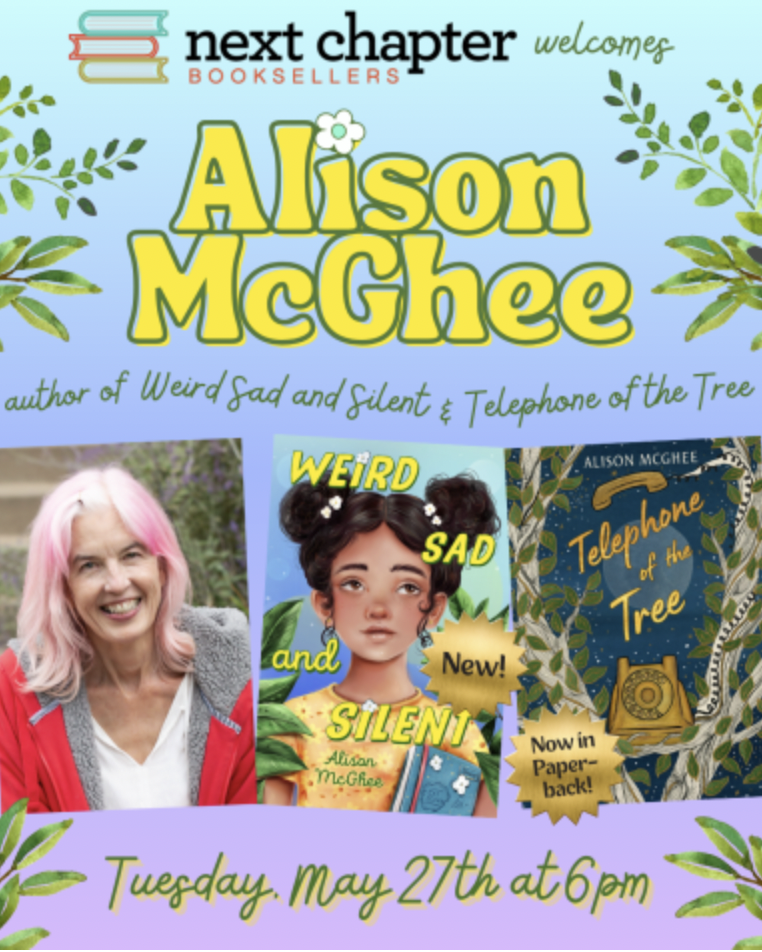
WEIRD SAD AND SILENT (book giveaway!)

Friends, please meet my girl Daisy Jackson. See that look in her eyes? This girl has some questions, and she’s also got opinions, not that she’s about to share them with you. Daisy is ten years old and highly skilled in the art of invisibilizing, a skill she honed two years ago, when the school bullies nicknamed her Weird Sad and Silent.

Daisy sits in the back of the classroom, she doesn’t raise her hand, and she doesn’t eat lunch in the cafeteria. In fact, Daisy talks mostly to the adults in her life: her mama Flora, her neighbor Lulu, Marimba the school librarian, and Captain the school custodian.

That’s until a new kid, Austin, shows up one day. There’s something about Austin, something Daisy can’t explain, something that makes him feel like…a kindred spirit. Daisy might be your kindred spirit too. WEIRD SAD AND SILENT, on bookshelves everywhere May 6. 

GIVEAWAY: Is there a kindred spirit in your life? Someone who just gets you and always has? Tell me about them in an email or the comments, and I’ll enter you in this week’s drawing for a signed copy of the novel.

WEIRD SAD AND SILENT, on bookshelves everywhere May 6. 

Poem of the Week, by Cati Porter

Minnesotans! There’s still room in my FREE workshop tomorrow, April 6, 1-4 Central time: Rewriting the Story, Reclaiming the Self. This workshop, held via Zoom, is designed for anyone living with the memories, recent or long ago, of abuse: bullying, domestic violence, an emotionally abusive relationship, a sexual or physical assault. Click here for more information and to register. All are welcome, no writing experience necessary. 

Are you concealing a kidnapped child in the back of your car? Have you transported materials to make a bomb or flame thrower or grenade launcher across state lines? How much fentanyl or heroin, if any, are you concealing in your car? Where is your final destination? Do you know what you did wrong and why we pulled you over?

These were some of the many questions I was asked last week while driving from California to Minnesota after a cop and his partner tailed me for a good ten miles before finally pulling me over for an entirely fictitious reason.

Many things went through my head as they kept traipsing back and forth to their police car: how much more scared I would be if I weren’t white. How straightfaced and serious they looked as they told me what I (hadn’t) done wrong. How my dog would not stop barking and I was afraid they would get angry because of it. But mostly? That I’m the one being pulled over while a bunch of craven cowards are fine letting our democracy die. Am I angry, America? You have no idea.

Dear America, by Cati Porter

I am your daughter and
I am angry.

Born in a barn and
raised by wolves,

I have eaten
the porridge

and the plums
and I am not sorry.

You told me that
I can never go home again

but it was you
who sold me a bridge

that was not yours,
then set it on fire. 

Click here for more information about poet Cati Porter. Today’s poem is included in small mammals, published in 2023 by Mayapple Press.  
alisonmcghee.com
My podcast: Words by Winter
Poem of the Week, by Brian Bilston

Minnesotans! There’s plenty of room in my FREE workshop Sunday, April 6, 1-4 Central time: Rewriting the Story, Reclaiming the Self. This workshop, held via Zoom, is designed for anyone living with the memories, recent or long ago, of abuse: bullying, domestic violence, an emotionally abusive relationship, a sexual or physical assault. Click here for more information and to register. All are welcome, no writing experience necessary. 

I never understood until now, deep down in my gut and in a way that jolts me awake throughout the night, how Hitler came to power so horrifyingly fast. Please, save me from hatred and disdain. Save me from refusing to see the hopes and dreams of others as equal to my own.

Refugees, by Brian Bilston

They have no need of our help
So do not tell me
These haggard faces could belong to you or I
Should life have dealt a different hand
We need to see them for who they really are
Chancers and scroungers
Layabouts and loungers
With bombs up their sleeves
Cut-throats and thieves
They are not
Welcome here
We should make them
Go back to where they came from
They cannot
Share our food
Share our homes
Share our countries
Instead let us
Build a wall to keep them out
It is not okay to say
These are people just like us
A place should only belong to those who are born there
Do not be so stupid to think that
The world can be looked at another way

(Now read from bottom to top.)

Click here for more information about Brian Bilston. I first found this poem last week on poet George Bilgere’s wonderful poetry site Poetry Town
alisonmcghee.com
My podcast: Words by Winter
Poem of the Week, by Jeffrey Harrison

Minnesotans! There’s plenty of room in my FREE workshop this coming Tuesday, March 25, 6-9 pm Central: Mapping the Unmapped. This workshop is offered free of charge and designed for anyone living in the wake of loss: of a loved one, a job, a home, a relationship, a long-cherished dream, your physical or mental health. Click here for more information and to register. All are welcome, no writing experience necessary.  (Non-Minnesotans, note that I will be adding these to my workshop offerings in the future, and they will always be free.)

A long time ago my dog and I got up at 3 am and drove north out of the city because I wanted to see the Perseid meteor shower, which was intense that year. By the time we reached our destination (the entrance to a closed state park) and parked, the meteors were streaking down the sky. I sat on the hood of my car and watched them.

Gradually the bottom half of the sky was swallowed up by clouds, while above the clouds the meteors streaked silently on. Within minutes all I could see was darkness. I pictured the meteors behind the clouds, silently falling through space, burning themselves out in blackness.

When I need to remember I’m part of something much bigger, full of mystery and beauty and far beyond my tiny human life, I remember that night.

Interval, by Jeffrey Harrison

Sometimes, out of nowhere, it comes back,
that night when, driving home from the city,
having left the nearest streetlight miles behind us,

we lost our way on the back country roads
and found, when we slowed down to read a road sign,
a field alive with the blinking of fireflies,

and we got out and stood there in the darkness,
amazed at their numbers, their scattered sparks
igniting silently in a randomness

that somehow added up to a marvel
both earthly and celestial, the sky
brought down to earth, and brought to life,

a sublunar starscape whose shifting constellations
were a small gift of unexpected astonishment,
luminous signalings leading us away

from thoughts of where we were going
or coming from, the cares that often drive us
relentlessly onward and blind us

to such flickering intervals when moments
are released from their rigid sequence
and burn like airborne embers, floating free.

Click here for more information about Jeffrey Harrison. Today’s poem first appeared in his book Feeding the Fire, published in 2001 by Sarabande Books.
alisonmcghee.com
My podcast: Words by Winter

Poem of the Week, by Bradley Trumpfheller

​Minnesotans! I’m offering three free workshops this spring on the transformation of trauma. Click here for more information and to register. All are welcome, no writing experience necessary. (Non-Minnesotans, note that I will be adding these to my workshop offerings in the future, and they will always be free.)

When you fold laundry you see the insides of clothes and sheets and towels –their raggedy seams and straining buttonholes and raveling threads–before you turn them right side out so they’re presentable for public viewing.

I’m like that laundry. No matter what’s unraveling inside, I know how to look smooth and together. Maybe most of us are like this.

This poem makes me think about the invisible seams in everyone. From heartbreaks mended (you’re never the same), memories beautiful or awful (you remember them all), dreams you dreamed that came true (or didn’t), a place or a person you return to in your mind when you need to be soothed.

Loom, by Bradley Trumpfheller

My mother says when she is anxious she finds a seam, 
finds stitches on her clothes, on furniture she’s near, always 
a verge has that feel, birch joints, wrinkles. It’s a relief
to think with the hands. Not with what years do, 
not with rings or someone else’s sadness. With the repair 
in a sheet her sister tore, breeze-fretted in the yard. 
Finds exactly where the hickory trees start themselves
against the yard. And shows me on the photograph 
which is only one of several, where though again 
they did not touch each other, standing on some shore, 
her mothers’ shadows touch each other. 
She shows it to me now to soothe me. As if soon 
it will be that blue in the air. Soon is what 
she thinks with. What she runs 
the edge of her thumb, her index finger over. 

Click here for more information about Bradley Trumpfheller. Today’s poem was published in 2024 by the Academy of American Poets. 

alisonmcghee.com
My podcast: Words by Winter

Three new free workshops for Minnesotans

The Transformation of Trauma

Have you gone through something awful, either recently or a long time ago? Maybe someone you love died, or you lost your job or home. Maybe someone you love is an addict, and you struggle with conflicting feelings on how best to care for them and yourself. Maybe someone sexually assaulted you, or abused you over a long period of time. Maybe as a child, or adult, you struggled through domestic violence or emotional manipulation. If your life is compromised by any of these experiences, and you’re looking for some relief and support, welcome to these workshops.

Note that I am not a therapist. But as a lifelong writer, as well as a trained crisis counselor, I know that the making of art, in all its many and varied forms, can be a profound way to help cope with experiences that were grievous, unfair, unwanted, or cruel. In each three-hour workshop, we’ll work on three creative writing exercises, read and discuss a few short readings, and hopefully find ways to unlock your own power.

These workshops are offered free of charge via Zoom. You do NOT have to be a writer, or even be interested in writing, to enroll. I’ve designed them for people of any or no writing experience – all are welcome. There’s no feedback or public sharing of work in these workshops (unless you want to), so you are free to unburden yourself and follow the prompts in whatever way is beneficial to you without fear of anyone seeing your work. Enrollment in each workshop is limited to 30.

To register for any or all of the workshops, email me directly at alisonmcghee@gmail.com. Feel free to share this note with anyone who might find the workshops helpful.

Please note: While these first three workshops below are open only to Minnesotans, I plan to add them to my regular workshop offerings in future, and they will always be offered free of charge.

Tuesday, March 25, 6-9 Central Time, via Zoom. Mapping the Unmapped
This workshop is designed for anyone living in the wake of loss: of a loved one, a job, a home, a relationship, a long-cherished dream, physical or mental health.

Sunday, April 6, 1-4 Central Time, via Zoom. Rewriting the Story, Reclaiming the Self
This workshop is designed for anyone living with the memories, recent or long ago, of abuse: bullying, domestic violence, an emotionally abusive relationship, a sexual or physical assault.

Friday, May 2, 1-4 Central Time, via Zoom. The Echo That Remains
This workshop is for anyone who loved someone who died of suicide, substance abuse, or untreated mental or physical illness.

Poem of the Week, by Anna Belle Kaufman

My father, who died two years ago today, was a giant man. Some of his clothes hang in my closet: his old army jacket, his Dairylea windbreaker, one of his Yankees baseball caps.

After he died I turned two of his other shirts and a pair of his worn pants into a simple patchwork quilt for my mother. It was hard to cut up his clothes. Wait, this is his favorite shirt, he’s going to need it, even though he wasn’t.

I still need him though. His enormous presence –that giant laugh, that hurricane hug, his absolute solidity–was grounding in a way I didn’t understand until he was gone.

Cold Solace, by Anna Belle Kaufman

When my mother died,
one of her honey cakes remained in the freezer.
I couldn’t bear to see it vanish,
so it waited, pardoned,
in its ice cave behind the metal trays
for two more years.

On my forty-first birthday
I chipped it out,
a rectangular resurrection,
hefted the dead weight in my palm.

Before it thawed,
I sawed, with serrated knife,
the thinnest of slices —
Jewish Eucharist.

The amber squares
with their translucent panes of walnuts
tasted — even toasted — of freezer,
of frost,
a raisined delicacy delivered up
from a deli in the underworld.

I yearned to recall life, not death —
the still body in her pink nightgown on the bed,
how I lay in the shallow cradle of the scattered sheets
after they took it away,
inhaling her scent one last time.

I close my eyes, savor a wafer of
sacred cake on my tongue and
try to taste my mother, to discern
the message she baked in these loaves
when she was too ill to eat them:

I love you.
It will end.
Leave something of sweetness
and substance
in the mouth of the world.

Click here for more information about poet, artist, and writer Anna Belle Kaufman. Today’s poem first appeared in The Sun magazine in 2010. 

 alisonmcghee.com
My podcast: Words by Winter

Poem of the Week, by Robert W. King

My house is more than a century old and filled with handcrafted woodwork and leaded glass bookcases and windows so beautiful that some days I stop just to admire them. I wonder about the craftspeople who made them, and how many hours and weeks and months and years of painstaking work it took them, and for only a single purpose: to make something beautiful and durable that would last for hundreds of years, far beyond their own lifetimes. Something for others to depend on. Something to be nurtured and cared for.

The people who made my house are the opposite of people who move fast and break things –things like the idea of democracy–that others, for centuries, have loved and cherished and protected and given their lives for.

Work, by Robert W. King

The workmen over and above the fence
fit bricks, lift mortar, slap it accurately
in place. Guilty by sitting idle, I
imagine they envy my luxury
of doing nothing until I remember
the days I had my hands full of shovel,
the dragline plowing the ditch of a sewer
through a future subdivision and how
I pitied those who walked by our work
with no apparent occupation,
denied the pleasure of making something,
piece by piece—even if it would soon
be buried—they would depend upon.

Click here for more information about poet Robert W. King. This poem was first published in 2008, in the online journal Rattle #29
alisonmcghee.com
My podcast: Words by Winter

Poem of the Week, by Danusha Laméris

​Where are they now, those fictional people I spun up out of thin air and set free? I miss them: Clara and Mallie and William T., The Bartender and Tamar and Crystal. I miss Will, lonely boy wandering the streets of LA, leaving kindness in his wake.

My people live in an invisible world parallel to ours. Sometimes I’m able to coax them through the scrim. Sometimes they fill me in on their lives. Sometimes I wish I could change things for them, but they are their own selves now, and they get to be who they are. I wish I could have them all over to dinner, make their favorite foods, tell them how much I love them.

Fictional Characters, by Danusha Laméris

Do they ever want to escape?
Climb out of the white pages
and enter our world?

Holden Caulfield slipping in the movie theater
to catch the two o’clock
Anna Karenina sitting in a diner,
reading the paper as the waitress
serves up a cheeseburger.

Even Hector, on break from the Iliad,
takes a stroll through the park,
admires the tulips.

Maybe they grew tired
of the author’s mind,
all its twists and turns.

Or were finally weary
of stumbling around Pamplona,
a bottle in each fist,
eating lotuses on the banks of the Nile.

For others, it was just too hot
in the small California town
where they’d been written into
a lifetime of plowing fields.

Whatever the reason,
here they are, roaming the city streets
rain falling on their phantasmal shoulders.

Wouldn’t you, if you could?
Step out of your own story,
to lean against a doorway
of the Five & Dime, sipping your coffee,

your life, somewhere far behind you,
all its heat and toil nothing but a tale
resting in the hands of a stranger,
the sidewalk ahead wet and glistening.

Click here for more information about the wondrous poet Danusha Laméris. Today’s poem is from from The Moons of August, published in 2014 by Autumn House Press.
alisonmcghee.com
My podcast: Words by Winter

Poem of the Week, by June Beisch

When your world is being swamped with cruelty and greed, when you’re exhausted by the hatred and pain others seem determined to unleash, what do you do? How do you resist? One way is to write fiction. Not as an escape, but a conjuring.

Doesn’t matter if you’re not a writer, write the world you want to live in. Write the world you do live in but make it better, full of people who see others as they truly are – fellow humans with dreams, hopes, sorrows, loves. Don’t give away your power. Understand that conjuring begins with knowing that things that seem impossible right now aren’t. Think of those bulbs that flower under snow, and imagine the world you want to live in, and then stubbornly live in it as if it already exists. Will a better world into being until it blooms.

Henry James, by June Beisch

“Poor Mr. James,” Virginia Woolf once said:
“He never quite met the right people.”
Poor James. He never quite met the
children of light and so he had to invent them.
Then, when people said: No one is like that.
Your books are not reality, he replied:

So much the worse for reality.

He described himself as “slow to conclude,
orotund, a slow-moving creature, circling his rooms
slowly masticating his food.”

Once, when a nephew asked his advice
on how to live, he searched his mind.
Number One, be kind, he said.
Number Two, be kind and
Number Three, be kind.

Click here for more information on June Beisch. Today’s poem was first published in 2004 by Cape Cod Literary Press in Beisch’s collection Fatherless Woman
alisonmcghee.com
Words by Winter: my podcast