Pablo and Birdy: Immigration story #1

pablo-and-birdy-9781481470261_hrLike all U.S. citizens but Native Americans, I’m descended from immigrants. One grandfather arrived on Ellis Island with his Russian Jewish family, fleeing the pogroms at the turn of the 20th century. My great-grandparents all came to this country in hopes of a better life, from Russia and Ireland and Denmark and Germany and France. Their journeys were, without exception, long and hard and painful.

One great-grandfather was sixteen years old when his mother died. He walked alone from the mountains –he was French Basque, born and raised in the Pyrenees Mountains– and stowed aboard a ship bound for New York City. He was discovered halfway across the Atlantic, put to work on the boat, and put in the brig when they docked in the harbor so that he could be returned to France. In the middle of the night he escaped and dove overboard into the frigid waters of the harbor and swam ashore. Sixteen years old. He emerged in lower Manhattan, where he lived for the rest of his difficult life. His is not the American rags-to-riches dream story most of us are fed from birth, but it is certainly an American story.

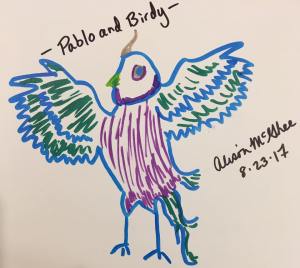
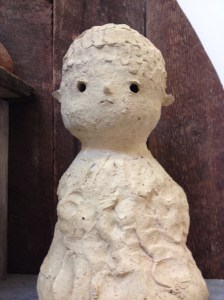
My new children’s novel, Pablo and Birdy, is about a boy named Pablo and his beloved parrot, Birdy. Pablo doesn’t know where he came from – he floated in to shore in the southernmost town of Isla one morning after a wild storm, tied into an inflatable raft.

Why was Pablo set adrift on the ocean, alone, with no one but a silent, fierce parrot to watch over him? Who was his first family, and why had they let him go? Had he done something wrong, screamed too much, been somehow unlovable? 

There’s a legend in Isla, of a remarkable bird called the Seafaring Parrot, who holds within herself all the sounds ever made in the world, and who –under special circumstances– can reproduce them. If Pablo could just find a Seafaring Parrot, maybe he would learn something, anything, about his origins?

At heart, Pablo and Birdy grew out of my experiences as an adoptive mother and as someone who has worked with refugees and immigrant students my entire adult life. As Pablo’s adoptive father tells him, “There are many others in this world who had to leave their homes, for various reasons, and their journeys are long and hard.” Over the next week, I’ll be posting a few more immigrant stories, in hopes that our elected employees don’t forget that they too –every last one of them, so far as I know, and please correct me if I’m wrong– are descended from immigrants.


Poem of the Week, by Kay Ryan

IMG_0447People look at me with confusion when I tell them I’m deeply wary of charismatic people, with charisma defined in the broad sense as “a personal magic of leadership arousing special popular loyalty or enthusiasm for a public figure (such as a political leader).” But wait, isn’t charisma charming, magnetic, powerful? Sometimes. And sometimes it’s a mask for manipulation, a bottomless need for adulation, attention, look at me look at me look at me, take care of me and do as I say because I am more important than you. Charismatic people so often go unchecked, no matter their behavior, because a) people are drawn to them by that magnetic personality and b) charismatic people often snap at anyone who calls them out on their behavior, in a vicious, malevolent and wildly cruel way. 

Which means that the only thing to do is exactly that: call them on their behavior. Not after seventy years of uncontrolled power-grabbing, but the first time it happens. When I began (only a few years ago, sadly) to call people on their awful, manipulative behavior –sometimes only in my own mind and sometimes with a fake-it-till-you-make-it calm in public– the relief was immediate and enormous. We’re all in this world together, friends. Don’t stand for bad behavior. Call it when you see it, and tell your elected employees to call it when they see it. Otherwise we end up exactly where we are in this country, right now, with unchecked petty tyrants trying to take down our democracy. I turn to this poem below, by the strange and wondrous poet Kay Ryan, for strength.


Relief, by Kay Ryan

We know it is close
to something lofty.
Simply getting over being sick
or finding lost property
has in it the leap,
the purse, the quick humility
of witnessing a birth–
how love seeps up
and retakes the earth.
There is a dreamy
wading feeling to your walk
inside the current
of restored riches,
clocks set back,
disasters averted.


​Fo​r more information on Kay Ryan, please click here.

Website
Blog
Facebook page
@alisonmcghee
 

Poem of the Week, by Mary Jo Salter

IMG_7772The other day a new friend walked into my house and stopped to look at some photos perched on a bookcase. “Is that you?” he said, pointing to one of a girl on a windsurfer. “No, that’s my daughter,” I said, admiring her, how the wind was blowing her long hair back. Then time did one of its weird pivots and I startled and sort of laugh/winced, because why had I said the girl on the windsurfer was my daughter? She wasn’t. She was me, long ago, when I was the age that my daughter is now. Do we, at some point, evolve into the mothers of our own selves? What a beautiful and sorrowful thought, a thought which keeps me re-reading Mary Jo Salter’s haunting poem below. 


Here I Am, by Mary Jo Salter

Here I am, making my grand tour
the summer after graduation.
What is this? Must be the Rome train station.
We never noticed we were poor.
Backpacks and low-rise jeans—
we never lived beyond our means.
(Back then there were no ATMs.)
Here we are,
my friends and me.
We’re napping on a bank of the Thames,
when love was free.

Here I am with that girl I met
on the trip to Brussels or Bruges.
(My God, her duffel bag is huge!)
What was her name? Yvonne? Yvette?
She ditched me; I’m forgetting why.
Oh yeah—when I slept with that Swedish guy.
His sleeping bag was full of fleas.
Here we are,
with our bread and cheese,
on a park bench in the Tuileries,
when love was free.

    Here I am,
    a woman in the middle
    of her life,
    and her life
    is an endless riddle.
    In all of Europe
    I couldn’t stir up
    a memory more un-
    likely and foreign
    than me at twenty-two.
    I can’t help gazing
    at her bright young eyes,
    at her nice firm thighs.
    Was I ever twenty-two?
    Look at her skin, it’s amazing.
    Can you be me? Am I you?

Here I am at the Berlin Wall.
They tore it down, but it’s still there
in this picture, like my long dark hair.
But there’s a wall between her and me
that, like me, won’t be getting thinner.
Here we are,
myself and me,
thinking, Ich bin ein Berliner,
but who is free?

    Here I am,
    looking at this kernel
    of myself,
    and I feel
    so strangely maternal.
    Do I have a choice?
    I can’t believe I’m hearing
    my own mother’s voice
    giving me advice:

Did you pack your passport?
Sign your traveler’s checks?
Don’t talk to men,
they only want sex;
keep a ladylike appearance
and when was the last time you sent
a postcard to your parents?

Here it is.
Here’s my postcard to me.
I’ve become my own mother;
never thought I’d be.
But here I am …
here I am.


For more information on Mary Jo Salter, please click here.

Website
Blog
Facebook page
@alisonmcghee

Poem of the Week, by David Hernandez

img_3441“Hi, this is Alison McGhee, patriotic citizen, calling from 55408.” Ever since the atrocity, which is my term for what went down last November, I make calls or send emails every day. I march if there’s a march. Taking action is the one thing that keeps me from sinking into a kind of paralyzed despair at both the crumbling of democracy I see all around me and the cruelty that is being encouraged and applauded. 

But taking action doesn’t just mean protesting. It means doubling down on kindness, on friendliness, on generosity. These are my vows, which I frequently break but keep re-upping: Smile and say hi to everyone you pass. Be your kindest self. Focus all your energy on the students in this room. Make life better for everyone you can, every time you can.  

The world gives back to you the energy you put into it, as David Hernandez –a poet new to me but whose work I’m now tracking down wherever I can find it– says so beautifully in this poem below.


Anyone Who Is Still Trying, by David Hernandez

Any person, any human, any someone who breaks
          up the fight, who spackles holes or FedExes
ice shelves to the Arctic to keep the polar bears
          afloat, who talks the wind-rippled woman
down from the bridge. Any individual, any citizen
          who skims muck from the coughing ocean,
who pickets across the street from antigay picketers
          with a sign that reads, GOD HATES MAGGOTS,
or, GOD HATES RESTAURANTS WITH ZAGAT RATINGS
          LESS THAN 27. Any civilian who kisses
a forehead heated by fever or despair, who reads
          the X ray, pins the severed bone. Any biped
who volunteers at soup kitchens, who chokes
          a Washington lobbyist with his own silk necktie—
I take that back, who gives him mouth-to-mouth
          until his startled heart resumes its kabooms.
Sorry, I get cynical sometimes, there is so much
          broken in the system, the districts, the crooked
thinking, I’m working on whittling away at this
          pessimism, harvesting light where I can find it.
Any countryman or countrywoman who is still
          trying, who still pushes against entropy,
who stanches or donates blood, who douses fires
          real or metaphorical, who rakes the earth
where tires once zeroed the ground, plants something
          green, say spinach or kale, say a modest forest
for restless breezes to play with. Any anyone
          from anywhere who considers and repairs,
who builds a prosthetic beak for an eagle—
          I saw the video, the majestic bird disfigured
by a bullet, the visionary with a 3-D printer,
          with polymer and fidelity, with hours
and hours and hours, I keep thinking about it,
          thinking we need more of that commitment,
those thoughtful gestures, the flight afterward. 


For more information on David Hernandez, please click here.


Poem of the Week, by Anna Marie Sewell

Screen Shot 2017-07-15 at 4.04.18 PMMama passed, honey. That was the subject line of my friend S’s email to me last week. S had been by the side of the woman who, though not her mother, was close enough to be. S had helped Mama out of this world into whatever comes after. Before work, after work, on weekends, she was with her, a steadying presence full of love and jokes. When Mama told her she was hungry, S would feed her little bites of avocado, apple sauce, ice cream. S was with Mama when she finally said goodbye to the world. Mama was in her 90’s. It was time. 

But it’s not always time. I remember the day that the mother of one of my daughter’s best friends died. I hung up the phone and screamed and threw it across the room. So unfair, that this middle-schooler, a girl I adore, should have to live with that loss. 

The stars of my new novel, Never Coming Back (my first novel for adults in a long time, forthcoming in October), are Clara Winter and her mother Tamar. Tamar has been diagnosed with early-onset Alzheimer’s, which means that she and Clara are running out of time together. While most of us, if we’re lucky, have decades to resolve our relationships with our parents –the ins and outs, the nuances and realizations and disconnections and reconnections– Clara and Tamar have only months. This small, lovely poem by Anna Marie Sewell makes me think about mothers and daughters, parents and children, my friend S and Mama, and all the ways in which we do or don’t cradle each other.  


Nocturne: Tiny Now, by Anna Marie Sewell

She is tiny now, my mother
and jokes in the morning, when
her teeth aren’t in, how she whistles
like a little bird. And i want to reach
back to the nights when
she brought the piglets in
laid them in the woodstove oven
so tiny, but she believed in them
and in that warm cradle, the spark
of life rekindled in them. How
do i cradle her? now
she is so tiny, softly
drawing nearer to
the Western Door.
This poem won’t do it.
This poem is for me
a piglet grown, with
my snout astonished
at discovery, how the power
that built a world for me still
reveals itself, blue
slight, soft, tiny


For more information on Anna Marie Sewell, please click here.

Poem of the Week, by Yehuda Amichai, translated by Assia Gutmann

Screen Shot 2017-07-15 at 7.55.54 AMRemember the man in the photo to the right? He stood in front of those tanks during the Tiananmen Square protest in 1989, nothing but a briefcase in his hands. When the tanks tried to maneuver around him, he stepped in front of them again. I don’t know what became of him.

When the protest happened, I was teaching Mandarin at a big urban high school in Minneapolis, and I wheeled a television into the classroom each day so that we could watch world history being made. I was young and naive and I assumed that the protest –thousands of pro-democracy unarmed students occupying a massive public square– would end peacefully. I was wrong.  

But the Tiananmen pro-democracy movement continues to this day. One of the bravest to carry its flame throughout his life was one of my heroes, poet, human rights activist and Nobel Peace Prize laureate Liu Xiaobo*, who died yesterday from liver cancer after spending much of his adult life in prison. He consistently refused offers of freedom in return for admissions of guilt. He hoped to transcend his own personal nightmare, writing “If you want to enter hell, don’t complain of the dark.” In these terrible, ominous times –a time when our own elected employees seem bent on destroying American democracy– his example brings strength.Screen Shot 2017-07-15 at 11.12.38 AM

His wife, Liu Xia, entered into hell with him. Also a poet and activist, she suffers physical and emotional problems from the cruelty of their long separation and, now, his death. Their love was unwavering. Liu once said that it was the thought of his wife that kept him steady and strong. In mourning, I combed through my thousands of poems last night, looking for one to mark the passing of a person who had such courage and steadfastness. In the end I took a sideways turn and chose this one by Yehuda Amichai, in honor of the remarkable love between husband and wife.


In the Middle of This Century, by Yehuda Amichai (translated by Assia Gutmann)

In the middle of this century we turned to each other
with half faces and full eyes
like an ancient Egyptian picture
and for a short while.

I stroked your hair
in the opposite direction to your journey,
we called to each other,
like calling out the names of towns
where nobody stops
along the route.

Lovely is the world rising early to evil,
lovely is the world falling asleep to sin and pity,
in the mingling of ourselves, you and I,
lovely is the world.

The earth drinks men and their loves
like wine,
to forget. 
It can’t.
And like the contours of the Judean hills,
we shall never find peace.

In the middle of this century we turned to each other,
I saw your body, throwing shade, waiting for me,

the leather straps for a long journey
already tightening across my chest.
I spoke in praise of your mortal hips,
you spoke in praise of my passing face,
I stroked your hair in the direction of your journey,
I touched your flesh, prophet of your end,
I touched your hand which has never slept,
I touched your mouth which may yet sing.

Dust from the desert covered the table
at which we did not eat
but with my finger I wrote on it
the letters of your name


*Transliterated Mandarin is not pronounced the way it looks in English. Phonetically, Liu’s name is pronounced more like this: Lee-yu Shee-yow Baw. His wife’s name is pronounced more like Lee-yu Shee-yah.

 
​For more information on Yehuda Amichai, please click here.​
For more information on Liu Xiaobo, please click here.

Poem of the Week, by Alden Nowlan

Digital story, cartwheelI’m going through my entire house, cleaning and sorting and organizing and paring. Most things I can jettison, but the things I can’t ever seem to throw away are cards and notes and notebooks and little scraps of paper with lists jotted onto them. The other day I found one that I had written a long time ago, titled Things I Love. Among them: that one small cup of coffee with heavy cream at dawn, the way the little white solar lights look when they flicker on at dusk, the raspberries that ripen for three weeks each summer, the sound of my best friend’s voice on the phone, time with my parents, time with my children, time with my friends, time with my sweetheart, doing nothing but being. It’s a big fat life and it’s filled with love and today’s my birthday so I’m celebrating, beginning with this beautiful poem by the wondrous Alden Nowlan. Enjoy.

Great Things Have Happened, by Alden Nowlan

We were talking about the great things
that have happened in our lifetimes;
and I said, “Oh, I suppose the moon landing
was the greatest thing that has happened
in my time.” But, of course, we were all lying.
The truth is the moon landing didn’t mean
one-tenth as much to me as one night in 1963
when we lived in a three-room flat in what once had been
the mansion of some Victorian merchant prince
(our kitchen had been a clothes closet, I’m sure),
on a street where by now nobody lived
who could afford to live anywhere else.
That night, the three of us, Claudine, Johnnie and me,
woke up at half-past four in the morning
and ate cinnamon toast together.

“Is that all?” I hear somebody ask.
Oh, but we were silly with sleepiness
and, under our windows, the street-cleaners
were working their machines and conversing in Italian, and
everything was strange without being threatening,
even the tea-kettle whistled differently
than in the daytime: it was like the feeling
you get sometimes in a country you’ve never visited
before, when the bread doesn’t taste quite the same,
the butter is a small adventure, and they put
paprika on the table instead of pepper,
except that there was nobody in this country
except the three of us, half-tipsy with the wonder
of being alive, and wholly enveloped in love.


For more information on Alden Nowlan, please click here.

Poem of the Week, by Marie Howe

See that old photo to the right? I found it yesterday in a scrapbook filled with random high school mementoes. The girl with the beautiful smile playing the violin used to be one of my closest friendsIMG_7430. She lived in a small bright green ranch house right across the street from the middle school, which meant that all she had to do was walk out her front door, cross Route 365 –the main street of the town– and there she was, at school. Unlike me, sitting on that accursed bus, groaning and lurching its way around endless curve after endless curve, down from the foothills, 45 minutes or more to school.

In my memory she is always smiling. She had silky dark brown hair, parted in the middle, falling over her shoulders. Her nose was sharp and red and a bit hooked, and her eyes, in my memory, are blue, blue, blue. And the smile. A big, merry smile that showed off her high cheekbones. I can picture her in the yearly school class photo. She would have been in the back row, with me, because when we were kids she was tall, too. She would have been smiling that big happy smile.

In middle school the two of us used to escape at lunch and walk across the street to the bright green ranch house. She lived there with her older brothers and her older sisters and her mother, who was, I’m pretty sure, a teacher down in Utica. Her father had died when she was a baby.

Her sisters and brothers were in high school, unimaginably older and cool. They were hippies. She and I were too young, we missed out on that. But often, when we walked into that little house with her, they and their friends would be there. Lying on the old couch, sitting on chairs, laughing and talking and wrestling and making offhand comments and jokes about things like sex and drugs and rock ‘n roll.

Had I been alone I would have been stunned and cowed and half-paralyzed by their coolness, their easy laughter. But I wasn’t alone. I was with her.

Why did she like me? In retrospect I was quiet and reserved and an observer and not much fun back then, although maybe I’m not the best judge of that. But one reason she liked me is easy: she liked nearly everyone. She had a huge and generous heart. She was also unafraid of things that I was afraid of, like saying out loud that which scared me, hurt me, made me angry. She was honest about things. She saw life clearly, and stating the obvious didn’t scare her.

The boy I had a crush on used to ask if he could have a punch off my lunch ticket.

“Sure,” I used to say.

“I’ll pay you back,” he used to say.

I would watch him run across the grass, back into the school. She and I would be nearly to Route 365 now, ready to zip across and into the safety of that little green house.

“He won’t, you know,” she observed. “He won’t pay you back. And you’ll give it to him tomorrow if he asks.”

I looked at her. She looked at me and smiled. She was wise. She was honest. She stated things the way they were. And she was unjudging. Into her house the two of us would go, breaking the school rule, although in retrospect it’s hard to imagine that any number of teachers didn’t see us zipping across that street every day and mentally shrug.

The cool older siblings and their cool older friends might be lounging about. She would greet them all, smiling, and then the two of us would go into the tiny dark kitchen and pour enormous glasses of milk. Stir in the Quik with tall-handled spoons. Dig the knife into the big jar of peanut butter and spread giant swaths of it on slices of Wonder bread.

We would sit eating and drinking while I tried to overhear the conversations in the other room, trying to get some sense of what life could be like, were I cooler and older and wore tight bell bottoms and peasant shirts. She was one of the few friends I kept in touch with after high school. She stayed there, in the tiny town, population 300. She went to college, sure, but she never wanted to leave the town. Me? I left at 18 and never went back other than to visit my family. Not that I didn’t, and don’t, love it there, love the way I grew up. But staying there never felt like an option. For her, there was no other.

“I love it here,” she said. “I want to live here my whole life.”

She got a degree in gerontology and worked with old people. She loved them too. People on the fringes, people unnoticed, people quiet and shy, she saw them. She noticed them.

Twice that I know of, because she told me, men asked her to marry them.

“I said no,” she said. Smiling that big bright smile.

I asked her why. She shrugged.

“Didn’t feel right,” she said. “I don’t know. I’m happy just the way I am.”

She was Catholic and that, too, was something she loved. Hers was a happy Catholicism, a big bright generous religion whose God was always with her.

Everyone in the town knew her. At the drugstore, at the one tiny bar, at the church, in the one tiny grocery store, at the bank. She was one of those rarest of creatures, a human being completely comfortable in her own skin.

She’s been gone almost twenty years now, but I think of her most every day. When she appears in my mind, it’s always in winter. She’s always brushing up against me, wearing a bright blue nylon parka. That dark hair, those blue blue eyes, that grin. On the rare occasions when I drink chocolate milk, I make a mental toast to her. When I write my annual check to the food bank in that little town, I fill in the “in honor of” box in her name. If she were still here, she’d no doubt be running the place. I wish I could go home and see her again. Walk into that bright green house and have a peanut butter sandwich. I’d go to the bar with her, let her introduce me around. 

When I think of her, I also think of this poem by Marie Howe, one of my all-time favorites. Whatever leads to joy, they always answer, to more life and less worry.


My Dead Friends, by Marie Howe

I have begun,
when I’m weary and can’t decide an answer to a bewildering question

to ask my dead friends for their opinion
and the answer is often immediate and clear.

Should I take the job? Move to the city? Should I try to conceive a child
in my middle age?

They stand in unison shaking their heads and smiling—whatever leads
to joy, they always answer,

to more life and less worry. I look into the vase where Billy’s ashes were —
it’s green in there, a green vase,

and I ask Billy if I should return the difficult phone call, and he says, yes.
Billy’s already gone through the frightening door,

whatever he says I’ll do.


​For more information on Marie Howe, please ​click here.

Poem of the Week, by Sabine Miller

IMG_4206

Please help me be a good teacher today. Please help me bring kindness and clarity and joy. Please help me heal and never hurt. This is one version of an ongoing prayer that unreligious me invokes before I walk into the door of every classroom I teach. It is tough, tough going these days, for so many of us. We feel ourselves, our families, our friends to be under direct attack from our own elected employees. We fear the crumbling of a great, flawed, ugly and beautiful democracy. But hopelessness is not an option. When the terror and outrage threaten to paralyze me I think about the decades I have spent teaching. I think about how energy –my own energy, one single scrawny human being’s energy– can change the feel of an entire room. Exhausted, grieving, in despair, it doesn’t matter; stand outside that room and vow to be and to project energy and kindness and connection. The air in the room will change. You can literally feel it. Every moment of every day you can bring people down or you can lift them up –you, one small person– by the energy you project. We choose what we want our lives to mean, and what we want to leave behind. We have the power to write our own stories. Remember that.

Story, by Sabine Miller

Tell me the one
about the sick girl —
not terminally ill, just years in bed
with this mysterious fever —
who hires a man
to murder her — you know,
so the family is spared
the blight of a suicide —
and the man comes
in the night, a strong man,
and nothing is spoken
—he takes the pillow
to her face — tell me
how he is haunted the rest
of his life — did he
or didn’t he
do the right thing — tell me
how he is forgiven,
and marries, and has
2 daughters, and is happy —
no, tell me she doesn’t
die, but is cured and
gives her life to God,
and becomes a hand-holder for
men on death row —
tell me the one where the man
falls in love with the girl
and can’t do it, or
the girl falls in love
with a dog and calls
the man to tell him
not to come, or
how each sees their pain
mirrored in the other’s eyes —
tell me how everyone has already
forgiven every story
they ever told themselves
about living
or not living —
tell me, oh tell me
the one where love wins, again
and again                and again.


Sabine Miller is a writer, visual artist, and qigong practitioner. Recent work has appeared or is forthcoming in Haiku 2013Lilliput ReviewModern HaikuSolitary PloverThe Red Moon AnthologyContemporary Haibun, and Mariposa.

Poem of the Week, by Richard Wilbur

Calligraphy letters, 2011When it came to homework, I was kind of a hands-off mother, a mother whose life –and whose children’s lives– became instantly better when I made the decision to quit checking the portal. (The portal. The portal. The portal of hell.) My children never asked me to look at or edit their papers, so I didn’t, and when it came to math, I couldn’t help them anyway. But my youngest daughter preferred to do her homework, especially essay assignments, at the dining table when I was working. She would write her papers, I would write my stories. This daughter works best with solid blocks of time, earbuds in and playlist on, while her mother at the other end of the table twitches and rocks and grinds her teeth, trying trying trying to get the words out. My sleek iridescent child, my clattering commotion of keys. This poem feels as if it came straight out of my own heart. 


The Writer, by Richard Wilbur

In her room at the prow of the house
where light breaks, and the windows are tossed with linden,
my daughter is writing a story.

I pause in the stairwell, hearing
from her shut door a commotion of typewriter-keys
like a chain hauled over a gunwale.

Young as she is, the stuff
of her life is a great cargo, and some of it heavy:
I wish her a lucky passage.

But now it is she who pauses,
as if to reject my thought and its easy figure.
A stillness greatens, in which

the whole house seems to be thinking,
and then she is at it again with a bunched clamor
of strokes, and again is silent.

I remember the dazed starling
which was trapped in that very room, two years ago;
how we stole in, lifted a sash

and retreated, not to affright it;
and how for a helpless hour, through the crack of the door,
we watched the sleek, wild, dark

and iridescent creature
batter against the brilliance, drop like a glove
to the hard floor, or the desk-top,

and wait then, humped and bloody,
for the wits to try it again; and how our spirits
rose when, suddenly sure,

it lifted off from a chair-back, 
beating a smooth course for the right window
and clearing the sill of the world.

It is always a matter, my darling,
of life or death, as I had forgotten. I wish
what I wished you before, but harder. 


For more information on Richard Wilbur, please click here.

Website
Blog
Facebook page
@alisonmcghee