Poem of the Week, by John Ashbery
 Growing up in the age of Darwinian elementary schools –the gym teacher would choose the two best athletes to captain every team, and one by one they would pick off first the good athletes, then the midlings, then the uncoordinated, until finally there was only one child remaining, huddled against the wall– I hated gym class. Not because I was bad at sports (I’m not) but because I can’t stand cruelty. And that little ritual was fundamentally cruel.
I don’t see the point of competition unless you’re competing with yourself, trying to get better at something you value, something you love. All the years I sat on bleachers cheering on my children, it was an effort to remember that I was supposed to cheer for their team and not any random child on the field who made a great goal, who ran fast, who helped lift up another player. There were times when the other parents glared at me because in my absentmindedness/idiocy I would cheer for the opposing team.
I still don’t like team sports. What I don’t like about them is exactly what I despise in my country today, which is the idea that there are winners and losers, and winning is what matters. What is happening in my country right now is so far beyond right vs. left. What is happening right now is wrong, and on some level, every single one of us knows it. No matter how you spin it, there is no excuse –not one, ever– to torture children and their families. Democracy is crumbling and fascism is rising and the elected officials who should stop it, who should call out injustice and hold abusers accountable, are silent despite our protests. This poem starts out sweet and ends up terrifying, and boy does it feel familiar. It doesn’t end this way, but I would like it too: We are all one here, and if one of us goes the other goes too.
How to Continue, by John Ashbery
Oh there once was a woman
and she kept a shop
selling trinkets to tourists
not far from a dock
who came to see what life could be
far back on the island.
And it was always a party there
always different but very nice
New friends to give you advice
or fall in love with you which is nice
and each grew so perfectly from the other
it was a marvel of poetry
and irony
And in this unsafe quarter
much was scary and dirty
but no one seemed to mind
very much
the parties went on from house to house
There were friends and lovers galore
all around the store
There was moonshine in winter
and starshine in summer
and everybody was happy to have discovered
what they discovered
And then one day the ship sailed away
There were no more dreamers just sleepers
in heavy attitudes on the dock
moving as if they knew how
among the trinkets and the souvenirs
the random shops of modern furniture
and a gale came and said
it is time to take all of you away
from the tops of the trees to the little houses
on little paths so startled
And when it became time to go
they none of them would leave without the other
for they said we are all one here
and if one of us goes the other will not go
and the wind whispered it to the stars
the people all got up to go
and looked back on love
For more information on John Ashbery, please click here.
Website
Blog
@alisonmcghee
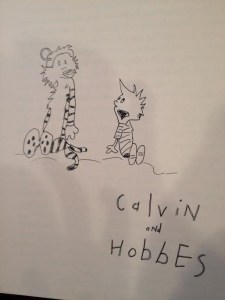 My son was two years old and we were in the backyard. It was early spring, and I was digging around in the dirt when he suddenly bent double and started laughing and pointing. Dinosaurs, he said, dinosaurs! I followed his pointing finger to the patch of ferns next to us. They were just beginning to unfurl their fronds, and the stem of each was bent and curved, and in that instant I saw what he saw: the long curved necks of T-Rexes. My laughing little boy, looking at the world in a way I’d never seen it before. I have never looked at ferns the same way since. The memory of that day almost chokes me up, and so does this small poem.
  Rough, rough week. Children torn from their parents at borders, the suicides of loved people who projected happiness, the cruelty of our elected employees and the ongoing and unfathomable cowardice of their minions who stand by, watching our democracy crumble. Last night I scrolled through poem after poem, looking for one with clear eyes and a level gaze, like this one below. A poem that sees the situation for what it is and imagines it as it can be. Time for us to be the goddesses who remake this world.
  Yesterday, after heavy rains, I went for a long walk. I kept hearing opera music and I looked around to see a man grinning at me and nodding from his car, where the windows were open and the volume turned way up. I laughed and waved back at him, and the below poem leaped up into my mind. My grandmother, whose life was extraordinarily hard, used to recite it to us with an unfamiliar lilt in her voice.
 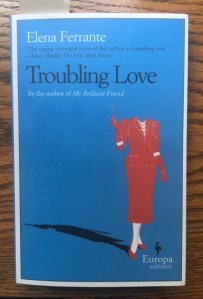 Troubling Love, by Elena Ferrante.
 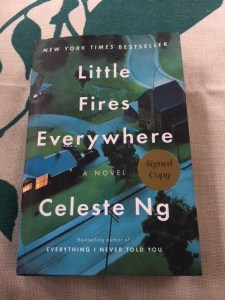 Little Fires Everywhere, by Celeste Ng. Damn. This is a hell of a novel. I was instantly absorbed into the lives of this Shaker Heights community and its denizens. Ng writes with such clarity about every one of her people, no matter who they are, weaving issues of class and race into the powerful themes of the book in such a way that I empathized with everyone. That’s not an easy task. You know what else is an inordinately difficult task? To write in the third person omniscient (in which you’re inside the heads of everyone) and pull it off, the way Ng does, seemingly without effort. And her portrayal of Mia, the photographer artist at the core of every scene, was astonishing in its powerful take on what drives an artist and her art. I loved this book.
 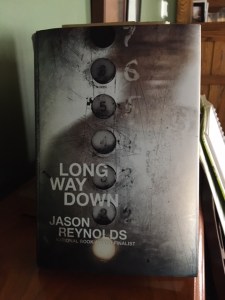 Long Way Down, by Jason Reynolds. Jason Reynolds can do no wrong in my eyes. He’s changing the world, one book and one speech at a time, and Long Way Down is no exception. The structure of the book is cool –it takes place in a single elevator ride from the 13th floor to the lobby of the building in which the main character lives–and it’s told in near-verse. Few words, huge power. This novel shook me up and made me want to reach into its world and wrap my arms around everyone, living and dead, who is given a voice here.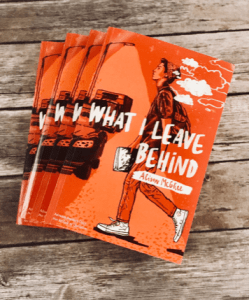
 Looking for Alaska, by John Green. This is my third John Greene novel, and when I finished it I decided to read everything else he’s written. The man deserves his bestselling and critically acclaimed status. The way he gets straight to the heart of the matter, the matter being life and its big questions in the face of tough situations, especially in his brilliant dialogue, is the way I wish we all were, all the time, in real life. His people are so real and so lovable, and they care so much about each other. Hilarious, painful, heart-opening.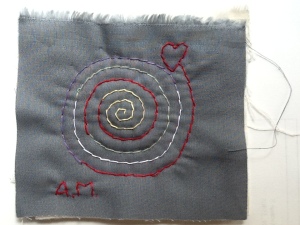
 Old men who hold their wives’ handbags for them as they put on their coats. Young fathers who hold their toddlers’ hands as they cross the street. The girl who jumps up to open the door for the woman using the walker. The cafe manager who keeps a water bowl outside, filled with cool water, for passing dogs. The man with the truck who goes up and down the rural road, plowing out his elderly neighbors. Everyone waving goodbye, tears in their eyes, as the ones they love disappear into the airport, like in the movie Love Actually*. The movie Love Actually. A note left in a poetry box, thanking the “poem attendant” for “all the good poems.” A carful of grinning men chattering in Spanish, pulling over to the side of a snowy road and pushing the young woman’s car out of the ditch. The world is full of sweetness. When I need to remind myself of that, which is often, in these days of bewildering cruelty and greed by our elected employees, this is one of the poems I recite to myself.
  Last week my water filter leaked into the storage bin where my youngest’s childhood mementoes are kept. I brought it upstairs and spread her things out to dry. Onesies, footie pajamas, overalls with ripped-out knees. Her high school graduation cap. Notebooks filled with book reports and drawings and journal entries. Cards she’d written to me, mostly construction paper drawings along with I love you mom. The arc of eighteen years spread out on the kitchen table and counters. The tiny quilt I made for her before she was born and which she wore to literal shreds was damp, and I picked up the strands and held them to my heart.
 I. My new novel, What I Leave Behind, out on May 15, stars 16-year-old Will. Will is one of those charming people that everyone loves – maybe because he’s naturally cool, but probably because he’s fundamentally kind. He knows how to make lonely people feel less lonely, for example his socially-awkward boss Tom at Dollar General. He knows how hard life can be –he lost his dad to suicide a few years ago and his childhood friend was recently assaulted—but instead of turning inward to his own pain and sorrow Will tries to make the lives of those around him better.
 Alison McGhee