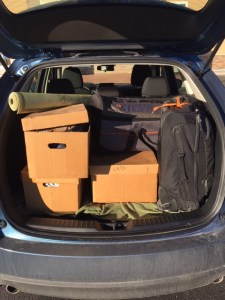
 In my life as a road tripper I’ve been to every one of the forty-eight lower states multiple times. Road trips have been part of my life since I was a little girl and my family went on a two-week driving vacation every summer. Now I go solo, for the most part, and mostly westward because I love the west. The endless rangeland, mesas and buttes and mountains rising in the distance. Sweeping across the country on wide-open highways. This is when I think best. This is when ideas for books come to me. This is when knotty problems unknot themselves. This is when I see parts of my country that I don’t live in and don’t often know much about. My road trip rules: A la Bertrand Russell in his ten commandments of critical thinking and democratic decency, Don’t be absolutely certain of anything. Be open to new information. Make conversation with everyone you meet. Listen to what they have to say.
 Days One and Two: 807 miles, five states –Minnesota, Iowa, Nebraska, Kansas, Colorado– and two time zone changes. A thousand twirling wind turbines across endless Iowa fields in all the colors of brown. The near-empty highways of Nebraska and Kansas, swooping across plains so vast you swear you can see the curvature of the earth. Soundtrack: an utterly enchanting acoustic covers playlist, Ted Radio, Hidden Brain, Beautiful Stories from Anonymous People, and the first two lessons from Coffee Break Spanish twice over.

Day Three: 367 miles from the high plains of eastern Colorado to the mesas and mountains of New Mexico. Enormous grain elevators rising up from empty roads and hardscrabble towns. Traffic so sparse that oncoming drivers raise a hand in greeting, the way we always did in my rural childhood. Pulled over to take a photo and a truck pulled up beside me: “You okay? Need some help?” “Nope, just taking a photo.” Grins. Waves.
Turn a long curve and see the first snow-capped peak in the distance and feel that familiar awe surging through you. The Sangre de Cristos, southernmost range of the Rockies, look like someone gently pleated them between thumb and finger.

Day Four: 410 miles, from Taos to El Paso. Woke up before dawn, finished my words before breakfast, and consequently felt so free that I decided to spend the entire day exploring. Wandered around Taos and had a long and serendipitous conversation about poets and writers with the owner of Brodsky’s Books. Exchanged info. Gave him a copy of Never Coming Back.
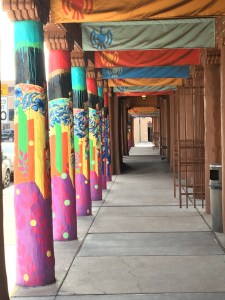 Drove south and on a whim decided to head into Santa Fe, where I had never been. Within five minutes of arriving had decided to sell all my possessions and move there. Kidding. Maybe. I’m smitten. It was one of those magical afternoons where everyone I walked past smiled at me, everyone I talked to was interesting and kind, and the whole place is down home, lived-in, human-scale beauty. Tore myself away because miles to go before I sleep. Drove south 300 more miles to El Paso. Arrived long after dark, winding my way around a mountain below which sprawls the twinkling lights of this border city of border cities.
 Day Five: El Paso. Snippets from my long conversation with Carlos, the trolley driver.
*
Carlos: “You know how San Antonio calls itself the Gateway to Mexico? Well, they’re a couple hundred miles from Mexico. Two hundred miles? How about three feet? See that bridge down at the end of the street? Walk across it and you’re in Juarez.”
*
Carlos: “See that big high school at the end of that street? That’s El Paso High School.”
Me: “Wow, that’s a beautiful building. Did you go there?”
Carlos: “No. El Paso was segregated when I was growing up. That was the white high school. I went to the other high school.”
Me: “Which I’m sure was just as beautiful, right?”
(At which point we both smile.)
 *
*
Carlos: “See that bar, Tap? Famous for its nachos. U2 went there in the 80’s and no one recognized them so they loved it. They spread the word to all their musician friends, hey, go to Tap if you’re in El Paso.”
Me: “Which ruined it, I bet.”
Carlos: “Yep. The nachos are still good, though.”
*
Carlos: “You know the barrio you were walking around in all morning?”
Me: “Where I felt so white and non-Spanish speaking?”
Carlos: “That’s the place. Young people are moving in there now, opening up all kinds of shops and things. They’re making it cool to live in downtown El Paso.”
*
Carlos: “That’s the public library over there. They built it on Indian burial grounds. Dug up the bodies and tossed them. So, it’s haunted. Don’t go inside, Alison. Trust me.” 
*
Me: “Carlos, what are your thoughts on the wall?”
Carlos: “See that brownish thing at the end of the street? It’s a partial fence. We’ve had it for a decade now. We have a bunch of partial fences. No one needs a wall.”
*
Carlos: “When we were in high school the plan was that if any of us did anything bad we’d just run onto the bridge. There’s a four-foot no man’s land and our plan was just to stand there, free from prosecution by anyone.”
Then the trolley ride was over and we took a selfie and Carlos told me he hoped he wasn’t overstepping but he had greatly enjoyed our conversation and would I allow him to take me out to dinner.
 Day Six. Breakfast in El Paso, where all the servers and half the customers switch fluidly from Spanish to English. Happy to recognize many words from my first three Coffee Break Spanish lessons. What’s the problem with multiple languages and cultures anyway? Isn’t multiplicity only a good thing? Doesn’t it make the world bigger and also smaller, for everyone? Yes, these questions are rhetorical. But they are on my mind, because this road trip was originally going to be a hike our national parks road trip, and the reasons it’s not are so, so troubling to me.
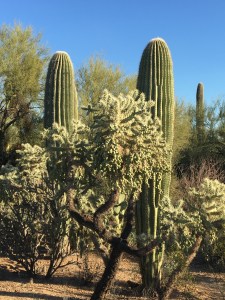
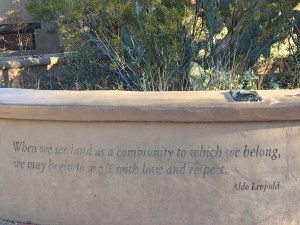 Drove to Saguaro National Park anyway, to behold the giant sentinels standing guard over the red hills that belong to all of us, unearthly beautiful hills that I couldn’t hike because of human stupidity and ego. Aldo Leopold: “When we see land as a community to which we all belong, we may begin to use it with love and respect.” Same thing with people.
 Last two days: 547 miles total, from Tucson to southern California. Do you know what to do in a dust storm? Based on the hundred or so signs on the highways yesterday, I do: Pull off the road, turn off your ignition, turn off your lights, stay buckled, wait until it passes. Yesterday: one of the great museums of the world, the Arizona Sonora Desert Museum, to see raptors, wolves, coyotes, javelinas, all manner of cacti and interesting bugs. Afterward hiked the King’s Canyon trail nearby because even though there are no rangers, there were lots of cars at the trailhead. Drove on through the nearly humanless Arizona desert to Yuma, where everyone in the breakfast room this morning was mysteriously dressed in Victorian period costume.
 Drove through the nearly deserted Mexicali desert and mountains, encountering distinct and extreme landscapes. Enormous sand dunes that looked as if sand-colored heavy cream had been whipped to soft peak status. Huge fields between mountain ranges that, from a distance, looked to be growing a kind of black shrub I’d never seen before, which turned out to be solar panels up close. “Danger: rock slides next 15 miles” territory in which I felt as if I were driving a hotwheels car around huge piles of boulders flung down by a giant.
Drove through Pima County surrounded by what looked like cotton fields and semis loaded with huge round bales of plastic-encased cotton and thought Cotton? Can this be real? and then thought, Pima cotton! This must be where it comes from! Listened to a This American Life interview
 with Pima County’s longtime sheriff, a thoughtful, smart and experienced man who is concerned with the fact that many families, instead of single men, now try to cross the border. Thought about his concerns as I looked out on that forbidding landscape. Stopped at my third border patrol checkpoint in as many hours, the final one patrolled by many men with many guns, drug-sniffing dogs, and hundreds of cameras. “Are you a U.S. citizen?” “Yes.” “Have a good day.” Could not shake the unease from all the guns and dogs and men and cameras. Imagined myself with my three small children, trekking through hundreds of miles of desert to get to a human-made border. How much guts does it take to be an undocumented migrant in this country? Way, way more than I have.
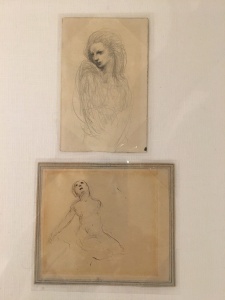 In the lobby of the Minnesota Public Radio headquarters are three white egg-shaped chairs. Whenever I’m there I crawl into one of them, sit cross-legged, and close my eyes. Sitting in one is like wearing a warm sweatshirt with the hood pulled entirely over your head. My love for those chairs is inordinate. When I picture a safe place to comfort myself when sad or troubled, those egg-shaped chairs come to mind.
  A few years ago a lifelong minor heart glitch spiraled out of control. I didn’t tell anyone until a couple hours before the surgery to fix it, so as not to worry them, and I took a Lyft to the hospital. But just before the procedure, as the surgical team was pushing the gurney into the OR, I put my hand on the arm of the nearest blue-masked nurse. Please take good care of me, I said. I don’t want to die.
 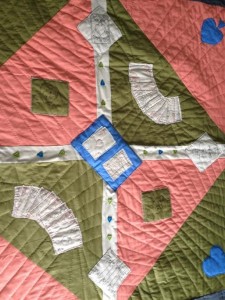 The day after I moved to Minneapolis, I bought a sewing machine. This was in the days of newspaper ads, and I found a used one for $60 and insisted my then-boyfriend and I track it down that very day. That ancient, impossibly heavy machine is what I’ve used to make all the quilts I’ve ever made, sewing together blocks I hand-stitch piecemeal. Story quilts, every one of them, made not according to a pattern but out of my head and heart.
  Someone close to me sent me a booklet a while ago, photos and written memories of her life. It’s a fascinating glimpse into a childhood spent solo with older parents in upper Manhattan, a gentle childhood filled not with money, of which there was very little, but with family card games, shared meals, trips to museums and playgrounds, school days and summer camp upstate. Black and white photos show a small, smiling girl in the embrace of a mother and father who clearly adored her. Here they are leaning against a railing by Rockaway Beach. Here they are on the stoop of an apartment building. Here’s the little girl on the first day of school.
 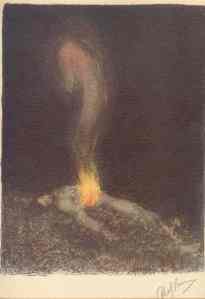 This body of mine. These bodies of ours. As a girl I often witnessed both my friends and older women close to me disparage their bodies. One of my grandmothers had been a model in her youth, and she despised photos of her aged self so much that I couldn’t let them near her – she would snatch them and tear them up. My other grandmother openly hated her heavy legs, had hated them her whole life long. In response to this self-hatred, which was so painful to see, I early on vowed never to say one bad word about my body to anyone, especially my daughters. This is a vow I kept. But still. This body of mine. This body that will do everything in its power to keep me alive until my last breath. Oh my body, I have not always loved you the way you deserve to be loved. Fearfully and wonderfully made body, I have not always been good to you. When I heard this poem, I wept.
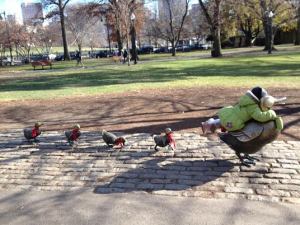 My three children and I were in upstate New York. This was a long time ago, and we were making our annual summer trek around New England to visit family and friends. We had just finished touring the Utica Club Brewery, one of my favorite childhood destinations, a tour that ends with a complimentary beer or root beer in a Victorian saloon. We were all tired. I was chatting with my parents while my children wandered around, trying out various red velvet chairs.
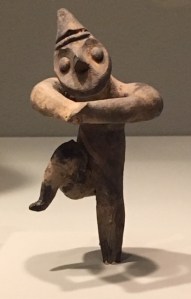 We went to a museum the other day with no specific purpose in mind and found ourselves in the Chinese art galleries. Jade. Porcelain. Bronze. Ornate vessels for cooking, for ceremonies, for burial. An arched gateway which used to lead to a family’s compound. A room with a low table, ink, brushes, where someone used to practice calligraphy. We peered in through the interwoven black wooden squares of traditional Chinese architecture. At one point a tiny capering man entranced me and I wanted to reach through the glass, and the thousands of years between us, and take him home.
  When my dog Petey was still alive I used to bring him to the Blessing of the Animals at the Basilica. One year, a woman with a small clear plastic box sat at the end of the pew next to Petey and me. She was anxious, agitated, and when the priests began walking up and down the aisle swinging incense and shaking holy water on the animals, she held the box up in the air.
 A couple of months ago I hurt a friend when I pushed a semi-joke too far. The friend didn’t say anything or change expression, but I went to bed uneasy. Despite the Painter’s assurances that he had noticed nothing and all was well, my gut said otherwise. I woke up and sent an apology, the gracious acceptance of which proved that my gut was right. In the weeks since, shame and sadness keep bubbling up in their familiar way. How many times a day do you feel like a failure? I once asked the Painter. All day every day, he answered, to which I nodded.
  Alison McGhee