Four spots open in each of our two remaining one-day workshops next month – I’d love to see you there. Check them out here.
When my kids were tiny and one of them or their friends fell and hurt themselves, they would all cry in sympathy. I remember them touching their scrapes to my body, as if that would somehow take away the hurt.
If a tree is in distress, other trees funnel sugar and water to it through their roots. How many times have you seen someone in pain and felt your own throat close up in sorrow with them? We humans walk around contained inside skin but sometimes skin feels like a mirage.
Indian Creek with Neighbor Boy, by Robin Rosen Chang
When we were kids, we explored the creek, meandered with it through our yards and beyond as if we had discovered it ourselves. We wandered along its bed, navigating its contours until we learned where the water moved fastest, where it trickled, where its stones jutted out forming steps for us to cross from one side to the other. When we knew the creek perfectly, we rolled our pants, tossed our dirty socks and damp sneakers and waded through it, lifting rocks to catch crayfish and scooping up salamanders shrouded in the cool mud.
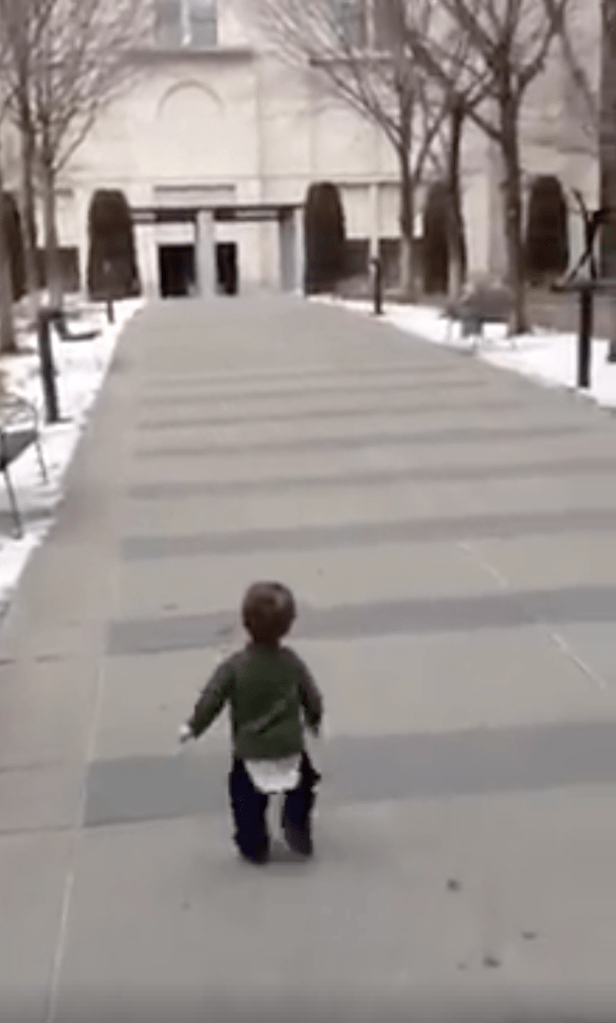
In winters, we stomped along its gray frozen surface like giants, cracking the ice with our heavy steps, or slid clumsily on the thicker patches behind the McCabes’ house. Once, you shattered it and fell in. When you got up, dripping wet, tears streaming down your chubby child cheeks, you turned to me, as if maybe it was my fault. A true friend wouldn’t just stand there. To ease your pain, I lay in the frigid creek, in the exact spot where you had fallen.
Four spots open in each of our two remaining one-day workshops next month – I’d love to see you there. Check them out here.
Long ago, I went to look at a little house for sale on a lake. My realtor and I showed up at the appointed time but the homeowner was still there. She stood at an ironing board in the living room, ironing pieced quilt squares with a grim-faced focus that made me wary and quiet. Are you making a quilt, I ventured, but she said nothing.
The rooms of the house emanated sadness and fury. She’s getting divorced and she doesn’t want to and she has to sell her house and she doesn’t want to do that either, was the thought that came to me. I inclined my head in the direction of the ironing board and left the house in silence.
This poem makes me think about the wild, silent grief and rage of that long-ago woman. It makes me think about what we’re really doing when we do the things we do.
Raising the Titanic, by Robert Hedin
I spent the winter my father died down in the basement, under the calm surface of the floorboards, hundreds
of little plastic parts spread out like debris on the table. And for months while the snow fell
and my father sat in the big chair by the Philco dying, I worked my way up deck by deck, story by story,
from steerage to first class, until at last it was done, stacks, deck chairs, all the delicate rigging.
And there it loomed, a blazing city of the dead. Then painted the gaping hole at the waterline
and placed my father at the railings, my mother in a lifeboat pulling away from the wreckage.
Two spots open in our Freedom of Form workshop tomorrow, and five spots each in our two remaining one-day creative writing workshops next month – I’d love to see you there. Check them out here.
Me talking to me: Alison! For God’s sake, respond to all those piled-up emails. Clean up the kitchen. Teach yourself the WWI history you never learned. Scrub the tub, re-learn all those Chinese characters, get busy studying Spanish, go to bed at a reasonable hour, get up early and go straight to work. Alison! Do this do that do better!
But sometimes I don’t want to do better. Sometimes I just want to stay up late and make a martini and turn off all the lights and dance around my living room and dining room to loud music while the sly curvy lines of this poem spin round and round and round in my head.
Late Night Poem, by Hailey Leithauser
Better to risk, she says, the whiskey’s wheeze and the throttle’s urge and a blonde with curves like tennis serves than to wait as a sheep for the chilling nap, the buttoned breeze, the pallid tap of an autumn moth, kept safe by glass from the candle’s breath.
Spots are still open in most of our one-day workshops this fall – maybe you should treat yourself to a class! Check them out here and let me know if you’re interested. I’d love to see you in one.
When I first read this poem, by the wondrous Ada Limon, it turned me still and focused the way all her poems do. I pictured my grandmother, a woman who refused to dance and was ashamed of her big body, the one time I came upon her swaying to Herb Alpert and the Tijuana Brass in the kitchen when she thought she was alone.
I pictured my other grandmother, who at the moment she died appeared to my sleeping mother flying overhead, calling her name in a voice restored to youth and happiness.
I remembered the owl in the tree above me, who tilted his head back and forth with mine, whose eyes stared direct and unblinking at my eyes. I thought about Ada Limon’s friend, and about those rare times in life when all the names and roles others give us fall away, and we are only our essential selves.
Open Water, by Ada Limòn
It does no good to trick and weave and lose the other ghosts, to shove the buried deeper into the sandy loam, the riverine silt, still you come, my faithful one, the sound of a body so persistent in water I cannot tell if it is a wave or you moving through waves. A month before you died you wrote a letter to old friends saying you swam with a pod of dolphins in open water, saying goodbye, but what you told me most about was the eye. That enormous reckoning eye of an unknown fish that passed you during that last–ditch defiant swim. On the shore, you described the fish as nothing you’d seen before, a blue–gray behemoth moving slowly and enduringly through its deep fathomless North Pacific waters. That night, I heard more about that fish and that eye than anything else. I don’t know why it has come to me this morning. Warm rain and landlocked, I don’t deserve the image. But I keep thinking how something saw you, something was bearing witness to you out there in the ocean where you were no one’s mother, and no one’s wife, but you in your original skin, right before you died, you were beheld, and today in my kitchen with you now ten years gone, I was so happy for you.
If you’re interested in taking one of my one-day creative writing workshops this fall, you can check them out here.
In grad school my stories often came back with margin notes like Repetitive; you’ve used this word three times in two sentences and Transition needed here and Let the reader know how this was done or said, e.g., “she shrieked wildly.”
Me, internally: But I meant to use that word three times, and I see no need for transitions, and maybe you love adverbs but I don’t. These professors didn’t like my writing and I didn’t like theirs, so it was a relief when I took a workshop with someone who knew exactly what I was trying to do. Who admired my writing the way I admired his. Whose one or two sentence responses on the last page of my stories were all I needed.
My last semesters of grad school were completed via independent studies with this writer, except that they weren’t. I’d fill out the forms, he’d sign them, and then… I’d just take his workshop. Again.
It worked out great. When I read this stunning poem below those long-ago days of silent, fierce rebellion flashed over me.
Trouble with Math in a One-Room Country School, by Jane Kenyon
The others bent their heads and started in. Confused, I asked my neighbor to explain—a sturdy, bright-cheeked girl who brought raw milk to school from her family’s herd of Holsteins. Ann had a blue bookmark, and on it Christ revealed his beating heart, holding the flesh back with His wounded hand. Ann understood division. . . .
Miss Moran sprang from her monumental desk and led me roughly through the class without a word. My shame was radical as she propelled me past the cloakroom to the furnace closet, where only the boys were put, only the older ones at that. The door swung briskly shut.
The warmth, the gloom, the smell of sweeping compound clinging to the broom soothed me. I found a bucket, turned it upside down, and sat, hugging my knees. I hummed a theme from Haydn that I knew from my piano lessons. . . . and hardened my heart against authority. And then I heard her steps, her fingers on the latch. She led me, blinking and changed, back to the class.
If you’re interested in taking one of my one-day creative writing workshops this fall, you can check them out here.
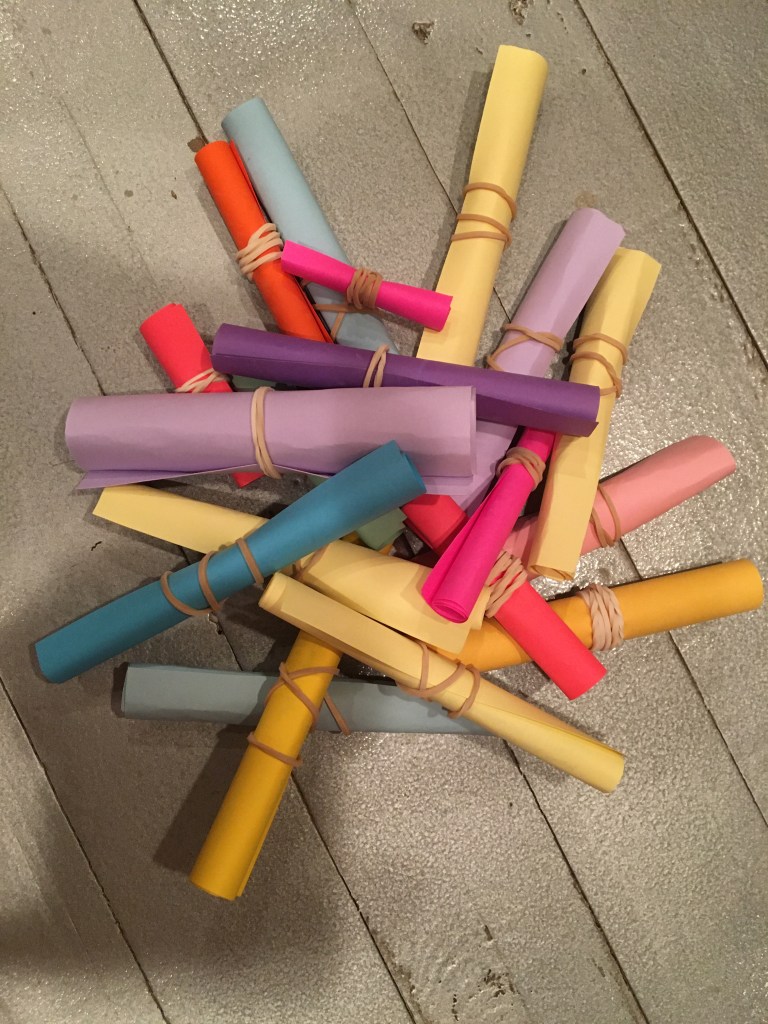
It’s busy here at poetry hut central. Poems are disappearing at a rapid clip and we have to keep up, printing, scrolling and rubber banding new ones while bingeing shows. When I’m on the porch, which is most of the time, I love to see passersby stop and choose a poem, read it, put it in their pocket.
A few fun facts about operating a poetry hut:
1) People greatly prefer poems printed on neon paper. Violent pink and intense teal are always the first to go.
2) People do not like yellow poems. Yellow poems are always the last to go.
3) Some people read their poem, then carefully scroll it up, replace the rubber band, and put it back in the hut. For some reason this goes straight to my heart.
4) Over the years, a wood engraver has left limited edition prints of their gorgeous, intricate, otherworldly work as gifts. Maybe an art-to-art exchange? We save every one and my daughter framed several. One of these days I’ll spot the artist in the act, but no luck yet.
5) Some passersby leave poems of their own making, written on the scrap paper we leave in the hut. Others write down their own favorite poems, ones they must have memorized, like the beautiful poem below that I found a few minutes ago when I returned from a run (okay fine, slow jog).
The world feels so lonely sometimes, but not always.
Happiness, by Günter Grass
An empty bus hurtles through the starry night. Perhaps the driver is singing and is happy because he sings.
If you’re interested in taking one of my one-day creative writing workshops this fall, you can check them out here.
Every day my goal is to get to Amazing in the New York Times spelling bee game (I don’t care about Genius). The other night, at dinner with friends who also love the Bee, I told them “jouncing” had been my best word of the day. They looked at me with blank faces. What? I said. It’s a very common word!
But guess what? It’s not. Over the next three days, out of many word-ish adults queried, only my sister in law Julie and my friend Julie (two Julies!) had ever heard of the word. This led to a mini existential crisis: how is it possible I’ve used this word all my life and never noticed that no one knew what the hell I was saying?
Words obsessed me as a kid. I’d mutter words, think words, write words in the air with my finger. Nothing has changed. Last night one of the two jouncing Julies and I sat talking about how much we love words, even confounding combinations like temblor and trembler, careen and career, bounce and jounce.
Words! They’re alive.
Anatomy Class, by Betsy Franco
The chair has arms. The clock, a face. The kites have long and twirly tails. The tacks have heads. The books have spines. The toolbox has a set of nails. Our shoes have tongues, the marbles, eyes. The wooden desk has legs and seat. The cups have lips. My watch has hands. The classroom rulers all have feet.
The Book of Delights, by Ross Gay. I’d dipped in and out of this book before, but finally read it straight through, essayette to essayette, until all the essayettes were gone, kind of like I do with the bags of Lindt milk chocolate truffles I buy and stash away on a high shelf. These tiny essays, every one of them, made me laugh, smile, nod, frown, and see something about the world in a slightly different way. Every time I read something by Ross Gay I feel like calling him and talking about it, that’s how much I love his work, and then I remember that oh, we’ve never met and we’re not friends in real life. (Yet…bwahaha.) So far I’ve bought four copies of this tiny book –FOUR–at my beloved neighborhood indie Magers and Quinn to give to people I adore. That alone should tell you something.
Goldenrod, by Maggie Smith. How I love this book of poems. I treasure it as much as Good Bones, and I didn’t think that would be possible. Maggie Smith’s poems are so spare. There’s space and light on every page of her books, yet what she conjures in both image and feeling is vast. She’s a word artist in her use of the visual, and of negative space. Same thing in her imagery – the woman has an uncanny ability to flip a situation, or an emotion, inside out and upside down until suddenly you see possibility and freedom where you didn’t before. (I’ve also bought four copies of this book too, one to keep, three to give away.)
Pablo and Birdy, by me. You would think that, having written this book myself, I would remember everything about it. You would be wrong. I want to adapt Pablo and Birdy into a screenplay, so I re-read it in preparation, only to find that I’d forgotten so much. In fact, it felt like a novel I’d never read before. Who was Pablo’s original family? Why was he floating alone on the sea with only a parrot to watch over him? What will happen when the winds of change come over Isla? What if there really were such a bird as a Seafaring Parrot – what could I learn, and put to rest, about my own past? (Yes, I realize this not-remembering my own novel reveals way too much about me, but so be it. Shrug emoji.)
The Night Watchman, by Louise Erdrich. Damn, this woman knows how to tell a story. I was captivated by this book from page one and didn’t want to put it down. Pixie! She will live inside me forever, and so will her sister Vera. So will Thomas, and dear Wood Mountain, and the unearthly Zhaanat. So will the land they live on so deeply that when I think about this novel I think about its people as part-land. Historical fiction based on the life of Erdrich’s grandfather, this novel is contemporary and timeless and sweeping and specific and just wonderful.
Leaving Time, by Jodi Picoult. You know those little shelf cards you often see in indie bookstores, placed by booksellers next to books they love? Sometimes one of my novels has one with something like “If you love Jodi Picoult, give Alison McGhee a try!” So I’ve always been scared to read a Jodi Picoult novel because what if I hated it, and by extension hated my own books? Finally I decided it was time to get over it, and wow did I love Leaving Time. It’s captivating, mysterious, sad, funny, with a wild twist at the end, and I learned so, so much about elephants, those beautiful creatures. Now I want to read all Jodi Picoult’s novels – which one should I read next?
Sanity and Tallulah, by Molly Brooks. This graphic novel has been on my shelf for a while now, and I finally plucked it off and figured I’d read a few pages to see if I was interested. Three hours later I’d gobbled the whole thing down – so funny and full of adventure. Two best friends relegated, with their cool and funny parents, to a far corner of the universe in a falling-apart space station who have to figure out, on the fly, how to fix the thing before everyone dies. That’s kind of the plot – I was having too much fun reading it to keep close track. The whole way through I kept thinking damn, Molly Brooks must’ve had a blast with this book. Reading Sanity and Tallulah made me want to come up with my own joyride of a graphic novel.
My dog is perfect at being himself. He twirls madly at the sight of his food bowl, springs straight up when he sees a favorite human, sprawls belly-first when he wants affection. If he wants to play he places his paws on my keyboard and bats at my typing fingers. If I accidentally step on his paw he yips. He hides nothing but the miniature Greenies he buries in the couch cushions.
My dog doesn’t put on a smooth facade when something or someone is hurting him. He doesn’t pretend he’s not hungry or exhausted or sad or in need of love and comfort.
It wouldn’t occur to him to override his own feelings. I wish I were more like my dog but I’m not, which is probably why I so love this little tiny poem.
In order of preference, here are my spoons. 1. The wood-handle spoon. 2. The all-silver spoon. 3. The red spoon. 4. The green spoon. 5. The blue spoon. (The Chinese spoon doesn’t count because I only use it for soup.)
I detest the blue spoons, but they are the ones I use. Save the other spoons, Alison! I think whenever I open the silverware drawer. Save them for later!
Why? We have plenty. What am I saving them for? So on my deathbed I can look back and think, Super job not using your favorite spoons all those years, Allie!
How many times I’ve written an entire novel, hoarding the mystery or my most cherished lines until the end, because…I’m scared I’ll run out? I won’t run out. None of us will. Recognizing this fear and rejecting it is why I’ve had to rewrite many an entire book, so as to give, give it all, give it now.
I don’t want to open my safe at the end of my life and find ashes.
Excerpt from Write Till You Drop, by Annie Dillard (prose rearranged into poem-ish lines by me)
Spend it all, shoot it, play it, lose it, all, right away, every time.
Do not hoard what seems good for a later place in the book, or for another book; give it, give it all, give it now.
The impulse to save something good for a better place later is the signal to spend it now.
Something more will arise for later, something better.
These things fill from behind, from beneath, like well water.
Similarly, the impulse to keep to yourself what you have learned is not only shameful, it is destructive.
Anything you do not give freely and abundantly becomes lost to you.