Click here for details and to register for our new Write Together session in early June. I’d love to see you in the Zoom room!
One evening last week I did a series of interviews with various media in Japan for my book Someday, which is about a mother’s dreams for her child. It was late night for me, morning in Japan, and each interviewer asked specifically about two pages in the book, one in which the child is alone, entering a deep wood, and another in which the child, having just received painful news, is folded up with sorrow.
Why did you include those pages? each interviewer asked.
Through the years, my best friend and I have talked about wishing we could bear our children’s pain for them. How much easier it would be, easier on us, and how wrong. To be fully alive means facing the unknown, experiencing everything, come what may. I remember not wanting to write those two pages and also knowing I had to.
Living in the Moment, by J. Estanislao Lopez
I like to live in the moment. No, not that one —
Click here for more information about J. Estanislao Lopez
Click here for details and to register for our new Write Together session in June. I’d love to see you in the Zoom room!
Someone I love told me recently that she had first glimpsed her future husband at a dance and was instantly captivated by the sparkle in his eyes and his intense interest in everyone and everything. Four months later they were engaged.
She told me about their wedding long ago, and how when it was over, and she and her new husband were driving away from the reception, just the two of them, she looked at him and felt everything in her relax. A feeling of deep security, of I’m safe now, I’ll always be able to count on him, filled her entire being.
Anniversary, by Cecilia Woloch
Didn’t I stand there once, white-knuckled, gripping the just-lit taper, swearing I’d never go back? And hadn’t you kissed the rain from my mouth? And weren’t we gentle and awed and afraid, knowing we’d stepped from the room of desire into the further room of love? And wasn’t it sacred, the sweetness we licked from each other’s hands? And were we not lovely, then, were we not as lovely as thunder, and damp grass, and flame?
Click here for more information about Cecilia Woloch.
Click here for details and to register for our new Write Together session in early June. I’d love to see you in the Zoom room!
One of my grandmothers worked as a legal secretary in a Manhattan law firm, proud of her skill with shorthand and typing. Once, her boss, who was otherwise a good guy, yelled at her in front of the entire secretarial pool. Later that day he called her into his office to apologize. You shouted at me in public, she said, and you’ll apologize to me in public. Which he did.
My grandmother marched in the streets of New York as a suffragette. She had her first and only child at age forty and raised her with a love at once fierce and unconditional. This poem made me think of her, as I often do, and her hard, brave life. It hurts me to remember how much she always wanted to go to France. One of my first short stories, drafted while sitting on a bench on Sacré-Coeur, was about a young woman wandering the streets of Paris in honor of the grandmother who never had the means to travel.
My time in better dresses, by Marge Piercy
I remember job hunting in my shoddy and nervous working class youth, how I had to wear nylons and white gloves that were dirty in half an hour for jobs that barely paid for shoes.
Don’t put down Jew, my mother warned, just say Protestant, it doesn’t commit you to anything. Ads could still say “white” and in my childhood, we weren’t.
I worked in better dresses in Sam’s cut-rate department store, $3.98 and up. I wasn’t trusted to sell. I put boxes together, wrapped, cleaned out dressing rooms.
My girlfriend and I bought a navy taffeta dress with cutout top, wore it one or the other to parties, till it failed my sophistication test. The older “girls” in sales, divorced, sleek,
impressed me, but the man in charge I hated, the way his eyes stroked, stripped, discarded. How he docked our pay for lateness. How he sucked on his power like a piece of candy.
Saints of the Household, by Ari Tison. Brothers Jay and Max live in a home charged with the constant worry and fear that their abusive father will again unleash his violence on their mother and them. Their own unspoken, buried rage at their father erupts one day when they beat up their cousin Nicole’s threatening boyfriend. That single act of violence propels the boys into both enforced counseling and a first-ever pulling away from each other. Max turns his pain into art in the form of paintings, while Jay’s awareness of his own frustrated sorrow begins to inform his plans for the future, his close friendship with Nicole, and his understanding of his place within his family. Alternating chapters in the voice of each brother interweave stories and wisdom from their Bri Bri and Anishinaabe ancestors, and the physical presence of their gentle Bri Bri grandfather lends depth and insight to their struggles. A beautiful, heartfelt book.
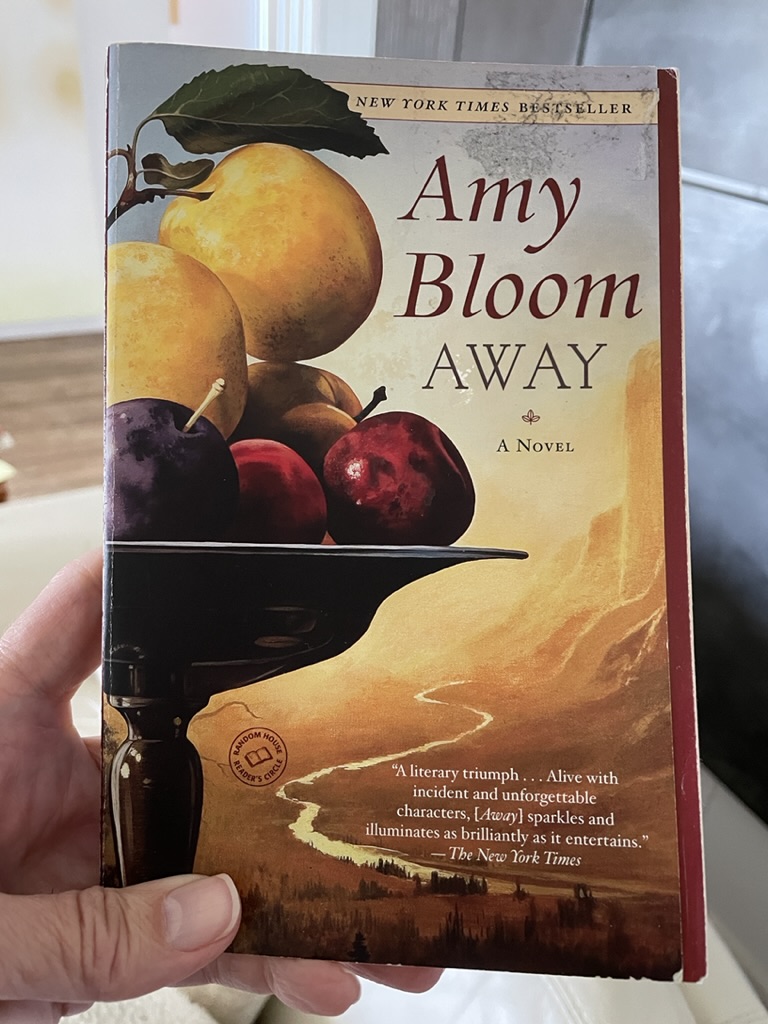
Away, by Amy Bloom. Damn, this writer can tell a story. Fearless, funny, written in times and places far from ours but so rich in detail that you feel as if you’re living her people’s lives right along with them, Away is the story of Lillian, who survived the massacre of her family and village back in Russia and escaped to the Lower East Side. When you’ve lost everything, you’ll do whatever it takes to thrive, and Lillian does. But the news that her daughter survived death sets her on a quest across America and into Alaska. Bloom never, not once, loses sight of the joy and humor that can be found in the darkest of circumstances. This novel propels its way forward, shimmering with light and life and laughter and love.
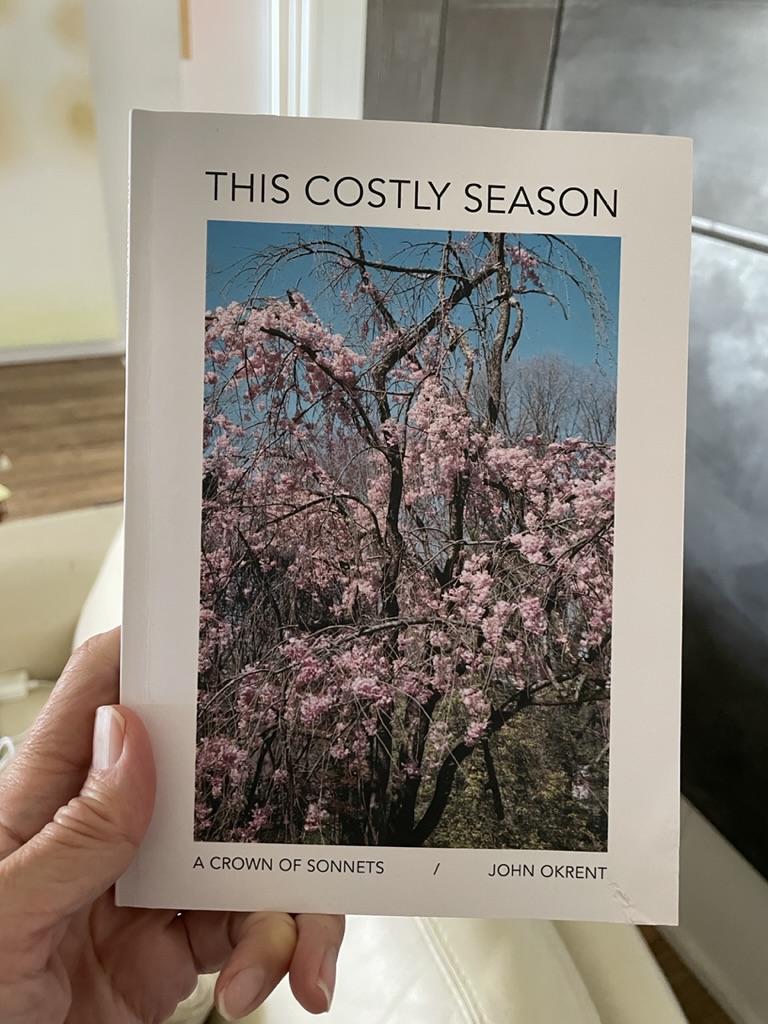
This Costly Season, by John Okrent. It usually takes me a while to read a book of poetry –poems I love being to me tiny emotion bombs—but not this one. A collection of free-form sonnets written by a family physician in the Pacific Northwest over several months in the beginning of the pandemic, This Costly Season is almost hallucinogenic in its evocation of those early days. The fear. The inability to help. The lack of knowledge or cure. The title of each poem is the day’s date, and each ending line is woven into the first line of the next poem. Time marches on, the pandemic deepens, questions remain unanswered but for the fact that all answers, for the living, still and always remain the same: to love our people and our world and hold them close, because time, time is always short.
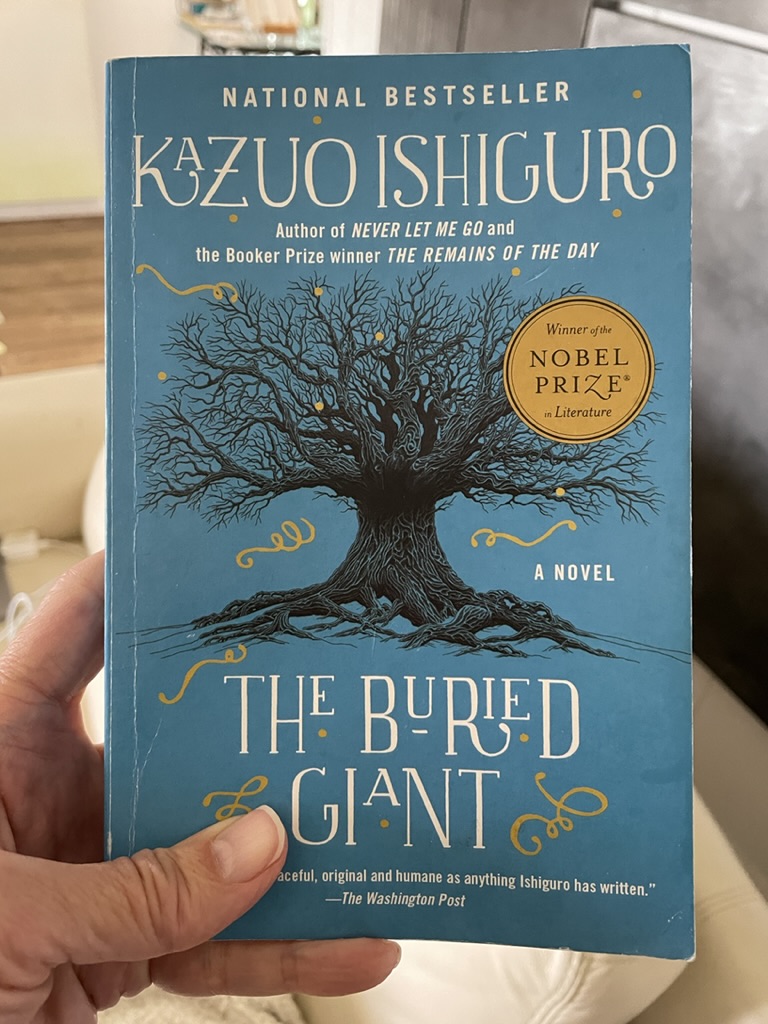
The Buried Giant, by Kazuo Ishiguro. I’ve been a writer my entire life, something that influences the way I relate to structure, point of view, storytelling. Most of the time, I instinctively understand the decisions a writer made, no matter the form, because the process of writing is so familiar to me – I’ve been there and done that (this is not a negative). But with writers who are my personal giants, I am rarely able to anticipate from which deep well their books emerged or how they managed to pull them off. These writers are few. Ishiguro is one of them. I space out his books because I know each one will in a small, profound way transform me – but the transformation will not come without cost. Few writers break my heart the way Ishiguro does. Set in post-Arthurian England, The Buried Giant is odd, dreamlike, unlike anything else I’ve ever read by the man, and, like everything he writes, mesmerizing.
The Lowland, by Jhumpa Lahiri. To pick up a Lahiri novel or collection of stories is to commit yourself to a journey: through time, eras, over continents, in and out of the minds and hearts of the people who populate these deeply internal worlds. I seem to be in a heartbreaking-book streak and The Lowland is not an exception. Set in post-partition Calcutta and Rhode Island and spanning half a century, this novel, despite a plot that in one particular way occasionally strained my credulity (possibly because one of my own plots strains my credulity in the exact same way?) kept me up late. Two brothers, alike and unlike, one enigmatic woman, political divides, and the weight and painful beauty of parenthood. Carefully wrought and utterly absorbing.
Notorious Nineteen, by Janet Evanovich. Years ago my parents, believing I should read more books that make me laugh, turned me on to the Stephanie Plum novels, about a Jersey bond enforcement girl. After reading the first in the series I realized my parents were correct, so I bought the first twenty-two off eBay in one big cheap used batch. I dole them out to myself when in need. These books exist in a slightly parallel world that looks like ours but is funnier, and where everyone has a gun but the guns aren’t actually dangerous. By the end of each book Stephanie will have ordered from Cluck in a Bucket at least twice, had great sex with Joe Morelli and contemplated even greater sex with Ranger, been covered with paint, garbage, or something else icky, witnessed her car go up in a ball of fire, done something mildly illegal with her friend Lula, and rescued her grandmother from making yet another scene at yet another funeral viewing. There’s a reason people read Evanovich novels. If you know you know.
Click here for details and to register for our new Write Together session in early June. I’d love to see you in the Zoom room!
The first day you bring him home, hold the little street pup in your arms while he trembles and trembles. Reassure him you’ll be good to him. Tell him you’ll try to make every day a happy day. Make some food for him and watch him gobble it. Worry about his silence; why doesn’t he ever make a sound?
Two weeks in, leap when you hear a sharp and insistent bark. Turn from the stove to behold an unblinking, time to go for a walk gaze. Realize he hasn’t trembled or prostrated himself on the floor at the sound of his name in at least a week.
Two years in, sing him a good morning song when he wakes up. Race up and down the stairs playing I’m gonna get you until your heart pounds. Structure your time around runs and walks and visits to the dog park. Make room in the bed. Make room on your lap. A dog fills a dog-sized hole you didn’t know was there.
A Small-Sized Mystery, by Jane Hirshfield
Leave a door open long enough, a cat will enter. Leave food, it will stay. Soon, on cold nights, you’ll be saying “Excuse me” if you want to get out of your chair. But one thing you’ll never hear from a cat is “Excuse me.” Nor Einstein’s famous theorem. Nor “The quality of mercy is not strained.” In the dictionary of Cat, mercy is missing. In this world where much is missing, a cat fills only a cat-sized hole. Yet your whole body turns toward it again and again because it is there.
Click here for more information about Jane Hirshfield.
My father, who died last month, was a giant of a man from boyhood on. He was famous for keeping the house-heating wood stove in our kitchen cranked to stupefying levels of heat. Much of our childhood was spent in service to that wood stove: cutting, chopping, hauling and stacking wood to keep it fed.
Many of my abiding memories of my father are centered around wood, which, even in his eighties, he continued to chop and haul. As a child, his giant presence could be overwhelming, but I picture him now, and think of how easy it can be to overlook, in a giant man, the tenderness and gentleness that also lived inside him.
The Pick, by Cecilia Woloch
I watched him swinging the pick in the sun, breaking the concrete steps into chunks of rock, and the rocks into dust, and the dust into earth again. I must have sat for a very long time on the split rail fence, just watching him. My father’s body glistened with sweat, his arms flew like dark wings over his head. He was turning the backyard into terraces, breaking the hill into two flat plains. I took for granted the power of him, though it frightened me, too. I watched as he swung the pick into the air and brought it down hard and changed the shape of the world, and changed the shape of the world again.
Click here for details and to register for our new Write Together session in early June.
Click here for more information about Cecilia Woloch.
Welcome to the world, Dear Brother!I’m so happy that this book, a collaboration with Tuan Nini (the artist I refer to as the Mad Genius) will be in the world as of this summer. (We’re thrilled that it’s already been chosen as a Junior Literary Guild selection.)
I’m horrible at describing my own books but here goes me trying to think like a book jacket person: Dear Brother is a graphic novel-ish (yes, I made up that category and I’m sticking with it) about a little sister whose travails with her older brother are chronicled in notes, photos, sketches and texts. Sister’s always the sidekick, never the star, or at least that’s how it feels.
Brother proclaims himself America’s Famous Chef, but it’s Sister who does the chopping and clean-up. Brother proclaims himself America’s Famous Magician, but it’s Sister who’s the one he nearly saws in half. Brother proclaims himself America’s Famous Daredevil, but guess who ends up with the broken leg?
Worst of all, when it’s time to get a family pet, Sister wants the dog she’s always longed for, but Brother insists on…a bearded dragon.
Like Dear Sister, the first in the Dear series, Dear Brother chronicles the evolving relationship, over time, between siblings. A cult favorite among siblings of all ages, Dear Sister has been described as both “unremittingly funny” and “I’m not crying, you’re crying.”
Dear Brother will be here on August 8, but you can pre-order it now, and I would be so grateful if you did. Here’s why: the number of books printed is determined by the number of pre-orders it receives. This seems backward to me, and maybe to you too, but we live in an inside-out world.
Soooo…if you’ve got a child or an adult in your life who was once a sibling, or who ever felt overlooked, or unseen, or ignored, and maybe feels like laughing and possibly crying about it all, Dear Brother is the book to pre-order. Here are a bunch of pre-order links for you. Thank you so much!
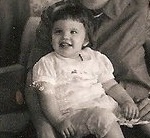
Lots of old photos have been passing around my family these days, some I don’t remember ever being taken, except there I am: a laughing baby, a smiling teen, a young woman making funny faces at her babies, most recently a middle-aged woman in a pink sweatshirt crouched next to her dad, both smiling up at the photo taker.
Oh my face. You’ve been with me through every moment of my life, never questioning any feeling or how to express it. Immediately and by instinct you pull yourself into smiles, tears, laughter, anger, excitement. The older I get the more I appreciate you and all we have been through together, and the fact that no matter how you change, you are the face that everyone who loves me loves.
(Excerpt from) Ode to My Hands, by Tim Seibles
Five-legged pocket spiders, knuckled starfish, grabbers of forks, why do I forget that you love me: your willingness to button my shirts, tie my shoes—even scratch my head! which throbs like a traffic jam, each thought leaning on its horn. I see you
waiting anyplace always at the ends of my arms—for the doctor, for the movie to begin, for freedom—so silent, such patience! testing the world with your bold myopia: faithful, ready to reach out at my softest suggestion, to fly up like two birds when I speak, two brown thrashers brandishing verbs like twigs in your beaks, lifting my speech the way pepper springs the tongue from slumber.
Click here for details and to register for our new Write Together session in early June.
Click here for more information about Tim Seibles.
Black Panther: A Nation Under Our Feet, by Ta-Nehisi Coates. Coates is one of my favorite writers. After reading an interview in which he talks about his experience writing the first six books in Marvel’s Black Panther series, I read the first in the series, a gift from my Coates-fan son and his partner. The majesty and gravity of the visual and literary collaboration between Coates and artist Brian Stelfreeze held me in its grip for an afternoon. Black Panther reminded me of childhood, when I was obsessed with Batman comics (still am, actually) and would dream myself to sleep at night making up scenarios in which I was Batgirl, saving the world. Comics and graphic novels: I so admire what writer and artists, working in sync within the freeing confines of the hallowed graphic form, can create.
Out Stealing Horses, by Per Petterson. Such a quiet, introspective, surprising novel. It completely absorbed me, and since finishing it, I’ve been thinking about how our early adolescence –just a few moments, even—informs our understanding of adulthood ever after. How we turn those moments over and over in our minds and hearts as we age and gain wisdom. A few trustworthy friends had described this novel as “nothing happens!” so (despite the fact that I often secretly think the same of my own novels) it was never on my must-read list. But I found it riveting in the way that sitting by the bank of a river for a slow afternoon, absorbed in watching the eddies and swirls, is riveting. Highly recommend.
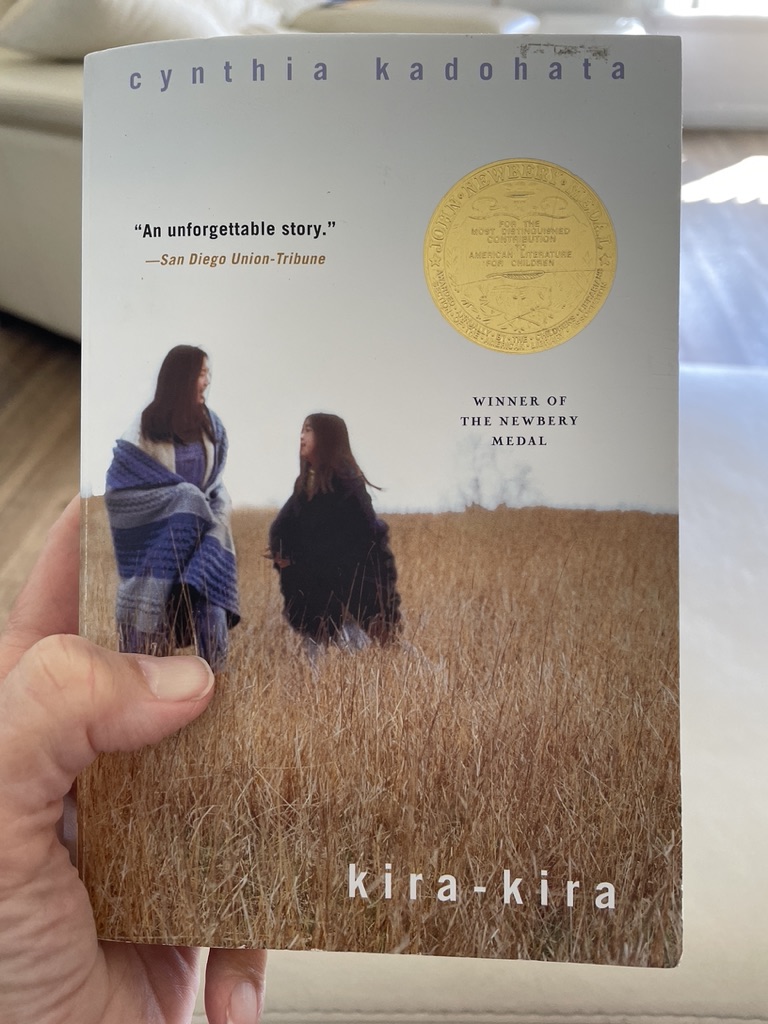
Kira-Kira, by Cynthia Kadohata. I didn’t want my heart to be broken by another book –sometimes your heart just gets tired of breaking, you know?—and I had long assumed this novel would break my heart, because such is the way of most Newbery books. But I picked it up one morning and finished it the next, swept along by the narration of Katie, the middle child of the Takeshima family, who’s blunt, funny, enjoys being “bad,” and whose sister Lynn means everything to her. Set in the 1950’s, in the chicken-sexing Japanese-American subculture of southern hatcheries, this novel feels so real in its depiction of poverty, the cruelty and abuse of racism, endless work, family devotion, and a childhood filled with wonder and love. This is also an example of the rare child narrator who feels truly, infectiously, beautifully real. This lovely novel and its people will stay with me forever.
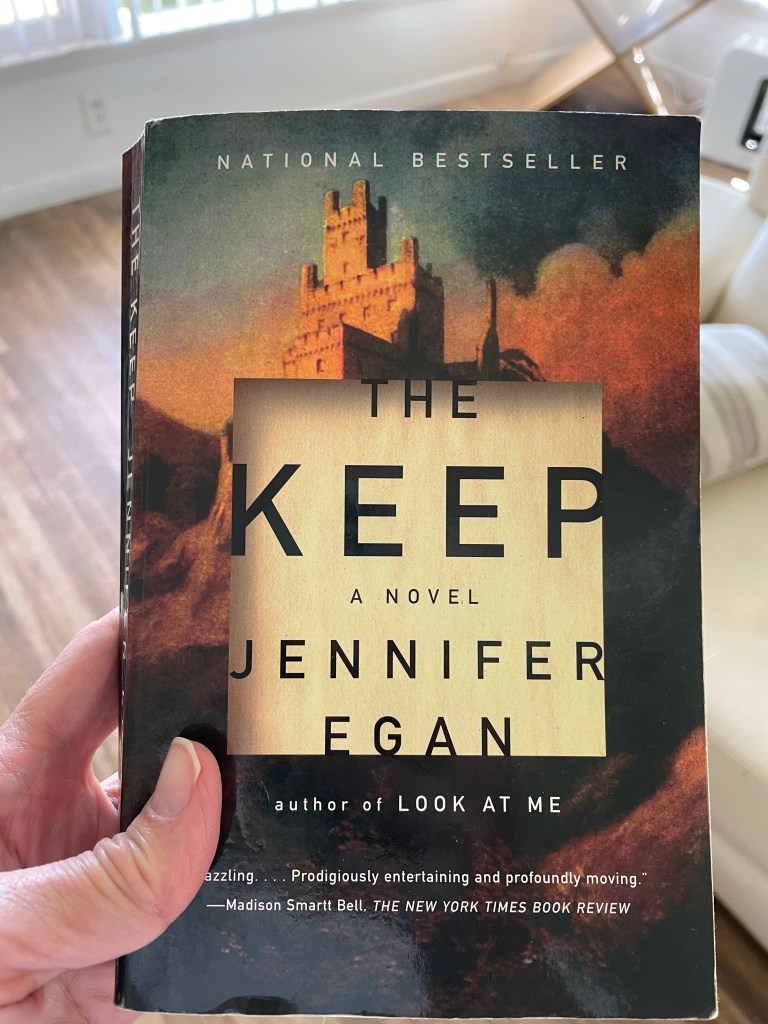
The Keep, by Jennifer Egan. Every once in a while, I pick up a novel by Jennifer Egan and each time she surprises me with the way she bends and twists her people and their narratives. She’s incredibly inventive, layering in all kinds of unusual twists that in another writer might seem showy, but not her. Who’s telling this story? I kept asking myself as I read this novel, because the narrators keep changing as the story deepens. Two cousins, bound by a singular traumatic childhood event, meet again as adults with a vision of turning a European ruin of a castle into a tech-free hotel. Technology and our addiction to it, imagination and our fundamental need for it, guilt and the ache of dreams that didn’t come true, all against the chilling backdrop of a castle from which you can never escape infuse this novel with a despairing kind of love. Brilliantly wrought.
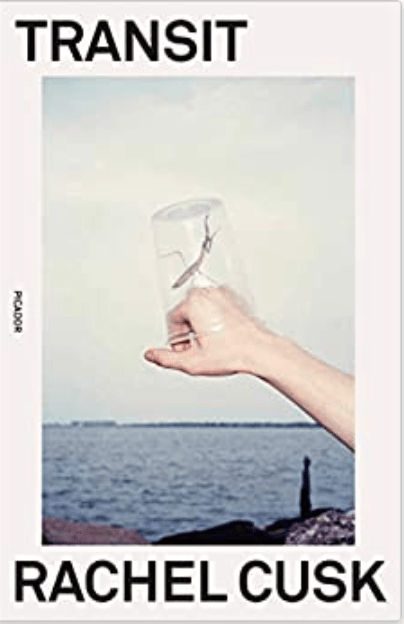
Transit, by Rachel Cusk. Onward, ever onward, with my new infatuation with Rachel Cusk. Transit is the second in a trilogy of novels about a writer, recently divorced, whose books are both well-known and well-reviewed, who teaches occasional workshops both in England and abroad, who has two children currently staying with the father while the writer undertakes a difficult renovation of her newly-purchased awful house in a neighborhood she loves. That little summary makes it seem as if Cusk’s writing is pretty standard, yet it’s anything but. Only at the very end of Transit does the writer-narrator finally let us know her first name. Every actual “fact” of her life is painfully extracted, but who cares, because facts are not the point of these novels, in my reading of them. Instead, Cusk lays bare, with unsparing honesty, the heart and soul of a person’s hard-won insight into human nature. The conversations throughout these novels are like the (few) purely honest conversations I’ve had in my life that happen when everything is stripped away and there’s nothing to lose. I’ve already bought the third in this trilogy. Cannot get enough of this writer.
How do I love thee, this poem? Let me count the ways. 1. Because I’m a sucker for teacher praise poems. 2. Because as a child the only way I could cope with the horror of writing elementary school book reports (people! to reduce a book to a plot summary is to kill it dead!) was to make up imaginary books and then write fake book reports about them. 3. Because I too adore Langston Hughes and Gwendolyn Brooks. 4. Because Nikki Giovanni is a lifelong badass and I love her. 5. Because censoring what a child reads and which books are allowed on shelves is a crime. 6. Because every book a child reads is a rung on a ladder leading up and up and up to a future they dream of making.
In Praise of a Teacher, by Nikki Giovanni
The reason Miss Delaney was my favorite teacher, not just my favorite English teacher, is that she would let me read any book I wanted and would allow me to report on it. I had the pleasure of reading The Scapegoat as well as We the Living as well as Silver Spoon (which was about a whole bunch of rich folk who were unhappy), and Defender of the Damned, which was about Clarence Darrow, which led me into Native Son because the real case was defended by Darrow though in Native Son he got the chair despite the fact that Darrow never lost a client to the chair including Leopold and Loeb who killed Bobby Frank. Native Son led me to Eight Men and all the rest of Richard Wright but I preferred Langston Hughes at that time and Gwendolyn Brooks and I did reports on both of them. I always loved English because whatever human beings are, we are storytellers. It is our stories that give a light to the future. When I went to college I became a history major because history is such a wonderful story of who we think we are; English is much more a story of who we really are. It was, after all, Miss Delaney who introduced the class to My candle burns at both ends; /It will not last the night; /But, ah, my foes, and, oh, my friends— /It gives a lovely light. And I thought YES. Poetry is the main line. English is the train.
Click here for Nikki Giovanni’s brief, funny, wonderful ‘biography.’








 Alison McGhee