Poem of the Week, by Philip Larkin

Minnesotans! There’s ​plenty of room in my FREE workshop on Friday, May 2, 1-4 Central Time: The Echo That Remains. This workshop, held via Zoom, is for anyone who loved someone who died of suicide, substance abuse, or untreated mental or physical illness. Click here for more information and to register. ​Note that we do not share our writing with each other in this workshop, which you may find freeing. All are welcome, free of charge, no writing experience necessary.  

Last week I stood on a beautiful bridge, watching the current flow beneath, when an idling motorboat dislodged a duck nest from the pilings. The nest went floating down the river, the mother duck frantic, fluttering up from her seven eggs and down again, helpless to stop the drift. Finally she jumped off and paddled to shore, her nest soon out of sight.

It hurt beyond all reason to witness that duck and her nest, because even though it was unintentional, too many other losses aren’t, like this heinous administration’s wanton, daily, abject cruelty. The world throws so much at all of us, animal and human; we should be careful of each other, and kind.

The Mower, by Philip Larkin

The mower stalled, twice; kneeling, I found   
a hedgehog jammed up against the blades,   
killed. It had been in the long grass.

I had seen it before, and even fed it, once. 
Now I had mauled its unobtrusive world   
unmendably. Burial was no help:

Next morning I got up and it did not.
The first day after a death, the new absence   
is always the same; we should be careful

of each other, we should be kind   
while there is still time.

Click here for more information about Philip Larkin. 
alisonmcghee.com
My podcast: Words by Winter

Poem of the Week, by Sarah Freligh

A few of the thousands of memories I conjure when I need them: my grandmother, telling me of course I was doing the right thing. A night in summer when RJ and Doc and I slept on quilts on the beach, the sound of the waves and the smell of the ocean. How my father’s hug would lift me off the ground.

The day long ago when my phone chirped and I opened it to a tiny video from a daughter far away: a mother and child sea lion, sunning on the rough shore of a Galapagos sea. The mother sea lion stretched and flopped over. Then the camera flipped around and a girl with wide eyes and a tumble of dark curls was smiling at me. Love you, Mom, she whispered, and then the screen went blank. I still see her smile, hear that whisper.

Wondrous, by Sarah Freligh

I’m driving home from school when the radio talk
turns to E.B. White, his birthday, and I exit
the here and now of the freeway at rush hour,

travel back into the past, where my mother is reading
to my sister and me the part about Charlotte laying her eggs
and dying, and though this is the fifth time Charlotte

has died, my mother is crying again, and we’re laughing
at her because we know nothing of loss and its sad math,
how every subtraction is exponential, how each grief

multiplies the one preceding it, how the author tried
seventeen times to record the words She died alone
without crying, seventeen takes and a short walk during

which he called himself ridiculous, a grown man crying
for a spider he’d spun out of the silk thread of invention —
wondrous how those words would come back and make

him cry, and, yes, wondrous to hear my mother’s voice
ten years after the day she died — the catch, the rasp,
the gathering up before she could say to us, I’m OK.

For more information on Sarah Freligh, please visit her website.

Poem of the Week, by Tony Hoagland

Minnesotans! There’s still room in my FREE workshop on Friday, May 2, 1-4 Central Time: The Echo That Remains. This workshop, held via Zoom, is for anyone who loved someone who died of suicide, substance abuse, or untreated mental or physical illness. Click here for more information and to register. All are welcome, no writing experience necessary. 

How many times a day do you feel like a failure? I once asked the Painter. All day every day, he answered, to which I nodded.

Ten years ago, on a whim at the end of December, I sat down at my dining table and hand-wrote myself a letter. Dear Allie, it began, here are some things you did in 2015. The letter is a simple bulleted list, but each entry, such as tried to be a good teacher and stayed in good shape despite plantar fasciitis, holds within it an arc of emotion and effort and accomplishment. I hadn’t looked at that letter since I wrote it, nor the subsequent letters I’ve written to myself every year since, but everything I tried to do that year came rushing back over me, along with a deep sense of being just one of a long, long line of humans who are all just trying.

Which brings me to this beautiful farewell poem by Tony Hoagland. The ending, which I had to read twice to understand was not an admonition but a gentle acknowledgment to himself that he had been a good man who should have been kinder to himself, still chokes me up.

Distant Regard, by Tony Hoagland

If I knew I would be dead by this time next year
I believe I would spend the months from now till then
writing thank-you notes to strangers and acquaintances,
telling them, “You really were a great travel agent,”
or “I never got the taste of your kisses out of my mouth.”
or “Watching you walk across the room was part of my destination.”
It would be the equivalent, I think,
of leaving a chocolate wrapped in shiny foil
on the pillow of a guest in a hotel–
“Hotel of earth, where we resided for some years together,”
I start to say, before I realize it is a terrible cliche, and stop,
and then go on, forgiving myself in a mere split second
because now that I’m dying, I just go
forward like water, flowing around obstacles
and second thoughts, not getting snagged, just continuing
with my long list of thank-yous,
which seems to naturally expand to include sunlight and wind,
and the aspen trees which gleam and shimmer in the yard
as if grateful for being soaked last night
by the irrigation system invented by an individual
to whom I am quietly grateful.
Outside it is autumn, the philosophical season,
when cold air sharpens the intellect; 
the hills are red and copper in their shaggy majesty.
The clouds blow overhead like governments and years.
It took me a long time to understand the phrase “distant regard,”
but I am grateful for it now,
and I am grateful for my heart,
that turned out to be good, after all;
and grateful for my mind,
to which, in retrospect, I can see
I have never been sufficiently kind.

For more information about the one and only Tony Hoagland, please read his obituary.

alisonmcghee.com
My podcast: Words by Winter

WEIRD SAD AND SILENT (book giveaway!)

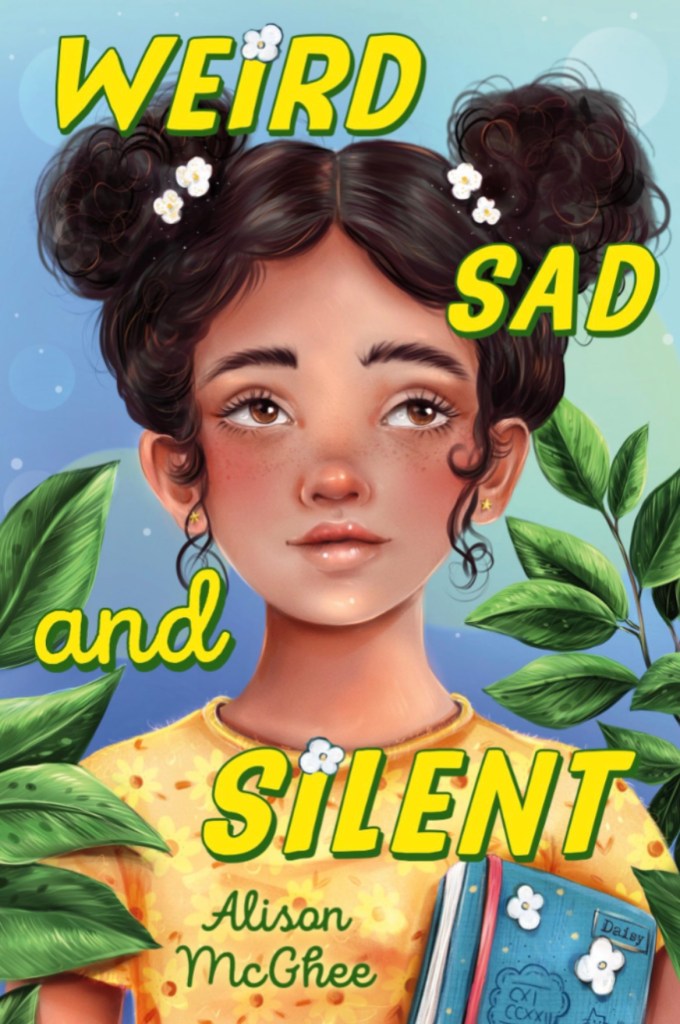
Friends, please meet my girl Daisy Jackson. See that look in her eyes? This girl has some questions, and she’s also got opinions, not that she’s about to share them with you. Daisy is ten years old and highly skilled in the art of invisibilizing, a skill she honed two years ago, when the school bullies nicknamed her Weird Sad and Silent.

Daisy sits in the back of the classroom, she doesn’t raise her hand, and she doesn’t eat lunch in the cafeteria. In fact, Daisy talks mostly to the adults in her life: her mama Flora, her neighbor Lulu, Marimba the school librarian, and Captain the school custodian.

That’s until a new kid, Austin, shows up one day. There’s something about Austin, something Daisy can’t explain, something that makes him feel like…a kindred spirit. Daisy might be your kindred spirit too. WEIRD SAD AND SILENT, on bookshelves everywhere May 6. 

GIVEAWAY: Is there a kindred spirit in your life? Someone who just gets you and always has? Tell me about them in an email or the comments, and I’ll enter you in this week’s drawing for a signed copy of the novel.

WEIRD SAD AND SILENT, on bookshelves everywhere May 6. 

Poem of the Week, by Cati Porter

Minnesotans! There’s still room in my FREE workshop tomorrow, April 6, 1-4 Central time: Rewriting the Story, Reclaiming the Self. This workshop, held via Zoom, is designed for anyone living with the memories, recent or long ago, of abuse: bullying, domestic violence, an emotionally abusive relationship, a sexual or physical assault. Click here for more information and to register. All are welcome, no writing experience necessary. 

Are you concealing a kidnapped child in the back of your car? Have you transported materials to make a bomb or flame thrower or grenade launcher across state lines? How much fentanyl or heroin, if any, are you concealing in your car? Where is your final destination? Do you know what you did wrong and why we pulled you over?

These were some of the many questions I was asked last week while driving from California to Minnesota after a cop and his partner tailed me for a good ten miles before finally pulling me over for an entirely fictitious reason.

Many things went through my head as they kept traipsing back and forth to their police car: how much more scared I would be if I weren’t white. How straightfaced and serious they looked as they told me what I (hadn’t) done wrong. How my dog would not stop barking and I was afraid they would get angry because of it. But mostly? That I’m the one being pulled over while a bunch of craven cowards are fine letting our democracy die. Am I angry, America? You have no idea.

Dear America, by Cati Porter

I am your daughter and
I am angry.

Born in a barn and
raised by wolves,

I have eaten
the porridge

and the plums
and I am not sorry.

You told me that
I can never go home again

but it was you
who sold me a bridge

that was not yours,
then set it on fire. 

Click here for more information about poet Cati Porter. Today’s poem is included in small mammals, published in 2023 by Mayapple Press.  
alisonmcghee.com
My podcast: Words by Winter

Poem of the Week, by Brian Bilston

Minnesotans! There’s plenty of room in my FREE workshop Sunday, April 6, 1-4 Central time: Rewriting the Story, Reclaiming the Self. This workshop, held via Zoom, is designed for anyone living with the memories, recent or long ago, of abuse: bullying, domestic violence, an emotionally abusive relationship, a sexual or physical assault. Click here for more information and to register. All are welcome, no writing experience necessary. 

I never understood until now, deep down in my gut and in a way that jolts me awake throughout the night, how Hitler came to power so horrifyingly fast. Please, save me from hatred and disdain. Save me from refusing to see the hopes and dreams of others as equal to my own.

Refugees, by Brian Bilston

They have no need of our help
So do not tell me
These haggard faces could belong to you or I
Should life have dealt a different hand
We need to see them for who they really are
Chancers and scroungers
Layabouts and loungers
With bombs up their sleeves
Cut-throats and thieves
They are not
Welcome here
We should make them
Go back to where they came from
They cannot
Share our food
Share our homes
Share our countries
Instead let us
Build a wall to keep them out
It is not okay to say
These are people just like us
A place should only belong to those who are born there
Do not be so stupid to think that
The world can be looked at another way

(Now read from bottom to top.)

Click here for more information about Brian Bilston. I first found this poem last week on poet George Bilgere’s wonderful poetry site Poetry Town
alisonmcghee.com
My podcast: Words by Winter

Poem of the Week, by Jeffrey Harrison

Minnesotans! There’s plenty of room in my FREE workshop this coming Tuesday, March 25, 6-9 pm Central: Mapping the Unmapped. This workshop is offered free of charge and designed for anyone living in the wake of loss: of a loved one, a job, a home, a relationship, a long-cherished dream, your physical or mental health. Click here for more information and to register. All are welcome, no writing experience necessary.  (Non-Minnesotans, note that I will be adding these to my workshop offerings in the future, and they will always be free.)

A long time ago my dog and I got up at 3 am and drove north out of the city because I wanted to see the Perseid meteor shower, which was intense that year. By the time we reached our destination (the entrance to a closed state park) and parked, the meteors were streaking down the sky. I sat on the hood of my car and watched them.

Gradually the bottom half of the sky was swallowed up by clouds, while above the clouds the meteors streaked silently on. Within minutes all I could see was darkness. I pictured the meteors behind the clouds, silently falling through space, burning themselves out in blackness.

When I need to remember I’m part of something much bigger, full of mystery and beauty and far beyond my tiny human life, I remember that night.

Interval, by Jeffrey Harrison

Sometimes, out of nowhere, it comes back,
that night when, driving home from the city,
having left the nearest streetlight miles behind us,

we lost our way on the back country roads
and found, when we slowed down to read a road sign,
a field alive with the blinking of fireflies,

and we got out and stood there in the darkness,
amazed at their numbers, their scattered sparks
igniting silently in a randomness

that somehow added up to a marvel
both earthly and celestial, the sky
brought down to earth, and brought to life,

a sublunar starscape whose shifting constellations
were a small gift of unexpected astonishment,
luminous signalings leading us away

from thoughts of where we were going
or coming from, the cares that often drive us
relentlessly onward and blind us

to such flickering intervals when moments
are released from their rigid sequence
and burn like airborne embers, floating free.

Click here for more information about Jeffrey Harrison. Today’s poem first appeared in his book Feeding the Fire, published in 2001 by Sarabande Books.
alisonmcghee.com
My podcast: Words by Winter

Poem of the Week, by Bradley Trumpfheller

​Minnesotans! I’m offering three free workshops this spring on the transformation of trauma. Click here for more information and to register. All are welcome, no writing experience necessary. (Non-Minnesotans, note that I will be adding these to my workshop offerings in the future, and they will always be free.)

When you fold laundry you see the insides of clothes and sheets and towels –their raggedy seams and straining buttonholes and raveling threads–before you turn them right side out so they’re presentable for public viewing.

I’m like that laundry. No matter what’s unraveling inside, I know how to look smooth and together. Maybe most of us are like this.

This poem makes me think about the invisible seams in everyone. From heartbreaks mended (you’re never the same), memories beautiful or awful (you remember them all), dreams you dreamed that came true (or didn’t), a place or a person you return to in your mind when you need to be soothed.

Loom, by Bradley Trumpfheller

My mother says when she is anxious she finds a seam, 
finds stitches on her clothes, on furniture she’s near, always 
a verge has that feel, birch joints, wrinkles. It’s a relief
to think with the hands. Not with what years do, 
not with rings or someone else’s sadness. With the repair 
in a sheet her sister tore, breeze-fretted in the yard. 
Finds exactly where the hickory trees start themselves
against the yard. And shows me on the photograph 
which is only one of several, where though again 
they did not touch each other, standing on some shore, 
her mothers’ shadows touch each other. 
She shows it to me now to soothe me. As if soon 
it will be that blue in the air. Soon is what 
she thinks with. What she runs 
the edge of her thumb, her index finger over. 

Click here for more information about Bradley Trumpfheller. Today’s poem was published in 2024 by the Academy of American Poets. 

alisonmcghee.com
My podcast: Words by Winter

Poem of the Week, by Keith Leonard

 My neighbor who shovels my sidewalk if he gets up earlier than me. The rhubarb I share with him in the spring. The people who leave sweet notes in my Poetry Hut. The little free food library at the church a few blocks away. These and a thousand more small daily acts of generosity and kindness make life better for everyone.

Remember when, instead of patiently answering his question, a presidential candidate made fun of a disabled reporter in front of a huge crowd and instead of going silent in revulsion, they cheered? Witnessing acts of cruelty twists something up in me —what should I do what should I do what should I do–in an almost paralyzing way. The saying “hurt people hurt people” makes sense but not enough sense, because aren’t we all hurt? The only thing to do about cruelty is resist it.

Boléro, by Keith Leonard

From the kitchen, I catch the neighbor
cross the street to switch off my car’s interior lights.
He returns to his house without announcing the favor.
For the last three years, a friend has woken early
and walked the beach, combing for bottle caps
and frayed fishing line. She mentions this
only casually at lunch, after I’ve asked
what she did that morning.
Care has a quiet soundtrack: the sycamore’s
rustling leaves, your nails tracing my shoulder blades.
A melody that repeats—a bit like Ravel’s Boléro.
When it was first performed, a woman shouted,
Rubbish! from the balcony. She called Ravel
madman. I think I understand. I wish I didn’t.
I’ve been taught that art must have conflict,
that reason must meet resistance.

Click here for more information about Keith Leonard. Today’s poem first appeared in Poetry in December, 2023. 
alisonmcghee.com
My podcast: Words by Winter
Three new free workshops for Minnesotans

The Transformation of Trauma

Have you gone through something awful, either recently or a long time ago? Maybe someone you love died, or you lost your job or home. Maybe someone you love is an addict, and you struggle with conflicting feelings on how best to care for them and yourself. Maybe someone sexually assaulted you, or abused you over a long period of time. Maybe as a child, or adult, you struggled through domestic violence or emotional manipulation. If your life is compromised by any of these experiences, and you’re looking for some relief and support, welcome to these workshops.

Note that I am not a therapist. But as a lifelong writer, as well as a trained crisis counselor, I know that the making of art, in all its many and varied forms, can be a profound way to help cope with experiences that were grievous, unfair, unwanted, or cruel. In each three-hour workshop, we’ll work on three creative writing exercises, read and discuss a few short readings, and hopefully find ways to unlock your own power.

These workshops are offered free of charge via Zoom. You do NOT have to be a writer, or even be interested in writing, to enroll. I’ve designed them for people of any or no writing experience – all are welcome. There’s no feedback or public sharing of work in these workshops (unless you want to), so you are free to unburden yourself and follow the prompts in whatever way is beneficial to you without fear of anyone seeing your work. Enrollment in each workshop is limited to 30.

To register for any or all of the workshops, email me directly at alisonmcghee@gmail.com. Feel free to share this note with anyone who might find the workshops helpful.

Please note: While these first three workshops below are open only to Minnesotans, I plan to add them to my regular workshop offerings in future, and they will always be offered free of charge.

Tuesday, March 25, 6-9 Central Time, via Zoom. Mapping the Unmapped
This workshop is designed for anyone living in the wake of loss: of a loved one, a job, a home, a relationship, a long-cherished dream, physical or mental health.

Sunday, April 6, 1-4 Central Time, via Zoom. Rewriting the Story, Reclaiming the Self
This workshop is designed for anyone living with the memories, recent or long ago, of abuse: bullying, domestic violence, an emotionally abusive relationship, a sexual or physical assault.

Friday, May 2, 1-4 Central Time, via Zoom. The Echo That Remains
This workshop is for anyone who loved someone who died of suicide, substance abuse, or untreated mental or physical illness.