One new book and three new one-day classes!
 Once, when I was ten years old and the proud owner of a three-speed Schwinn with a basket and a speedometer, I rode to the top of the biggest hill nearby and surveyed my surroundings. Pine woods, fields, farmhouses and barns, and the lonely two-lane road in front of me. Breaking my land speed record was the goal, so I stood up and pedaled as hard as I could down the hill. 5, 10, 15, 20, all the way up to 35 mph, with the wind roaring in my ears and my long hair blowing back (no helmet; this was back in the day).
That personal land speed record, 35 mph pedaling as fast as I could, is what this summer felt like to me. Planes and trains and automobiles, bikes and kayaks and mostly, my own two feet, traipsing around the city and the country.
Now it’s fall. Time to take a breath. Time to survey the surroundings. Time for one new book and three new one-day classes!
DEAR SISTER
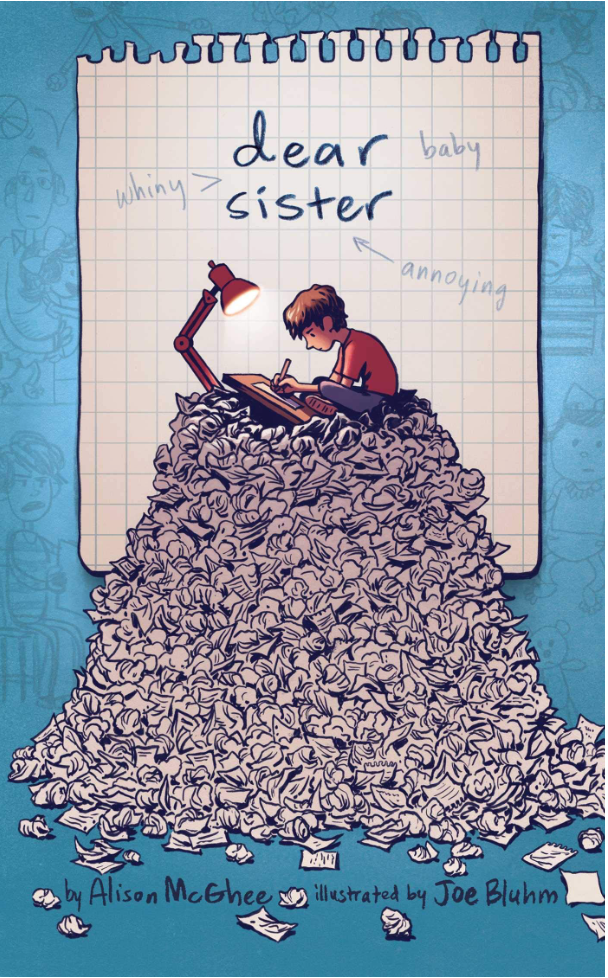
Dear Sister is my new graphic novel for all ages, especially 8 on up. It’s a collection of letters and drawings from a brother to his little sister, beginning on the day she’s born and continuing for the next ten years, until he goes to college. This book was inspired in part by notes my own kids used to write each other, notes that were alternately horrifying and hilarious, and also by my own fifth-grade diary, which is filled with entries about my baby brother. Funny, tender, and honest, Dear Sister is my love letter to the sibling relationship.
Dear Sister is illustrated –amazingly so–by the talented Joe Bluhm, who’s one of the artistic geniuses behind The Fantastic Flying Books of Mr. Morris Lessmore. I loved working with Joe on this book. I’ll be visiting upstate New York, Washington DC, Philadelphia, southern California and the Twin Cities for Dear Sister. Please check my blog for details of upcoming readings and events – if I’m in your neck of the woods for any of them, I’d love to meet you.
To pre-order a copy of Dear Sister:
From your local indie bookstore
From Amazon
From Barnes & Noble
NEW ONE-DAY CLASSES, NOVEMBER 2-4
Do you have an interest in creative writing but haven’t yet taken the plunge? Are you a writer already, interested in exploring a new form or just taking a class for the fun of it? I’d love to see you in one of these upcoming November classes. Please join us!
Friday, November 2: Creative Writing Kickstart!
Location: Uptown Minneapolis
Time: 12-4 pm
Cost: $100, payable via personal check or this Paypal link.
Have you always wanted to write but aren’t sure how to begin? Or, are you a writer in need of an energy boost and a fresh start? This four-hour intensive Kickstart workshop will recharge your writing energy and help you develop a regular writing practice. We’ll do several brief writings and talk about various aspects of craft and process –maybe language, maybe flow, maybe dialogue, maybe tense and point of view, maybe some other things– in terms of what makes great writing great.
The class is designed for writers of all abilities, experience levels and genres – so I forbid you to worry if you’ve never written before! Whether you’re a longtime writer in need of a boost or someone who’s always had an interest in writing but never known how to sit down and get started, the class is designed for you. Bonus: Weekly writing prompts will be emailed to you for one month following the end of class. Enrollment is limited to 15.
Saturday, November 3: The Art of Writing Picture Books
Location: Uptown Minneapolis
Time: 12-4 pm
Cost: $100, payable via personal check or this Paypal link
Do you love picture books? Have you ever wanted to write one? Are you curious how to go about it? Welcome to my one-day picture book writing workshop! In our intensive, fun class, we’ll deconstruct some classic picture books, talk about ideas for new ones, and go through all the nuts and bolts, such as how long can a picture book be? What’s the relationship between writer and artist? How do you write a picture book that children will love and adults won’t mind reading ten thousand times in a row? I promise it will be informative and fun. Enrollment is limited to 15.
Sunday, November 4: The Freedom of Form
Location: Uptown Minneapolis
Time: 12-4 pm
Cost: $100, payable via personal check or this Paypal link.
When you’re stuck in a piece of writing, feeling lifeless, what do you do? Grind through, hoping desperately that a window will open? Give up? Take a break? Declare yourself a failure and slink off to drown your sorrows? I’ve taken a shot at all these methods, and none of them work as well for me as re-framing the work itself. I give myself seemingly arbitrary rules to work within, e.g., Write this scene as a series of text messages, or, Write this novel as a series of one-hundred-word passages. The freedom of assigned form is real, people, and it’s why novels usually have chapters, and picture books are usually under 500 words. It’s why enduring forms of poetry like haiku and sonnets and sestinas are still alive and thriving. In this workshop, which is designed for writers in all genres, we will play with form as a way to open up your writing, your mind and your heart to the freedom and creativity inherent in all art. We’ll complete some in-class writings, discuss published works and in general have a great and exhilarating time. Enrollment is limited to 15.
Thanks for reading, and happy fall to all.

Alison McGhee, writer
alison_mcghee@hotmail.com
Website
Blog
Facebook page
@alisonmcghee
 A few years ago my brother sent me a photo of my nephew, with the caption Getting his mind blown at Nickelodeon Universe. Nickelodeon Universe is a crowded and noisy place, but in the photo, my tiny nephew stands alone in a huge open space, his head craned up, staring at something I can’t see. The photo conveys profound stillness and concentration. Sometimes it pops up on my screensaver and I wonder again what my nephew was staring at, what was going through his mind.
  Once, a long time ago, someone close to me handed me a memo and asked me to read it. It was a work memo that summarized some unfair working conditions. I didn’t know who had written it, but my first comment was “Wow. Whoever wrote this can’t spell worth a damn and doesn’t know how to use punctuation, either.” The person who had handed me the memo didn’t hear me say this, for which I was instantly grateful, because it turned out that they had written it. This was a person I loved with all my heart. The shame I felt in that moment is something that will be with me forever.
  My youngest didn’t walk until she was 22 months old. Instinct told me she was fine so I didn’t worry about this, but I observed her with interest. One day, when I was in the kitchen and she was sitting in a patch of sun on the living room floor, her back to me, I watched in wonder as she rose –no hands, no support, no nothing– to a full stand and began to walk. I had never seen a child go from crawling to perfect walking in an instant like that. She never went back to crawling.
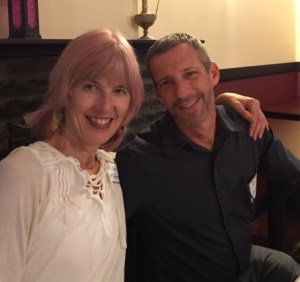 Neither my friend nor I had been to a high school reunion in many years –in my case, decades–and we were both nervous. The years we had spent growing up together in upstate New York seemed far away, and we hadn’t kept in touch with many classmates. So we met early, at the bar in that tiny stoplight-less town, and fortified ourselves with gin while paging through our yearbook to remind ourselves of faces and names. At one point I said to him, It’s been decades. We don’t look the same, will anyone else?
  Long ago, when I taught Mandarin at a big city high school in Minneapolis, some of my students would stay after school and talk with me. One was a Hmong young man, quiet and shy, with halting English. He would sit in the chair by my desk and cast his glance at the floor. For a long time I would inwardly urge him to look at me —look at me look at me come on look me in the eye– and then it came to me that his avoiding my direct gaze was part of his culture, and a sign of respect. All my annoyance melted away and from then on I was more soft-spoken, gentle, and slow in his presence.
  For years I’ve written
  A few days ago at the store I stood in line, my groceries on the conveyor belt: butter, greens, an avocado, carrots and peppers and potatoes. The person behind me placed their items on the belt: two packages of ice cream sandwiches. About once a year I get a craving for an ice cream sandwich, and looking at the picture on the boxes made me want one. I turned to see who was buying them. She was middle-aged, with faded hair and a worn, tired face, wearing a jacket with a broken zipper. Hunched over. She’s been through some things, was the thought in my mind, and I waited for her to look up so I could smile at her and chat a little while we waited for the cashier. But she never did look up. And I thought of this poem, by the wondrous Dorianne Laux. So many people out there, all of us maybe, who have been through some things. Oh, the water.
 Growing up in the age of Darwinian elementary schools –the gym teacher would choose the two best athletes to captain every team, and one by one they would pick off first the good athletes, then the midlings, then the uncoordinated, until finally there was only one child remaining, huddled against the wall– I hated gym class. Not because I was bad at sports (I’m not) but because I can’t stand cruelty. And that little ritual was fundamentally cruel.
  Alison McGhee