Poem of the Week, by Tess Gallagher

Shack, view straight up from the hammockYears ago I bought some raw land on a slope in Vermont. Hired someone to grade a tiny cleared patch in the woods. Drilled a well. Bought a one-room cabin kit off eBay and hired a carpenter to put it together. Spent many days and nights staring up from the porch and the hammock at the enormously tall pines pictured to the right.

The cabin was a seasonal place but even in summer it was always dark and cool. After some years I craved sunlight, so I asked a lumberjack friend if he would cut down a few of the pines. He said yes, if he could do it in the middle of winter. I don’t like to cut down trees, he said, even though he was a lumberjack. And I only do it in winter, when all the birds have left the nests.

When I read this poem I thought of him, my lumberjack friend who snowshoed alone up the unplowed dirt road to the cabin in February, towing his chainsaw and axe on a toboggan behind him, and went to work in the frozen stillness so he wouldn’t hurt the birds. 


Choices, by Tess Gallagher

I go to the mountain side
of the house to cut saplings,
and clear a view to snow
on the mountain. But when I look up,
saw in hand, I see a nest clutched in
the uppermost branches.
I don’t cut that one.
I don’t cut the others either.
Suddenly, in every tree,   
an unseen nest
where a mountain   
would be.  

                              for Drago Štambuk


​For more information on Tess Gallagher, please ​click here.

Website

Blog

Facebook page

@alisonmcghee

Poem of the Week, by Gregory Orr

IMG_4207Certain moments are burned into your brain and heart, moments that even as they happened you knew would haunt you forever, like the way your little boy nodded and kept nodding, that one afternoon on the couch. Looking back now, through the tunnel of time, there are passages so rough that you narrowed time down to half-hour segments in order to make it through. Had to trust that somehow the invisible ship would carry you from one invisible shore and deposit you on another. That you would find yourself again.

You do find yourself again, over and over, but you’re not the same person you were before. Each time, there has been a long season of necessary silence, and even if you look the same, you aren’t. Maybe we don’t heal so much as shift, and yield, and absorb in a way that lets us keep living with all the everythings that happen in a life.  


Aftermath Sonnet, by Gregory Orr

Letting my tongue sleep, 
and my heart go numb.

Sensing that speech
too soon,
after such a wound,
would only be
a different bleeding.

Even needing to leave
the page blank.
Long season
of silence—
trusting that under

its bandage of snow,
the field of me is healing.


For more information about Gregory Orr, please click here​.​

Website

Blog

Facebook page

@alisonmcghee


For more information about Gregory Orr, please https://www.poetryfoundation.org/poets/gregory-orr.


Poem of the Week, by Wendy Chin-Tanner

Screen Shot 2019-02-16 at 10.16.17 AMIn my 1000 Words class you could write anything you wanted –poem, essay, memoir, story, children’s book–as long as it was fewer than one thousand words. Does it sound easier to write short than long? It’s not. You have to take an image, a dream, a thought, a burning wish, and hone and pare it until there’s not an extra word.

This process of distilling words is my great love and my great challenge in everything I write. When I read the poem below –twelve short words that encompass the un-beginning of an entire life–I was spellbound.


Infertility, by Wendy Chin

You end me
like a period

ends a sentence
ends a line. 


For more information about Wendy Chin-Tanner, please click here.

Website

Blog

Facebook page

@alisonmcghee

Portrait of a Writer: Rene Denfeld

Screen Shot 2019-10-29 at 7.42.25 AMBoiling a work of art down to a few lines feels like an impossible task to me, which is why I dreaded writing book reports as a child (pre-internet, I got around it by writing book reports about imaginary books I dreamed up in my own mind). This is why I avoid book jackets, movie trailers, and podcast episode descriptions in favor of plunging in and figuring it out as I go.

This back-your-way-into-it method is how I first became aware of the writer Rene Denfeld on the This Is Actually Happening podcast. This Is Actually Happening is an unusual podcast in which the grave-voiced narrator, Whit Misseldine, edits himself entirely out of each episode. All you hear is the voice of the person being interviewed. You can sense when a question has been asked and then erased, but the result is a steady, unbroken hour-long stream of a single voice talking about their past, their present, how they got from where they were to where they are. It’s an hypnotic, unsettling way to present a human being.

On this particular episode, per usual, I didn’t know the featured interviewee. She mesmerized me, though. She spoke about her childhood, in which she was sexually and emotionally abused, recounting the events with a deep calm –her mother’s boyfriend, whom she loved, gradually deepened into a horror–and her even, conversational tone never altered. She ran away from home as a teenager and lived on the streets. She told the truth about what had happened to her. By the end of her recounting, the storyteller was middle-aged, her ties to her beloved younger sister had been lost, and the abuser was in prison. You could hear the sadness of that loss, and her love for her sister, and also her mother in her voice. Screen Shot 2019-10-29 at 7.46.36 AM

When she made it out of the brokenness of her early life and turned herself into a strong, grounded woman, she became a foster mother to children who also came from traumatized childhoods, eventually adopting three of them. Her voice slowed, turned tender and low, as she spoke of her children. She would be one hell of a mother, I thought as I listened. She spoke of how mothering children from foster care, no matter how challenging it was at times, was a lesson in the constancy of love and the resilience of both mother and children. 

“If I gave up on them, I would be giving up on myself,” she said at one point, and I felt in my own body how being the mother she wished she’d had helped her own childhood pain. At this point something in me rang a bell, a memory of having read this Modern Love essay a couple of years ago about a woman who fostered-to-adopted her children. Could it be the same writer?

Both her voice and her recounting of her life were calm and thoughtful. But there was something else about her that charmed me: her profound kindness in the face of true horror, abuse, and evil. It felt to me that this kindness was the result of a decision on the part of the speaker not to give in to bitterness, to hatred, but to walk toward love and light instead.

Screen Shot 2019-10-29 at 7.37.58 AMFinally, at the very end of the podcast, the narrator came back on to say that we had been listening to “Rene Denfeld, internationally best-selling novelist and public defense investigator.” I looked her up immediately. A public investigator for a public defender’s office, she has won multiple awards for her justice work with victims and the wrongly accused, including a 2017 Hero Award from the New York Times.

I bought her novel The Child Finder and read it in two days (warp speed for me). The star of the book, Naomi, is a young woman who specializes in finding missing, lost, stolen and trafficked children. The book is set in the mountainous depths of an Oregon winter, and Naomi slowly, with intuition and experience, tracks down a missing child and her captor. As I read, I heard Rene’s voice from the podcast reading to me. Echoes of her own life story were everywhere: in Naomi’s own lost childhood and the abuse she had suffered, in her determination to save the children she could, in the profound empathy, compassion, and understanding she shows even the captor.

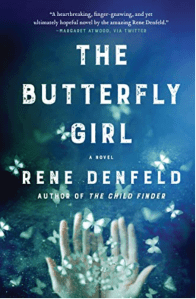
It was another six months before her new novel, The Butterfly Girl, was published. I walked to Magers & Quinn the day it came out and bought it. Took it home and read it. This book, too, stars Naomi the child finder, but this time she is searching for the sister she left behind twenty years earlier. The book is in large part the stories of the “street kids” Naomi encounters in the gritty neighborhoods of Portland, Oregon, how they look out for each other and understand each other when no one else will take the time.

Despite the pain and suffering experienced by the children in her novels, Denfeld imbues the books with hope and an implicit faith that if you work toward a better reality, you can make it happen. In this, the novel is like its creator. These are dark times in our country and in the world. When my faith in goodness needs to be shored up, and I need reminding that steady work toward a better world will make it happen, Rene Denfeld is one of the heroes I turn to, both her life and her work. Beautiful human, beautiful writer.

Poem of the Week, by Gerald Stern

IMG_4897Last week I tucked myself behind a long black semi, far enough back so he could see me and my rattletrap moving truck in his big side mirrors. I do this sometimes on the highway when I’m tired or troubled or just want someone else to take over a little of the decision-making. Truckers (with a few exceptions) are the best drivers out there. They have to be. 

After a while, the trucker realized I was following him. In construction zones, he’d slow down a little once we were through, so that I could catch up to him. I was hungry and I had to pee but I didn’t want to lose my trucker, so I kept going. More than two hundred miles in, he put on his blinker for the next exit. Damn. So sad to see him go, sad, somehow, to think I’d never see him again. But he’d gotten me within fifty miles of home. I sped up at the exit ramp to say goodbye, and there he was in the window, smiling down at me, with a thumbs-up and a wave. 


Waving Good-Bye, by Gerald Stern

I wanted to know what it was like before we
had voices and before we had bare fingers and before we
had minds to move us through our actions
and tears to help us over our feelings,
so I drove my daughter through the snow to meet her friend
and filled her car with suitcases and hugged her
as an animal would, pressing my forehead against her,
walking in circles, moaning, touching her cheek,
and turned my head after them as an animal would,
watching helplessly as they drove over the ruts,
her smiling face and her small hand just visible
over the giant pillows and coat hangers
as they made their turn into the empty highway.


For more information on Gerald Stern, please click here.

Website

Blog

Facebook page

@alisonmcghee

Poem of the Week, by James Baldwin

IMG_4907Last week, late at night, the fire alarm in my cheap motel began to shriek. Doors opened up and down the hall and men began to emerge: huge men, small men, men in their underwear, one on crutches, one pushing a walker, one carrying a case of beer, one sweating as if just out of a sauna. This is the strangest assortment of men I’ve ever seen, I murmured to myself. One of the men leered or smiled, hard to tell.

Next morning in the breakfast room I sat tapping on my laptop while the hallway men shuffled in one by one. The leer/smile man sat next to me. I could tell he wanted to talk but I pretended to be too absorbed in my work to look up. This did not stop him.

“Hey! I like your pink hair! How’s it goin’?” 

It was early. There were six hundred miles ahead of me. I didn’t want to talk. But then the last lines of this poem by James Baldwin came to me and I closed my laptop and turned to him and smiled. Had a long conversation about the fire alarm, the slim pickings at the breakfast buffet, his favorite smoking rituals back when everybody smoked, hard to believe it now, right? 

He was a lonely man. He just wanted to talk. Sometimes it feels like most people are lonely, and most people just want to talk. 


For Nothing Is Fixed, by James Baldwin

For nothing is fixed,
forever, forever, forever,
it is not fixed;
the earth is always shifting,
the light is always changing,
the sea does not cease to grind down rock.
Generations do not cease to be born,
and we are responsible to them
because we are the only witnesses they have.
The sea rises, the light fails,
lovers cling to each other,
and children cling to us.
The moment we cease to hold each other,
the moment we break faith with one another,
the sea engulfs us and the light goes out.


If you’d like to read more about James Baldwin, this is an interesting profile.

Website

Blog

Facebook page

@alisonmcghee

Poem of the Week, by Lisel Mueller

Screen Shot 2018-04-05 at 8.44.54 AM

It must be awful to watch TV next to me, the way I constantly put my hands over my ears, or murmur about the specifics of someone’s voice, or the strange way news anchors inflect their syllables, or oh no oh no there’s that song again, where’s the remote so I can mute it. I am the woman you see in crowds stuffing bits of wadded-up tissue into her ears. Sound is visible to me, literally – words and music and ambient noise have shape and color and texture – and it overwhelms me.

A couple of years ago when the Painter said “Here, try these,” and put his noise-canceling headphones over my ears, the relief was so great I almost cried. The world is so full of noise. Hard to imagine what it would feel like if it were more intense than it already is for intense me. What if we could hear our own cells growing? Our consciousness expanding? The earth breathing?


What the Dog Perhaps Hears, by Lisel Mueller

If an inaudible whistle
blown between our lips
can send him home to us,
then silence is perhaps
the sound of spiders breathing
and roots mining the earth;
it may be asparagus heaving,
headfirst, into the light
and the long brown sound
of cracked cups, when it happens.
We would like to ask the dog
if there is a continuous whir
because the child in the house
keeps growing, if the snake
really stretches full length
without a click and the sun
breaks through clouds without
a decibel of effort,
whether in autumn, when the trees
dry up their wells, there isn’t a shudder
too high for us to hear.

What is it like up there
above the shut-off level
of our simple ears?
For us there was no birth cry,
the newborn bird is suddenly here,
the egg broken, the nest alive,
and we heard nothing when the world changed.


For more information on Lisel Mueller, please read her bio at the Poetry Foundation.

Website

Blog

Facebook page

@alisonmcghee

Poem of the Week, by Kevin Hart

Pete in first snow, 2011

This poem memorized itself into my body the first time I read it many years ago. Each time one of the lines drifts through my mind, like dark ice air through which we fall, all the sensations of snow settle over me. The particular, muffled quiet that only falling snow brings. The feeling of stillness and waiting. Numbness of cheeks and nose and fingers and toes after hours playing in it as a child. My dog, looking up and then around in wonder every year in the first snow. 

These days my heart aches when the poem comes to me, in a please let there still be a future with winter in it way. Please let the earth go dormant, please let that dark ice air return, please let the planet keep breathing. 


Snow, by Kevin Hart

Some days
the snow has taken me in
to know the time of snow, to live
inside a world so quiet

i​ts music
is all a shimmering. Some evenings
when quite alone
I turn off every light

and watch the snow
enjoy the dark, moving lushly
through spiky air,
finding more time

in time
than when I stretch myself
and am
my father’s father. Oh yes,

there is
a sparkling choir, there surely is,
and dark ice air
through which we fall.


​For more information on Kevin Hart, please ​click this link.

Website

Blog

Facebook page

@alisonmcghee

Poem of the Week, by Danusha Lameris

img_1857At a wedding last weekend I sat near a curvy, beautiful woman with a deep voice who radiated a wild and warm confidence. She was free with opinions and didn’t care what others thought; an artist expressed admiration for a specific modern museum and she laughed outright.

She moves through the world in a way I don’t. My voice doesn’t project; I need a mic when giving a talk. A friend once described my narrow body, turned sideways, as like a piece of paper he could slip into his bookshelf. The wedding woman claims space in the world with her solid belief in herself. I claim space in the world by distilling it into stories made of all the ways it overwhelms me. Nonetheless we are alike, both of us caught inside the cathedral, singing inside the song.


Bonfire Opera, by Danusha Lameris
 
In those days, there was a woman in our circle
who was known, not only for her beauty,
but for taking off all her clothes and singing opera.
And sure enough, as the night wore on and the stars
emerged to stare at their reflections on the sea,
and everyone had drunk a little wine,
she began to disrobe, loose her great bosom,
and the tender belly, pale in the moonlight,
the Viking hips, and to let her torn raiment
fall to the sand as we looked up from the flames.
And then a voice lifted into the dark, high and clear
as a flock of blackbirds. And everything was very still,
the way the congregation quiets when the priest
prays over the incense, and the smoke wafts
up into the rafters. I wanted to be that free
inside the body, the doors of pleasure
opening, one after the next, an arpeggio
climbing the ladder of sky. And all the while
she was singing and wading into the water
until it rose up to her waist and then lapped
at the underside of her breasts, and the aria
drifted over us, her soprano spare and sharp
in the night air. And even though I was young,
somehow, in that moment, I heard it,
the song inside the song, and I knew then
that this was not the hymn of promise
but the body’s bright wailing against its limits.
A bird caught in a cathedral—the way it tries
to escape by throwing itself, again and again,
against the stained glass.


For more information about Danusha Lameris, please check out her website

Poem of the Week, by Darrell Bourque

IMG_E4567Last week I stood reading Vincent Van Gogh’s letters to his brother Theo. Back then the mail came two or three times a day, sometimes overnight from Paris to Amsterdam or wherever Vincent was living: the yellow house in France, the room in his parents’ house where he would sometimes retreat, from behind the barred window of the asylum where he committed himself.

The great love between the brothers was clear. So was Vincent’s belief that art would save him from the anxiety and despair that overwhelmed him. In the seventy days before he shot himself, he made seventy-five paintings filled with light, and sun, and the brilliant colors he loved and made his own.

Self-portraits filled one whole room of the museum. In each, his blue eyes shone out at me. They must have shone out at him, too, in the moment he painted himself. When I walked out into the Amsterdam afternoon, I thought of this poem.


Lumina
      – Darrell Bourque

We’re all extensions
          of someone or another’s
                     golden light.

In the moment
          I was made
                     stars filled the sky

& some parts
          of the bodies
                     making me

were fleetingly
          illuminated—
                     briefly luminous.

Druids see light
          in wood
                     and worship trees.

When we wave
          in recognition,
                     we disperse light,

set light in motion
          toward
                     the beloved.

We string our trees
          with lights
                     in wintertime.

We want
          to see ourselves
                     in the dark.


For more information on Darrell Bourque, please click here.

Website

Blog

Facebook page

@alisonmcghee