A few months after my father died I was driving Route 89 in New Hampshire, a gorgeous fall day, swooping around curves of mountains turned to flame, and it came to me that my father would never make this drive again. It was just me in the car, and I howled with grief the way no one alive has ever seen me howl.
My father and I did not understand each other for many years. Once, when I was in elementary school, he brought me a huge, bright-green, horned bug from our garden: Look! You can bring it in to school for the bug project! When he turned away I placed some tomatoes on top of the bug, and later had to admit in shame that I had ‘accidentally’ crushed it. Alison! What the hell were you thinking?
Looking back, I see a child who was afraid of that enormous bug and afraid of her enormous father, a child who could not admit fear and could not ask for help. And I see a young, gruff man who had found something magic and brought it as a gift to his daughter, sure she would love it. A scared daughter, a bewildered man. Who both, over many years, came to understand each other by sailing on, finding out the story by pushing into it, until only love remained.
Voyage, by Tony Hoagland
I feel as if we opened a book about great ocean voyages and found ourselves on a great ocean voyage: sailing through December, around the horn of Christmas and into the January Sea, and sailing on and on
in a novel without a moral but one in which all the characters who died in the middle chapters make the sunsets near the book’s end more beautiful.
And someone is spreading a map upon a table, and someone is hanging a lantern from the stern, and someone else says, “I’m only sorry that I forgot my blue parka; It’s turning cold.”
Sunset like a burning wagon train Sunrise like a dish of cantaloupe Clouds like two armies clashing in the sky; Icebergs and tropical storms, That’s the kind of thing that happens on our ocean voyage —
And in one of the chapters I was blinded by love And in another, anger made us sick like swallowed glass & I lay in my bunk and slept for so long, I forgot about the ocean, Which all the time was going by, right there, outside my cabin window.
And the sides of the ship were green as money, and the water made a sound like memory when we sailed.
Then it was summer. Under the constellation of the swan, under the constellation of the horse.
At night we consoled ourselves By discussing the meaning of homesickness. But there was no home to go home to. There was no getting around the ocean. We had to go on finding out the story by pushing into it — The sea was no longer a metaphor. The book was no longer a book. That was the plot. That was our marvelous punishment.
For more information about Tony Hoagland, please read his obituary. Today’s poem first appeared in Hard Rain, published in 2005 by Hollyridge Press.
Write Together 2026 is coming right up and we have plenty of spots still open! Come write with us for an hour each morning, January 12-17. Each day’s Zoom session features different readings, different prompts, and the chance to write quietly together in solidarity and appreciation. Click here for more information and to sign up.
Minnesotans! There’s still room in my FREE workshop on Friday, May 2, 1-4 Central Time: The Echo That Remains. This workshop, held via Zoom, is for anyone who loved someone who died of suicide, substance abuse, or untreated mental or physical illness. Click here for more information and to register. All are welcome, no writing experience necessary.
How many times a day do you feel like a failure? I once asked the Painter. All day every day, he answered, to which I nodded.
Ten years ago, on a whim at the end of December, I sat down at my dining table and hand-wrote myself a letter. Dear Allie, it began, here are some things you did in 2015. The letter is a simple bulleted list, but each entry, such as tried to be a good teacher and stayed in good shape despite plantar fasciitis, holds within it an arc of emotion and effort and accomplishment. I hadn’t looked at that letter since I wrote it, nor the subsequent letters I’ve written to myself every year since, but everything I tried to do that year came rushing back over me, along with a deep sense of being just one of a long, long line of humans who are all just trying.
Which brings me to this beautiful farewell poem by Tony Hoagland. The ending, which I had to read twice to understand was not an admonition but a gentle acknowledgment to himself that he had been a good man who should have been kinder to himself, still chokes me up.
Distant Regard, by Tony Hoagland
If I knew I would be dead by this time next year I believe I would spend the months from now till then writing thank-you notes to strangers and acquaintances, telling them, “You really were a great travel agent,” or “I never got the taste of your kisses out of my mouth.” or “Watching you walk across the room was part of my destination.” It would be the equivalent, I think, of leaving a chocolate wrapped in shiny foil on the pillow of a guest in a hotel– “Hotel of earth, where we resided for some years together,” I start to say, before I realize it is a terrible cliche, and stop, and then go on, forgiving myself in a mere split second because now that I’m dying, I just go forward like water, flowing around obstacles and second thoughts, not getting snagged, just continuing with my long list of thank-yous, which seems to naturally expand to include sunlight and wind, and the aspen trees which gleam and shimmer in the yard as if grateful for being soaked last night by the irrigation system invented by an individual to whom I am quietly grateful. Outside it is autumn, the philosophical season, when cold air sharpens the intellect; the hills are red and copper in their shaggy majesty. The clouds blow overhead like governments and years. It took me a long time to understand the phrase “distant regard,” but I am grateful for it now, and I am grateful for my heart, that turned out to be good, after all; and grateful for my mind, to which, in retrospect, I can see I have never been sufficiently kind.
For more information about the one and only Tony Hoagland, please read his obituary.
Four spots open in Memoir in Moments: Writing Your Life, next Friday, September 8, 1-4:30 CT. To register, please click and scroll down. I’d love to see you in the zoom room.
Eight years ago, on a whim, I sat down at my dining table and hand-wrote myself a letter. Dear Alison, it began, here are some things you did in 2015. Each entry, such as loved your children and wrote and rewrote that book and stayed in good shape despite plantar fasciitis, holds within it an arc of emotion and effort and accomplishment. I read it again just now. Everything I tried to do that year came rushing back over me, along with a sense of being just one of a long line of humans who are all just trying.
Which brings me to this beautiful farewell poem by Tony Hoagland, especially the ending lines, which I had to read twice to understand were not an admonition but a gentle acknowledgment to himself that he had been a good man who should have been kinder to himself.
Distant Regard, by Tony Hoagland
If I knew I would be dead by this time next year I believe I would spend the months from now till then writing thank-you notes to strangers and acquaintances, telling them, “You really were a great travel agent,” or “I never got the taste of your kisses out of my mouth.” or “Watching you walk across the room was part of my destination.” It would be the equivalent, I think, of leaving a chocolate wrapped in shiny foil on the pillow of a guest in a hotel– “Hotel of earth, where we resided for some years together,” I start to say, before I realize it is a terrible cliche, and stop, and then go on, forgiving myself in a mere split second because now that I’m dying, I just go forward like water, flowing around obstacles and second thoughts, not getting snagged, just continuing with my long list of thank-yous, which seems to naturally expand to include sunlight and wind, and the aspen trees which gleam and shimmer in the yard as if grateful for being soaked last night by the irrigation system invented by an individual to whom I am quietly grateful. Outside it is autumn, the philosophical season, when cold air sharpens the intellect; the hills are red and copper in their shaggy majesty. The clouds blow overhead like governments and years. It took me a long time to understand the phrase “distant regard,” but I am grateful for it now, and I am grateful for my heart, that turned out to be good, after all; and grateful for my mind, to which, in retrospect, I can see I have never been sufficiently kind.
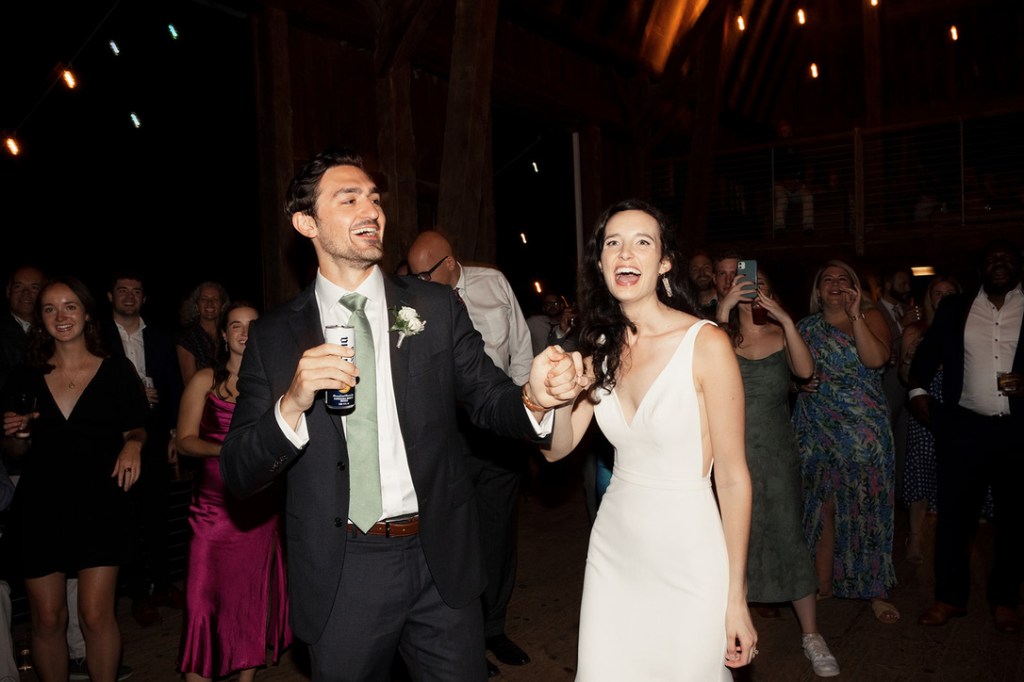
Most great celebrations, like my daughter’s wedding last month, begin long before the celebration itself. Yards of cotton chosen years ago, to be turned into a quilt. Endless bottles of vodka turned into homemade gin, enough for 180 miniature party favors. Evenings with my daughter and a letterpress kit, hand-stamping each letter of each name of each place card.
Early mornings, late nights: hand-stitching, hand-stamping, hand-steeping juniper and cardamom. Moment after moment in which I thought about how much I love both my girl and her now-husband. Nothing was hurried. Everything took time, time, time, and every moment of it was a reminder that, among our endless rushing, time itself is an act of love.
The Word, by Tony Hoagland
Down near the bottom of the crossed-out list of things you have to do today,
between “green thread” and “broccoli,” you find that you have penciled “sunlight.”
Resting on the page, the word is beautiful. It touches you as if you had a friend
and sunlight were a present he had sent from someplace distant as this morning—to cheer you up,
and to remind you that, among your duties, pleasure is a thing
that also needs accomplishing. Do you remember? that time and light are kinds
of love, and love is no less practical than a coffee grinder
or a safe spare tire? Tomorrow you may be utterly without a clue,
but today you get a telegram from the heart in exile, proclaiming that the kingdom
still exists, the king and queen alive, still speaking to their children,
—to any one among them who can find the time to sit out in the sun and listen.
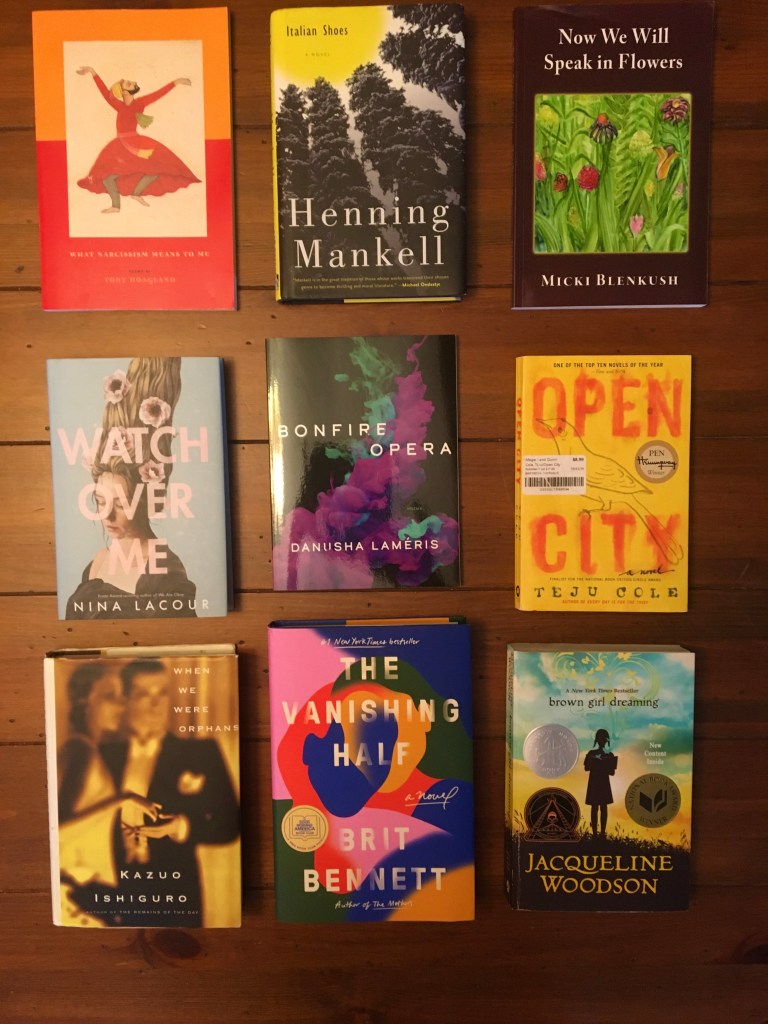
Ohhhhh I am so behind with my 2020 mini-book reviews. My lofty goal of a round-up review each month entirely fell by the wayside, along with so much else in this overwhelming year. Let me partially remedy that right this minute with mini-book reviews of books I read in the last few months, written on the spot just now.
Note that I only review books I loved or that, even if I didn’t love them, have stayed with me in inexplicable ways that somehow merit attention. Note also that all these books were ordered and bought from indie bookstores, the beautiful lifeblood of readers and publishers. Please support your independent bookstores. You can find yours right here at this handy-dandy link: https://www.indiebound.org/
Bonfire Opera, by Danusha Lameris. Oh, I love this woman’s poems. The first time I read Small Kindnesses, I wrote it out by hand and then copied it into my Favorite Poems files. And then scurried over to Magers and Quinn to pre-order Bonfire Opera, the book from whence it came. Lameris writes of ordinary life the way our greatest writers do, the way that allows us to see that no life is ordinary, that our every smallest action ripples out. A beautiful, beautiful book.
Brown Girl Dreaming, by Jacqueline Woodson. I’m late to the party with this lovely book, a memoir in verse-like prose written for middle grades readers but which really, like all great books ostensibly for children, is written for everyone. Woodson writes about her life, from birth through middle school, dipping down into small details the way a hummingbird alights on the sweetest flowers. Each chapter is so brief, so full of love and wonder and subtle commentary on life as a brown girl in the 60s and 70s, and every few chapters is one consisting solely of a haiku that somehow punctuates and coheres the entirety. Such a beautiful book.
The Vanishing Half, by Brit Bennett. This woman is such a good writer. I loved her first novel, The Mothers, and this one is equally absorbing. Identical twins Stella and Desiree, born in the 60s into an almost-mythical small town populated entirely by light-skinned Black citizens, leave home at age sixteen to make their way in the wider world. Stella chooses to “pass” as white, a decision that haunts every aspect of her life thereafter, while Desiree gives birth to a daughter as “black as tar.” Bennett infuses her fictional people with such specificity that their pain, joy, and unbreakable sisterly bonds reveal the intricacies of our nation’s historical racism and sexism while pulling the reader so deeply into their personal life struggles that they will be with me forever.
Italian Shoes, by Henning Mankell. This is my first dip into the vast array of books by renowned Swedish writer Mankell (the man who writes the Kurt Wallander detective series), It’s an intensely serious, quiet novel narrated by a former doctor who, after a tragic surgical mistake, chooses to isolate himself on the island his grandparents left to him, where he is the sole inhabitant. He cuts a hole in the ice of the bay every morning and plunges in – the only time he feels truly alive. Over the course of the novel he encounters, for the first time in decades, a past love who comes in search of him, sparking a small but profound reconnection with the wider world. While I did not love, or even particularly like, the narrator of this book, I remain both haunted and heartened by his inherent sadness and gradual, slow, opening back up to his fellow humans.
Watch Over Me, by Nina LaCour. I loved Nina’s novel We Are Okay and I loved this one too, for the same reasons – her uncanny way with the small, perfect detail that bring both setting and people to life. LaCour writes of the Bay area the way that only an observer with a poet’s eye can, so that the landscape becomes as much a character as the people. Set on a farm for foster-to-adopt children, Watch Over Me follows teenager Mila as she gradually, painfully begins to place pattern to the trauma of her past. LaCour’s descriptions of The Farm are like a dream, the kind of farm where everyone is loved and cared for, where there’s always plenty to eat, plenty of blankets, flowers everywhere, warmth when you need it, solitude when you need it, and, I imagine board games everywhere. The foster parents surround their traumatized charges with the kind of love and support that would heal the entire world should we all be so lucky to experience it. A lovely novel, full of hard-earned hope.
Now We Will Speak in Flowers, by Micki Blenkush. I read this slender book of poetry in one sitting, and felt as if I’d been given a glimpse into the poet’s entire life. Set in northern Minnesota and dipping down into childhood, young adulthood, middle age, town and country and church and work, this is a work set firmly in place and time. The poet’s perspective, wise from experience and innate understanding of how the small and subtle inform the wider world, is captivating in a quiet, gentle way. Lovely.
Open City, by Teju Cole. Set entirely in New York City and almost exclusively in Manhattan, this slender novel follows its main character, a young Nigerian scholar, as he walks about the city. As I read, I kept having to remind myself that it was a novel and not a memoir, so intimate and quiet is the voice of the narrator. As a lifelong walker who soaks up the world through the soles of my feet while silently thinking and observing, the book felt deeply familiar both in its perspective and its essential loneliness. Toward the end, a small scene in a tailor’s shop shocked me. I did not love the main character but I will be thinking about him, and what he has to say about the world we all live in, for a long, long time.
What Narcissism Means to Me, by Tony Hoagland. How I love this man’s poems, and how I wept and wept when he died, too young, of cancer. There are few poets whose poems I almost universally love and treasure; Hoagland is one of them. This book was published in 2003 but no matter, any Hoagland poem lives in its own time and place that transcend the current time and place of the world. Hoagland aches for the world, and life, and his place in it, the same way my own heart does. Go forth and read him.
When We Were Orphans, by Kazuo Ishiguro. Ishiguro’s Never Let Me Go is one of my favorite books of all time. So far, he has not written a book I haven’t loved, although there are several I haven’t yet read. It takes me a while to work up to an Ishiguro novel because I know that a few chapters in, he will have inexorably taken hold of me and pulled me into whatever world he’s created. This one is no exception. Set in London and (mostly) Shanghai in the 1940s, this novel follows Banks, a celebrated London detective, as he attempts to discover why he was orphaned at age nine. Nothing is as it seems in When We Were Orphans, and every small revelation leads the reader further down a path of no return. Quintessential Ishiguro in his understanding of loneliness, longing, and transcendent love.
When I was nine my father brought me a huge, bright-green, horned bug from our garden: Look! You can bring it in to school for the bug project! When he turned away I placed some tomatoes on top of the bug, and later had to admit in shame that I had ‘accidentally’ crushed it. Alison! What the hell were you thinking?
Looking back, I see a girl who was afraid of that enormous bug and afraid of her father, a girl who could not admit fear and could not ask for help. And I see a young, gruff man who had found something magic and brought it as a gift to his daughter, sure she would love it. A scared daughter, a bewildered man. Who both, over the years, kept sailing on, finding out the story by pushing into it, until only love and laughter were left.
Voyage, by Tony Hoagland
I feel as if we opened a book about great ocean voyages and found ourselves on a great ocean voyage: sailing through December, around the horn of Christmas and into the January Sea, and sailing on and on
in a novel without a moral but one in which all the characters who died in the middle chapters make the sunsets near the book’s end more beautiful.
And someone is spreading a map upon a table, and someone is hanging a lantern from the stern, and someone else says, “I’m only sorry that I forgot my blue parka; It’s turning cold.”
Sunset like a burning wagon train Sunrise like a dish of cantaloupe Clouds like two armies clashing in the sky; Icebergs and tropical storms, That’s the kind of thing that happens on our ocean voyage —
And in one of the chapters I was blinded by love And in another, anger made us sick like swallowed glass & I lay in my bunk and slept for so long, I forgot about the ocean, Which all the time was going by, right there, outside my cabin window.
And the sides of the ship were green as money, and the water made a sound like memory when we sailed.
Then it was summer. Under the constellation of the swan, under the constellation of the horse.
At night we consoled ourselves By discussing the meaning of homesickness. But there was no home to go home to. There was no getting around the ocean. We had to go on finding out the story by pushing into it — The sea was no longer a metaphor. The book was no longer a book. That was the plot. That was our marvelous punishment.
A couple of months ago I hurt a friend when I pushed a semi-joke too far. The friend didn’t say anything or change expression, but I went to bed uneasy. Despite the Painter’s assurances that he had noticed nothing and all was well, my gut said otherwise. I woke up and sent an apology, the gracious acceptance of which proved that my gut was right. In the weeks since, shame and sadness keep bubbling up in their familiar way. How many times a day do you feel like a failure? I once asked the Painter. All day every day, he answered, to which I nodded.
Four years ago, on a whim, I sat down at my dining table and hand-wrote myself a letter titled “Letter to Self.” Dear Alison, it began, here are some things you did in 2015. The letter is a simple bulleted list, but each entry, such as loved your children and stayed in good shape despite plantar fasciitis, holds within it an arc of emotion and effort and accomplishment. I hadn’t looked at the letter since I wrote it, nor the subsequent letters I wrote to myself in 2016 and 2017, but I read it again just now. Everything I tried to do that year came rushing back over me, along with a deep sense of being just one of a long line of humans who are all just trying. Which brings me to this beautiful farewell poem by Tony Hoagland. Its ending lines, which I had to read twice to understand were not an admonition but a gentle acknowledgment to himself that he had been a good man who should have been kinder to himself, brought me to tears.
Distant Regard, by Tony Hoagland
If I knew I would be dead by this time next year I believe I would spend the months from now till then writing thank-you notes to strangers and acquaintances, telling them, “You really were a great travel agent,” or “I never got the taste of your kisses out of my mouth.” or “Watching you walk across the room was part of my destination.” It would be the equivalent, I think, of leaving a chocolate wrapped in shiny foil on the pillow of a guest in a hotel– “Hotel of earth, where we resided for some years together,” I start to say, before I realize it is a terrible cliche, and stop, and then go on, forgiving myself in a mere split second because now that I’m dying, I just go forward like water, flowing around obstacles and second thoughts, not getting snagged, just continuing with my long list of thank-yous, which seems to naturally expand to include sunlight and wind, and the aspen trees which gleam and shimmer in the yard as if grateful for being soaked last night by the irrigation system invented by an individual to whom I am quietly grateful. Outside it is autumn, the philosophical season, when cold air sharpens the intellect; the hills are red and copper in their shaggy majesty. The clouds blow overhead like governments and years. It took me a long time to understand the phrase “distant regard,” but I am grateful for it now, and I am grateful for my heart, that turned out to be good, after all; and grateful for my mind, to which, in retrospect, I can see I have never been sufficiently kind.
Q: Does writing about hard things ever make you agitated and upset, so that you have to walk away from the writing and regain your equilibrium?
A: Nope. Life is what’s hard. Writing is always solace.
This exchange took place in a university undergraduate creative writing class a couple of weeks ago. Writing is how I translate all the emotion and experience of living into something that’s bigger than me. It’s a means of transcendence, a way to push away all that hugeness and also absorb it. To make a connection with other human beings you don’t know and have never met.
So is reading, poetry especially. For decades Tony Hoagland’s work has been solace. It’s like he saw into my heart and wrote poems meant just for me, even though he was beloved by so many. I meant to write him a letter this fall, telling him how much he means to me, but he died last week, so my letter will never be written. Don’t take it personal, they said; but I did, I took it all quite personal– Oh Tony, I’m so sad you’re gone.
Personal, by Tony Hoagland
Don’t take it personal, they said; but I did, I took it all quite personal—
the breeze and the river and the color of the fields; the price of grapefruit and stamps,
the wet hair of women in the rain— And I cursed what hurt me
and I praised what gave me joy, the most simple-minded of possible responses.
The government reminded me of my father, with its deafness and its laws,
and the weather reminded me of my mom, with her tropical squalls.
Enjoy it while you can, they said of Happiness Think first, they said of Talk
Get over it, they said at the School of Broken Hearts
but I couldn’t and I didn’t and I don’t believe in the clean break;
I believe in the compound fracture served with a sauce of dirty regret,
I believe in saying it all and taking it all back
and saying it again for good measure while the air fills up with I’m-Sorries
like wheeling birds and the trees look seasick in the wind.
Oh life! Can you blame me for making a scene?
You were that yellow caboose, the moon disappearing over a ridge of cloud.
I was the dog, chained in some fool’s backyard; barking and barking:
trying to convince everything else to take it personal too.
I’ve sent out many Tony Hoagland poems in the past, and I could send out Tony Hoagland poems every week for a year; that’s how much I loved him. For more poems by Tony, please click here.
Sometimes I wish I were still out
on the back porch, drinking jet fuel
with the boys, getting louder and louder
as the empty cans drop out of our paws
like booster rockets falling back to Earth
and we soar up into the summer stars.
Summer. The big sky river rushes overhead,
bearing asteroids and mist, blind fish
and old space suits with skeletons inside.
On Earth, men celebrate their hairiness,
and it is good, a way of letting life
out of the box, uncapping the bottle
to let the effervescence gush
through the narrow, usually constricted neck.
And now the crickets plug in their appliances
in unison, and then the fireflies flash
dots and dashes in the grass, like punctuation
for the labyrinthine, untrue tales of sex
someone is telling in the dark, though
no one really hears. We gaze into the night
as if remembering the bright unbroken planet
we once came from,
to which we will never
be permitted to return.
We are amazed how hurt we are.
We would give anything for what we have.




 When I was nine my father brought me a huge, bright-green, horned bug from our garden: Look! You can bring it in to school for the bug project! When he turned away I placed some tomatoes on top of the bug, and later had to admit in shame that I had ‘accidentally’ crushed it. Alison! What the hell were you thinking?
  A couple of months ago I hurt a friend when I pushed a semi-joke too far. The friend didn’t say anything or change expression, but I went to bed uneasy. Despite the Painter’s assurances that he had noticed nothing and all was well, my gut said otherwise. I woke up and sent an apology, the gracious acceptance of which proved that my gut was right. In the weeks since, shame and sadness keep bubbling up in their familiar way. How many times a day do you feel like a failure? I once asked the Painter. All day every day, he answered, to which I nodded.
  Q: Does writing about hard things ever make you agitated and upset, so that you have to walk away from the writing and regain your equilibrium?
 Alison McGhee