 I’m the mother of an immigrant and the aunt to immigrants. Family members and many of my dearest friends are gay. I am both a patron and former client of Planned Parenthood. I do not identify as Christian. These four facts alone make me –a white, middle-class born-and-bred citizen of this country– and my immediate and extended family current targets for persecution by my own government. Beyond that, many of my students, colleagues and friends are a) not white, b) Muslim, c) immigrants, d) people living with mental and physical disabilities. Being a patriotic American, which I most certainly am, means that my responsibility is to speak out against fascism. Being a progressive, which I also most certainly am, means keeping my focus on the bigger picture, which is the world as I know it to be, the one that Naomi Nye so beautifully brings to life in this poem.
Gate A-4, by Naomi Shihab Nye
Wandering around the Albuquerque Airport Terminal, after learning
my flight had been delayed four hours, I heard an announcement:
“If anyone in the vicinity of Gate A-4 understands any Arabic, please
come to the gate immediately.”
Well—one pauses these days. Gate A-4 was my own gate. I went there.
An older woman in full traditional Palestinian embroidered dress, just
like my grandma wore, was crumpled to the floor, wailing. “Help,”
said the flight agent. “Talk to her. What is her problem? We
told her the flight was going to be late and she did this.”
I stooped to put my arm around the woman and spoke haltingly.
“Shu-dow-a, Shu-bid-uck Habibti? Stani schway, Min fadlick, Shu-bit-
se-wee?” The minute she heard any words she knew, however poorly
used, she stopped crying. She thought the flight had been cancelled
entirely. She needed to be in El Paso for major medical treatment the
next day. I said, “No, we’re fine, you’ll get there, just later, who is
picking you up? Let’s call him.”
We called her son, I spoke with him in English. I told him I would
stay with his mother till we got on the plane and ride next to
her. She talked to him. Then we called her other sons just
for the fun of it. Then we called my dad and he and she spoke for a while
in Arabic and found out of course they had ten shared friends. Then I
thought just for the heck of it why not call some Palestinian poets I know
and let them chat with her? This all took up two hours.
She was laughing a lot by then. Telling of her life, patting my knee,
answering questions. She had pulled a sack of homemade mamool
cookies—little powdered sugar crumbly mounds stuffed with dates and
nuts—from her bag—and was offering them to all the women at the gate.
To my amazement, not a single woman declined one. It was like a
sacrament. The traveler from Argentina, the mom from California, the
lovely woman from Laredo—we were all covered with the same powdered
sugar. And smiling. There is no better cookie.
And then the airline broke out free apple juice from huge coolers and two
little girls from our flight ran around serving it and they
were covered with powdered sugar, too. And I noticed my new best friend—
by now we were holding hands—had a potted plant poking out of her bag,
some medicinal thing, with green furry leaves. Such an old country tradi-
tion. Always carry a plant. Always stay rooted to somewhere.
And I looked around that gate of late and weary ones and I thought, This
is the world I want to live in. The shared world. Not a single person in that
gate—once the crying of confusion stopped—seemed apprehensive about
any other person. They took the cookies. I wanted to hug all those other women, too.
This can still happen anywhere. Not everything is lost.
For more information on Naomi Shihab Nye, please click here.
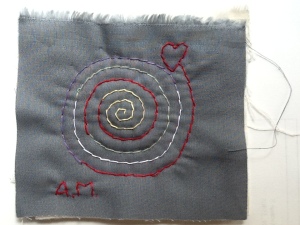 Last week the painter had a dream in which an old friend, dead in an instant two years ago now, appeared, smiling and so happy to see him. Do you think he came back because he died so fast and he wanted to say goodbye to you? I asked him when he told me about the dream. Who knows? Maybe, the painter said. Either way it was good to see him, happy and healthy. W.S. Merwin has always been a poet of dreams to me, what with his imagery and the way his unpunctuated poems float on the page. His calm voice drifts across the water, and sometimes one of his poems feels exactly right.
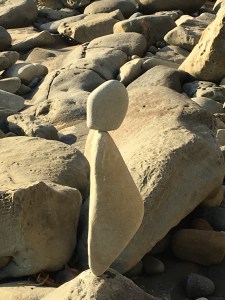 This poem haunts me. Not because it’s sad –or maybe it is; I don’t really know what this poem is about– but because when I read it, it brings back times of internal struggle. Like
  That photo over there to the right is the very long tail of a very large rat that ran over my bare feet as I stood at the stove cooking dinner. The story behind the tail is one of intrigue and horror – me sauteeing vegetables at the stove while chatting with The Painter who was seated behind me, me suddenly feeling a squirrel or a small cat run over my bare feet, me shrieking and whirling around to tell The Painter that a squirrel or a cat had run over my bare feet, The Painter trying desperately to contain his horror because he had witnessed exactly what ran over my bare feet and rats are not cats.
  Yesterday I sprinkled some sliced almonds into a small pan and turned the flame on low. I stood beside the stove watching over the pan and occasionally flipping the almonds so that they would brown evenly and not burn. When they were dark golden I shook a little sugar over them and stirred until they were caramelized. Then I turned the almonds out onto a plate to cool and took the pan over to the sink. The sink is a strange, cheap, plasticky thing, scarred from hot pans, so I held the pan up to the faucet and ran water in it to cool it down first. The water hit the pan and steam billowed up into my face. Suddenly I was breathing in vaporized sugar – I could feel it in my lungs and taste it as it went down. It was the most amazing sensation. I stood there by the sink and thought, All these years I’ve been alive and this has never once happened to me before. Then I thought of this poem, which I have secretly treasured ever since I first read it because I love how words, if you toss them around in your mind and on your tongue, turn surprising and magical in that same alchemical way.
  Hello, you’ve reached the Crisis Connection. This is Anna. Could you tell me your first name? I remember the sound of that woman’s voice. This was many many years ago. Someone close to me was in terrible shape, and nothing I did helped, and in panic and desperation I had called the hotline seeking guidance as to how to help. My name is Alison but that doesn’t matter it’s not me who needs help it’s my friend and I don’t know what to do and I began to describe the situation as she listened. And listened. Her calm and her focus, over more than a thousand miles of an invisible cell phone connection, was tangible. How are you feeling right now, Alison? Where are you, Alison? What’s your plan for the next few hours? Is there a way you can take care of yourself in this hard time? To this day I can hear her voice, so calm and warm in my ear. Saying my name. Listening. I remember looking up at the sky at one point. It was late at night, far from the city, and the stars were thick in the heavens. After a long time my voice was slow and tired, but I now had a little more energy to keep going. I will remember that conversation the rest of my life. The poem below made me think of Anna, and that long ago dark night. I wish there were some way to tell her how grateful I will always be to her.
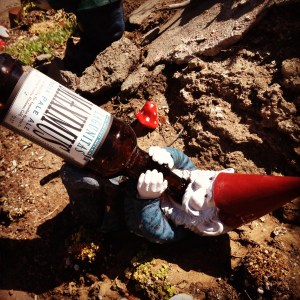 Quite a year we just had. A year that drove that poor little garden gnome in the photo on the right to drink, not to mention me with my cabinet full of gin. So many poems feel like possibilities to greet the new year, but this one by Langston Hughes feels the most possible. It’s strange, because if asked I would never list Langston Hughes on my Favorite Poet list, but lines from his poems come drifting through my mind almost every day. Like this one: Hold fast to dreams, for if dreams go, life is a barren field frozen with snow. And this one: They’ll see how beautiful I am and be ashamed– I, too, am America. And this one: I’ve known rivers: Ancient, dusky rivers. My soul has grown deep like the rivers. And most of all, I see that my own hands can make the world that’s in my mind. Goodbye, 2016. Here’s to the baby new year.
