Poem of the Week, by D.R. Goodman
 Last week I dreamed a dream so disturbing that I was afraid to google its meaning and asked the Painter to do so for me. The closest interpretation I can find says it’s about something you once dreamed of doing, he said. You want to reclaim something you’ve lost in yourself.
The interpretation hit me hard. Thinking about it over the next few days, I kept remembering a late afternoon almost twenty years ago when I was wandering trail-less through a quiet forest. At one point I stopped and looked up and met the eyes of an owl looking back at me. This was the first time I had ever seen a living owl. I tilted my head to take it in, and the owl tilted its head the same way. Back and forth we went, observing each other. I don’t know exactly what that owl or this poem below –a poem I’ve held in my heart ever since I first read it–have to do with my terrible, galvanizing dream. But I intend to figure it out.
Owls in the City Hills, by D.R. Goodman
how they hunt us,
casting their deep vowels like feathered hooks,
to pull us from shallow sleep or simple talk,
and out to the night, the stand of eucalyptus
a looming silhouette, the black above us;
we, barefoot on the littered deck, and blind,
stare wide into the dark and hear the sound
move eerily from tree to tree around us;
our backs to the spreading net of city lights
below, we’ve nothing but the trees, our eyes,
the dark, the sound, these owls we cannot see—
though once at dusk, by chance, I saw one light
and spread its wings, and tinged by copper skies,
lay silence to the city, utterly.
For more information on poet and martial arts expert D.R. Goodman, please click here.
Website
 The suicide of Alan Krueger last week, a man I didn’t know but whose work I admire, a man clearly beloved by so many, hit me hard. It brought me back to my early twenties, when the suicide of someone I loved both ended his life and permanently altered mine. Crying comes hard to me and does not bring relief, but it came anyway this week. At one point I found myself alone, apologizing out loud for things I wish I’d done differently.
  One of the top-rated MFA programs in the country once recruited me to fly out and interview for a fiction position. A day into the interview, deep in discussion of teaching technique with the faculty and students, I subtly began to portray myself as less interested in criticism and more interested in nurturing a creative spark. This wasn’t what they wanted in a teacher and I knew it. I was in effect throwing the interview, but I wasn’t sure why.
 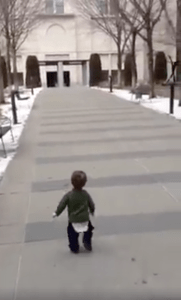 My five year old nephew is currently huddled behind closed doors inside his family’s new freestanding pantry, where he fits neatly into the bottom cupboard. I know this because my brother texts me ongoing updates as to this fixation with the pantry, along with the fact that my nephew just declared he’s no longer a ninja genius but a secret agent. (Didn’t surprise me at all. I never bought the ninja genius line.) My nephew cracks me up and breaks my heart the way all little kids, over and over, break my heart.
 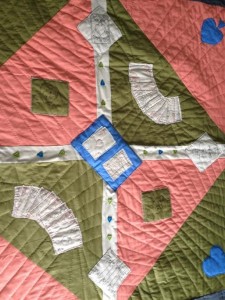 The day after I moved to Minneapolis, I bought a sewing machine. This was in the days of newspaper ads, and I found a used one for $60 and insisted my then-boyfriend and I track it down that very day. That ancient, impossibly heavy machine is what I’ve used to make all the quilts I’ve ever made, sewing together blocks I hand-stitch piecemeal. Story quilts, every one of them, made not according to a pattern but out of my head and heart.
  Someone close to me sent me a booklet a while ago, photos and written memories of her life. It’s a fascinating glimpse into a childhood spent solo with older parents in upper Manhattan, a gentle childhood filled not with money, of which there was very little, but with family card games, shared meals, trips to museums and playgrounds, school days and summer camp upstate. Black and white photos show a small, smiling girl in the embrace of a mother and father who clearly adored her. Here they are leaning against a railing by Rockaway Beach. Here they are on the stoop of an apartment building. Here’s the little girl on the first day of school.
 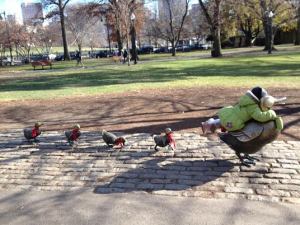 My three children and I were in upstate New York. This was a long time ago, and we were making our annual summer trek around New England to visit family and friends. We had just finished touring the Utica Club Brewery, one of my favorite childhood destinations, a tour that ends with a complimentary beer or root beer in a Victorian saloon. We were all tired. I was chatting with my parents while my children wandered around, trying out various red velvet chairs.
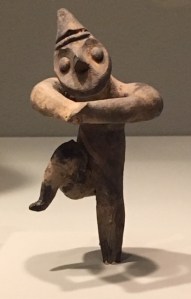 We went to a museum the other day with no specific purpose in mind and found ourselves in the Chinese art galleries. Jade. Porcelain. Bronze. Ornate vessels for cooking, for ceremonies, for burial. An arched gateway which used to lead to a family’s compound. A room with a low table, ink, brushes, where someone used to practice calligraphy. We peered in through the interwoven black wooden squares of traditional Chinese architecture. At one point a tiny capering man entranced me and I wanted to reach through the glass, and the thousands of years between us, and take him home.
  When my dog Petey was still alive I used to bring him to the Blessing of the Animals at the Basilica. One year, a woman with a small clear plastic box sat at the end of the pew next to Petey and me. She was anxious, agitated, and when the priests began walking up and down the aisle swinging incense and shaking holy water on the animals, she held the box up in the air.
 A couple of months ago I hurt a friend when I pushed a semi-joke too far. The friend didn’t say anything or change expression, but I went to bed uneasy. Despite the Painter’s assurances that he had noticed nothing and all was well, my gut said otherwise. I woke up and sent an apology, the gracious acceptance of which proved that my gut was right. In the weeks since, shame and sadness keep bubbling up in their familiar way. How many times a day do you feel like a failure? I once asked the Painter. All day every day, he answered, to which I nodded.
  Alison McGhee