Poem of the Week, by Carl Dennis

IMG_E4246

Yesterday I went to the funeral of a man my age. He was a man who, within minutes of meeting him, would tell you he was a Marine –present tense, not past–a man who signed all his memos semper fi. I stood in front of the photo boards his children and wife had assembled, taking photos of photos with my cell phone.


There he was, laughing with his babies, his wife, his dog. There he was dancing with his ancient mother, wearing one of his spectacular ties. A complicated man who didn’t speak of his combat experience, a man who was always, according to one of the young Marines he had quietly mentored during and after their tours of duty, “the guy.” The guy who anticipated what would be needed, whether for a road trip or a party or a combat operation, and provided it. The guy that the other young Marines went to for private advice and free counsel. The guy who tried his best to keep everyone else safe. I hope, in his life, there were times when he himself felt safe. When I woke up this morning I thought of this poem.


Candles
– Carl Dennis

If on your grandmother’s birthday you burn a candle
to honor her memory, you might think of burning an extra
to honor the memory of someone who never met her,
a man who may have come to the town she lived in
looking for work and never found it.
Picture him taking a stroll one morning,
after a month of grief with the want ads,
to refresh himself in the park before moving on.
Suppose he notices on the gravel path the shards
of a green glass bottle that your grandmother,
then still a girl, will be destined to step on
when she wanders barefoot away from her school picnic
if he doesn’t stoop down and scoop the mess up
with the want-ad section and carry it to a trash can.
For you to burn a candle for him
you needn’t suppose the cut would be a deep one,
just deep enough to keep her at home
the night of the hay ride when she meets Helen,
who is soon to become her dearest friend,
whose brother George, thirty years later,
helps your grandfather with a loan so his shoe store
doesn’t go under in the Great Depression
and his son, your father, is able to stay in school
where his love of learning is fanned into flames,
a love he labors, later, to kindle in you.
How grateful you are for your father’s efforts
is shown by the candles you’ve burned for him.
But today, for a change, why not a candle
for the man whose name is unknown to you?
Take a moment to wonder whether he died at home
with friends and family or alone on the road,
on the look-out for no one to sit at his bedside
and hold his hand, the very hand
it’s time for you to imagine holding.


For more information on Carl Dennis, please read this bio.

Poem of the Week, by Gwendolyn Brooks

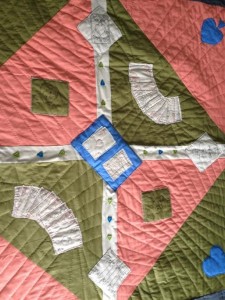
quilt, overviewOnce, at a Twins play-off game, I sat next to an older couple. They opened a tote and pulled out sandwiches wrapped in waxed paper, peeled carrots, small bags of grapes, and cookies. Dinner, packed at home and brought to the game. There was something about this couple I loved.

“We’ve been going to play-off games all over the country for more than fifty years,” they told me. “And we’ve brought our supper to every one of them.”

When I read the poem below I picture that couple in their kitchen together making sandwiches, and my grandmother swaying in her kitchen to Herb Alpert & the Tijuana Brass, and my mother sauteeing zucchini in her ancient electric frying pan, and the way my father combs through the ads in the Sunday paper. Picturing all the small, particular rituals that make up our lives makes me want to put my arms around the whole entire world.


The Bean Eaters, by Gwendolyn Brooks

They eat beans mostly, this old yellow pair.
Dinner is a casual affair.
Plain chipware on a plain and creaking wood,
tin flatware.

Two who are Mostly Good.
Two who have lived their day,
but keep on putting on their clothes
and putting things away.

And remembering …
remembering, with twinklings and twinges,
as they lean over the beans in their rented back room
that is full of beads and receipts and dolls and cloths,
tobacco crumbs, vases and fringes.


For more information about Gwendolyn Brooks, please click here.

Website

Blog

Facebook page

@alisonmcghee

Poem of the Week, by Rainer Maria Rilke

IMG_0316That woman sitting on the bar stool with a martini and a magazine, or alone on her couch spinning imaginary people into books, or flying solo around the world: she is me. But won’t you be lonely? is a question I’ve heard a lot in my life, and I don’t know how to answer it, because isn’t everyone, somewhere inside themselves, lonely?
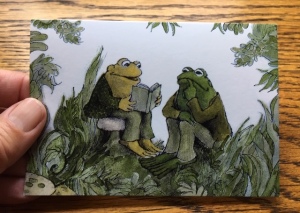
It’s rare to be truly seen. Rare to meet a kindred spirit who understands when you need to jump in your car and drive alone for thousands of miles, or go to a movie alone, or hike alone. Falling in love doesn’t change this conundrum. It took me a long time to understand that my heart’s silent, fierce response to a disappointed partner —What you want from me I can’t give you–did not mean I was at fault. 

It’s rare to meet someone with the same pilgrim soul as you. It might feel like a revelation, like finally you can relax. Thirty years ago I might not have understood this beautiful poem below, but I do now. 


Pathways, by Rainer Maria Rilke

Understand, I’ll slip quietly
away from the noisy crowd
when I see the pale stars rising, blooming, over the oaks.

I’ll pursue solitary pathways
through the pale twilit meadows,
with only this one dream: 

You come too.


Click here more information about Rainer Maria Rilke.

Website

Blog

Facebook page

@alisonmcghee

Poem of the Week, by Carl Dennis

IMG_3760One of my best friends and I sat on my porch last night talking about how our lives might have been different. What if I’d made myself deal with that suicide instead of trying to escape the pain? What if she’d said yes to that job? What if I’d stayed in New England? What if we’d mothered our children differently?
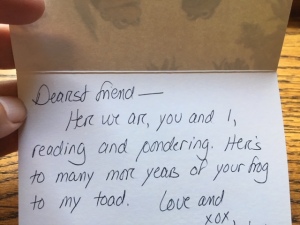

Floating in the air of the summer porch, our empty plates on the table before us, was the sense of the lives we might have lived, the ghost ships that didn’t carry usBut we didn’t know then what we know now, she said, and I thought back to earlier in the evening, when she was talking about time, how time is a writer’s only real trick.

IMG_3761The God Who Loves You, by Carl Dennis

It must be troubli
ng for the god who loves you   
to ponder how much happier you’d be today  
had you been able to glimpse your many futures.
It must be painful for him to watch you on Friday evenings   
driving home from the office, content with your week—
three fine houses sold to deserving families—
knowing as he does exactly what would have happened   
had you gone to your second choice for college,   
knowing the roommate you’d have been allotted   
whose ardent opinions on painting and music   
would have kindled in you a lifelong passion.   
A life thirty points above the life you’re living   
on any scale of satisfaction. And every point   
a thorn in the side of the god who loves you.   
You don’t want that, a large-souled man like you
who tries to withhold from your wife the day’s disappointments   
so she can save her empathy for the children.   
And would you want this god to compare your wife   
with the woman you were destined to meet on the other campus?   
It hurts you to think of him ranking the conversation   
you’d have enjoyed over there higher in insight   
than the conversation you’re used to.
And think how this loving god would feel   
knowing that the man next in line for your wife   
would have pleased her more than you ever will   
even on your best days, when you really try.   
Can you sleep at night believing a god like that
is pacing his cloudy bedroom, harassed by alternatives   
you’re spared by ignorance? The difference between what is
and what could have been will remain alive for him   
even after you cease existing, after you catch a chill   
running out in the snow for the morning paper,
losing eleven years that the god who loves you   
will feel compelled to imagine scene by scene   
unless you come to the rescue by imagining him   
no wiser than you are, no god at all, only a friend   
no closer than the actual friend you made at college,
the one you haven’t written in months. Sit down tonight   
and write him about the life you can talk about   
with a claim to authority, the life you’ve witnessed,   
which for all you know is the life you’ve chosen.   
 
For more information about Carl Dennis, please click here.

Website

Blog

Facebook page

@alisonmcghee

Poem of the Week, by Sarah Sadie

Screen Shot 2019-06-30 at 7.23.48 AMTwo lovely Japanese maple trees in a front yard one block south are symmetrically planted amid cement squares filled with small white stones. For eight years I walked past this house every day, so I could admire the way the owners, whom I always pictured as two calm men, swept the leaves and raked the stones into perfect, weed-free squares. Looking at this yard calmed my spirit. A few years ago the house was sold, and since then it has been reclaimed by wildness.

Last week, as I made my way through a morning-long panic attack, I weeded my gardens, cleaned my kitchen, and folded laundry. Laundry has always been meditation to me. Give me your towels, your fitted sheets, your underwear even, and I will make symmetry of it all. Strangely, later that same panicky day, I came across the poem below. From wildness we improvise order.

                                           Folding the Clothes, by Sarah Sadie

Even the most capacious bath towels fold
into squares, and the wash cloths fold
into smaller squares. Pants meet themselves

and quiet down nicely. Underwear
resigns itself, socks domesticate, and the shirts,

well, the shirts get wrinkled.

They’ll have plenty of time to relax
dreaming through hours a rumor of buttons.
Which is not to say shirts meditate, but

there’s almost a Zen to the job, if that weren’t so trendy.
Almost the little sand garden with its rake
and its rock.                                                

Its imagined snake.

For more information about Sarah Sadie, please click here.

Poem of the Week, by Tony Hoagland

Alison and DonaldWhen I was nine my father brought me a huge, bright-green, horned bug from our garden: Look! You can bring it in to school for the bug project! When he turned away I placed some tomatoes on top of the bug, and later had to admit in shame that I had ‘accidentally’ crushed it. Alison! What the hell were you thinking? 

Looking back, I see a girl who was afraid of that enormous bug and afraid of her father, a girl who could not admit fear and could not ask for help. And I see a young, gruff man who had found something magic and brought it as a gift to his daughter, sure she would love it. A scared daughter, a bewildered man. Who both, over the years, kept sailing on, finding out the story by pushing into it, until only love and laughter were left.


Voyage, by Tony Hoagland

I feel as if we opened a book about great ocean voyages
and found ourselves on a great ocean voyage:
sailing through December, around the horn of Christmas
and into the January Sea, and sailing on and on

in a novel without a moral but one in which
all the characters who died in the middle chapters
make the sunsets near the book’s end more beautiful.

And someone is spreading a map upon a table,
and someone is hanging a lantern from the stern,
and someone else says, “I’m only sorry
that I forgot my blue parka; It’s turning cold.”

Sunset like a burning wagon train
Sunrise like a dish of cantaloupe
Clouds like two armies clashing in the sky;
Icebergs and tropical storms,
That’s the kind of thing that happens on our ocean voyage —

And in one of the chapters I was blinded by love
And in another, anger made us sick like swallowed glass
& I lay in my bunk and slept for so long,
I forgot about the ocean,
Which all the time was going by, right there, outside my cabin window.

And the sides of the ship were green as money,
and the water made a sound like memory when we sailed.

Then it was summer. Under the constellation of the swan,
under the constellation of the horse.

At night we consoled ourselves
By discussing the meaning of homesickness.
But there was no home to go home to.
There was no getting around the ocean.
We had to go on finding out the story
by pushing into it —
The sea was no longer a metaphor.
The book was no longer a book.
That was the plot.
That was our marvelous punishment.


For more information about Tony Hoagland, please read his obituary.

Poem of the Week, by Margaret Hasse

Steuben, looking northOld friend, it has been decades since that last summer before college, the last time I ever lived at home. But when I return to visit my parents and drive by the street where you once lived, I remember you. I remember rain on a canvas roof, darkness all around, the silent sleeping breath of other friends. I remember how surprised I was that someone wanted to kiss me –me?–and I remember your gentleness. Let me tell you now that you were the one who first showed me how touch could open up a new world. At seventeen I could not have known how the memory of that fleeting sweetness would sustain me in future dark times. This achingly beautiful poem brought back the memory of you.   
 

High School Boyfriend, by Margaret Hasse

You are hometown.
You are all my favorite places
the last summer I grew up.
Every once in a while
I write you
in my head
to ask how Vietnam
and a big name college
came between us.
We tried to stay in touch
through the long distance,
the hum and fleck of phone calls.

It was inevitable
that I should return
to the small prairie town
and find you
pumping gas, driving a truck, measuring lumber,
and we’d exchange
weather talk,
never able to break through words
and time to say simply:
“Are you as happy
as I wanted you to be?”

And still I am stirred
by musky cigarette smoke
on a man’s brown suede jacket.
Never having admitted the tenderness
of your hands, I feel them now
through my skin.
Parking on breezy nights,
in cars, floating passageways,
we are tongue and tongue like warm cucumbers.
I would walk backwards
along far country roads
through late evenings cool as moving water,
heavy as red beer,
to climb into that August.

In the dark lovers’ lanes
you touched my face
and found me here.


For more information on Margaret Hasse, please click here.

Website

Blog

Facebook page

@alisonmcghee

Poem of the Week, by Dante di Stefano

IMG_1937

Write about something you’ve never told anyone before. That was the prompt a few years ago, given to a tableful of sundry people sitting in a library far from the big city. You have twelve minutes. I’ll let you know when you have two minutes left. Pens to paper. Fingertips on keyboards. We went around the room and read aloud, everyone listening intently. 

One older man read about the night in Vietnam when his best friend died in his arms. How he tried to keep him from dying. How they were both nineteen. How he had whispered to him and his friend whispered back as he bled to death. How he had thought of that boy every day of his life since. When he finished, we were all silent. He looked up at us in confusion and wonder. I have never told anyone about this before, he said, not even my wife.


Prompts (for high school teachers who teach poetry), by Dante di Stefano

Write about walking into the building
as a new teacher. Write yourself hopeful.
Write a row of empty desks. Write the face
of a student you’ve almost forgotten;
he’s worn a Derek Jeter jersey all year.
Do not conjecture about the adults
he goes home to, or the place he calls home.
Write about how he came to you for help
each October morning his sophomore year.
Write about teaching Othello to him;
write Wherein of antres vast and deserts idle,
rough quarries, rocks and hills whose heads touch heaven.

Write about reading his obituary
five years after he graduated. Write
a poem containing the words “common”
“core,” “differentiate,” and “overdose.”
Write the names of the ones you will never
forget: “Jenna,” “Tiberious,” “Heaven,”
“Megan,” “Tanya,” “Kingsley,” “Ashley,” “David.”
Write Mari with “Nobody’s Baby” tattooed
in cursive on her neck, spitting sixteen bars
in the backrow, as little white Mike beatboxed
“Candy Shop” and the whole class exploded.
Write about Zuly and Nely, sisters
from Guatemala, upon whom a thousand
strange new English words rained down on like hail
each period, and who wrote the story
of their long journey on la bestia
through Mexico, for you, in handwriting
made heavy by the aquís and ayers
ached in their knuckles, hidden by their smiles.
Write an ode to loose-leaf. Write elegies
on the nub nose of a pink eraser.
Carve your devotion from a no. 2
pencil. Write the uncounted hours you spent
fretting about the ones who cursed you out
for keeping order, who slammed classroom doors,
who screamed “you are not my father,” whose pain
unraveled and broke you, whose pain you knew.
Write how all this added up to a life.


For more information on Dante di Stefano, please click here.

Poem of the Week, by Alison McGhee

Whether you’re a parent or not, everyone was once someone’s child. This one goes out to all of you. 

img_6112


Bargain
     – Alison McGhee

The newspaper reports that at twilight tonight
Venus and Jupiter will conjoin
in the southwestern sky,
a fist and a half above the horizon.
They won’t come together again for seventeen years.
What the article does not say is that Mercury, the
dark planet, will also be on hand.
He’ll hover low, nearly invisible in a darkened sky.
I stare out the kitchen window toward the sunset.

Seventeen years from now, where
will I be?
Mercury, Roman god of commerce and luck,
let me propose a trade:
Auburn hair, muscles that don’t ache, and a seven-minute mile.
Here’s what I’ll give you in return:
My recipe for Brazilian seafood stew, a talent for
French-braiding, an excellent sense of smell and
the memory of having once kissed Sam W.

Then I see my girl across the room.
She stands on a stool at the sink,
washing her toy dishes and
swaying to a whispered song,
her dark curls a nimbus in the lamplight.
The planets are coming together now.
Minute by minute the time draws nigh for me to watch.
Minute by minute my child wipes dry her red
plastic knife, her miniature blue bowls.

Mercury, here’s another offer, a real one this time:
Let her be.
You can have it all in return,
the salty stew, the braids, the excellent sense of smell
and the softness of Sam’s mouth on mine.
And my life. That too.
All of it I give for this child, that seventeen years hence
she will stand in a distant kitchen, washing dishes
I cannot see, humming a tune I cannot hear.


Poem of the Week, by Ed Bok Lee

IMG_3192

“Is it lonely to be a writer?” “What is the greatest and worst thing about being a writer?” “I loved your book because the brother in it is mean to his sister and my brother is mean to me.” “What if reading is really, really hard for you – can you still be a writer?” “My grandma used to read to me but she died.”

And, as the others file out, the solemn child who stands before me and whispers: “I’m the new kid.”

When I first began writing, I wrote only novels for adults. I couldn’t have imagined that my life would someday include visits to schools where hour by hour, first and second and third and fourth graders sit in criss-cross-applesauce rows on the carpeted library floor, listening. Watching. Thinking.

Why do I do so few school visits? Because kids. Their questions go straight into your heart, and then you carry them around with you forever. We bring kids into this fraught world and they have no idea what awaits them. But there they are, like the child in this poem below, by the brilliant Ed Bok Lee, turning their faces skyward.

Pink Lady’s Antenna Receives the Future
 
Atop my shoulders, she trots me like a Clydesdale.
Pink pussy hats & hearts, 100,000, thronging the Capitol.
When it begins to rain, some head for shelter,
Most chant even louder.
                   Is she okay? I shout.
Bridget momentarily lowers our umbrella & takes a picture:
Between pink hat and pink scarf,
                   Babygirl’s tongue, extended skyward like a stamen.

​For more information on Ed Bok Lee, please check out his blog