Poem of the Week, by Jim Moore

IMG_0342On a moonless night a long time ago, just off the highway, I leaned against a cinder block wall with a payphone pressed to my ear. The only light came from passing cars and a bug-stained fluorescent bulb mounted above the phone. The voice on the other end was bored, disinterested. Across the miles I felt the connection diminishing, no, diminished, no, gone.

I ground my forehead against the wall and tried to sound un-desperate, un-despairing, un-lonely, un-everything I actually felt. At that moment something dropped onto my shoulder and then to the ground – a blob of white putty that turned into an albino frog that then dragged itself away into the weeds. 

That frog and that night still come washing over me sometimes, the way they did when I read this poem.


True Enough, by Jim Moore

         I have forgotten many things.
But I do remember
         the bank of clover along the freeway
we were passing thirty years ago
         when someone I loved made clear to me
it was over.


For more information about poet Jim Moore, please check out his website.

Poem of the Week, by Abraham Lincoln

Photos 967Yesterday I sat at the table all day and labored through every paragraph of every page of a forthcoming novel, trying for the many-eth time to get the timeline perfect, and then I got up this morning and did it again. If Micah disappears on Wednesday night and Sesame starts looking for him on Thursday morning and winter break is a week from Friday and the weekends don’t count then how many days will it take for blah blah blah blah blah. Scratch paper and pen to my right, calendar to my left, stuck in the middle with my own inadequacy. 

Why are timelines so maddeningly difficult for you, Alison? Shouldn’t you be better at them by now? Just how hard can it possibly be to count up the days and make them fit? Very, apparently. This is when I turn for help to this poem, which floats through my head at least a few times a day, written by a little boy who wanted to be good someday. 


Abraham Lincoln, by Abraham Lincoln, age nine 

Abraham Lincoln
his hand and pen 
he will be good but 
god knows When 


Poem of the Week, by Steve Healey

IMG_6661One of my daughters had a friend when she was little, a friend the rest of us couldn’t see. He had a strange name which we all loved. Sometimes we would check in on him. “He’s asleep,” was the most common answer. Sometimes “He’s visiting his grandma,” or even “He went away.” Once, disturbingly, “he died.”

The invisible friend was a shadow part of our family. Mentions of him made us laugh, but I used to wonder if he helped my daughter figure out the world and cope with it in ways I, her mother, couldn’t. It’s hard for me to be around small children, the way they march forward into the world despite their tininess. How their inherent, bewildering bravery propels them toward all the things that will break their hearts. How they keep going anyway.


How About, by Steve Healey

the house is haunted but
all the ghosts are nice ones
mostly nice but sometimes mean
when they eat our snacks without asking
how about there’s a ghost horse
with big snack lips but she’s nice and gives us
slow-gallop rides over furniture hills

all the ghosts are part of our family
but grown-ups can’t see them
how about I’m the daughter you’re the son
or we’re both half daughter half son
half comet half horse
going around the carousel

over there is the black hole where
we ate crackers and grapes today for snack
in that corner all the galaxies
that don’t care if we don’t
say please and thank you

how about Dad never says we have to clean up
this mess because he’s our tiny cute baby
he’s always napping in his crib
or he’s in the room where he writes poems
and inside him there’s a baby who has
another baby inside him

how about the babies have a war 
inside him and become orphans or
how about we’re the orphans in a poem
Dad writes then we’re adopted
by the ghost horse and off
we ride through the snowy air
we say the words 
and disappear


For more information about Steve Healey, please check out his website.

My websiteMy blogMy Facebook page

Twitter and Instagram: @alisonmcgheewriter 

Poem of the Week, by Sean Thomas Dougherty

IMG_3702

Mr. Kraft and his family lived in the town of 300 I grew up five miles north of. One day when I was about nine, he and my mother stood talking in his driveway. He nodded to me at one point and said quietly to my mother, “She’s got it.”

She, meaning me. Got it, as in. . . I don’t know what. But those three words have seen me through every rough patch of my entire life. Every awful conversation, every time someone has tried to tear me down, and also in those dark and frequent moments when I think, You’re a failure, Alison. 

I remember how still I stood in Mr. Kraft’s driveway that day, how something lifted from my shoulders, how the world suddenly seemed bigger and kinder. I thought of him again when I read this poem. Wherever you are now, Mr. Kraft, in whatever far-off universe, know how you softened the world for a small girl that day, and how she never forgot your words.


Why Bother, by Sean Thomas Dougherty

Because right now there is someone
out there with
a wound in the exact shape
of your words.


For more information about Sean Thomas Dougherty, please check out his website.

 
Twitter and Instagram: @alisonmcgheewriter 

Poem of the Week, by Tom Sastry

IMG_2194Before taking the city bus for the first time, I was scared. How much does it cost and what if you don’t have exact change and what are those green cards everyone else seems to be holding and oh crap what about that scanner thingie? Etcetera.
“Help. This is my first time ever on the bus,” I said once onboard. The driver and everyone who heard me looked up and smiled. “Hello!” “Welcome!” “Congratulations!” They showed me how to pay, asked where I was going, showed me how to pull the stop cord.

Giving up and admitting my cluelessness like that changed me, relaxed me. Help. I have no idea what I’m doing. When I read this poem I thought of that long-ago ride bus ride.


Hanging out with musicians, still in my suit, by Tom Sastry

He said fucking and that was important:
“We’re all fucking broken.”
He said it gently
like a priest, soothing the smart of sin.

I hadn’t heard about it before
this shared brokenness
and it was new to me, this idea
that being in pieces could bring us together

so my mind worked through all the things he might mean
and
like the fourteen-stone word-association machine that I am
I remembered all the world’s once-complete, now-shattered things

until I couldn’t get it out of my head
that we were broken like jigsaws
fucking broken like fucking jigsaws
and it felt right and wise and true.


​For more information about Tom Sastry, please click here.


My websiteMy blogMy Facebook page.

Twitter and Instagram: @alisonmcgheewriter


Poem of the Week, by Mike White

IMG_0696A few years ago, from my front porch, I watched an enormous, dark turtle labor its way across Emerson Avenue. It was winter. Snow and ice and slush. A giant turtle? Then the scene resolved itself; the turtle was not a turtle but an old man who had fallen and was trying to crawl to the curb.

I ran out and helped him up and got his walker securely situated. He refused my offer of a ride and carried on down the sidewalk. Sometimes the world turns itself inside out for a few seconds and you stand there entirely confounded. All you can do is wait, and wonder, and let yourself be amazed.


Wind, by Mike White

Not a remarkable wind. 
So when the bistro’s patio umbrella 
blew suddenly free and pitched 
into the middle of the road, 
it put a stop to the afternoon. 

Something white and amazing 
was blocking the way. 

A waiter in a clean apron 
appeared, not quite 
certain, shielding his eyes, wary 
of our rumbling engines. 

He knelt in the hot road, 
making two figures in white, one 
leaning over the sprawled, 
broken shape of the other, 
creaturely, great-winged, 
and now so carefully gathered in.


For more information about Mike White, please check out his website.

My websiteMy blogMy Facebook page.
Twitter and Instagram: @alisonmcgheewriter 

Poem of the Week, by Maggie Smith

IMG_4264Would your life be worse then than it is right now? is a question to ask yourself when you wake up every day in fear and dread of something that hasn’t happened but might happen. Something you fight and fight and work and work to prevent happening, to you or to someone you love. Foreclosure. Suicide. Recurrence of cancer. Loss of a job, a friend, a romance.

At some point the panic might be so huge that it takes over your life, and what then? Then a balance has been achieved. The thing you so fear has, in the fearing of it, destroyed your peace, your health, your daily existence. So. If the thing you fear actually happened, would your life be worse than it is right now? 

Maybe. Maybe not. Maybe something else would rush in once the anticipatory dread and panic are finally gone, something huge and unfamiliar: relief. This poem brought so many feelings flooding through me.


At the End of My Marriage, I Think of Something My Daughter Said about Trees, by Maggie Smith 

When a tree is cut down, the sky’s like 
finally, and rushes in. 

Even when you trim a tree, 
the sky fills in before the branch 

hits the ground. It colors the space blue 
because now it can.


For more information about Maggie Smith, please check out her website.


My websiteMy blogMy Facebook page

Twitter and Instagram: @alisonmcgheewriter 

Poem of the Week, by Dean Young

IMG_3673As a kid desperation used to fill me for more, more, more, but I couldn’t put words to the panicky feeling beyond once telling my mother that “I don’t want to be normal. I don’t want a normal life,” knowing even then that “normal” wasn’t exactly the right word. 

More of everything is what I wanted: more sky, more wind, more space, more freedom more travel more music more poems more love more life. As I type these words my own voice in my own head keeps whispering more in italics. 

Every line of the poem below, hopping and skipping from more to more, skimming through a life and dipping down into the wild hunger and hurt and joy bursting out of it, feels familiar to me. Then the last line made me laugh out loud, and all I could think was: Yeah. This guy wants everything, too.


New Restrictions, by Dean Young

It doesn’t matter how many
Wallace Stevens poems you’ve memorized
or if you had sex in the graveyard
like an upside-down puppet
or painted your apartment red
so it feels like sleeping inside a heart
or the trees were frozen with ravens
which you sent pictures of to everyone you know
or your pie dough’s perfect
or you once ran a sub-5-minute mile
or you’re on the last draft
of your mystery novel and still
don’t know if the vicar did it
or every morning that summer
you saw a fox stepping through the fog
but it got no closer
or once you helped drag a deer
off the road by the antler
sit blinked
or which song comes from which side
of your mouth as you drive
all night all night all night
or how deep and long you carry
a hitch in your breath after crying
or shot a man in Tennessee
or were so happy in France
or left your favorite scarf in a café,
the one with the birds and terrible art
or the Klimt
or you call your mother once a week
even after she’s dead
or can’t see a swan without panic
or have almost figured out
what happened to you as a child,
urge, urge, nothing but urge
or 600 daffodils
or a knife in the glove box
or a butterfly on a bell,
you can’t park here.


For more information on Dean Young, please click here.
Twitter and Instagram: @alisonmcgheewriter 

Poem of the Week, by William Butler Yeats

IMG_5657This was back in the days of dial-up modems with their squealy screechy sounds. The first line of the first review of my first novel came shimmering up on that clunky old computer screen: “First time novelist tries but fails to move or matter.” 

Or matter.”

I sat staring at the screen, my little kids looking at me silent and troubled, knowing something was wrong. I turned to them and smiled. I laughed about the review, pretended I didn’t care. But the photo above is what I typed into my journal that night.

This is not a story about a writer who got a bad review – all writers get bad reviews. Nor is it a story about a plucky young woman whose novel went on to win a bunch of awards so haha. It’s a tiny story that stands in for a much larger story of casual, ongoing cruelty in a world in which those two words –or matter–should never be written by a human being about another human being. 

Those two words broke something in me a long time ago that can’t be fixed. That’s what cruelty does. When judgment rears its ugly head inside me, as it does way too often, I recite the last two lines of this poem to myself.


He Wishes for the Cloths of Heaven, by William Butler Yeats

Had I the heavens’ embroidered cloths,
enwrought with golden and silver light,
the blue and the dim and the dark cloths
of night and light and the half-light,
I would spread the cloths under your feet:
But I, being poor, have only my dreams;
I have spread my dreams under your feet;
tread softly because you tread on my dreams.

For more information on Yeats, please click here.

Twitter and Instagram: @alisonmcgheewriter 


Poem of the Week, by William Stafford

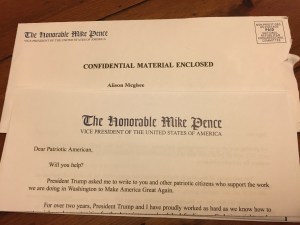
60004839212__30E2EEDE-424A-48BE-B9AD-706C3B31C6F8Last fall I began getting letters like this from the president, the vice-president, the NRA, anti-abortion organizations. Not my typical mail. Why me? Then it came to me: in August a friend died, a Marine combat veteran, and in his honor I made a donation to the Wounded Warrior project, which must have triggered a hundred conservative mailing lists.

Given my political leanings, it would be easy to post those letters on Twitter with a snarky comment and watch the equally snarky responses roll in, but that would only make things worse. Here’s the thing: most people are not zealots. You can be a pacifist and still support veterans. You can be an atheist and still respect your neighbor’s need to pray to a God you don’t believe in. You can have deep qualms about abortion and still support the right to have one.

You can despise your uncle’s racist comments and cut off contact with him, or you can remember how he taught you to ride a bike and showed up at all your basketball games. You can remember how it felt when you woke up to your own internalized racism. You can choose to open a conversation with him, one that might open a mental window, one that will take a lot of patience that you might assume neither of you have. 

But you do have that patience. We all do, once we recognize how deep the darkness is, and how easy it is to get lost. 


A Ritual to Read to Each Other, by William Stafford

If you don’t know the kind of person I am
and I don’t know the kind of person you are
a pattern that others made may prevail in the world
and following the wrong god home we may miss our star.

For there is many a small betrayal in the mind,
a shrug that lets the fragile sequence break
sending with shouts the horrible errors of childhood
storming out to play through the broken dike.

And as elephants parade holding each elephant’s tail,
but if one wanders the circus won’t find the park,
I call it cruel and maybe the root of all cruelty
to know what occurs but not recognize the fact.

And so I appeal to a voice, to something shadowy,
a remote important region in all who talk:
though we could fool each other, we should consider—
lest the parade of our mutual life get lost in the dark.

For it is important that awake people be awake,
or a breaking line may discourage them back to sleep;
the signals we give — yes or no, or maybe —
should be clear: the darkness around us is deep.


​For more information about William Stafford, please click here.​


My websiteMy blogMy Facebook page

Twitter and Instagram: @alisonmcgheewriter