Poem of the Week, by Laura Gilpin

My poems podcast, Words by Wintercan be found here.

Whenever I pass a baby on the sidewalk our eyes meet and hold. Babies turn their heads to keep holding that gaze, sometimes all the way to the end of the block. They want to examine me, so they do. This is what I most appreciate about babies; that acceptance of themselves and what they want.

My dog is also like this. When he wants his belly rubbed, his throat stroked, he flops next to me and pushes his nose into me until I pet him. He’s taught himself how to speak what he must think is Human: low mutterings, high warbles that all mean touch me touch me touch me. He too knows what he wants and is unafraid to ask for it.

I don’t exactly know why babies and dogs and this poem make me want to cry, but they do.


The Two-Headed Calf, by Laura Gilpin

Tomorrow when the farm boys find this
freak of nature, they will wrap his body
in newspaper and carry him to the museum.

But tonight he is alive and in the north
field with his mother. It is a perfect
summer evening: the moon rising over
the orchard, the wind in the grass. And
as he stares into the sky, there are
twice as many stars as usual.

For more information on Laura Gilpin, please click here.

alisonmcghee.com

Poem of the Week, by Eileen Myles

My poems podcast, Words by Wintercan be found here.

The way my dog places his paws on my shoulders and looks into my eyes. That day last week when the rain blew in and the temperature dropped 29 degrees in twenty minutes. How coffee beans smell when they’re ground fresh at dawn. The way the man behind the cheese counter yesterday said Excuse me, I just have to tell you I love your hair and then hugged himself with happiness. These purple Dr. Seussian flowers. This bowl of crisp popcorn. How extravagantly the mint spreads beneath the baby apple tree. How the earth begins to rise beneath the car from the Dakotas westward, like the crest and slope of the planet’s chest. The way the calm baby in the stroller this morning silently turned to keep my gaze all the way down the block. I wish I could give all of this to all of you.

At a Waterfall, Reykjavik, by Eileen Myles

I still feel like
the world
is a piece
of bread

I’m holding
out half
to you.

For more information about Eileen Myles, please click here.

alisonmcghee.com
Words by Winter: my new podcast

Poem of the Week, by Cathy Ross

My poems podcast, Words by Wintercan be found here.

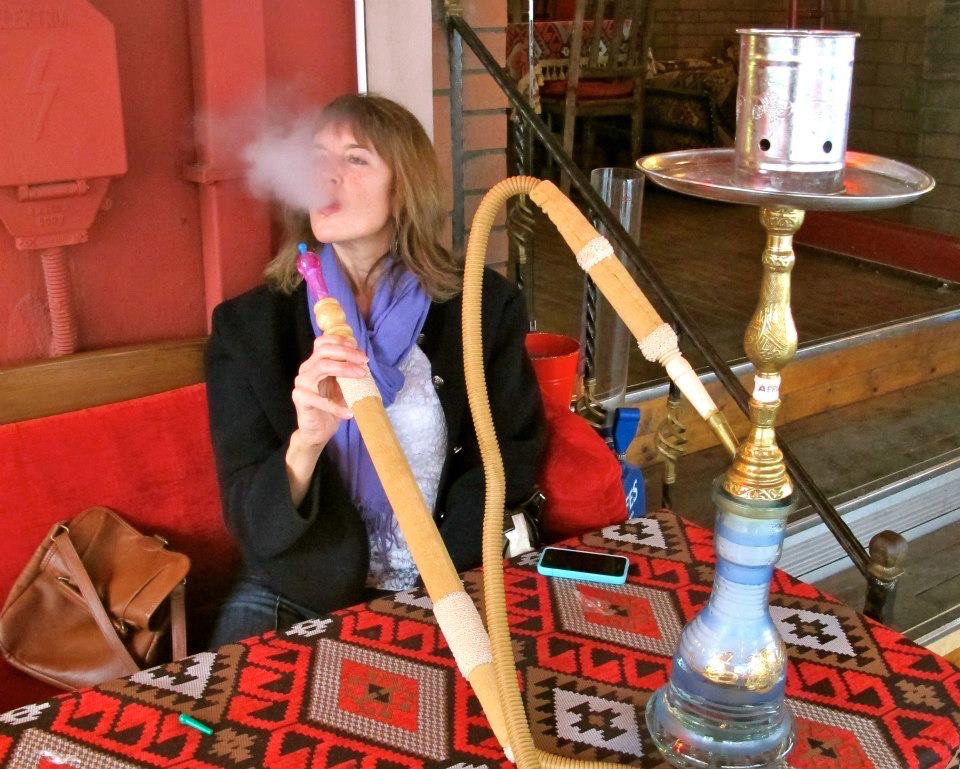
Years ago my daughter and I spent a magical week in Istanbul. We visited mosques, ate Turkish candy, drank mint tea, took a boat down the Bosphorus to the mouth of the Black Sea, smoked a hookah on the front porch of a restaurant where we sat for hours watching the passersby. We were mistaken, variously, for Brazilian, French, and Canadian women.

One evening, while my daughter slept, I sat by the window and listened to the calls of the muezzins rising over the city in the call to prayer. The sound filled my heart and I told myself what I always do when something beautiful happens during a trip: You’ll be back, Allie. You’ll hear this again. But I won’t. Every beautiful moment is a miracle, and then it’s gone.

If the Moon Came Out Only Once a Month, by Cathy Ross

If the moon came out only once a month
people would appreciate it more. They’d mark it
in their datebooks, take a walk by moonlight, notice
how their bedroom window framed its silver smile.
And if the moon came out just once a year,
it would be a holiday, with tinsel streamers
tied to lampposts, stores closing early
so no one has to work on lunar eve,
travelers rushing to get home by moon-night,
celebrations with champagne and cheese.
Folks would stay awake ’til dawn
to watch it turn transparent and slowly fade away.
And if the moon came out randomly,
the world would be on wide alert, never knowing
when it might appear, spotters scanning empty skies,
weathermen on TV giving odds—“a 10% chance
of moon tonight”—and when it suddenly began to rise,
everyone would cry “the moon is out,” crowds
would fill the streets, jostling and pointing,
night events would be canceled,
moon-closure signs posted on the doors.
And if the moon rose but once a century,
ascending luminous and lush on a long-awaited night,
all humans on the planet would gather
in huddled, whispering groups
to stare in awe, dazzled by its brilliance,
enchanted by its spell. Years later,
they would tell their children, “Yes, I saw it once.
Maybe you will live to see it too.”
But the moon is always with us,
an old familiar face, like the mantel clock,
so no one pays it much attention.
Tonight
why not go outside and gaze up in wonder,
as if you’d never seen it before,
as if it were a miracle,
as if you had been waiting
all your life.

For more information on Cathy Ross, please check out her website.


alisonmcghee.com

Poem of the Week, by Rosemerry Wahtola Trommer

My poems podcast, Words by Wintercan be found here.

Dog person versus cat person versus beer versus wine versus Gen Z versus baby boomers versus millennials versus Gen X versus The Greatest Generation versus red states versus blue states versus New England versus Midwest versus West versus North versus South versus pro versus anti.

Categorization makes me tense. Can’t I love both dogs and cats? (I do.) Can’t I be a novelist and a poet and a picture book writer? (I am.) Why do any of us have to be this and not that? Someone profits by having us believe it’s a good thing to divide, slot, label and categorize, and it’s not us. I love blurred lines and this poem for the same reason.

Where We Are Headed, by Rosemerry Wahtola Trommer

At first we just say flower. How
thrilling it is to name. Then it’s
aster. Begonia. Chrysanthemum.

We spend our childhood learning
to separate one thing from another.
Daffodil. Edelweiss. Fern. We learn

which have five petals, which have six.
We say, “This is a gladiolus, this hyacinth.”
And we fracture the world into separate

identities. Iris. Jasmine. Lavender.
Divorcing the world into singular bits.
And then, when we know how to tell

one thing from another, perhaps
at last we feel the tug to see not
what makes things different, but

what makes things the same. Perhaps
we feel the pleasure that comes
when we start to blur the lines—

and once again everything
is flower, and by everything,
I mean everything.


For more information on Rosemerry Wahtola Trommer, please check out her website.

alisonmcghee.com

Poem of the Week, by Kirsten Dierking

My poems podcast, Words by Wintercan be found here.

Last week a writer friend and I hiked through the woods and talked about how in middle age you realize that some things won’t happen. You’ve run out of time to be an Olympic athlete, to have a sixty-year marriage, to sail around the world on a boat you built yourself.

We talked about how mystifying it is to realize that some things you thought you wanted were precluded from the start by circumstances, or by your own personality. Because you were frantically busy trying to earn a living, or raise your children, or hold yourself together. Because in truth you crave solitude, time to make art.

We talked about our books, and how often we feel like failures. Then we ordered more cocktails and ate cake and laughed. I feel so lucky to have friends like him, and to live this odd life of mine, so full of failure and love in equal measure.

Lucky, by Kirsten Dierking


All this time,
the life you were
supposed to live
has been rising around you
like the walls of a house
designed with warm
harmonious lines.

As if you had actually
planned it that way.

As if you had
stacked up bricks
at random,
and built by mistake
a lucky star.


For more information about Kirsten Dierking, please click here.

alisonmcghee.com

Poem of the Week, by Ron Koertge

My poems podcast, Words by Wintercan be found here.

How to survive the next meeting you don’t want to be in: Focus on the famished, clawed creature that just now slunk into the room and is now crawling over everyone’s feet in turn. Does anyone else notice? They do not!

Where is the creature now? The only way to know is to pay close attention to body language. An upper lip will twitch, a butt will shift on its chair, fingers will suddenly drum.

Meanwhile, the endless droner drones on and on, no one brave enough to interrupt. Only the clawed creature can finally stop the madness. But when? When will sweet release come?

This is how I get through meetings. It’s also why I so love Ron Koertge’s funny, subversive, turn-things-inside-out world-of-imagination poems.

The Search Party, by Ron Koertge
       

It’s hopeless. Maureen and I broke up
again. While the party goes on
without me, I’m sulking in the kitchen

eating all the chips and guacamole
when the host’s daughter comes in.

Nora opens the door to the refrigerator.
There’s a stuffed bear leaning on the cottage
cheese.

She says, “That’s Robert Falcon Scott,
the explorer. He needs medical attention
ASAP.”

She looks at me. “Can I trust you to wait
right here while I go for the huskies?”

Now I cannot leave my post. Not to dance,
not to make a beer run. Not even if someone
comes in to say she likes my new shirt.

Nora returns with two stuffed dogs. The door
to Antarctica opens.

Nora cradles the bear. She tries to feed it
a Cheeto. “Hold on, Robert. Help
is on the way.”

To me, she says, “Harness the dogs.
We have to move fast.”

It’s starting to snow. My hands are freezing
as I untangle the tow lines.


For more information about Ron Koertge, please click here.

alisonmcghee.com
Words by Winter: my new podcast

Poem of the Week, by Grace Schulman

My poems podcast, Words by Wintercan be found here.

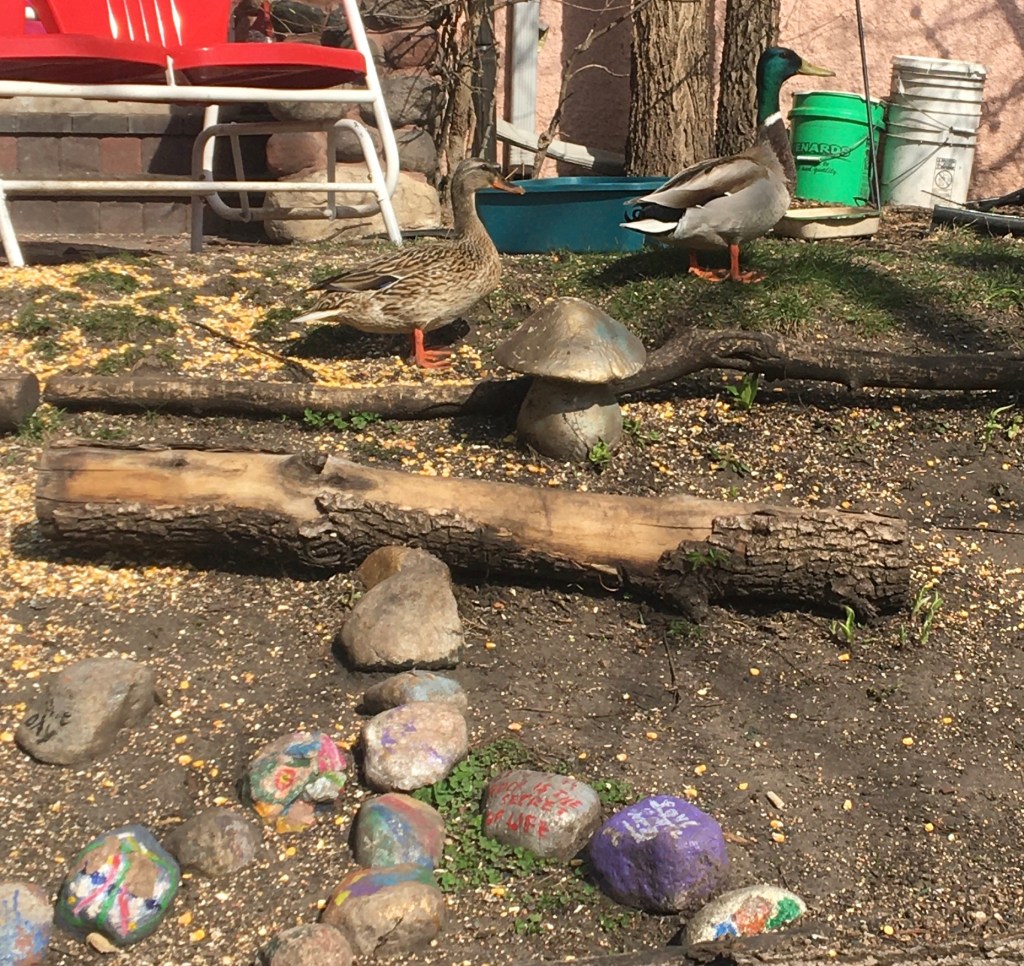
Find the ducks

The pink stucco and stone house across the street is slanty, sprawling, and old, with a few apartments carved out of what at one point must have been a single-family house. I think of it as the Francis of Assisi house – the place exudes an easygoing generosity and a happiness with the earth it’s built on.

Animals think so too. Squirrels, birds, and rabbits abound in the yard. A family of ducks has lived there for years, right here in the middle of the city. The inhabitants of the Francis of Assisi house put out birdbaths and a tiny pool for them. The ducks fly to nearby rooftops, including ours, and perch there to survey the block.

When walking home I sometimes see a car or two waiting patiently for the ducks to cross the street. Neighbors stroll by to watch the ducks. The ducks live happily on our block in the duck world that they and everyone else seem to love. They remind me of this beautiful poem.

Because, by Grace Schulman

Because, in a wounded universe, the tufts
of grass still glisten, the first daffodil
shoots up through ice-melt, and a red-tailed hawk

perches on a cathedral spire; and because
children toss a fire-red ball in the yard
where a schoolhouse façade was scarred by vandals,

and joggers still circle a dry reservoir;
because a rainbow flaunts its painted ribbons
and slips them somewhere underneath the earth;

because in a smoky bar the trombone blares
louder than street sirens, because those
who can no longer speak of pain are singing;

and when on this wide meadow in the park
a full moon still outshines the city lights,
and on returning home, below the North Star,

I see new bricks-and-glass where the Towers fell;
and I remember my lover’s calloused hand
soften in my hand while crab apple blossoms

showered our laps, and a yellow rose
opened with its satellites of orange buds,
because I cannot lose the injured world

without losing the world, I’ll have to praise it.

For more information on Grace Schulman, please click here.

alisonmcghee.com
Words by Winter: my new podcast

Poem of the Week, by Michael Pearce

My poems podcast, Words by Wintercan be found here.

Yesterday a friend told me that when his family tracks mud inside he goes silent and forces himself to be calm while he scrubs it away. He doesn’t want his children to go through what he did. As he spoke I remembered yelling at my little kids and hating myself for it.

And I remembered a year ago, when a young father and his little son meandered by my house. The boy desperately wanted a toy on the lawn across the street. He went into full meltdown, screaming and thrashing, but his father knelt down and spoke softly.

You really want the truck, don’t you. Do you want to talk about it?

Yes. Yes. Yes.

His father picked him up and held him while they talked. By the end of the block, he was calm. When I read this beautiful poem I thought about my friend’s determination not to repeat his father’s patterns. I pictured that young dad and how he soothed his son. It gives me hope for the future.

My Father Got Beat, by Michael Pearce

My father got beat
but he never beat me.

His skinny frame would tighten up,
he’d start to shake with a seething rage
at my errors, my arrogance,
he’d clench his bony fingers and say
“I’ll sock ya” but he never did.

My father’s father drank like a drunk.
He hit my dad,
called him a sissy,
infected him with T.B.,
threatened him with a knife,
and sometimes just disappeared
for a week or longer.
My dad drank at night,
drank beer and worked.
A quiet man, he put in long hours
and never talked about what hurt.

He told me that when he’d worked
Emergency at County General
he’d seen what beatings do to kids
and then he knew he’d never beat his.
He didn’t say much about himself
but he told me that.

You’ll hear guys say
they’d take a bullet for their kid.
You’ll hear guys say a lot of stuff.
My dad stepped between a bullet and me,
stopped that mayhem
from ripping through his chest and
into the hearts of the ones he loved,
did it at a cost to his angry soul,
did it for me and my sister and brother
and for what is decent.

One time I got up the nerve
to tell him I loved him.
All he could say was thank you.

MICHAEL PEARCE’s first collection of poems, Santa Lucia by Starlight, is forthcoming.

alisonmcghee.com
Words by Winter: my new podcast

Poem of the Week, by Jim Moore

My poems podcast, Words by Wintercan be found here.

The other day I passed a tall chemo-bald man in a fur hat despite the warm day. They cut the bad parts out and now I’m good to go, he told the UPS driver. I smiled at him and he waved, full of cheer.

The broken world is a phrase I see everywhere these days. Yeah, it’s broken, and yeah, wild worry about the future keeps me from sleep. But haven’t all our hearts been broken, over and over, and don’t most of us just want to keep going? Want to haul ourselves up from a fall, from surgery, from depression, from everything that gets thrown at us, so that we can keep on living? There’s something so beautiful about that.

Whatever Else, by Jim Moore

Whatever else, the little smile on the face of the woman
listening to a music the rest of us can’t hear and a sky at dawn
with a moon all its own. Whatever else, the construction crane
high above us waiting to be told how to do our bidding,
we who bid and bid and bid. Whatever else, the way cook #1
looks with such longing at cook #2. Let’s not be too sad
about how sad we are. I know about the disappearance
of the river dolphins, the sea turtles with tumors.
I know about the way the dead
don’t return no matter how long they take to die
in the back of the police car. I know about the thousand ways our world
betrays itself. Whatever else, my friend, spreading wide his arms,
looks out at the river and says,
“After all, what choice did I have?” After all,
I saw the man walking who’d had the stroke, saw the woman
whose body won’t stop shaking. I saw the frog in the tall grass,
boldly telling us who truly matters. I saw the world
proclaim itself an unlit vesper candle while a crow
flew into the tip of it, sleek black match, burning.

For more information about Jim Moore, please check out his website

alisonmcghee.com

Poem of the Week, by Langston Hughes

My poems podcast, Words by Wintercan be found here.

My family is multiracial so these latest murders, of eight Asian Americans in Atlanta by yet another white guy with a Hitler haircut, feel more personal to me, more terrifying, right? Wrong. The idea that it’s on Asian Americans and their families to speak out against hatred is as exhausting as being the lone woman in a roomful of men trying to explain to them what sexism is. It is not my responsibility or my family’s responsibility to take a stand against these hate crimes, it’s everyone’s responsibility.

You know that phrase you still see here and there, If you see something, say something? Flip it around and use it for good. Fellow white people, I ask you to practice putting it to use in your own life. When you hear someone (including someone you love) make a “joke” or a remark with racist overtones, practice saying “Oh, I’m not comfortable with that.”

Do it in a way that works for you and your personality. I usually smile-grimace and squinch up my shoulders and say “oh yikes, no no no.” In my experience, this is surprisingly effective. It works for anti-gay and anti-women “jokes” too. Check out this perfect tiny tutorial by the wonderful Linda Sue Park for more tips. Remember that baby steps are still steps.


Freedom, by Langston Hughes

Freedom will not come
today, this year
            nor ever
through compromise and fear.

I have as much right
as the other fellow has
            to stand
on my two feet
and own the land.

I tire so of hearing people say,
let things take their course.
Tomorrow is another day.
I do not need my freedom when I’m dead.
I cannot live on tomorrow’s bread.
            Freedom
            is a strong seed
            planted
            in a great need.
            I live here, too.
            I want my freedom
            just as you.  

For more information on Langston Hughes, please click here.

alisonmcghee.com
Words by Winter: my new podcast