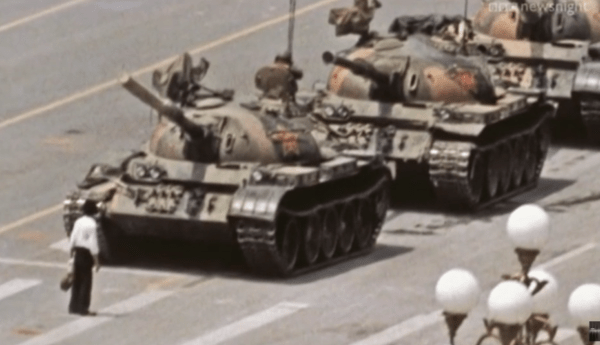
 Remember the man in the photo to the right? He stood in front of those tanks during the Tiananmen Square protest in 1989, nothing but a briefcase in his hands. When the tanks tried to maneuver around him, he stepped in front of them again. I don’t know what became of him.
When the protest happened, I was teaching Mandarin at a big urban high school in Minneapolis, and I wheeled a television into the classroom each day so that we could watch world history being made. I was young and naive and I assumed that the protest –thousands of pro-democracy unarmed students occupying a massive public square– would end peacefully. I was wrong.
But the Tiananmen pro-democracy movement continues to this day. One of the bravest to carry its flame throughout his life was one of my heroes, poet, human rights activist and Nobel Peace Prize laureate Liu Xiaobo*, who died yesterday from liver cancer after spending much of his adult life in prison. He consistently refused offers of freedom in return for admissions of guilt. He hoped to transcend his own personal nightmare, writing “If you want to enter hell, don’t complain of the dark.” In these terrible, ominous times –a time when our own elected employees seem bent on destroying American democracy– his example brings strength.
His wife, Liu Xia, entered into hell with him. Also a poet and activist, she suffers physical and emotional problems from the cruelty of their long separation and, now, his death. Their love was unwavering. Liu once said that it was the thought of his wife that kept him steady and strong. In mourning, I combed through my thousands of poems last night, looking for one to mark the passing of a person who had such courage and steadfastness. In the end I took a sideways turn and chose this one by Yehuda Amichai, in honor of the remarkable love between husband and wife.
In the Middle of This Century, by Yehuda Amichai (translated by Assia Gutmann)
In the middle of this century we turned to each other
with half faces and full eyes
like an ancient Egyptian picture
and for a short while.
I stroked your hair
in the opposite direction to your journey,
we called to each other,
like calling out the names of towns
where nobody stops
along the route.
Lovely is the world rising early to evil,
lovely is the world falling asleep to sin and pity,
in the mingling of ourselves, you and I,
lovely is the world.
The earth drinks men and their loves
like wine,
to forget.
It can’t.
And like the contours of the Judean hills,
we shall never find peace.
In the middle of this century we turned to each other,
I saw your body, throwing shade, waiting for me,
the leather straps for a long journey
already tightening across my chest.
I spoke in praise of your mortal hips,
you spoke in praise of my passing face,
I stroked your hair in the direction of your journey,
I touched your flesh, prophet of your end,
I touched your hand which has never slept,
I touched your mouth which may yet sing.
Dust from the desert covered the table
at which we did not eat
but with my finger I wrote on it
the letters of your name
*Transliterated Mandarin is not pronounced the way it looks in English. Phonetically, Liu’s name is pronounced more like this: Lee-yu Shee-yow Baw. His wife’s name is pronounced more like Lee-yu Shee-yah.
For more information on Yehuda Amichai, please click here.
For more information on Liu Xiaobo, please click here.
 People look at me with confusion when I tell them I’m deeply wary of charismatic people, with charisma defined in the broad sense as “a personal magic of leadership arousing special popular loyalty or enthusiasm for a public figure (such as a political leader).” But wait, isn’t charisma charming, magnetic, powerful? Sometimes. And sometimes it’s a mask for manipulation, a bottomless need for adulation, attention, look at me look at me look at me, take care of me and do as I say because I am more important than you. Charismatic people so often go unchecked, no matter their behavior, because a) people are drawn to them by that magnetic personality and b) charismatic people often snap at anyone who calls them out on their behavior, in a vicious, malevolent and wildly cruel way.
  Alison McGhee