poem of the week
 poem, from Salt
Poem of the Week, by Nancy Willard
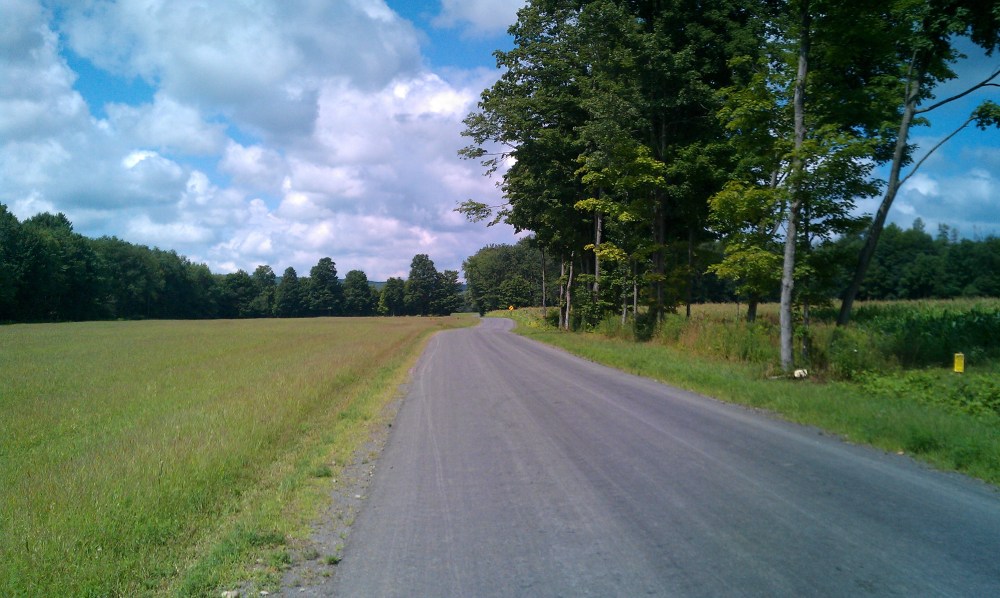
 Snow in the city is beautiful for about a day, sometimes two days if it’s a blizzard and no plows or cars can get through the streets. The minute the plows go through, that beauty degenerates into muddy ice, brown clumps flung up on curbs, nearly impassable single-file streets where cars take turns one by one. Snow in upstate New York, where I grew up, is beautiful for months (and months and months) on end, because there’s nothing to interfere with it. White and blue and green and pink, all the colors of snow in the shifting light, turn every field and wood into calm. I remember waking up in the middle of the night to the rumble of snowplows sweeping down Route 274, their orange revolving light circling the walls of my room. Someone out there is taking care of us, is what the memory of that sound still feels like to me.
The Snow Arrives After Long Silence
– by Nancy Willard
The snow arrives after long silence
from its high home where nothing leaves
tracks or stains or keeps time.
The sky it fell from, pale as oatmeal,
bears up like sheep before shearing.
The cat at my window watches
amazed. So many feathers and no bird!
All day the snow sets its table
with clean linen, putting its house
in order. The hungry deer walk
on the risen loaves of snow.
You can follow the broken hearts
their hooves punch in its crust.
Night after night the big plows rumble
and bale it like dirty laundry
and haul it to the Hudson.
Now I scan the sky for snow,
and the cool cheek it offers me,
and its body, thinned into petals,
and the still caves where it sleeps.
For more information on Nancy Willard, please click here.
My Facebook page.
Poem of the Week, by ee cummings
 When I was a kid I used to read ee cummings’ poems not so much for the words but for the way he put them down on the page, all shoved up against each other, parentheses around some, weird punctuation, missing spaces, and the complete lack of upper case letters, down to the way he spelled his own name. Why why why why does he do it that way, I used to wonder. The strangeness and unconventionality was so fascinating. He was a Famous Person so I knew that all these choices must be intentional, but why why why?
If at first I didn’t care about the poems themselves, now I love them. Mr. Cummings is one of my most beloved poets, in fact. A small white used paperback copy of his 50 Poems that I found at a garage sale sits on a shelf in the living room; this poem felt right for today.
in spite of everything
– e.e. cummings
in spite of everything
which breathes and moves, since Doom
(with white longest hands
neatening each crease)
will smooth entirely our minds
– before leaving my room
i turn, and (stooping
through the morning) kiss
this pillow, dear
where our heads lived and were.
For more about ee cummings, please click here.
Poem of the Week, by Ellery Akers
 Many years ago I read Innumeracy, a slender, astonishing book by John Allen Paulos, about how the understanding or lack thereof of basic math and statistics affects everything about the way we live our lives. What I learned in that book humbled me and has stayed me with me ever since, especially the singular fact that every breath every one of us takes contains at least three molecules of the air breathed by every human being and creature who has ever lived on this earth. Gandhi. Hitler. Wooly mammoths. Jesus Christ. The prophet Mohammad. Your great grandparents, your great grandchildren. Every, single, breath. This poem makes me think of that all over again, in yet another way. Poem of the Week, by Ellery Akers.
Breathing
– Ellery Akers
I love to feel as if I’m just another body, a breather along with the others:
blackbirds taking sips of air, garter snakes
lapping it up with their split tongues,
and all those plants
that open and close and throw up streamers of oxygen:
maybe that cottonwood that tilts across the creekbed
is the very one that just sucked up carbon dioxide
and let me breathe, maybe I should hang a card around it,
Thank you for the next two minutes of my life,
maybe some of
the air I just swallowed used to be inside the hot larynx of a fox,
or the bill of an ash-throated flycatcher,
maybe it just coursed past
the scales of a lizard–a bluebelly –
as he wrapped himself around his mate,
maybe he took an extra breath and let it out
and that’s the one I got.
Maybe all of us are standing side by side on the earth
our chests moving up and down,
every single one of us, opening a window,
loosening a belt, unzipping a pair of pants to let our bellies swell,
while in the pond a water beetle
clips a bubble of air to its shell and comes back up for another.
You want sanitary? Go to some other planet:
I’m breathing the same air as the drunk Southerner,
the one who rolls cigarettes with stained yellow thumbs
on the bench in the train station,
I’m breathing the same air as the Siamese twins
at the circus, their heads talking to each other,
quarreling about what they want to do with their one pair of hands
and their one heart.
Tires have run over this air,
it’s passed right over the stiff hair of jackrabbits and road kill,
drifted through clouds of algae and cumulus,
passed through airplane propellers, jetprops,
blades of helicopters,
through spiderlings that balloon over the Tetons,
through sudden masses of smoke and sulfur,
the bleared Buick filled with smoke
from the Lucky Strikes my mother lit, one after another.
Though, as a child, I tried my best not to breathe,
I wanted to take only the faintest sips,
just enough to keep the sponges inside,
all the lung sacs, rising and falling.
I have never noticed it enough,
this colorless stuff I can’t see,
circulated by fans, pumped into tires,
sullenly exploding into bubbles of marsh gas,
while the man on the gurney drags it in and out of his lungs
until it leaves his corpse and floats past doorknobs
and gets trapped in an ice cube, dropped into a glass.
After all, we’re just hanging out here in our sneakers
or hooves or talons, gripping a branch, or thudding against the sidewalk:
as I hold onto my lover
and both of us breathe in the smell of wire screens on the windows
and the odor of buckeye.
This isn’t to say I haven’t had trouble breathing, I have:
sometimes I have to pull the car over and roll down the window,
and take in air, I have to remember I’m an animal,
I have to breathe with the other breathers,
even the stars breathe, even the soil,
even the sun is breathing up there,
all that helium and oxygen,
all those gases blowing and shredding into the solar wind.
For more information about Ellery Akers, please click here.
Poem of the Week, by Rebecca Foust
I had another poem all ready to go this morning. Then I got a text from a distant city where someone I love lives: “Went to the tree lighting last night but the crowd was so huge that we got afraid of being in the middle of it so we watched from afar.” This text and the following one, “Avoiding crowds at all costs,” felt like the capper to a hard week of hard news. So I turned to my file of comfort-poems, like The Peace of Wild Things by Wendell Berry, like Kindness by Naomi Shihab Nye, like To My Young Friends Who Are Afraid by William Stafford, but none of them felt right. Then I read this one, by Rebecca Foust, and it struck the right chord. Poem of the Week.
Vernal
– Rebecca Foust
Some things we believe cannot be redeemed.
But in a valley the Railroad finally forgot,
the silted, slugged ditch we would not eat fish from
runs again, a river, rilled as before
by clear water, not black. Grass grows back
between tracks and rails. Limestone spalls
hewn from the mountain heal into soil.
Stumps heaped with live coals, split, and winched out
in spring frail a new circlet of green.
Panthers are seen. A son is born blue, and lives.
Some things we believe cannot be redeemed,
but the dawn, as yet, is diurnal. The woods keep
a hushed vigil, then rustle with life we can’t see;
small ponds well from the ground while we sleep.
For more information on Rebecca Foust, please click here.
My Facebook page.
Poem of the Week, by Franz Wright
Me last Thursday, on the way to the airport and halfway into a deep conversation about religious extremism with my Somali-born Uber driver: “It horrifies me. How does the longing for purpose and passion that every young person has turn into the belief that their god is the only god, and that their god justifies murder and mayhem and terror?”
Him (31 years old, handsome, laughing, who along with his Somali-born wife works full-time on different shifts so that they can trade off taking care of their four little kids): “I will tell you something. I almost became one of them.”
Pause.
“Um. . . you did?”
“Yes. After we fled the civil war in Somalia we lived in Nairobi for three years and I went to a new mosque. I was 18. And the leader taught hate. I began to be filled with hate and to think that others should suffer and die.”
“What changed?”
“I felt my heart turning hateful. And I decided to bring a notebook to the mosque with me for one week. I had one column Hate and another column Love and I kept track of what he was teaching. At the end of the week it was all hate. And I stopped going to the mosque.”
“And now? Did you find a mosque in Minneapolis that feels right to you?”
“I don’t go to any mosque anymore. I don’t raise my kids in any religion. If I want to pray, I pray inside my own head. My religion is two words only. You want to know what they are?”
“I do.”
“Don’t hate.”
Poem of the week, by Franz Wright.
Solution
– Franz Wright
What is the meaning of kindness?
Speak and listen to others, from now on,
as if they had recently died.
At the core the seen and unseen worlds are one.
For more information about Franz Wright, please click here.
My Facebook page.
Poem of the Week, by Kathleen Jamie
When I was a child the story of the Pied Piper, who lured the children of Hamelin out of town and into the side of a mountain, from which they never appeared again, held a dark fascination. Typing that last sentence out made me realize that it still does. The piper with his irresistible tune, the children who willingly followed, the finality of the mountain closing behind them: something about that story is enchanting in an awful way. This poem, which feels translated from a long-ago time (even though it’s not), brings me right back to the feeling that those old legends and fairy tales –the Grimm versions, not the sanitized Disney versions, conjures up in me.
The Hinds
– Kathleen Jamie
Walking in a waking dream
I watched nineteen deer
pour from ridge to glen-floor,
then each in turn leap,
leap the new-raised
peat-dark burn. This
was the distaff side;
hinds at their ease, alive
to lands held on long lease
in their animal minds,
and filing through a breach
in a never-mended dyke,
the herd flowed up over
heather-slopes to scree
where they stopped, and turned to stare,
the foremost with a queenly air
as though to say: ‘Aren’t we
the bonniest companie?
Come to me,
You’ll be happy, but never go home.’
For more about Kathleen Jamie, please click here.
Poem of the Week, by Al Zolynas
This morning at breakfast I learned something about my grandfather, who died when I was seven, that I never knew before. I’ve been thinking about him all day now in the light of this knowledge that I didn’t have before, how it recasts the image in my mind and heart of who he was, how he lived, what he loved and what he missed. This poem, which I’ve loved for a long time but never posted, came back to me as I thought, along with a quote from William Faulkner from Light in August: “Man knows so little about his fellows.” Poem of the Week, by Al Zolynas.
The Hat in the Sky
– Al Zolynas
After the war,
after I was born,
my father’s hobby
(perhaps his obsession)
was photography.
New fathers often become
photographers, it seems.
But he took pictures of many things
besides me,
as if he suddenly felt it all
slipping away
and wanted to hold it forever.
In one of the many shoe boxes
full of photographs
in my father’s house,
one photo sticks in my mind,
a snapshot
of a black hat
in midair,
the kind of hat fashionable in the forties,
a fedora – something
Bogie would wear.
Someone has thrown it
into the air–
perhaps my father himself,
perhaps someone in an exuberant moment
at a rally or gathering.
It’s still there,
hanging in the sky
as ordinary and impossible
as a painting by Magritte,
and it’s impossible
how it wrenches my heart, somehow.
At odd moments in my life,
that hat appears to me
for no discernible reason.
—
For more information on Al Zolynas, please click here.
Poem of the Week, by Galway Kinnell
 A few years ago one of my favorite people and I were having dinner on the rooftop patio of a restaurant, wine for her, a gimlet for me, both of us chattering away. At one point our conversation touched on the topic of suicide, something we both had experience with, and I remember her saying that no matter awful life could be and had been, something in her always wanted to hang around if only to see “what would happen next, ” that even at its worst, life was fundamentally interesting. I told her that my best advice to myself is usually “Wait.” I read this poem today and thought of that night, and my friend. “Trust the hours.”
Wait
– Galway Kinnell
Wait, for now.
Distrust everything, if you have to.
But trust the hours. Haven’t they
carried you everywhere, up to now?
Personal events will become interesting again.
Hair will become interesting.
Pain will become interesting.
Buds that open out of season will become lovely again.
Second-hand gloves will become lovely again,
their memories are what give them
the need for other hands. And the desolation
of lovers is the same: that enormous emptiness
carved out of such tiny beings as we are
asks to be filled; the need
for the new love is faithfulness to the old.
Wait.
Don’t go too early.
You’re tired. But everyone’s tired.
But no one is tired enough.
Only wait a while and listen.
Music of hair,
Music of pain,
music of looms weaving all our loves again.
Be there to hear it, it will be the only time,
most of all to hear,
the flute of your whole existence,
rehearsed by the sorrows, play itself into total exhaustion.
For more information about Galway Kinnell, please click here.
Poem of the Week, by Jack Gilbert
That 30-pound wonder to the left there, in that tiny photo, is, variously, Sweet Pete, Pete, Petey, Pedro, Peter, and Little Guy. He has been, variously, captivating, surprising, startling, annoying, tiring, and delighting us for 12 years now. He’s one of those dogs you sometimes wish weren’t as smart as he is. I remember, back when we first got him, watching him observe people opening the door to the kitchen, a door that we kept closed in order to keep him out of there. When he thought no one was in the room (I was stealth-sitting in a far corner), he jumped up, braced his front legs on the door, and began batting at the knob with his right paw until presto, the door opened, whereupon he raced into the kitchen and gobbled down an entire cooling rack of oatmeal scotchies in the 2.5 seconds it took me to race in there after him. He has taught himself how to do many, many other things in the intervening years. He can read my mind and I can read his. Right now he’s asleep at my feet, having ascertained the situation: She’s tapping at the thing again. She’s still in her pajamas. In about an hour she’ll put on her jeans and sweatshirt and come at me with the leash. I might as well take a nap until then. When I read this poem by Jack Gilbert, who is one of my favorite poets, I thought, you know what? If we have to come back to this world, coming back as a dog might not be so bad.
Alone
– Jack Gilbert
I never thought Michiko would come back
after she died. But if she did, I knew
it would be as a lady in a long white dress.
It is strange that she has returned
as somebody’s Dalmation. I meet
the man walking her on a leash
almost every week. He says good morning
and I stoop down to calm her. He said
once that she was never like that with
other people. Sometimes she is tethered
on their lawn when I go by. If nobody
is around, I sit on the grass. When she
finally quiets, she puts her head in my lap
and we watch each other’s eyes as I whisper
in her soft ears. She cares nothing about
the mystery. She likes it best when
I touch her head and tell her small
things about my days and our friends.
That makes her happy the way it always did.
My Facebook page.
For more on Jack Gilbert, please click here.
 Alison McGhee