Poem of the Week, by Michael Lee
 1) When I was young and had just lost someone I loved, I prayed one night for him to give me a sign from wherever, if anywhere, he was. The next morning I dreamed that his arms were the blanket over me and the bed under me. The sense of comfort disappeared the minute I woke up, but I’ve remembered it all these years. 2) Once, in a CVS, years after she had died, I smelled my grandmother, the powder she always wore. I followed my nose from aisle to aisle until I found her, a small old woman looking at birthday cards. She was not my grandmother, and yet she was my grandmother. 3) Last spring, my friend Kathi and I were on a television show that was being taped outdoors. As Kathi was talking, my friend John Brett, husband of my friend Gail, appeared at the edge of the set. He was smiling, of course, and a giant surge of happiness went through me at the sight of him and I waved at him and thought, I have to tell Gail I saw John! Then I remembered, again, that John had died. But I told Gail anyway. 4) I love this poem below for so many reasons, but most of all for these lines: The theory of six degrees of separation/ was never meant to show how many people we can find,/ it was a set of directions for how to find the people we have lost.
Pass On, by Michael Lee
When searching for the lost remember 8 things.
1.
We are vessels. We are circuit boards
swallowing the electricity of life upon birth.
It wheels through us creating every moment,
the pulse of a story, the soft hums of labor and love.
In our last moment it will come rushing
from our chests and be given back to the wind.
When we die. We go everywhere.
2.
Newton said energy is neither created nor destroyed.
In the halls of my middle school I can still hear
my friend Stephen singing his favorite song.
In the gymnasium I can still hear
the way he dribbled that basketball like it was a mallet
and the earth was a xylophone.
With an ear to the Atlantic I can hear
the Titanic’s band playing her to sleep,
Music. Wind. Music. Wind.
3.
The day my grandfather passed away there was the strongest wind,
I could feel his gentle hands blowing away from me.
I knew then they were off to find someone
who needed them more than I did.
On average 1.8 people on earth die every second.
There is always a gust of wind somewhere.
4.
The day Stephen was murdered
everything that made us love him rushed from his knife wounds
as though his chest were an auditorium
his life an audience leaving single file.
Every ounce of him has been
wrapping around this world in a windstorm
I have been looking for him for 9 years.
5.
Our bodies are nothing more than hosts to a collection of brilliant things.
When someone dies I do not weep over polaroids or belongings,
I begin to look for the lightning that has left them,
I feel out the strongest breeze and take off running.
6.
After 9 years I found Stephen.
I passed a basketball court in Boston
the point guard dribbled like he had a stadium roaring in his palms
Wilt Chamberlain pumping in his feet,
his hands flashing like x-rays,
a cross-over, a wrap-around
rewinding, turn-tables cracking open,
camera-men turn flash bulbs to fireworks.
Seven games and he never missed a shot,
his hands were luminous.
Pulsing. Pulsing.
I asked him how long he’d been playing,
he said nine 9 years
7.
The theory of six degrees of separation
was never meant to show how many people we can find,
it was a set of directions for how to find the people we have lost.
I found your voice Stephen,
found it in a young boy in Michigan who was always singing,
his lungs flapping like sails
I found your smile in Australia,
a young girl’s teeth shining like the opera house in your neck,
I saw your one true love come to life on the asphalt of Boston.
8.
We are not created or destroyed,
we are constantly transferred, shifted and renewed.
Everything we are is given to us.
Death does not come when a body is too exhausted to live
Death comes, because the brilliance inside us can only be contained for so long.
We do not die. We pass on, pass on the lightning burning through our throats.
when you leave me I will not cry for you
I will run into the strongest wind I can find
and welcome you home.
 I’m the mother of an immigrant and the aunt to immigrants. Family members and many of my dearest friends are gay. I am both a patron and former client of Planned Parenthood. I do not identify as Christian. These four facts alone make me –a white, middle-class born-and-bred citizen of this country– and my immediate and extended family current targets for persecution by my own government. Beyond that, many of my students, colleagues and friends are a) not white, b) Muslim, c) immigrants, d) people living with mental and physical disabilities. Being a patriotic American, which I most certainly am, means that my responsibility is to speak out against fascism. Being a progressive, which I also most certainly am, means keeping my focus on the bigger picture, which is the world as I know it to be, the one that Naomi Nye so beautifully brings to life in this poem.
 Hello, you’ve reached the Crisis Connection. This is Anna. Could you tell me your first name? I remember the sound of that woman’s voice. This was many many years ago. Someone close to me was in terrible shape, and nothing I did helped, and in panic and desperation I had called the hotline seeking guidance as to how to help. My name is Alison but that doesn’t matter it’s not me who needs help it’s my friend and I don’t know what to do and I began to describe the situation as she listened. And listened. Her calm and her focus, over more than a thousand miles of an invisible cell phone connection, was tangible. How are you feeling right now, Alison? Where are you, Alison? What’s your plan for the next few hours? Is there a way you can take care of yourself in this hard time? To this day I can hear her voice, so calm and warm in my ear. Saying my name. Listening. I remember looking up at the sky at one point. It was late at night, far from the city, and the stars were thick in the heavens. After a long time my voice was slow and tired, but I now had a little more energy to keep going. I will remember that conversation the rest of my life. The poem below made me think of Anna, and that long ago dark night. I wish there were some way to tell her how grateful I will always be to her.
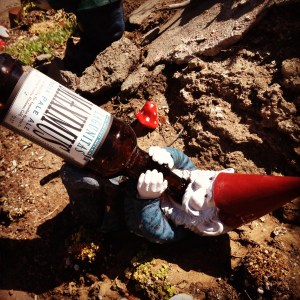 Quite a year we just had. A year that drove that poor little garden gnome in the photo on the right to drink, not to mention me with my cabinet full of gin. So many poems feel like possibilities to greet the new year, but this one by Langston Hughes feels the most possible. It’s strange, because if asked I would never list Langston Hughes on my Favorite Poet list, but lines from his poems come drifting through my mind almost every day. Like this one: Hold fast to dreams, for if dreams go, life is a barren field frozen with snow. And this one: They’ll see how beautiful I am and be ashamed– I, too, am America. And this one: I’ve known rivers: Ancient, dusky rivers. My soul has grown deep like the rivers. And most of all, I see that my own hands can make the world that’s in my mind. Goodbye, 2016. Here’s to the baby new year.
 ollege, and how when I make coffee for her she sits quietly at the kitchen table, her head slightly bowed, silent, because she’s not a morning person, and how her black hair shines in the lamplight. Then I pictured the other daughter, who lives in Boston and whose room still smells like her, and I resisted the urge to get up and walk across the hall and open the door to her so I could breathe her in. Then I pictured the son who lives in Chicago and I remembered the collection of duct tape + cardboard swords he made when he was a little boy. And the other people I most love –the best friend, the painter, the sisters and brother and parents and friends– gathered together in my mind in the dark. All this is to say that when I read the poem below, it feels exactly like those middle of the night thoughts – that everything that matters is small and specific and enormous at the same time.
 Young woman across the street, waving and calling to me as I trudge through the snowdrifts on the way home from
  Once, at a magic show held at night in a converted barn in rural New Hampshire, I watched a girl gasp in amazement as a happy young man in a cape pulled a rabbit from a hat, and then –somehow– made a bird in a cage disappear from the stage and reappear at the back of the room. Did you see that? the girl said to me. That was amazing. She was fifteen at the time, and I remember thinking how beautiful it was that she could still be captivated by magic. Some years later, from her first job, a year spent at the poorest elementary school in the poorest neighborhood of a big city, a job which taxed her spirit to the limit because of the nearly unimaginable suffering her students lived under, she sent me a text. It was “Atten-Dance” day for the fourth-graders, a day on which all the students with good attendance got to stay after school for a dance put on for them by the girl and her colleagues. This is the best day of the year, her text said. My babies —which is what she, at 22, called her students– are so excited. They’re jumping around like the little kids they for once get to be. Like the poem below says, we can make this place beautiful. Even now.
 Tough choosing a poem this week amidst the hours spent hiking, walking, trying to tromp my way into some form of inner calm. More hours on the couch scrolling through my thousands of poems. Searching for certain poets, the ones who bring me comfort because they’re fearless, because they talk about life the way it is, because they use ordinary words to write about ordinary things that in their magic hands turn transcendent and remind me that I’m not in this alone. That I am never alone. That all over this country right now, there are others waking every morning and breathing in and breathing out and reminding themselves that the world has never been easy, that humankind has always been under threat by the few among us who take pleasure in being cruel, in inciting violence, in tearing apart the social fabric because . . . why? because they can, I guess. Yes, we are always under siege by those who would divide us for their own sick pleasure, and also yes, we are always fighting back. Sometimes with harshness, and sometimes with a book that lasts for a lifetime, as in this beautiful poem.
 Alison McGhee