Poem of the Week, by Danez Smith

My new poems podcast, Words by Winter, can be found here.

D11E1B29-F92F-4FBA-B4E3-866135CE8A9F_1_105_cSometimes I feel so sad for men. All the unspoken rules. All the ways our culture tries to train boys out of their openness, their gentleness, their human need for hugs and touch. I think of the multiple men I know who have told no one but me the ways they were sexually abused as children. I think of my giant of a father, and the look on his face when he told me how his mother used to scream at him when he was little. I think of all the men I know who depend on the women they love to translate the world of emotion for them, to navigate the nuances of relationships. I think of how sex sometimes seems the only acceptable way for a man to give and receive physical affection, the only time they can let down their guard.

Lifelong fierce feminist that I am, I think of all the bright, tender little boys I know, and knew, and how we need a world softer for them. Which would translate into a world softer for us all. I cried when I read this poem. 


from Differences, by Danez Smith

once, there was a boy
who learned to sing
who then learned not to sing

once, there was a boy
who heard another boy singing
then told him to stop

these are the same boy
this is every boy

another story: once, a boy
loved summer & so moved
to the sun

same story: once, a boy
ran from winter but could
not shake the dead trees

same story: once, a boy
stood in the woods
until he became it

same story: a boy is a tree

same story: my mother cries
whenever she sees a tree


For more information about the wondrous Danez Smith, please check out their website.

alisonmcghee.com

Words by Winter: my new podcast

Poem of the Week, by June Jordan

My new poems podcast, Words by Wintercan be found here.


First there was childhood, with the woods and the fields and the wondering. Then came college, where the roof of your life disappeared and you found your tribe. Then came all the years of struggle and love and longing –to be a writer, to be a mother, to be a transplant in a new land, to be a someone. And then there was the breaking, and the reconfiguration, and now there is the Reckoning. E1A4EEB4-48CE-45F2-8516-A11D28953DB0

I’m talking to myself here, trying to place pattern to my life, to reconcile past and present and possible future. Taking stock of what I’ve surrounded myself with and what I’ve put forth. If all these books and poems and teaching and essays and blogs and letters and cards and now a podcast mean I’m just fragmented? Chaotic?

Then comes this poem by a woman I idolize, a woman who wrote as many different kinds of words as I do, and it runs through me like cool water on a parched day. Maybe all these words, no matter their form, are the through-thread work of my life. My invisible hands reaching out to all the invisible people. 


These Poems, by June Jordan

These poems
they are things that I do
in the dark
reaching for you
whoever you are
and
are you ready?

These words
they are stones in the water
running away

These skeletal lines
they are desperate arms for my longing and love.

I am a stranger
learning to worship the strangers
around me

whoever you are
whoever I may become.


For more information about the astonishing, fierce, and brilliant June Jordan, please click here.

alisonmcghee.com

Words by Winter: my new podcast

Poem of the Week, by Langston Hughes

My new poems podcast, Words by Wintercan be found here.

IMG_0695From my porch, which is all windows, people walk by in pairs or threes or solo. Some of them stop by my poetry hut and take a poem. Some keep their heads down and never look up. Some are slow and wandery, holding hands and scuffing their feet. Others stare straight ahead and laugh while they chatter to the person on the other end of their earbuds.
I picture them all at home before they headed out into the day, brushing their teeth, turning sideways, appraising themselves. Maybe they smiled into the mirror. Maybe they didn’t. What was in their minds and on their hearts? It feels to me that there are deep wells inside each of us that can’t ever be reached, of unanswered questions and secret happinesses, of loneliness. This tiny poem sings itself through me every day.


Hope, by Langston Hughes

Sometimes when I’m lonely,
don’t know why,
keep thinkin’ I won’t be lonely
by and by.


For more information about Langston Hughes, please click here.


My website

Poem of the Week, by Naomi Shihab Nye

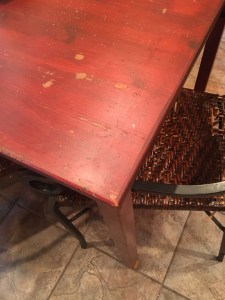
IMG_8937Small, wooden, stained a peeling dark red-brown, our kitchen table has moved with us from apartment to condo to house. It’s too short, so over the years I’ve glued and re-glued blocks of wood to the bottom of each leg. My little kids did their homework on it while I cooked for them, my teenagers and their friends talked and laughed around it while I cooked for them, my grown children sit around it laughing and drinking wine while I cook for them.

Salt and pepper grinders, Penzey’s Fox Point seasoning, a trivet that used to be my grandmother’s, cloth napkins each folded a different way to differentiate their owners, scuffs and burns from hot pots carelessly set down: this is our table, found curbside twenty years ago by me, who loved it at sight and for no apparent reason.

Now the table is leaving us, passed on to my daughter’s friend Shrimp, to be replaced by a kitchen island and four tall counter stools. When I sat at it yesterday eating a tomato sandwich, I thought of this beautiful poem.


Daily, by Naomi Shihab Nye

These shriveled seeds we plant,
corn kernel, dried bean,
poke into loosened soil,
cover over with measured fingertips

These T-shirts we fold into
perfect white squares

These tortillas we slice and fry to crisp strips
This rich egg scrambled in a gray clay bowl

This bed whose covers I straighten
smoothing edges till blue quilt fits brown blanket
and nothing hangs out

This envelope I address
so the name balances like a cloud
in the center of the sky

This page I type and retype
This table I dust till the scarred wood shines
This bundle of clothes I wash and hang and wash again
like flags we share, a country so close
no one needs to name it

The days are nouns: touch them
The hands are churches that worship the world


For more information about Naomi Shihab Nye, please click here.

My website
My podcast.
My Facebook page
@alisonmcgheewriter

Poem of the Week, by William Henry Davies

98CCB3C4-DC19-4DF8-B68C-5B477DC4CFDERelaxation is not my style. My style is more making long daily to-do lists and then crossing items off one by one. Sometimes I can trick myself into relaxing if I turn it into a task and add it to the list —rest and read–which when you think about it is kind of pathetic.

My mother sent me this poem last week. When I looked up the author, his sideways grin made me think he knew how to have fun. What did he remember, in the end, and what will I remember – how many things I crossed off my lists? Or the hour I spent yesterday in my kayak on Lake of the Isles, paddling in silence behind that drifting flock of geese?


Leisure, by William Henry Davies

What is this life if, full of care,
We have no time to stand and stare.

No time to stand beneath the boughs
And stare as long as sheep or cows.

No time to see, when woods we pass,
Where squirrels hide their nuts in grass.

No time to see, in broad daylight,
Streams full of stars, like skies at night.

No time to turn at Beauty’s glance,
And watch her feet, how they can dance.

No time to wait till her mouth can
Enrich that smile her eyes began.

A poor life this if, full of care,
We have no time to stand and stare.


For more information on William Henry Davies, please click here.

My website.
My podcast.
My Facebook page.
@alisonmcgheewriter

Poem of the Week, by Kari Gunter-Seymour

IMG_7693This morning on the porch a bee was bumbling against one of the screened windows. Its little legs drifted below its huge, furry body as it tried over and over to get out. So I upended my fox mug over it, slid a letter from my mother between the screen and the buzzing mug, then held the whole mess tight and maneuvered outside. Whisked the letter off and watched the bee lumber into the air again.
That bee made me think of the ending of this haunting poem. We endure so much to get here. To be alive. To stay alive. 


I Come From A Place So Deep Inside America It Can’t Be Seen, by Kari Gunter-Seymour
       

White oaks thrash, moonlight drifts
the ceiling, as if I’m under water.
Propane coils, warms my bones.

Gone are the magics and songs,
all the things our grandmothers buried—
piles of feathers and angel bones,

inscribed by all who came before.
When I was twelve, my cousins
called me ugly, enough to make it last.

Tonight a celebrity on Oprah
imagines a future where features
can be removed and replaced

on a whim. A moth presses wings
thin as paper against my window,
more beautiful than I could ever be.

Ryegrass raise seedy heads
beyond the bull thistle and preen.
Everything alive aches for more.


For more information on Kari Gunter-Seymour, please click here.

My new poems podcast, Words by Wintercan be found here.

My website

My Facebook page

@alisonmcgheewriter

Poem of the Week, by Marie Howe

991DA27A-58E0-41E4-87E6-9CA5515E0597Last week I was weeding my garden on a steambath afternoon when clouds tiered overhead, the air turned greenish, and a breeze sprang up. There’s a tall pine tree in my tiny front yard, with limbs that sweep down to earth, and when the first drops splatted down, I stepped inside them to watch the storm.

As a child I built a platform in the giant maple tree by the side of the road, accessible by a rope no one but me could climb. I used to stay up there for hours, reading and thinking in the crook of the tree. At one point I carved my initials into the biggest limb   –   A   R   M.   Over time, a decade or two, the tree puffed itself around the wound and healed itself. 

Trees talk to one another through their roots. Trees of the same species will share water and food. All trees in a forest are interconnected. They shelter one another, the way the tree in my front yard shelters me. 


The Copper Beech, by Marie Howe

Immense, entirely itself,
it wore that yard like a dress,

with limbs low enough for me to enter it
and climb the crooked ladder to where

I could lean against the trunk and practice being alone.

One day, I heard the sound before I saw it, rain fell
darkening the sidewalk.

Sitting close to the center, not very high in the branches,
I heard it hitting the high leaves, and I was happy,

watching it happen without it happening to me.


For more information about Marie Howe, please check out her website.

My website.

My podcast.

My Facebook page.

@alisonmcgheewriter

Poem of the Week, by Adrienne Rich

70673C9E-5CD7-42CC-9591-2302B73056D6Twice in my life I’ve started down a road and kept going, even when the road narrowed and turned into thorns, brambles, impenetrable darkness. A symbol of my refusal to accept that I had made the wrong choice in the very beginning. Years later, when I read about the theory of “sunk profits,” which describes a past investment that shouldn’t but still affects your decisions about the future, I knew it was what I had done in those situations. Kept going, because with so much invested, it felt impossible to let go, even though that something turned out to be full of pain and darkness. 

But clinging to what has always been wrong, whether a person or a system, because . . . why? it’s familiar? you’ve put so much into it? you fear the unknown? means missing out on the possibility of something different, something better, something beautiful. Deny something’s fundamentally wrong, and you deny your own power to change it.


Power, by Adrienne Rich

Living    in the earth-deposits    of our history

Today a backhoe divulged    out of a crumbling flank of earth
one bottle    amber    perfect    a hundred-year-old
cure for fever    or melancholy    a tonic
for living on this earth    in the winters of this climate

Today I was reading about Marie Curie:
she must have known she suffered    from radiation sickness
her body bombarded for years    by the element
she had purified
It seems she denied to the end
the source of the cataracts on her eyes
the cracked and suppurating skin    of her finger-ends
till she could no longer hold    a test-tube or a pencil

She died    a famous woman    denying
her wounds
denying
her wounds    came    from the same source as her power


For more information about Adrienne Rich, please click here.

My website.
My podcast.
My Facebook page.
@alisonmcgheewriter

Poem of the Week, by Craig Santos Perez

A994E53E-322E-47E7-ACA5-AEEF0E11266EThe area around Cup Foods in Minneapolis has become a memorial, and I walked there yesterday from my house, past a smiling man holding up a cardboard sign at 36th and Stevens.

Me: “I’m sorry, I didn’t bring any cash.”
Man: “You brought your good looks, though.”

I laughed and so did he, then we talked for a while and I told him where I was going. “It’s wrong, isn’t it,” he said. “Murdered like that.” Yes. It’s wrong. All the wrongness floods over in waves and the only thing that helps is to channel it into action toward a better world. I am not Pasifika, but this poem feels so familiar nonetheless.


Ars Pasifika, by Craig Santos Perez

when the tide

of silence

rises

say “ocean”

then with the paddle

of your tongue

rearrange

the letters to form

“canoe”


For more information about Craig Santos Perez, please click here.

My website

My podcast.

My Facebook page

@alisonmcgheewriter

Poems of the Week, by Ross Gay

img_5354

My daughter to me last night, as I weeded the front gardens with empty streets and choppers circling overhead: “Hey Ma. It’s past 8. Curfew.”

Me: “If I see the national guard tearing down the block I’ll just run inside.”

Another conversation I wouldn’t have predicted I’d ever be having, but this is where we are. I’ll be working the rest of my life to undo the racism baked into me, my community, and this country.


Pulled Over in Short Hills, NJ, 8:00 AM, by Ross Gay

It’s the shivering. When rage grows
hot as an army of red ants and forces
the mind to quiet the body, the quakes
emerge, sometimes just the knees,
but, at worst, through the hips, chest, neck
until, like a virus, slipping inside the lungs
and pulse, every ounce of strength tapped
to squeeze words from my taut lips,
his eyes scanning my car’s insides, my eyes,
my license, and as I answer the questions
3, 4, 5 times, my jaw tight as a vice,
his hand massaging the gun butt, I
imagine things I don’t want to
and inside beg this to end
before the shiver catches my
hands, and he sees,
and something happens.

A Small Needful Fact, by Ross Gay

Is that Eric Garner worked
for some time for the Parks and Rec.
Horticultural Department, which means,
perhaps, that with his very large hands,
perhaps, in all likelihood,
he put gently into the earth
some plants which, most likely,
some of them, in all likelihood,
continue to grow, continue
to do what such plants do, like house
and feed small and necessary creatures,
like being pleasant to touch and smell,
like converting sunlight
into food, like making it easier
for us to breathe.


For more information about Ross Gay, please click here.

My websiteMy blogMy Facebook page

Instagram: @alisonmcgheewriter