Books I Read in July and August

Maggie Harrison’s War on Wine, in the New York Times Magazine, 9 July 2023. Remember my take on the New Yorker, that each issue is a book in and of itself? Same with the NY Times magazine. I nearly skipped past this article because I hate wine and never drink it (I know, I know. I hate beer too. Sue me). But the mention of Harrison’s take on wine as a “cultural experience” intrigued me, so I read on. Like Harrison, I have synesthesia (words and all sounds appear in my mind with shape and color and texture; it’s a nonstop visual flow), and like her, my synesthesia is directly connected to the process of making art – in her case, wine; in my case, writing. She improvises her wine, based on the feel and memories and experiences she wants it to conjure in the drinker; I write books without knowing the storyline beforehand, only the feeling I hope they conjure in the reader. She doesn’t follow the traditional rules of winemaking, and her extraordinary wines are in a class of their own. I’ll be thinking about this article, and how it applies to the artistic process, for a long time.

Cloud Cuckoo Land, by Anthony Doerr. I zipped over to Magers & Quinn the day this book came out and scooped it up. Then I immediately lost it (not difficult, here at the House Made of Books). I may have bought another copy at some point and lost that too. At any rate, I was determined not to read it until I found the copy(s) I’d already bought. Carrot/stick. After I self-hatingly told this to a friend, she slipped another new copy through my mail slot. This long preamble is to show you both how ridiculous I can be and how much I revere Doerr’s writing. For four days I did little else but devour this novel. Is it possible to write a stunning work of fiction about climate devastation, the treachery of corporations, the brutality of humans, and AI that somehow, skipping from ancient Greece to medieval Constantinople to present-day America and on into the future, evokes in the reader the memory of all the libraries of their life, and how stories have been a balm and a call to action all their life, so that by the end of the book you are filled with so much emotion and love that you want to carry this book pressed to your heart forever? No, it is not possible. But Doerr does it. Again.

The Probability of Everything, by Sarah Everett. Throughout much of this novel, I was a little confounded, almost annoyed, along the lines of What am I missing?, because the premise was so strangely unbelievable, as if the characters had blindfolds on and we the readers were supposed to just accept it. I kept turning over possible outcomes in my mind, rejecting each one. But despite straining my credulity from page one, I liked the people in the book, especially the clear love among family members, so I kept going. The ending flipped the script in a way I did not expect, in a way that reflects the times in which we live and the lessons some of us just keep painfully learning, and it went straight to my heart.
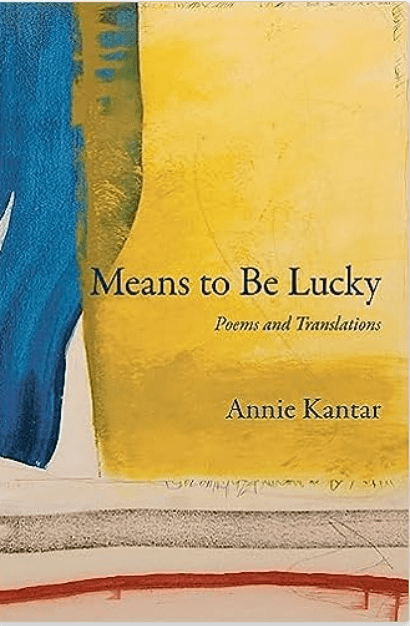
Means to Be Lucky, by Annie Kantar. What does it mean to be lucky? What are the means of being lucky? What does it mean to be a woman born and raised in the northern Midwest who transplants herself to the desert and blue skies of Israel? What does it mean to understand two worlds and live in the spaces they both inhabit? What does it mean to be a poet who is fluent in Hebrew, writes in her native English, and translates the work of Hebrew poets into English? What does it mean to be the mother of children whose home is Israel, to feel your own home to be Israel, and yet to sink into the green grass and tall trees of the landscape of your youth and know that your body will always hold this place in its bones? All these questions floated through me as I read Annie Kantar’s lovely, meditative first collection.
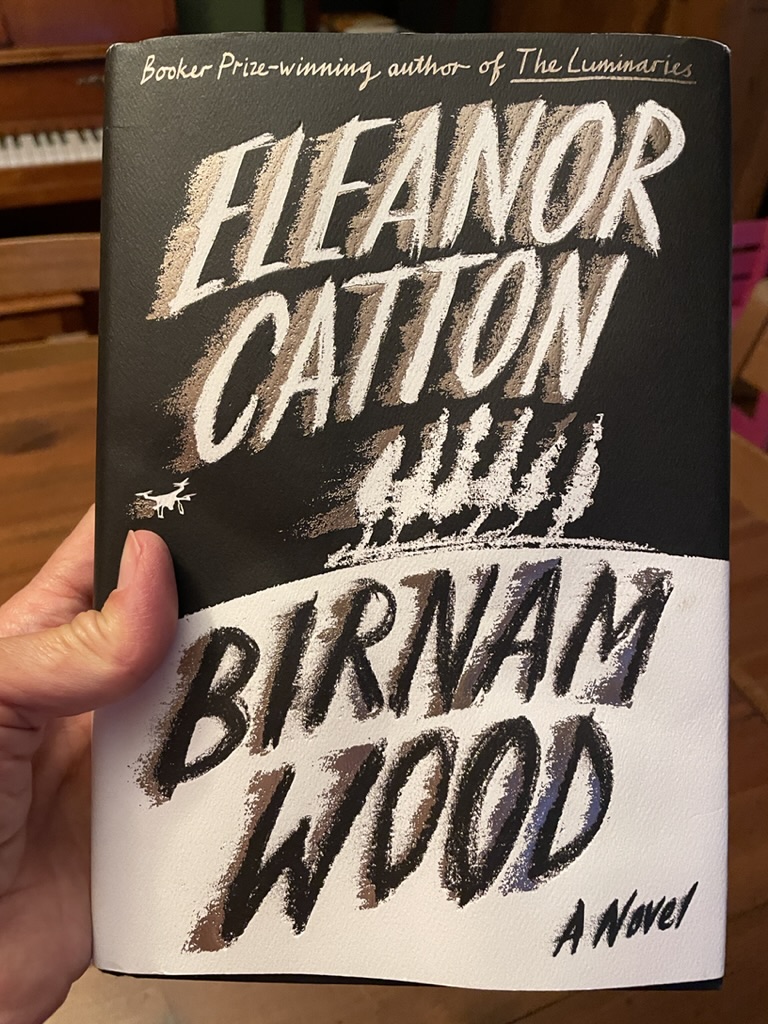
Birnam Wood, by Eleanor Catton. My friend Schumacher and I were discussing recent reads. “Have you read Birnam Wood?” she said, with a certain look I couldn’t quite identify on her face. I hied myself the four blocks to Magers & Quinn and snapped up a copy. Initially I figured I was reading an extremely well-written contemporary novel with a young environmentalist vs. cynical older person book. Which is true-ish, but holy crud. Holy. Crud. Did this book ever keep deepening and spiraling and boring into mystery and horror in a way that feels precisely designed for the melting-planet times in which we live. As I neared the end my heart was pounding and I couldn’t put it down. One of the most sentient and psychologically astute novels I’ve ever read.

The Sentence, by Louise Erdrich. This is a book unlike others by Erdrich, a writer whose novels I’ve loved forever. Set in my neighborhood in Minneapolis during the pandemic and the murder of George Floyd, much of what resonated for me in this novel was the pain and familiarity of both events and places. So many of the places, and even the people, in The Sentence, are second-nature to me, including Erdrich’s bookstore Birchbark Books, the walking paths, the lakes, the restaurants, and the fury and pain and power set in motion nationwide by those hideous last nine minutes of Floyd’s life. The ties that bind every one of the disparate people in this book together are books, specific and sought-after and longed for. Beginning with From the time of birth to the time of death, every word you utter is part of one long sentence, a perfect epigraph by Sun Yung Shin, the fierce, beating heart of this novel is the life-giving force of books and the people who sell them.
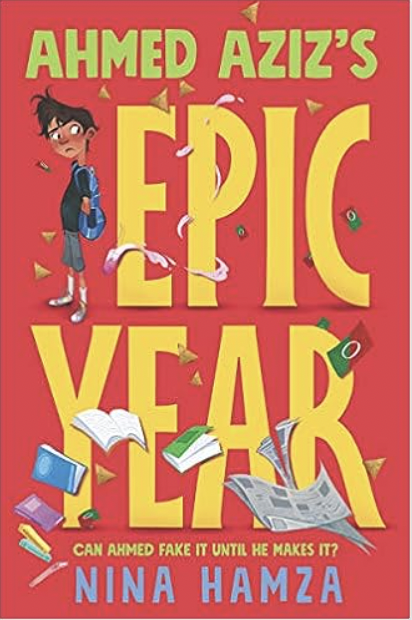
Ahmed Aziz’s Epic Year, by Nina Hamza. Poor Ahmed, whose father’s serious illness has forced the family to move, for medical care, from Hawaii to Minnesota, where his father grew up but where Ahmed knows no one. The same illness that threatens his father’s life killed Ahmed’s uncle Mohammed, the man he’s been compared to his entire life, both in looks and personality. Ahmed, the only Muslim kid in school and apparently the only brown kid as well, must navigate a sea of new classmates, unfamiliar routines, and winter. Hamza’s sensitivity, keen understanding of otherness, and matter of fact deadpan humor carry us along on Ahmed’s first year in a place different for him in every way, while her deep love of classic childhood books will appeal to every reader out there.
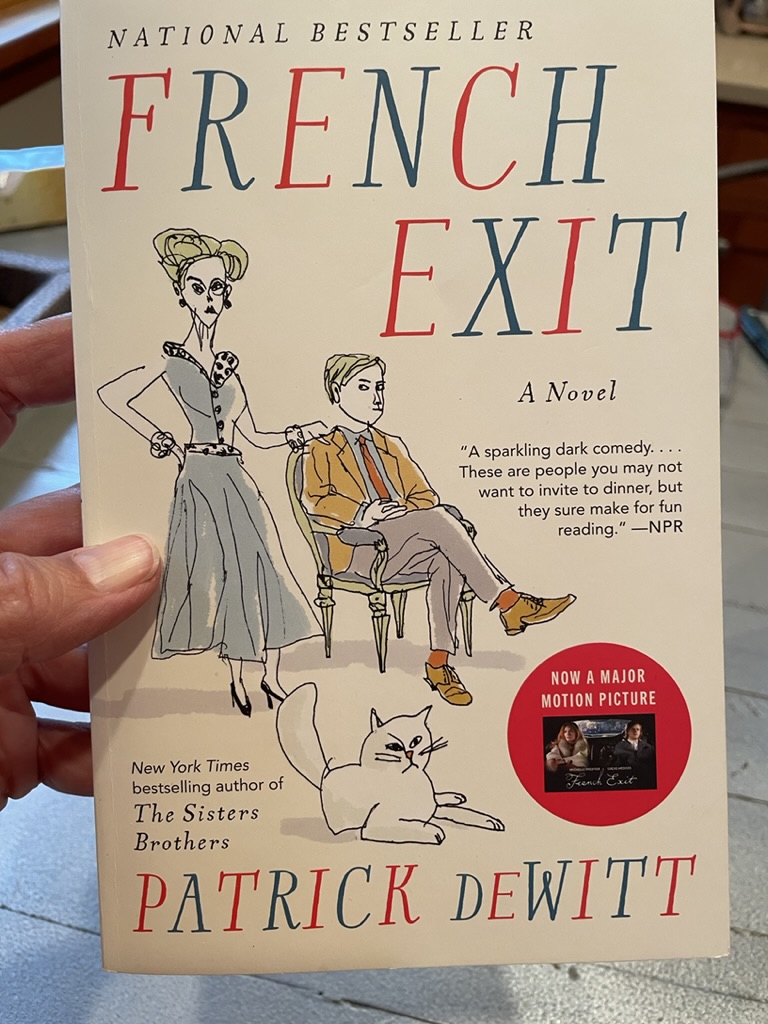
French Exit, by Patrick DeWitt. I wouldn’t have thought that a novel in which you know pretty much from the start that the main character plans to kill herself could be so damn funny, but live and learn. Please meet Frances Price, aging widowed beauty who can’t imagine a life without the money she has entirely squandered. Meet her hapless (but maybe not entirely) son Malcolm, who would be a perfect character on my beloved TV series Arrested Development. Meet Small Frank, the cat in whom Frances and Malcolm believe the soul of Frank Price (Frances’ husband, Malcolm’s father) is now housed. Watch them as they journey from Manhattan opulence to a borrowed apartment in Paris. Even though I knew the ending in the first few chapters of the book, this was a ride I was entirely willing to go on anyway.
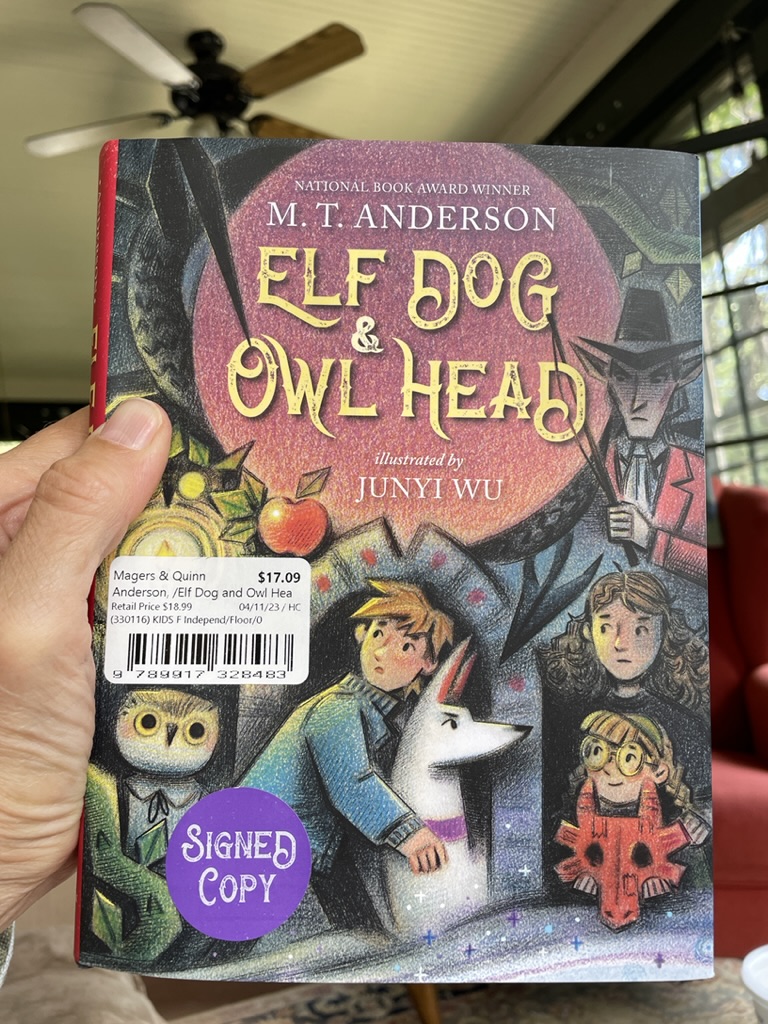
Elf Dog & Owl Head, by M.T. Anderson. This slender jewel of a novel by one of my favorite writers was indescribably moving to me. Set in the pandemic, a boy named Clay misses…everything. His older sister DiRossi (I seem to be on an Arrested Development kick with these mini-reviews, because this fictional DiRossi reminded me of Portia Di Rossi’s character on the TV show) and his younger sister Juniper are driving him crazy. The only thing that brings Clay any solace is escaping into the woods, where one day he meets a white dog unlike any other dog he’s ever encountered. From here, the novel turns into M.T. Anderson at his finest: Elphinore the elf-hound leads Clay into worlds parallel to our own but existing in different realms and different times both perilous and filled with wonder. There’s a sense throughout this book that it was written with both joy and longing for a dog whose connection with his human reaches from this world to the next.

 Everything that Kao Kalia Yang writes I read slowly and usually twice, not because there is anything confusing about her sentence structures but because her words and stories fill my heart with emotion. Sorrow, love, longing, rage and redemption – page by page, they all swim through. This is the second memoir by Yang. Her first, The Latehomecomer, was published some years ago and is (to my knowledge) the first Hmong American memoir, about her family’s long and arduous journey from the mountains of Laos to the refugee camps of Thailand to the grueling new world of Minnesota. In The Song Poet, which is primarily about her father Bee Yang, she adopts the voice of her father along with her own in order to tell his personal story and the family’s continuing saga.
 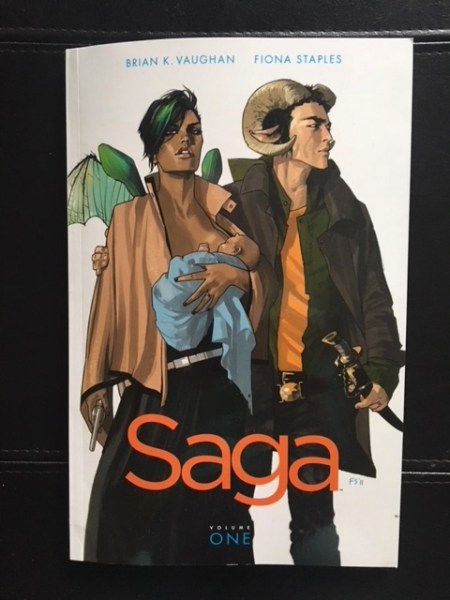 I’m late to the Saga party, but WOW. What a fabulous beginning to a graphic epic of one small family in a universe at war. Volume One and I spent the whole day together curled up on the couch, because I couldn’t put this book down. Fierce Alana, tender Marko, and baby Hazel –who is one of the narrators of the book, from an unnamed perspective many years hence– are impossible to resist. Artwork by Fiona Staples perfectly complements Brian K. Vaughan’s narrative, which leaps into action with the first sentence and Does Not Let Up. I’m swept away. Volume Two of many is up next. Highly recommend.
 Future Home of the Living God, by Louise Erdrich.
 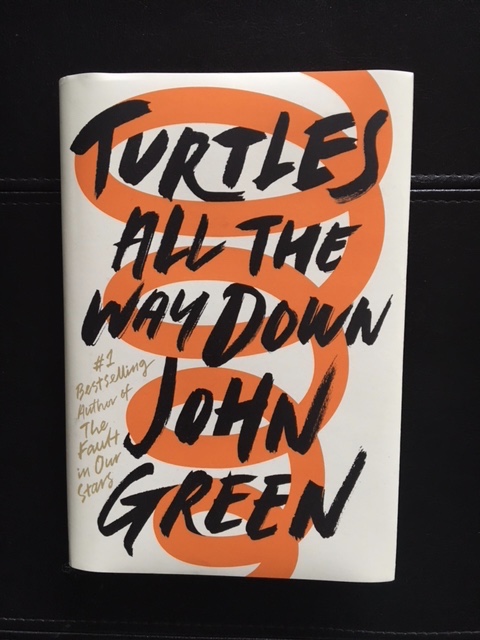 he Fault in Our Stars, I remember thinking, damn, this guy is captivating. I passed that book on to both my daughters and we all held it to our hearts and still quote lines from it to each other. Turtles All the Way Down is another book I’ll hold in my heart. John Green has an uncanny way with snappy dialogue, the profundity of best-friendship, setting (this one is set in his native Indianapolis, and after reading it I feel as if I could draw a map of the neighborhood), and his books are both deeply sorrowful and funny as hell. The man doesn’t shy away from the harshness of life, in this case the loss of a parent and the main character’s ongoing struggle with debilitating OCD and other mental health issues. Nor does he shy away from how beautiful life can be. What I most love about Green’s writing is how his characters slice through the external layers and speak to each other directly from the heart. It’s as if instead of turning away from the fact that they –and we–are all mortal, they fully know themselves to be exactly that, and they cut away the bullshit and get straight to the heart of the matter. Wonderful novel.
 Landscape with Invisible Hand, by M.T. Anderson.
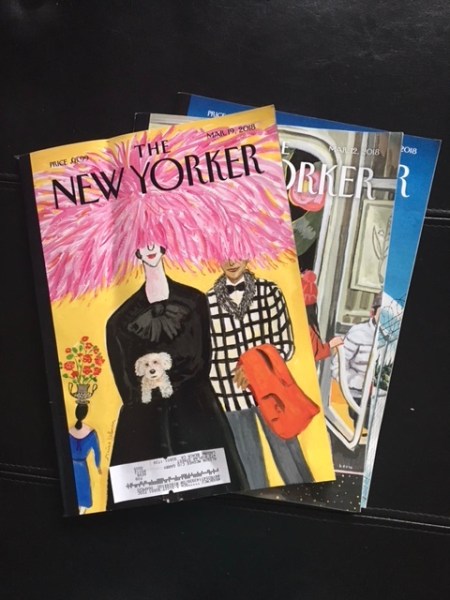 Yes, I’m adding a bunch of latest New Yorkers to this list, because let’s face it, people: A single New Yorker is the equivalent of a book. Which means that if you make it through an entire New Yorker every week, you’re reading a book a week. I used to panic when the New Yorkers would start piling up – I felt guilty and ashamed and like a loser. Then I said the hell with it and gave myself permission to read whatever I happened to read that week, or any week, or even years later. I have loved this magazine my entire adult life, and not once have I let my subscription lapse. The writers are so damn good, and they take their time, and I take my time, and that’s a beautiful thing in a world paced the way this one is paced. Some of my favorite writers ever began and/or still write for The New Yorker, people like Atul Gawande and John McPhee and Jelani Cobb and Jia Tolentino and Jerome Groopman. My secret pleasure: Reading the tiny reviews of restaurants I’ll never go to, just because I love the way a room and tables and plates of food on those tables come to life in my mind.
  Alison McGhee