
Just now I sat at my kitchen table, eating saag paneer and yogurt and sauteed carrots and reading a book of poems. Flipping through the book of poems, to be accurate, letting serendipity dictate which ones I ended up reading. A word here and there –ghost, twilight, firefly, road– the sort of word I’m inexorably drawn to, would catch my eye and then I would stop and read the poem.
In the early morning, every morning, I read a few poems. Three, usually. Sometimes I trawl the internet for poems, typing a few catch words into Mr. Google and seeing what the tide tosses up on the beach.
Some days are dry and stunted. No poems appear, or maybe my mind is a desert that day, unable to see glints in the sand.
Other days a friend will send me a poem I’ve never seen before, by a poet I’ve never heard of, and it will hit me like a shock wave, that enormous jolt that Miss Dickinson described as feeling as if the top of her head had come off. And when I hunt down that new poet, each poem I read shocks me anew.
And that new poet leads to other new poets. One shining poem after another, all cut and pasted into my poetry files. Thousands and thousands of poems I’ve saved over the years. Sometimes I go back twelve or more years, just to see what poems I loved back then, to see if my taste has changed.
Nope. The thing is, if I loved a poem back then, I still love that poem. Same with music. Same with art. Same with people, most of them anyway. I am not a fickle lover.
I don’t remember liking poetry when I was little. Back then it came in the form of limericks and doggerel and jingly ads. The ending words of every line rhymed. The meter was rigid, a prison of rhythm that forced you to recite the poem with Sousa-like precision.
If poetry didn’t come in the form of limericks and doggerel and the occasional haiku, it was so formal, with apostrophes in weird places and half-words like ’tis and ‘ere and o’er, not to mention a lack of thingness –literal thingness, as in things that you can see and touch– that my eyes glazed over.
I was little. I was untutored. I was semi-feral. If I wasn’t making forts in the hay barn or escaping into the treehouse that only I was able to haul myself into, I was reading novels or one of the hundreds of biographies about the Childhoods of Famous Americans that the library stocked.
The only thing I remember, about poetry, is that my grandfather used to recite it to us. He was a dairy farmer who didn’t graduate high school, but he knew a lot of poetry by heart. Long poems, which he would recite spontaneously, in the living room, in their entirety.
I don’t remember reading poetry in high school, unless you count the Rod McKuen and Susan Polis Schutz paperbacks that everyone carried around back then, and I don’t.
I don’t remember studying poetry in college either –I was a Chinese Studies major– unless you count the Chaucer-Milton-Shakespeare class I took freshman year, and I do. The teacher had us take turns reading the Canterbury Tales aloud, in middle English, and I loved that.
If I didn’t think about what I was reading, if I just let the strange words form themselves on my tongue, they rolled right out. It was as if I’d been speaking middle English my whole life. Reading them aloud, you could hear the music and laughter and enormous intelligence behind those bawdy tales.
For my 21st birthday my brilliant mathematician friend Doc gave me a book of poetry by John Ashbery. I puzzled over that book for a long time. Mostly because I wanted to be worthy of the poetry book that Doc, whom I adored, had picked out for me. So little of it made any sense to me, untutored and semi-feral poetry reader that I still was at that point.
But these lines made me shiver, and I memorized them. They still make me shiver:
Mostly I think of feelings, they fill up my life
Like the wind, like tumbling clouds
In a sky full of clouds, clouds upon clouds.
Like tumbling clouds in a sky full of clouds, clouds upon clouds. From those few lines in that book which, because my beloved Doc had given it to me, I read and read, searching for meaning, I learned the power of words repeated upon themselves.
In a sky full of clouds, clouds upon clouds. This was something that no Childhood of A Famous American, no matter how many dozens of them I tossed down like after-dinner mints back then, could teach me.
By the time I moved to Minneapolis at age 26 I must have turned the poetry corner. I know this because I remember standing in line in Calhoun Square with a paperback book of poetry clutched to my chest, waiting patiently for the woman who wrote the book to autograph it for me. I was getting up at dawn every day back then, writing my stories, not one of which would be published.
There was a poem in the book I was holding that haunted me. It still haunts me. The ending line especially, the italicized fierceness of it: Sister, there is nothing I would not do. That line stayed in my head for years.
It’s still in my head. Years ago it became part of my bones and blood and heart. One day, years after I first read that line, my friend GE and I were walking along the Mississippi River.
“Some people are still water,” he said, “and others are moving water.”
I didn’t know exactly what he meant –GE is a little Ashbery-esque himself– but still, I knew that he was right. In that same moment the line from the poem —Sister, there is nothing I would not do– came haunting back into my head. The next day I began to write All Rivers Flow to the Sea, which is a book about sisters, and which I wrote in the form of moving water.
So there I was, in my 20’s, waiting in line at Calhoun Square for the darkhaired, friendly woman sitting at the table they’d set up in the courtyard there to sign my book for me. She was there to sign another book, a newly-published, different book, a novel, but when I got to the table she took the little paperback poetry book and smiled at it.
“Jacklight,” she said. “I love that you brought this.”
She looked up at me and met my eyes. She looked at me for what felt like a long moment. Then she picked up her pen and wrote something in the book and handed it back to me.
 For she who enters the deep woods.
It was one of those rare moments in life, a moment when a stranger looks at you and sees something in you. Recognizes something in you, a fellow traveler. That line has been with me ever since, carried in my heart and also in that little paperback that has journeyed with me everywhere I’ve moved since that day.
Just now I was running upstairs to get some socks and I looked to the right, where a series of original sketches from the picture book most close to my heart hangs on the wall. Sometimes my own obtuseness stuns me, and this was one of those times. Look at this sketch, will you?

The line from Someday, the book that accompanies the sketch (by the wondrous Peter Reynolds) is “Someday you will enter a deep wood.”
That I didn’t consciously connect that line with the one the poet scribbled in my book so long ago doesn’t surprise me, because I’m a dolt, yes, but also because I have learned that those rare things, including those rare people, that you love completely and utterly the minute you see them, don’t ever go away. They migrate into your heart and become part of you.
(I just mis-typed the last part of that previous sentence, so that before I corrected it, it read “They migrate into your heart and become art of you.” Both sentences are true.)
I’ve never formally studied poetry, but knowledge of it has seeped into me by osmosis, the reading and reading and reading of beautiful poems. Giving myself poetry assignments –write a picture book in the form of a sestina, write a villanelle that contains a river flowing north, write a pantoum, write a free verse poem that begins with Carver’s question “Did you get what you wanted from this life?”– has been an education unto itself.
Once I sat in a lecture listening to a novelist talk about the two types of writers, those who were writers of story and those who were writers of language. I turned to the writer I was sitting next to.
“You’re a story teller,” I said.
“And you’re language,” she said.
I was right, and so was she. To this day plot is my weakness, story my weakness, not that I don’t like a good story, but I would prostitute myself for beautiful language, story be damned. This is why a novel that reads like poetry is my ideal novel. This is why I love the reviewer who wrote, “She’s a poet who writes novels.” This is why poetry is my ideal, period.
Long ago –fifteen years now?– I started choosing one poem a week and sending it to a few friends: “Poem of the Week.” Those few friends began forwarding them to a few friends, who sometimes asked to be put on the original mailing list. The list began to grow. Now it numbers in the many hundreds. Most of the recipients are people I don’t know, some of whom live in other countries halfway around the world.
Once a week or so a poem boomerangs back, the recipient having thought she was forwarding it to someone else but mistakenly sending it back to me. Sometimes, from the forwarded email, I see that the sender is sending it on to dozens of others, forming her own poem of the week list. In this way I know that the poems are seeding themselves, spreading far and wide like apple seeds.
Some of the poems I send are by famous writers, most are by lesser-known poets. The only criterion I have for the poem of the week is that I have to love it. Any other reason for sending a poem out would muddy the waters, and poetry is one part of my life that I will not muddy.
A few weeks ago I told my students to memorize a poem to recite in class next week.
“The only rule is that it has to be a poem you love,” I said. “It doesn’t have to be more than a couple lines long, but you have to love it.”
That way, when they memorize the poem, it will become part of them. A gift that they can carry within themselves forever, always available.
Mostly I think of feelings, they fill up my life
Like the wind, like tumbling clouds
In a sky full of clouds, clouds upon clouds.
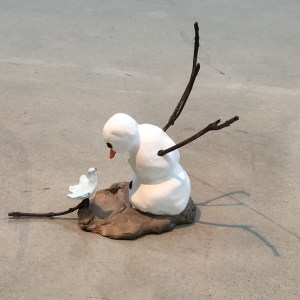
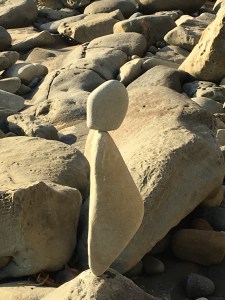 A long, long time ago I read Innumeracy, a slender, astonishing book by the mathematician John Allen Paulos, in which he explains how the inability of most of us to deal rationally with enormous numbers results in confused personal decisions and public policy as well as susceptibility to pseudoscience of all kinds. In one chapter Paulos lays out the fact that, on average, every breath we take contains a minimum of three molecules of air breathed by every single person who ever lived and breathed on this planet. I think about this fact every single day. It has influenced every aspect of my life, not least of which is that in times of deep grief, it brings me comfort. Breathe in, Alison. Remember that you’re breathing in some of the same air that every single person you love, the ones who are living and the ones who are dead, have breathed. This lovely, elegiac poem by Tim Nolan, one of a series about his mother and her passing, brings me that same sense of loss and comfort.
 Alison McGhee