Poem of the Week, by Dorianne Laux

IMG_2315The suicide of Alan Krueger last week, a man I didn’t know but whose work I admire, a man clearly beloved by so many, hit me hard. It brought me back to my early twenties, when the suicide of someone I loved both ended his life and permanently altered mine. Crying comes hard to me and does not bring relief, but it came anyway this week. At one point I found myself alone, apologizing out loud for things I wish I’d done differently.
I’m haunted by the sense that the cruelty and hatred so on display these days made things worse for Alan Krueger. It makes things worse for everyone. The only thing I can do, like the poet below, is try to subvert it with kindness.

For the Sake of Strangers, by Dorianne Laux

No matter what the grief, its weight,
we are obliged to carry it.
We rise and gather momentum, the dull strength
that pushes us through crowds.
And then the young boy gives me directions
so avidly. A woman holds the glass door open,
waits patiently for my empty body to pass through.
All day it continues, each kindness
reaching toward another – a stranger
singing to no one as I pass on the path, trees
offering their blossoms, a retarded* child
who lifts his almond eyes and smiles.
Somehow they always find me, seem even
to be waiting, determined to keep me
from myself, from the thing that calls to me
as it must have once called to them –
this temptation to step off the edge
and fall weightless, away from the world.   


*Note that this poem was published in 1994, when this word was in common usage.

For more information on Dorianne Laux, please check out her website


Website

Blog

Facebook page

@alisonmcghee


IMG_2315

Poem of the Week, by William Stafford

IMG_2323 A few days ago at sunset the sky was unearthly. The Painter came home, grabbed his camera and tripod and headed to the beach to take a bunch of photos. My internal, unspoken take on this, having never seen him take a sunset photo before: You had a frustrating day in the studio. Nothing was working with your paintings. You feel blocked, so you’re trying something new, to change up the energy and get things moving again. 
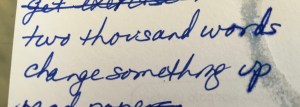
Talk of things like a muse, or writer’s block, makes me uneasy and impatient. But I deeply understand what it means to be stuck in a rut, retreading the same ground, unable to make something that feels wild and new when wild and new is what you crave. What the Painter was trying to do by varying his routine is what I’m trying to do when, on my daily list, I add “change something up.” It’s what William Stafford meant when he talked about the sunlight bending. It’s a kind of salvation that you have to search for and find, search for and find, your entire life long. 


When I Met My Muse, by William Stafford

I glanced at her and took my glasses
off–they were still singing.
They buzzed
like a locust on the coffee table and then
ceased.
Her voice belled forth, and the
sunlight bent.
I felt the ceiling arch, and
knew that nails up there took a new grip
on whatever they touched.
“I am your own
way of looking at things,” she said.
“When you allow me to live with you, every
glance at the world around you will be
a sort of salvation.”
And I took her hand.


For more information about William Stafford, please click here.


Website

Blog

Facebook page

@alisonmcghee

Poem of the Week, by Catherine Pierce

IMG_0531We were classmates. He was a country kid, like me, and like me, he was condemned to ride the bus for miles and miles. I dreaded that bus every day of my life –it was a place of fear and intimidation and endless cruelty.
On this particular day, he sat down next to me and everyone began teasing us. They were loud and relentless. I was desperate to make them stop, make it stop, make it all stop just stop just stop, and at some point I picked up my empty lunch box and bashed it over his head. 

Did the teasing end? I don’t remember. What I do remember is how he held his hands up to protect himself. The poem below brought me back to those years of fear and that day on the bus. Kindness is in part an act of self-preservation. Had I just sat still and endured the ride I could have spared myself the lifelong memory of having hurt a kid like me, another kid who was only trying to get home. 


Poem for the Woods, by Catherine Pierce 
        

Not as I would dream them now, not with growls
and twig snaps, not with dark birds and thorned vines

I’ve invented (keening blackwing, violencia). Not late-dayblood-
sun-dappled, not refuge of men equipped

with knives and lust, not a mouth into which you might
venture and not return, no, nothing like that.

This is a poem for the woods as I knew them,
shaded and cool behind the Novaks’ house.

They seemed endless, but there was a shortcut
to Fairblue Swim Club. They held no growls,

no spikes. Only squirrels skittering, plunking acorns
down the canopy. We’d been warned of poison ivy,

but never found it. We’d been warned of rotten limbs,
but none fell. One muddy, sun-laced afternoon, we took salt

from the pantry and ventured out to where the rocks
teemed with slugs. I’d like to say our cruelty

had to do with power—human girls versus torpidity—
but really it was our curiosity, pure and unnuanced.

We wanted to see mineral against membrane.
We wanted to see something living melt. If I could,

I’d find my younger self in those woods and stop her.
I’d say, Someday you’ll carry your cruelties with you

and you’ll never be able to set them down. Keep walking now.
Keep pretending you know of nothing but kindness
.


For more information on Catherine Pierce, please check out her website.

Poem of the Week, by Adelia Prado

Photos 997My daughter at eight: What would happen if you die? I tell her she would be very sad but everyone would take such good care of her, and she says No, they wouldn’t. Because I would be dead too, of sadness. My son at four shuffles out of the bedroom in his first pair of flip-flops, having put them on himself with the strap between his second and third toes. It’s fine, mama, don’t worry, they don’t hurt, I can walk. My grandmother, flustered and red-faced in the small kitchen where she’s trying to make dinner for me: Oh Alison, I’m just no use at all anymore. Me outwardly protesting but inwardly stricken by the knowledge that in that single instant, everything is now changed.  

“Because living is just too much!” I always say when someone in an audience asks why I became a writer. “It’s all too hard! I’d lose my mind if I didn’t turn it into books!” 

I laugh and they laugh, but do they know I’m not joking? Writing makes it possible for me to live in a world without my grandmother in it, a world where my heart beats outside my body in the form of my children, where every new day brings a thousand possibilities and a thousand losses. Writing is my way of cheating time.


The Mystical Rose, by Adelia Prado

The first time
I became conscious of form,
I said to my mother:
“Dona Armanda has a basket in her kitchen
where she keeps tomatoes and onions”
and began fretting that even lovely things
eventually spoil,
until one day I wrote:
“It was here in this room that my father died,
here that he wound the clock
and rested his elbows
on what he thought was the windowsill
but was the threshold of death.”
I understood that words grouped like that
made it possible to live without
the things they describe,
that my father was returning, indestructible.
It was as if someone had painted a picture
of Dona Armanda’s basket and said:
“Now you can eat the fruit.”
So, there is order in the world!
—where does it come from?
And why does order, which is joy itself,
and bathes in a different light
than the light of day,
make the soul sad?
We must protect the world from time’s corrosion,
cheat time itself.
And so I kept writing: “My father died in this room…
Night, you can come on down,
your blackness can’t erase this memory.”
That was my first poem.    


​For more information on Adelia Prado, please follow this link.​

Website

Blog

Facebook page

@alisonmcghee

Poem of the Week, by Naomi Shihab Nye

quilt, overviewThe day after I moved to Minneapolis, I bought a sewing machine. This was in the days of newspaper ads, and I found a used one for $60 and insisted my then-boyfriend and I track it down that very day. That ancient, impossibly heavy machine is what I’ve used to make all the quilts I’ve ever made, sewing together blocks I hand-stitch piecemeal. Story quilts, every one of them, made not according to a pattern but out of my head and heart. 

All these years since I bought that machine, I’ve wondered why I was so determined to get it when I was still surrounded by unpacked boxes and bags. I mean, a sewing machine? Strange. Now I think it represented security in a bewildering new place. Making friends had always been like breathing to me –easy, automatic, not something to think about–but it felt almost impossible when I moved to Minneapolis. Back then it was not the cosmopolitan city it is now, with young residents coming and going. People hung out with the same friends they’d had since kindergarten.

In retrospect, I was lonely, always trying to curb myself, be on the lookout, quiet my quick east coast way of speaking when out with my boyfriend and his friends. Maybe the sewing machine was something I could turn to for solace, something that the lonely girl I was could use to turn scraps of imaginary ideas and real fabric into something beautiful. Like the wondrous Naomi Nye says below, maybe it was a way to re-invent what my life had given me. 


Valentine for Ernest Mann
            by Naomi Shihab Nye

You can’t order a poem like you order a taco.
Walk up to the counter, say, “I’ll take two”
and expect it to be handed back to you
on a shiny plate.

Still, I like your spirit.
Anyone who says, “Here’s my address,
write me a poem,” deserves something in reply.
So I’ll tell a secret instead:
poems hide. In the bottoms of our shoes,
they are sleeping. They are the shadows
drifting across our ceilings the moment 
before we wake up. What we have to do
is live in a way that lets us find them.

Once I knew a man who gave his wife
two skunks for a valentine.
He couldn’t understand why she was crying.
“I thought they had such beautiful eyes.”
And he was serious. He was a serious man
who lived in a serious way. Nothing was ugly
just because the world said so. He really
liked those skunks. So, he re-invented them
as valentines and they became beautiful.
At least, to him. And the poems that had been hiding
in the eyes of skunks for centuries 
crawled out and curled up at his feet.

Maybe if we re-invent whatever our lives give us
we find poems. Check your garage, the off sock
in your drawer, the person you almost like, but not quite.
And let me know.    


Click here for more information about Naomi Shihab Nye.

Website

Blog

Facebook page

@alisonmcghee

Poem of the Week, by Ada Limon

Boston public garden ducklingsMy three children and I were in upstate New York. This was a long time ago, and we were making our annual summer trek around New England to visit family and friends.  We had just finished touring the Utica Club Brewery, one of my favorite childhood destinations, a tour that ends with a complimentary beer or root beer in a Victorian saloon. We were all tired. I was chatting with my parents while my children wandered around, trying out various red velvet chairs.

I was sitting on one of those red chairs when my son came up to me and wordlessly sat on my lap. Reading this poem below, by the wondrous Ada Limon, brings the moment rushing back over me. He was almost twelve at the time, not much shorter than me, his tall mother, and it had been a long time since he sat on my lap. I put my arms around him the way I always used to and held him tight. Time was rushing by me, by us, by our family and the world, and I remember thinking Is this the last time? –it was–Will he ever do this again?–he didn’t. I’m sitting here now remembering that moment, and picturing my son and his sisters, grown and scattered around the country. I don’t love anything in the world the way I love them. 


The Raincoat, by Ada Limon

When the doctor suggested surgery
and a brace for all my youngest years,
my parents scrambled to take me
to massage therapy, deep tissue work,
osteopathy, and soon my crooked spine
unspooled a bit, I could breathe again,
and move more in a body unclouded
by pain. My mom would tell me to sing
songs to her the whole forty-five minute
drive to Middle Two Rock Road and forty-
five minutes back from physical therapy.
She’d say that even my voice sounded unfettered
by my spine afterward. So I sang and sang,
because I thought she liked it. I never
asked her what she gave up to drive me,
or how her day was before this chore. Today,
at her age, I was driving myself home from yet
another spine appointment, singing along
to some maudlin but solid song on the radio,
and I saw a mom take her raincoat off
and give it to her young daughter when
a storm took over the afternoon. My god,
I thought, my whole life I’ve been under her
raincoat thinking it was somehow a marvel
that I never got wet.    


For more information on Ada Limon, please check out her website.

Website

Blog

Facebook page

@alisonmcghee

Poem of the Week, by Marie Howe

IMG_4207
The summer after college graduation, my sister and I headed to a Colorado ski town for the summer. We lived and worked in a hotel with a bunch of other temporary people, among them a guy named Jerry and his buddies. They were gay men, bright and blunt and full of hilarious advice. In my memory Jerry is always in a bathrobe, smoking and ironing shirt after shirt at the permanently set up ironing board in his room. The hotel felt like a giant dorm, doors ajar, constant conversation. We laughed all the time.

Six months later, I had moved far away to Boston. A strange disease was just beginning to take hold, a killer disease that seemed to affect only gay men. Rumors were that it was transmitted by sex. I remember unfunny jokes by unfunny straight people. I remember vast uneasiness among my gay friends. I remember feeling terrified for them.

Flash forward many years to now, when there is good treatment but still no cure for the strange disease. Some of my friends have lived with the virus for close to forty years. Others have died. Sometimes Jerry flashes into my mind, and I wonder about him and the others who lived in our long-ago hotel. The first time I read this poem by Marie Howe, whose brother died of AIDS, I memorized it. I don’t know why I think of Jerry when I recite it to myself, but I do. Jerry, are you out there, still ironing your shirts, still making everyone around you laugh? 


My Dead Friends, by Marie Howe

​I have begun,
when I’m weary and can’t decide an answer to a bewildering question

to ask my dead friends for their opinion
and the answer is often immediate and clear.

Should I take the job? Move to the city? Should I try to conceive a child
in my middle age?

They stand in unison shaking their heads and smiling—whatever leads
to joy, they always answer,

to more life and less worry. I look into the vase where Billy’s ashes were —
it’s green in there, a green vase,

and I ask Billy if I should return the difficult phone call, and he says, yes.
Billy’s already gone through the frightening door,

whatever he says I’ll do.


​Click for more information on​ Marie Howe.


Website

Blog

Facebook page

@alisonmcghee


Poem of the Week, by Sinead Morrissey

The first time I read the poem below a scene from the past flashed up in my mind: a winter day which my then-preschool children spent playing Ewok, which translated into them marching around the house/forest with yardsticks as hiking sticks. My son was Master Logray and my daughter was Teebo, Luke, with little Dev on the deck at Irving housenames and roles taken directly from a seriously cheesy VHS TV series called Ewoks (which I probably found for a quarter at a garage sale). What I remember most is my daughter’s bright eyes as she tromped around the house after her older brother, who was always kind to her.

My children rarely fought when they were little, but when they did, it always troubled me deeply. If the battle went on too long, I would tell them Listen to me. You have to be kind to each other, because someday I’ll be gone, and your dad will be gone, and it will be just the three of you to watch over each other. This is kind of a horrible thing to say, now that I look back on it, but it’s also kind of true. Which might be why reading this beautiful poem brought an instant lump to my throat.


The Rope
– Sinead Morrissey

I have paused in the door jamb’s shadow to watch you
playing Shop or Cliff! or Café or Under-the-sea
among the flotsam of props on our tarmacked driveway.
            All courtship. All courtesy.

At eight and six, you have discovered yourselves friends,
at last, and this the surprise the summer
has gifted me, as if some
             penny-cum-handkerchief conjuror

had let loose a kingfisher . . .
            you whirl and pirouette, as if in a ballet
take decorous turns, and pay for whatever you need
            with a witch’s currency:

grass cuttings, sea glass, coal, an archaeopteryx
of glued kindling from the fire basket.
You don two invisible outsize overcoats – for love?
For luck? And jump with your eyes shut.

And I can almost see it thicken between you –
your sibling-tetheredness, an umbilicus,
fattened on mornings like this as on a mother’s blood,
loose, translucent, not yet in focus

but incipient as yeast and already strong enough
to knock both of you off your balance
when you least expect it, some afternoon after work
            decades hence,

one call from a far-flung city and, look,
all variegated possibles – lovers, kids, apartments –
whiten into mist; the rope is flexing,
tugging you close, and you come, obedient

children that you are, back to this moment,
staggering to a halt and then straightening,
grown little again inside your oversize coats and shoes
and with sea glass still to arrange,
                                    but without me watching.


For more information on Sinead Morrissey, please click here​.

Poem of the Week, by Stephan Pastis

Alison and DonaldWe used to call them the funnies, and I have a memory of sitting on my dad’s big lap while he folded the newspaper in half, then quarters, so he could read them to me. This would have been on a Sunday, because I remember the strips as being full-color. I still read the daily comics, even though most of them are terrible – tired, unfunny, boring, and retreading the same exact ground for decades on end. Once in a while a strip comes along that’s electrifyingly good –Calvin & Hobbes, Boondocks, Cul de Sac–but they don’t last long, usually because their creators have the courage to cancel them when they’ve run out of steam. So I read out of habit, with no expectation of transcendence. But every once in a while one of them pierces my heart, like today’s Pearls Before Swine, by Stephan Pastis.


Tree Stump o’ Deep Thought You’re Not Usually Capable Of, by Stephan Pastis

No one knows what we’re doing here.
Some have faith that they do, but no one knows.

So we are scared.
We are alone.
We end.
And we don’t know where we go.

So we cling to money for comfort.
And we chase awards for immortality.
And we hide in the routine of our days.

But then the night.
Always the night.

Which, when it has you alone, whispers that
maybe none of this has any significance.

So love everyone you’re with.
Because comforting each other
on this journey we neither asked for
nor understand
is the best we can do.

And laugh as much as you can.


​For more information on Stephan Pastis, please click here.​