Poem of the Week, by James Richardson
My new poems podcast, Words by Winter, can be found here.
 Most of the furniture in our house is wood, found curbside like the tiny wooden table that caught my eye yesterday a few blocks from home. Polished burled top, slender wooden dowels, sturdy legs, it looked handmade. My backpack was stuffed full of heavy groceries but I picked the table up anyway and carried it home like a baby.
Box beam ceilings, cherry cabinets, oak floors, maple radiator covers. My house is over a century old, so the wood it’s made from must be far older than that, but it feels alive to me. After we moved in I wrote to the former owner, a cabinetmaker who had made all the kitchen cabinets, all the fitted radiator covers, a man who loves wood as much as me but, unlike me, knows everything about it.
Can you tell me about the wood in the house? was my question, and his long, long reply detailed the specifics of each room. Sorry, he signed off. I‘m sure this is way more than you ever wanted to know. I guess you can tell how much I love wood.
I thought about that man when I turned the tiny table over and saw the initials of the person who made it, burned into the wood.
Essay on Wood, by James Richardson
At dawn when rowboats drum on the dock
and every door in the breathing house bumps softly
as if someone were leaving quietly, I wonder
if something in us is made of wood,
maybe not quite the heart, knocking softly,
or maybe not made of it, but made for its call.
Of all the elements, it is happiest in our houses.
It will sit with us, eat with us, lie down
and hold our books, themselves a rustling woods,
bearing our floors and roofs without weariness,
for unlike us it does not resent its faithfulness
or question why, for what, how long?
Its branchings have slowed the invisible feelings of light
into vortices smooth for our hands,
so that every fine-grained handle and page and beam
is a wood-word, a standing wave:
years that never pass, vastness never empty,
speed so great it cannot be told from peace.
For more information on James Richardson, please click here.
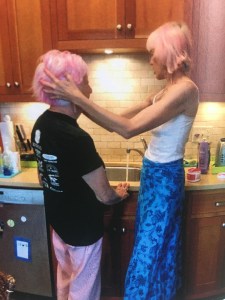 Here in the Time of Covid, my younger daughter and I have figured out how to maintain her complicated haircut. She does the back and sides with her electric clippers, and then I take over with my scissors, layering the sweep of black hair we refer to as “the plume” and lock by lock trimming and blending the rest.
  From my porch, which is all windows, people walk by in pairs or threes or solo. Some of them stop by my poetry hut and take a poem. Some keep their heads down and never look up. Some are slow and wandery, holding hands and scuffing their feet. Others stare straight ahead and laugh while they chatter to the person on the other end of their earbuds.
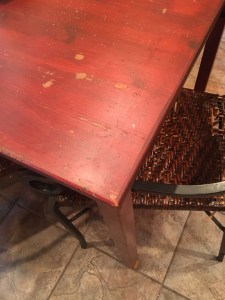 Small, wooden, stained a peeling dark red-brown, our kitchen table has moved with us from apartment to condo to house. It’s too short, so over the years I’ve glued and re-glued blocks of wood to the bottom of each leg. My little kids did their homework on it while I cooked for them, my teenagers and their friends talked and laughed around it while I cooked for them, my grown children sit around it laughing and drinking wine while I cook for them.
  Relaxation is not my style. My style is more making long daily to-do lists and then crossing items off one by one. Sometimes I can trick myself into relaxing if I turn it into a task and add it to the list —rest and read–which when you think about it is kind of pathetic.
 This morning on the porch a bee was bumbling against one of the screened windows. Its little legs drifted below its huge, furry body as it tried over and over to get out. So I
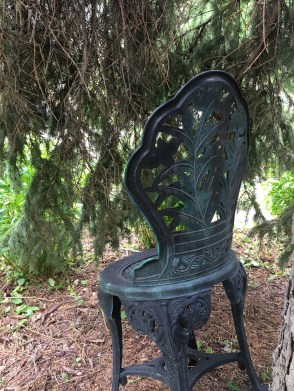 Last week I was weeding my garden on a steambath afternoon when clouds tiered overhead, the air turned greenish, and a breeze sprang up. There’s a tall pine tree in my tiny front yard, with limbs that sweep down to earth, and when the first drops splatted down, I stepped inside them to watch the storm.
 A couple of years ago my publisher emailed the cover art for a new novel. I thought it was beautiful – the rich color, the design, the way the title spread itself across the image– so I showed it to the Painter and our painter friend next door.
 Yesterday a friend told me how she longed for her father to show any interest in her. How she’d carefully planned to text him a few days before Father’s Day so that he wouldn’t feel the pressure of the holiday itself, but maybe he’d respond? I listened to her, told her how sorry I was, told her about others I knew in the same situation, thinking it might help her not feel so alone, as this poem by the magnificent Dwayne Betts floated through my mind.
  Twice in my life I’ve started down a road and kept going, even when the road narrowed and turned into thorns, brambles, impenetrable darkness. A symbol of my refusal to accept that I had made the wrong choice in the very beginning. Years later, when I read about the theory of “sunk profits,” which describes a past investment that shouldn’t but still affects your decisions about the future, I knew it was what I had done in those situations. Kept going, because with so much invested, it felt impossible to let go, even though that
 Alison McGhee