 The men I love most get it, with “it” being the malevolence of treating women as if we’re not equal. At one point the other night, when I could suddenly barely talk because of the rage that filled me, a male friend said about sexism, It’s like air, invisible and everywhere. And you breathe it in your whole life, but when the switch flips and you suddenly realize how deep it goes and how awful it is, it’s fucking overwhelming.
Yes. It is.
Me at 10: Waiting on the stairs to go back into school after kickball, a classmate reached out, grabbed my breast bud and jeered as he twisted it as hard as he could in front of everyone, a moment that changed the course of my life. At 16: Standing on a subway too crowded to move a single inch, a man standing behind me shoved his fingers up my skirt and inside me. At 19: Working as a summer hotel housekeeper, a guest called for help from inside his room, and when I went in, flipped over naked on the bed to show me his erection and ask me to help him with it. At 23: A man I was making out with yanked my underwear down and kept pushing at me until I escaped and ran.
These memories and others, which are nothing compared to what so many of my women friends have endured, bring back the humiliation and bewilderment and self-hatred I felt when they happened, when all I could think was What did I do wrong? Which is why the ending lines of the poem below, by the remarkable Betsy Brown, will be with me forever.
Midwest Boys, by Betsy Brown
In Oshkosh, Wisconsin,
we kept it in mind
I-41 went clear down
to Florida. These scoop-necked
midsized midwestern
towns, set up separate originally
on waterways for trading–
first furs, then lumber,
the worker drinkers
voiceless then fierce
for the hell of it, tense
machinery, construction.
As a teenager you noted
mainly the routes out.
Spring, the dead mud,
the bad paint job, drifting jarred
eaves troughs, sullen pickup
sunk to its axles on the lawn.
A boy’s mind turns to the road.
Tract houses, one, one,
all along the frontage road
with tequila and Old Style, pot,
cheap speed; if you’re
a girl you try to remember:
They shoved candlesticks
up Linda. They drew on her
with her Bonne Bell.
If you pass out
they’ll strip you,
you won’t know
and if you’re lucky only
photograph you. These pictures
show up on bulletin boards.
In Eau Claire, 1992, teenage
boys dropped rocks from
an overpass over I-94,
aiming for windshields.
Martin Blommer in his
Winnebago, hit by a 32-
pound rock; his wife alongside
didn’t hear it, the crash,
the RV veered in a second
into the median, staggering
to stop, and he, in silence,
transfixed instantly, forever.
32 pounds. These are
my highways. I remember.
Long-play radio stations,
driving in moonlight
past hours of white
white mute fields.
I never wanted
to go back to Florida.
As a girl I didn’t
have much to compare–
dime bags, shot glasses, lives
that trudged with losses
and butane. I can’t forgive them.
Where could one drunk girl
find an ocean?
In the first forced blink of spring
I hate you.
I remember your names.
My curse on you is this:
May you have daughters
and may you love them.
 When my children were little one of our favorite books was The Philharmonic Gets Dressed. Such a simple story. In apartments all over New York City, orchestra musicians are dressing for the evening performance. Everyone wears black. They muscle their instruments, large and small, into cabs and the subway, and they head to work. My children and I read this book over and over, usually at bedtime, where it soothed their way into sleep. It’s long gone from my shelves, but I still think about it.


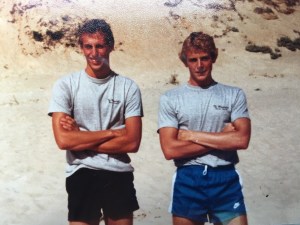 It was the summer of a long pink skirt, ice cream cones, cartwheels on the beach, waitress shifts followed by late nights at the bar followed by breakfast at the diner, a little rented room and a refrigerator shared with twelve other girls. This was Cape Cod, a long time ago, and my buddies Doc and RJ and Stu would descend on weekends. After we walked back from the bar I’d hold the back door open for them and they’d sneak upstairs to my room (guests weren’t allowed) to sleep on the floor around my bed. One weekend they brought a new boy with them, someone I’d never met, and I instantly liked him. That night we all decided to sleep on the beach instead of sneaking into my room. We spread quilts and looked up at the stars, waves lapping at the shore.
  Every summer in my teens I canoed with friends through the Rideau region of lakes and canals in Ontario. We camped every night, swam, cooked, laughed, told ghost stories and played games. One annual camping spot was on a lake with an enormous rope swing tied to an overhanging tree. You grabbed the rope, stepped back as far as you could, swung out over the water and then plummeted. The rope swing took nerve. The drop was steep and the water cold, and once you committed, you had to leap – if you swung back you’d crash against the tree and the rocky bluff. Leaping from it was wild and exhilarating. Once, as I swung out, I looked down to see a long water snake swirling in the water directly below me. My fear of snakes is lifelong and deep-seated, and I was horrified, but there was no going back. I plummeted with my eyes closed and struck out for shore the second I surfaced.
 A few years ago my brother sent me a photo of my nephew, with the caption Getting his mind blown at Nickelodeon Universe. Nickelodeon Universe is a crowded and noisy place, but in the photo, my tiny nephew stands alone in a huge open space, his head craned up, staring at something I can’t see. The photo conveys profound stillness and concentration. Sometimes it pops up on my screensaver and I wonder again what my nephew was staring at, what was going through his mind.
  Once, a long time ago, someone close to me handed me a memo and asked me to read it. It was a work memo that summarized some unfair working conditions. I didn’t know who had written it, but my first comment was “Wow. Whoever wrote this can’t spell worth a damn and doesn’t know how to use punctuation, either.” The person who had handed me the memo didn’t hear me say this, for which I was instantly grateful, because it turned out that they had written it. This was a person I loved with all my heart. The shame I felt in that moment is something that will be with me forever.
  My youngest didn’t walk until she was 22 months old. Instinct told me she was fine so I didn’t worry about this, but I observed her with interest. One day, when I was in the kitchen and she was sitting in a patch of sun on the living room floor, her back to me, I watched in wonder as she rose –no hands, no support, no nothing– to a full stand and began to walk. I had never seen a child go from crawling to perfect walking in an instant like that. She never went back to crawling.
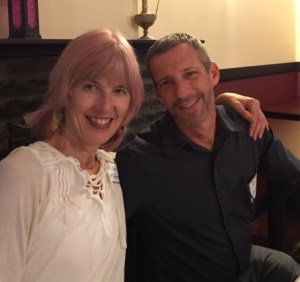 Neither my friend nor I had been to a high school reunion in many years –in my case, decades–and we were both nervous. The years we had spent growing up together in upstate New York seemed far away, and we hadn’t kept in touch with many classmates. So we met early, at the bar in that tiny stoplight-less town, and fortified ourselves with gin while paging through our yearbook to remind ourselves of faces and names. At one point I said to him, It’s been decades. We don’t look the same, will anyone else?
  Long ago, when I taught Mandarin at a big city high school in Minneapolis, some of my students would stay after school and talk with me. One was a Hmong young man, quiet and shy, with halting English. He would sit in the chair by my desk and cast his glance at the floor. For a long time I would inwardly urge him to look at me —look at me look at me come on look me in the eye– and then it came to me that his avoiding my direct gaze was part of his culture, and a sign of respect. All my annoyance melted away and from then on I was more soft-spoken, gentle, and slow in his presence.
  Alison McGhee